Final Exam Marketing (CH : 12,16,18)
 Call Kai
 Learn
Learn Practice Test
 Spaced Repetition
 Match
Match Flashcards
 Knowt Play
1/72

There's no tags or description
Looks like no tags are added yet.
Name | Mastery | Learn | Test | Matching | Spaced | Call with Kai |
|---|
No analytics yet
Send a link to your students to track their progress
73 Terms
innovation
The process by which ideas are transformed into new products and services that will help firms grow.
What percentage of new products succeed>
3%
WHY INTRODUCE NEW PRODUCTS AND SERVICES?
Firms continue to introduce new products because:
1. Customer Needs Change
2. Markets Become Saturated
3. A Need Exists to Manage Risk -Diversity helps achieve this
4. Fashion Cycles Change
5. A Need Exists to Improve Business Relationships -Innovation targeted at suppliers
diffusion of innovation
The process by which the use of an innovation, whether a product or a service, spreads throughout a market group over time and over various categories of adopters.
pioneers (breakthroughs)
New product introductions that establish a completely new market or radically change both the rules of competition and consumer preferences in a market. Also called breakthroughs.
first movers
Product pioneers that are the first to create a market or product category, making them readily recognizable to consumers and thus establishing a commanding and early market share lead.
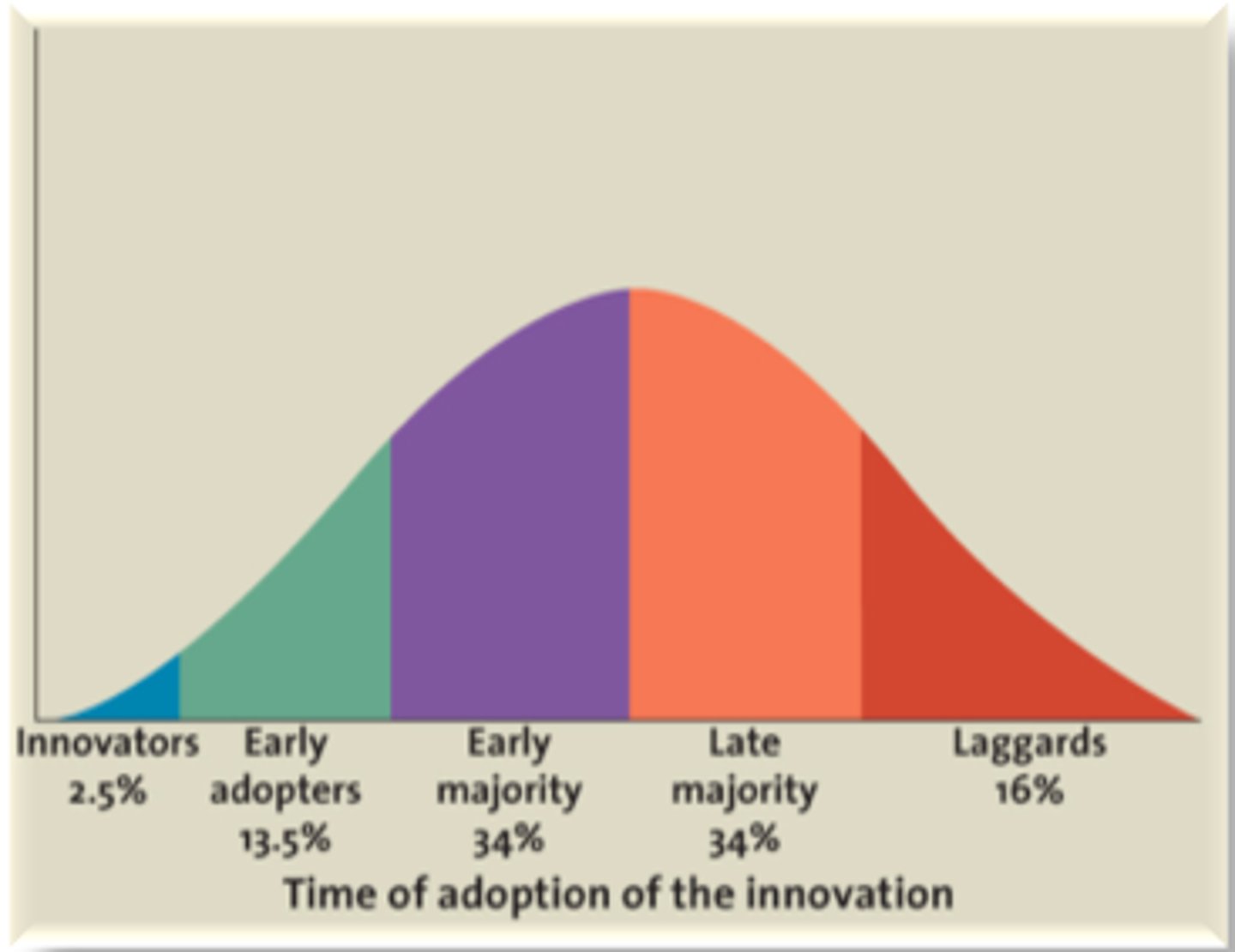
diffusion of innovation curve
innovators, early adopters, early majority, late majority, laggards
innovators
Those buyers, representing approximately 2.5 percent of the population, who want to be the first to have the new product or service.
early adopters
The second group of consumers in the diffusion of innovation model, after innovators, to use a product or service innovation represent about 13.5 percent of the population. They generally don't like to take as much risk as innovators but instead wait and purchase the product after careful review.
early majority
A group of consumers in the diffusion of innovation model that represents approximately 34 percent of the population; members don't like to take much risk and therefore tend to wait until bugs are worked out of a particular product or service; few new products and services can be profitable until this large group buys them.
late majority
The last group of buyers to enter a new product market, representing approximately 34 percent of the population; when they do, the product has achieved its full market potential.
laggards
Consumers, representing approximately 16 percent of the population, who like to avoid change and rely on traditional products until they are no longer available. Sometimes laggards never adopt a product or service.
Characteristics that effect the speed with which products diffuse
Relative advantage, compatibility, observability, complexity, and trialability
Product Development Process
1. idea generation
2. concept testing
3. product development
4. market testing
5. product launch
6. evaluation of results
Sources of Ideas
internal R&D, R&D consortia, licensing, brainstorming, outsourcing, competitors' products, customer input
R&D consortia
A group of firms and institutions, possibly including government and educational institutions, that explore new ideas or obtain solutions for developing new products.
outsourcing
A practice in which the client firm hires an outside firm to facilitate some aspect of its business. In the context of new product development, the outsourced firm helps its client develop new products or services.
reverse engineering
Taking apart a competitor's product, analyzing it, and creating an improved product that does not infringe on the competitor's patents, if any exist.
Customer Input
As much as 85% of new business-to-business products come from customers
Lead users modify existing products according to their own specific needs
concept testing
The process in which a concept statement that describes a product or a service is presented to potential buyers or users to obtain their reactions.
product development
Entails a process of balancing various engineering, manufacturing, marketing, and economic considerations to develop a product's form and features or a service's features. Also called product design.
premarket test
Conducted before a product or service is brought to market to determine how many customers will try and then continue to use it.
test marketing
A method of determining the success potential of a new product; it introduces the offering to a limited geographical area prior to a national launch.
product life cycle
Defines the stages that new products move through as they enter, get established in, and ultimately leave the marketplace and thereby offers marketers a starting point for their strategy planning.
introduction stage
Stage of the product life cycle when innovators start buying the product.
growth stage
Stage of the product life cycle when the product gains acceptance, demand and sales increase, and competitors emerge in the product category.
maturity stage
Stage of the product life cycle when industry sales reach their peak, so firms try to rejuvenate their products by adding new features or repositioning them.
decline stage
Stage of the product life cycle when sales decline and the product eventually exits the market.
marketing channel management
Developing and maintaining partners and relationships within the supply chain. To do so, it includes the set of approaches and techniques firms employ to integrate their suppliers efficiently and effectively to serve their customers.
supply chain management
A set of approaches and techniques firms employ to efficiently and effectively integrate their suppliers, manufacturers, warehouses, stores, and transportation intermediaries into a seamless operation in which merchandise is produced and distributed in the right quantities, to the right locations, and at the right time as well as to minimize systemwide costs while satisfying the service levels their customers require.
wholesaler
Firm engaged in buying, taking title to, often storing, and physically handling goods in large quantities, then reselling the goods (usually in smaller quantities) to retailers or industrial or business users.
Marketing Channels Add Value
Reduce number of transactions
Increase value for consumers
More efficient and effective
distribution center
A facility for the receipt, storage, and redistribution of goods to company stores or customers; may be operated by retailers, manufacturers, or distribution specialists.
fulfillment center
Warehouse facilities used to ship merchandise directly to customers.
just-in-time (JIT) inventory system (quick response (QR) inventory system in retailing)
Inventory management system designed to deliver less merchandise on a more frequent basis than traditional inventory systems; the firm gets the merchandise "just in time" for it to be used in the manufacture of another product, in the case of parts or components, or for sale when the customer wants it, in the case of consumer goods.
direct supply chain
A supply chain in which there are no intermediaries; the manufacturer sells directly to the buyer.
indirect supply chain
When one or more intermediaries work with manufacturers to provide goods and services to customers.
franchising
A contractual agreement between a franchisor and a franchisee that allows the franchisee to operate a business using a name and format developed and supported by the franchisor.
vertical channel conflict
A type of channel conflict in which members of the same marketing channel, for example, manufacturers, wholesalers, and retailers, are in disagreement or discord.
horizontal channel conflict
A type of channel conflict in which members at the same level of a marketing channel, for example, two competing retailers or two competing manufacturers, are in disagreement or discord, such as when they are in a price war.
power
A situation that occurs in a marketing channel in which one member has the means or ability to have control over the actions of another member in a channel at a different level of distribution, such as if a retailer has power or control over a supplier.
corporate vertical marketing system
A system in which the parent company has complete control and can dictate the priorities and objectives of the marketing channel; it may own facilities such as manufacturing plants, warehouse facilities, retail outlets, and design studios.
independent marketing channel (conventional marketing channel)
A marketing channel in which several independent members—a manufacturer, a wholesaler, and a retailer—each attempts to satisfy its own objectives and maximize its profits, often at the expense of the other members.
reward power
A type of marketing channel power that occurs when the channel member exerting the power offers rewards to gain power, often a monetary incentive, for getting another channel member to do what it wants it to do.
coercive power
A type of marketing channel power that occurs when a member uses threats or punishment of the other channel member for not undertaking certain tasks. Delaying payment for late delivery would be an example.
referent power
A type of marketing channel power that occurs if one channel member wants to be associated with another channel member. The channel member with whom the others wish to be associated has the power and can get them to do what they want.
expertise power
A type of marketing channel power that occurs when a channel member uses its expertise as leverage to influence the actions of another channel member.
information power
A type of marketing channel power within an administered vertical marketing system in which one party (e.g., the manufacturer) provides or withholds important information to influence the actions of another party (e.g., the retailer).
legitimate power
A type of marketing channel power that occurs if the channel member exerting the power has a contractual agreement with the other channel member that requires the other channel member to behave in a certain way. This type of power occurs in an administered vertical marketing system.
strategic relationship (partnering relationship)
A supply chain relationship that the members are committed to maintaining long term, investing in opportunities that are mutually beneficial; requires mutual trust, open communication, common goals, and credible commitments
radio frequency identification (RFID)
Tiny computer chip that automatically transmits to a special scanner all the information about a container's contents or individual products.
integrated marketing communications (IMC)
Represents the promotion dimension of the four Ps; encompasses a variety of communication disciplines—general advertising, personal selling, sales promotion, public relations, direct marketing, and electronic media—in combination to provide clarity, consistency, and maximum communicative impact.
sender
The firm from which an IMC message originates; the sender must be clearly identified to the intended audience.
transmitter
An agent or intermediary with which the sender works to develop the marketing communications; for example, a firm's creative department or an advertising agency.
encoding
The process of converting the sender's ideas into a message, which could be verbal, visual, or both.
communications channel
The medium—print, broadcast, the Internet—that carries the message.
receiver
The person who reads, hears, or sees and processes the information contained in the message or advertisement.
decoding
The process by which the receiver interprets the sender's message.
noise
Any interference that stems from competing messages, a lack of clarity in the message, or a flaw in the medium; a problem for all communication channels.
feedback loop
Allows the receiver to communicate with the sender and thereby informs the sender whether the message was received and decoded properly.
Elements of IMC
consumers, communication channels, results
AIDA model
A common model of the series of mental stages through which consumers move as a result of marketing communications: Awareness leads to Interests, which lead to Desire, which leads to Action.
brand awareness
Measures how many consumers in a market are familiar with the brand and what it stands for; created through repeated exposures of the various brand elements (brand name, logo, symbol, character, packaging, or slogan) in the firm's communications to consumers.
aided recall
An awareness metric that occurs when consumers recognize a name (e.g., of a brand) that has been presented to them.
top-of-mind awareness
A prominent place in people's memories that triggers a response without them having to put any thought into it.
lagged effect
A delayed response to a marketing communication campaign.
advertising
A paid form of communication delivered through media from an identifiable source about an organization, product, service, or idea designed to persuade the receiver to take some action now or in the future.
public relations (PR)
The organizational function that manages the firm's communications to achieve a variety of objectives, including building and maintaining a positive image, handling or heading off unfavorable stories or events, and maintaining positive relationships with the media.
sales promotions
Special incentives or excitement-building programs that encourage the purchase of a product or service, such as coupons, rebates, contests, free samples, and point-of-purchase displays.
personal selling
The two-way flow of communication between a buyer and a seller that is designed to influence the buyer's purchase decision.
direct marketing
Sales and promotional techniques that communicate directly with target customers to generate a response or transaction.
mobile marketing
Marketing through wireless handheld devices such as cellular telephones.
Online Marketing
websites, blogs, social media