5.11 - Intro to public goods games
 Call Kai
 Learn
Learn Practice Test
 Spaced Repetition
 Match
Match Flashcards
 Knowt Play
1/17

There's no tags or description
Looks like no tags are added yet.
Name | Mastery | Learn | Test | Matching | Spaced | Call with Kai |
|---|
No analytics yet
Send a link to your students to track their progress
18 Terms
Experimental games issues
Games may be too complex
leads to subjects making errors (needs to be accounted for)
Other subject’s actions may depends on their beliefs about others errors (exploit them)
Nash equilibrium in Game theory measures behaviours and beliefs at the same time and
assumes each player plays as if optimising given correct beliefs about strategies of others
in reality players can learn and adjust how they play based on how other behave (conditional convergence on a choice)
Control of preferences - GT specifies payoffs in utility whereas experiments only deal with money payoffs (not always equal)
only equal if players dont care about any other factors (equality or non-monetary aspects of play)
Duhem-Quine problem
single hypotheses cannot be tested in isolation
If predictions of a game theoretic model seem to fail, are players violating game theory itself or playing different game from one experimenter intended?
Voluntary contribution mechanism (VCM) game structure
Subjects in size n groups
Each player i has an endowment of E tokens
Each player can divide tokens between private account or a joint public account
Each token i puts in private account earns 1 token for i
Each token in public account earns m points (identical) for every group member
m - marginal per capita return
benefits of contribution to public account are a pure public good (as identical return for all members)
VCM payoffs
let ci = token contributed to public account by i
Total points for i = (E - ci) + mci + mQ = (E + mQ) + (m-1)ci
Q = tokens contributed to public fund by other members
To max own points if m < 1 → dominant strategy for i is ci = 0 (dont contribute)
Everyone gets E if all give 0
Everyone gets mnE if all give E
if mn > 1 then all do better if all give max (E)
if 1 > m > 1/n then we have an n-player prisoner dilemma game
should give max but dont know what others will do so give 0
Typical VCM findings
many studies set m = 0.4-0.6 (and set n so m > 1/n)
If one shot game:
only ~20% give 0 to public account
On avg subjects give ~40-60% of E to public account
Over contribution relative to equilibrium prediction (less than efficient though)
If game repeated with anonymous feedback:
Contribution rates decay to close to 0
Reasons for why players contribute
Error - player may be confused about game rules
Strategic - players may think contributing in early rounds of repeated game will raise future contributions of others
Preferences - Altruism + warm glow + conditional cooperation
Compelling explanation must account for decay, not just initial level of contribution
One-sided error problem and solution - Keser (1996)
As dominant strategy to contribute 0, errors and any intended contribution deviate in same direction as cant contribute negative amount (cant distinguish)
same for efficiency prediction
Keser (1996) - redesign game so NE has contribution > 0 so errors on both sides of NE possible
Amend VCM so points to i from tokens in private account given by: axi - bxi2
where xi = E - ci
Keser (1996) equilibrium graph
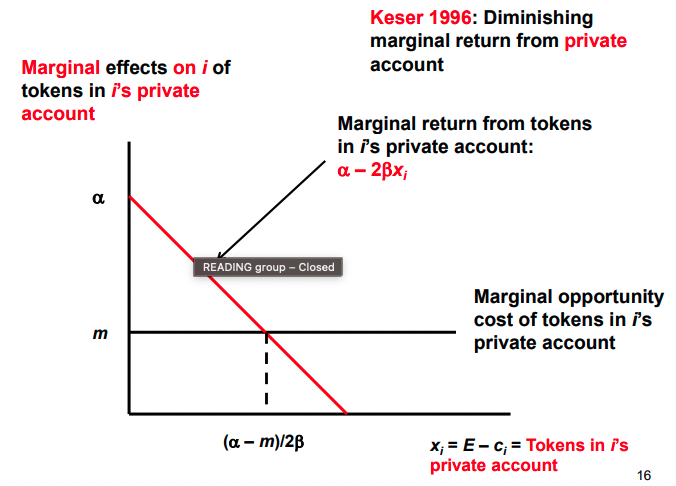
marginal return now a decreasing function
constant marginal cost of keeping
Equilibrium at A (when b positive & a > m)
Keser (1996) - results
Dominant strategy: Keep 13 & Contribute 7
marginal return shown to subjects in a table
results aggregated across all rounds:
27% gave 7 (mode)
12% < 7 (FR) & 60% > 7
Over-contribution in VCM games not fully explained by only direction of error possible (errors both ways)
Andreoni (1988) - OV
VCM game with standard payoff structure
aim to separate Learning hypothesis from Strategic hypothesis
to explain decay
Partners vs Strangers groups
P stay in same group of 5 for each round BUT strangers random every round
Strategic hypothesis predicts higher contribution in partners till final rounds
Learning hypothesis predicts no difference between groups as doesnt affect learning
Includes surprise restart after 10 rounds
Restart should not stop decay in contributions if LH the reason
Learning hypothesis
Players contribute in early rounds in error, as they have not yet understood the incentives
Contributions decay as they start to understand
Strategic hypothesis
P{layers contribute in early rounds in hope of boosting future contributions of those they will play with later
Contributions decay as final round gets closer
Andreoni (1988) - Results
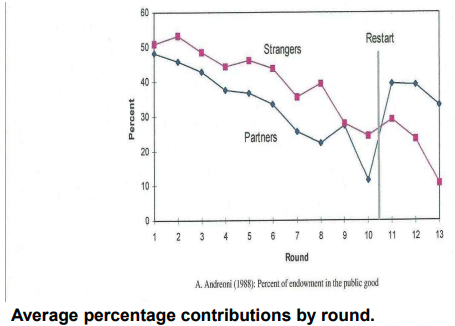
Restart with partners
Initial Strong decay from 50%
post restart decay gone and back to almost start again
- Learning hypothesis not shown by data
Strangers contribute more than partners
- Most replications find the opposite however (IMPORTANT)
Croson (1996)
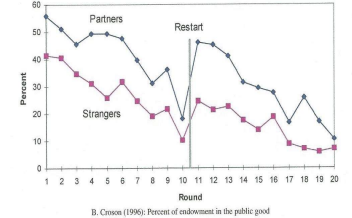
replication of Andreoni (1988)
Found robust effect of restart
BUT partners contribute more
Yamakawa et al (2016) - design
3 treatments
Human treatment (H) - Standard VCM
n = 2 & 20 rounds
Computer (C) - 1 human player and 1 computer
computer choices predetermined & payoff only goes to human
Design where no motive to contribute (C treatment) - Only error / confusion causing donations
HC - same as C but C acts on behalf of another human who received the payoff
Yamakawa et al (2016) - Rationale
No incentive to contribute in C, so contributions there must be errors.
Comparison of C and HC captures effect of there being a human to receive the computer’s payoffs
measure of altruism / pro-sociality
Comparison of HC and H captures effect of human co-group-member making decisions round by round.
no effect of cooperation in early rounds to encourage contribution in later rounds
Yamakawa et al (2016) - results
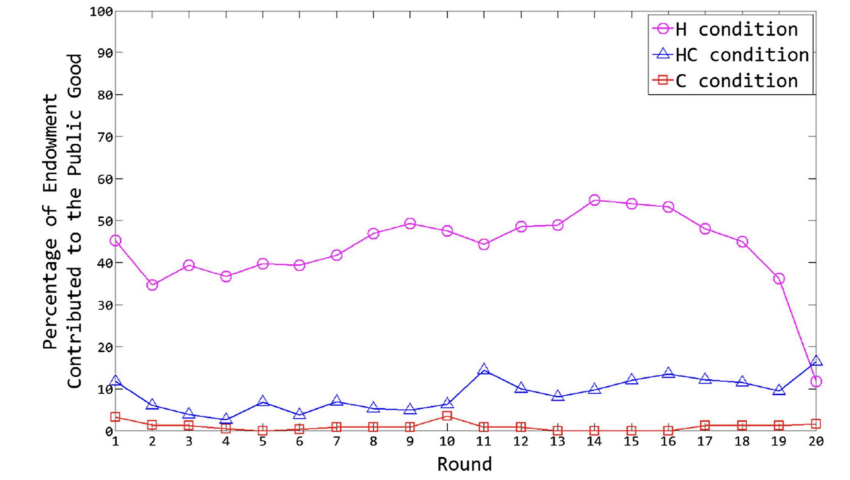
Unusually stable contribution levels in treatment H till late on, when decay finally sets in
- Decay delayed (maybe from small n = 2)
Very low contribution levels in treatment C
- Low confusion even from start
Contribution levels in HC closer to those in C than in H (for nearly all rounds)
- Their interpretation: shows evidence for importance of “multi-round incentives”
Summary of Why over-contribution
Errors / learning
play some role but do not seem to be whole story
Keser 1996 - Predominance of over-contribution
Restart effect for partners - Andreoni 1988
Low contributions for C treatment - Yamakawa 2016
Strategic
Some evidence
Yamakawa 2016 - supports this theory
Partners vs strangers has mixed results
some evidence that strangers give less