Physics 12 + 7.2
 Call Kai
 Learn
Learn Practice Test
 Spaced Repetition
 Match
Match Flashcards
 Knowt Play
1/43

There's no tags or description
Looks like no tags are added yet.
Name | Mastery | Learn | Test | Matching | Spaced | Call with Kai |
|---|
No analytics yet
Send a link to your students to track their progress
44 Terms
Magnetic flux is defined as
the number of magnetic field lines passing through a given closed surface.
It provides the measurement of
the total magnetic field that passes through a given surface area (usually within a loop).
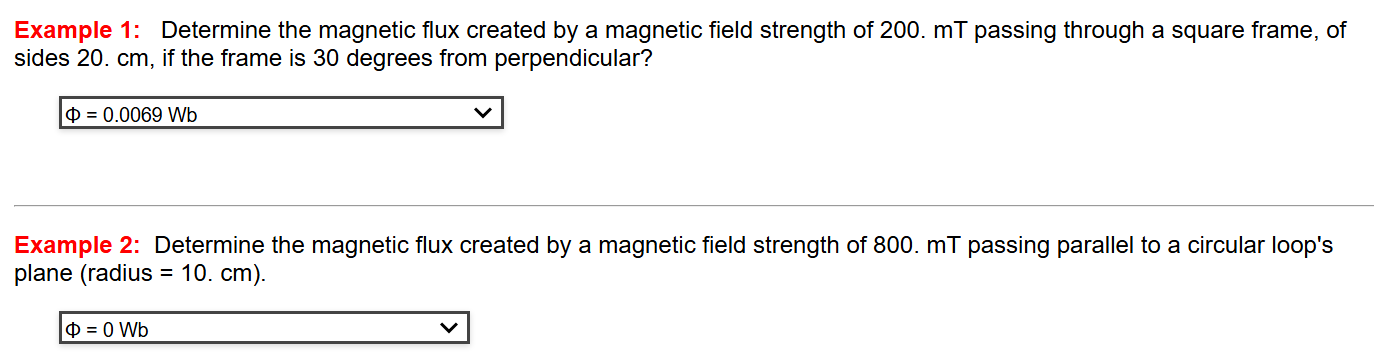
Magnetic flux is calculated as
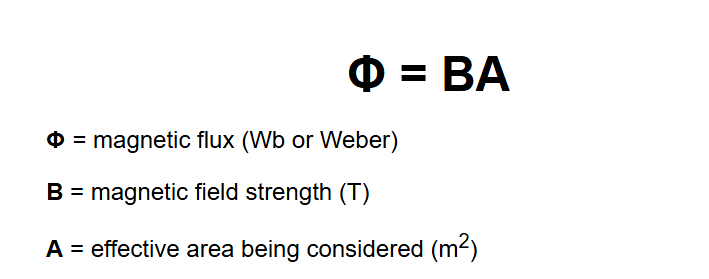
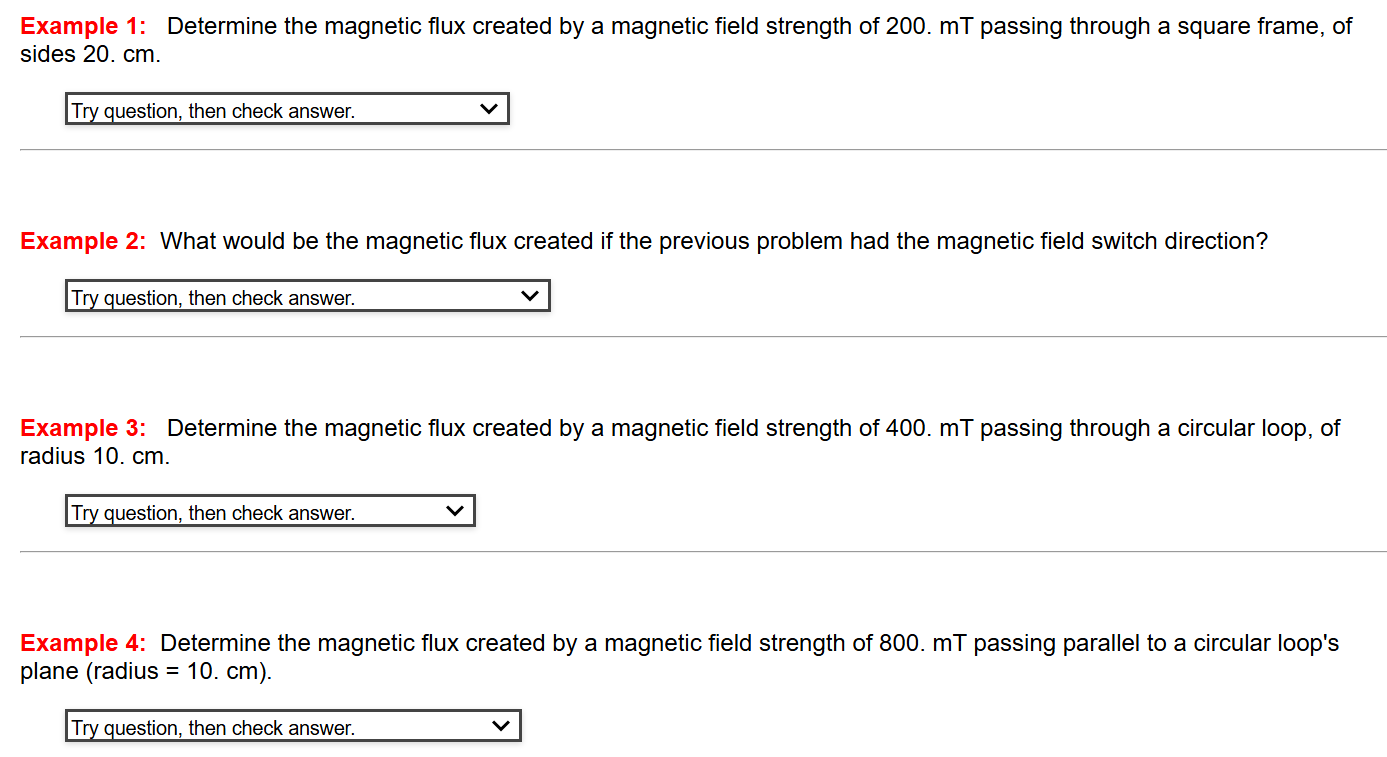
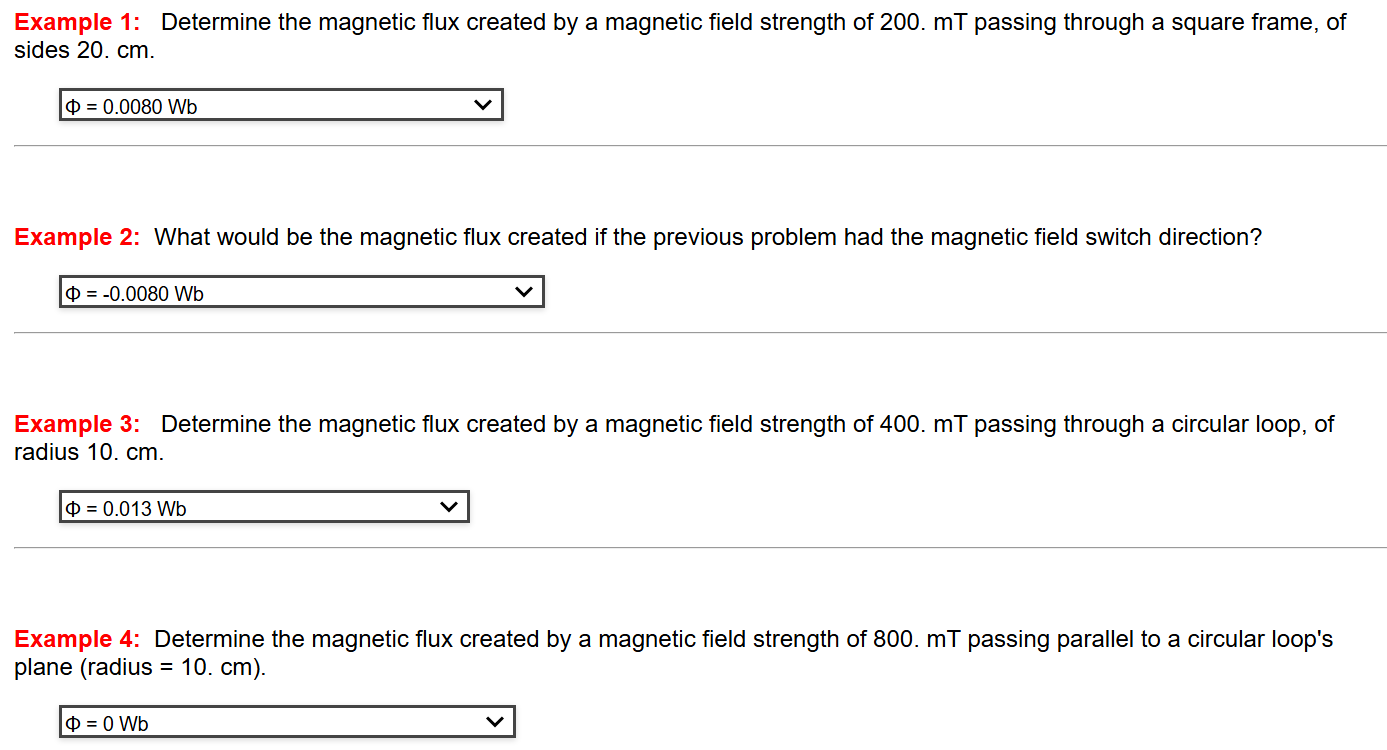

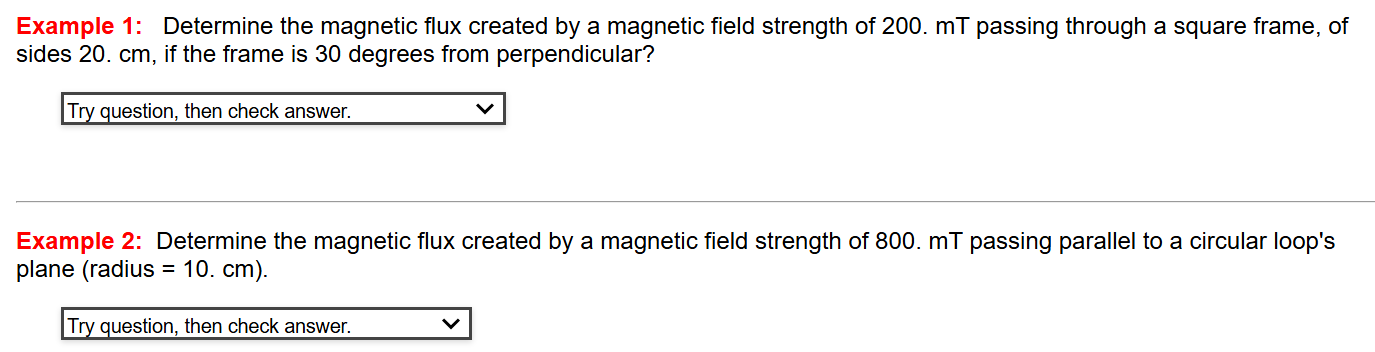
Max flux
Zero flux

Front: What did Michael Faraday discover regarding a stationary magnetic field and a conductor?
Back: He discovered that a stationary magnetic field has no effect on a conductor; no voltage is produced if there is no change in the field.
Front: Under what specific condition is a voltage induced in a conductor by a magnetic field?
Back: Voltage is only induced when the magnetic field is changing (e.g., moving a magnet closer or further away).
Front: According to Faraday’s findings, what two factors regarding the magnet's movement and the conductor's physical properties increase the induced voltage?
Speed: The faster the magnet moves, the greater the voltage.
Shape: The configuration of the conductor has a profound influence on the voltage produced.
Front: How can an electromotive force (emf) be induced if the magnetic field strength remains constant?
Back: By changing the orientation of the loop, which changes the effective area capturing the magnetic field lines.
Front: Define Magnetic Flux.
Back: It is the product of the magnetic field strength and the cross-sectional area it passes through. It can be visualized as the "flow" of magnetism through a surface.
Front: What is the unit of measurement for magnetic flux?
Back: The Weber (Wb).
Do page 5 exercise
Do page 7 quiz
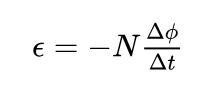
Faraday determined that the induced emf depends on
how quickly one changes the magnetic flux.
Formula for EMF:

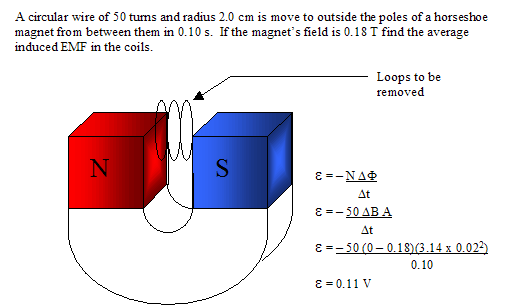
A loop of area 225 cm2 has 24 turns of wire. It is in a magnetic field of strength 3.6 x 10⁻² T. To begin with, its plane, face, is parallel to the magnetic field lines. In a time of 0.15 s it is rotated so that its plane is perpendicular to the magnetic field lines. What is the average emf induced in the loop during the one−quarter rotation?
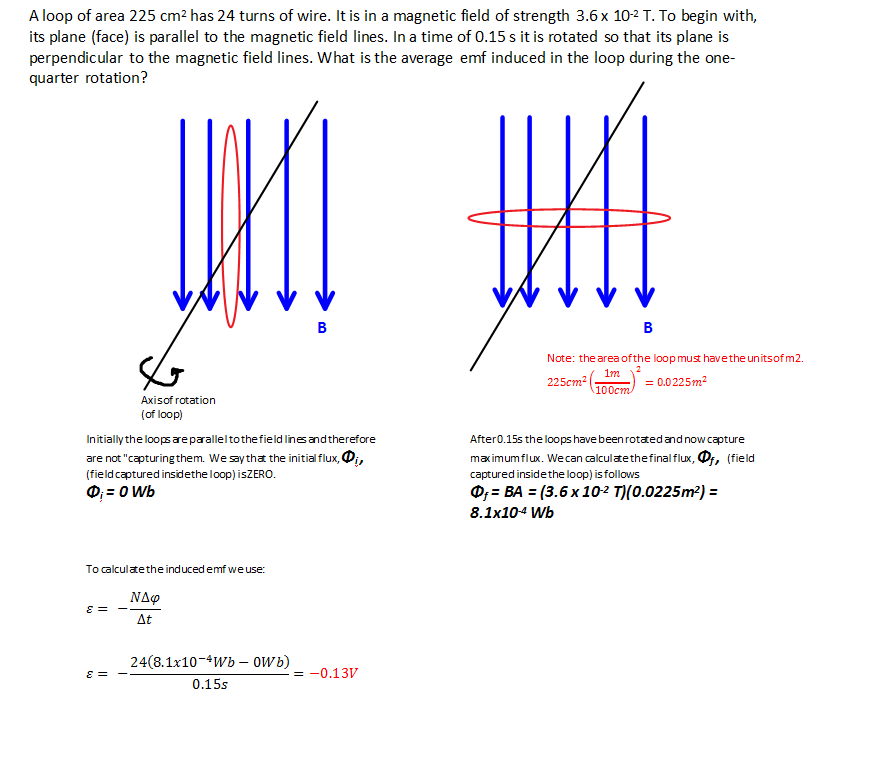
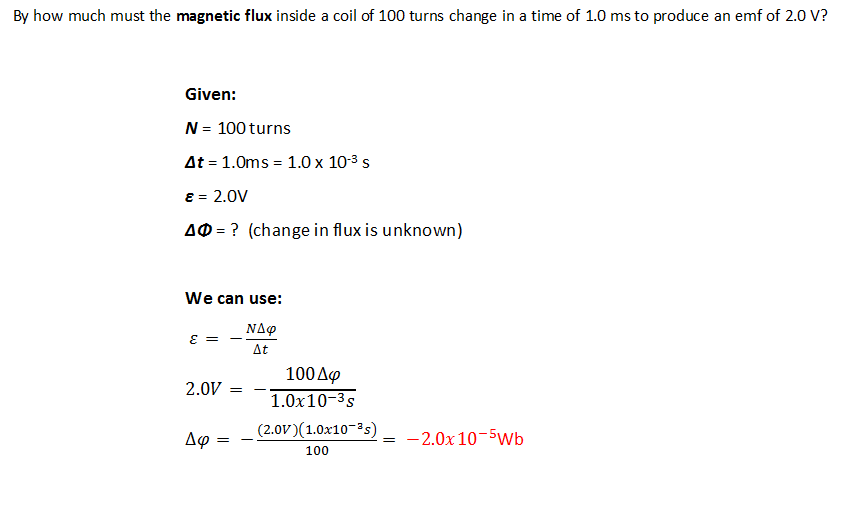
By how much must the magnetic flux inside a coil of 100 turns change in a time of 1.0 ms to produce an emf of 2.0 V?
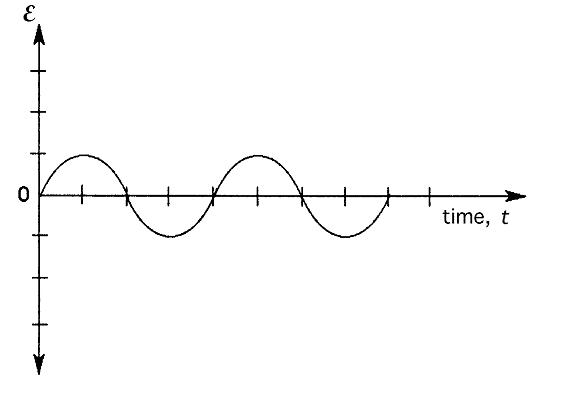
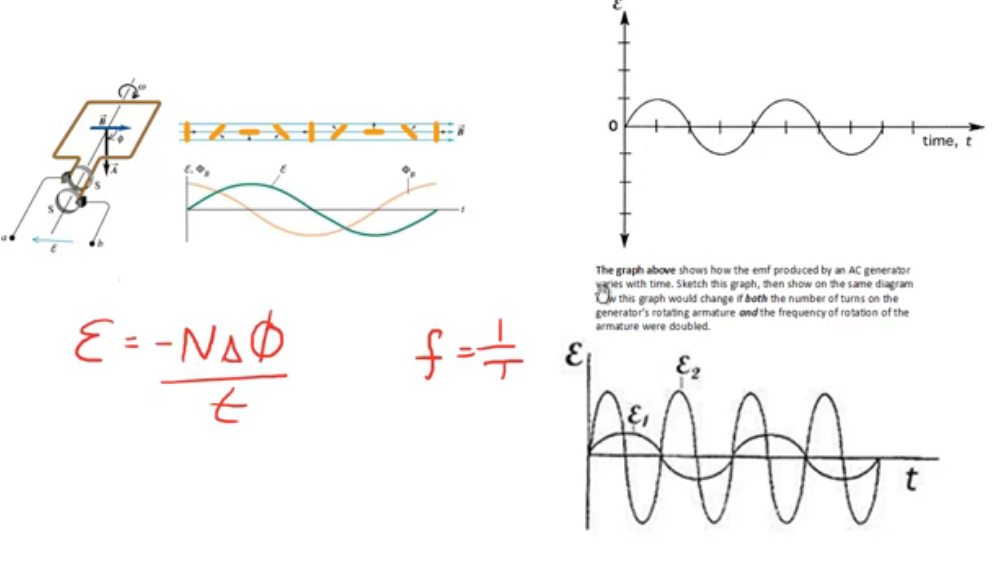
The graph below shows how the emf produced by an AC generator varies with time. Sketch this graph, then show on the same diagram how this graph would change if both the number of turns on the rotating armature and the frequency of rotation of the armature were doubled.
If the magnetic flux through a coil of wire with 300 turns changes from 5.0 Wb to − 10.0 Wb in a time of 0.050 s, what emf is induced in the coil?
Answer = 9.0 x 10⁴ V
Front: What happens to the random motion of charges in a conductor when it enters a magnetic field?
Back: The charges experience a magnetic force that separates them, with positive and negative charges moving in opposite directions, creating a potential difference (like a battery).
Front: According to the Right Hand Rule, if a positive charge moves to the right through an upward magnetic field, what is the direction of the force?
Back: The force is directed out of the page (represented by the palm).
Front: How do negative electrons react compared to positive charges when moving through a magnetic field?
Back: They experience a magnetic force in the opposite direction to that of the positive charges.
Front: What three physical variables determine the magnitude of the induced EMF in a straight conductor moving through a magnetic field?
Magnetic field strength (B)
Length of the conductor (l)
Velocity of the conductor (v)
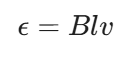
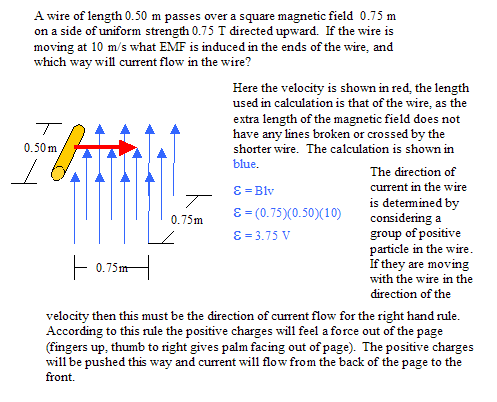
Front: What is the mathematical relationship (formula) for the EMF induced in a conductor moving at right angles to a magnetic field?
Front: Why does a longer conductor generate a greater EMF than a shorter one when moving through the same field?
Back: A longer conductor is considered to be crossing more magnetic field lines than a shorter one, increasing the rate of change of flux.
Front: How does the velocity (v) of the conductor affect the induced EMF?
Back: The faster the conductor moves, the greater the rate of change of flux, which results in a higher EMF.
Front: In the formula $\epsilon = Blv, what are the standard units for l?
Back: Meters (m).

Front: What is a "rail slide" in the context of electromagnetism?
Back: It is a contraption consisting of two conducting rails connected at one end with a sliding conductor that can move across them, effectively creating a loop with a changing area.
Front: According to Faraday's Law, what causes an EMF to be induced in a rail slide assembly?
Back: The change in magnetic flux, which in this specific case is caused by the changing area of the loop as the slide moves through a magnetic field [00:00:40].
Front: What are the two ways to analyze the induced EMF in a rail slide?

Front: In the derivation of EMF for a rail slide, why does N (number of turns) typically equal 1?
Back: Because the rail and slide assembly effectively forms a single conducting loop.
Front: How is the change in flux broken down for a rail slide where the magnetic field (B) and length (L) are constant?

Front: What is the final simplified formula for the induced EMF in a rail slide?

Here's an example rail slide:
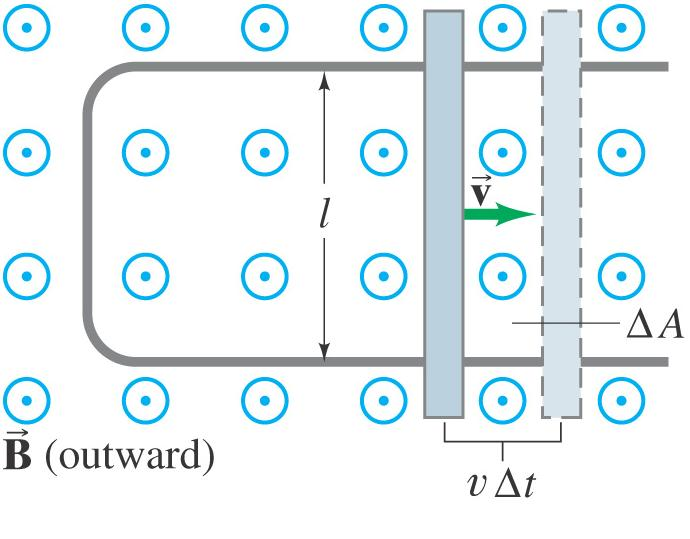
To create a flux we need two things;
a loop and a magnetic field flowing through the loop since flux, Φ =BA.
To CHANGE the flux and induce an emf we need to
change either B or A (or both).
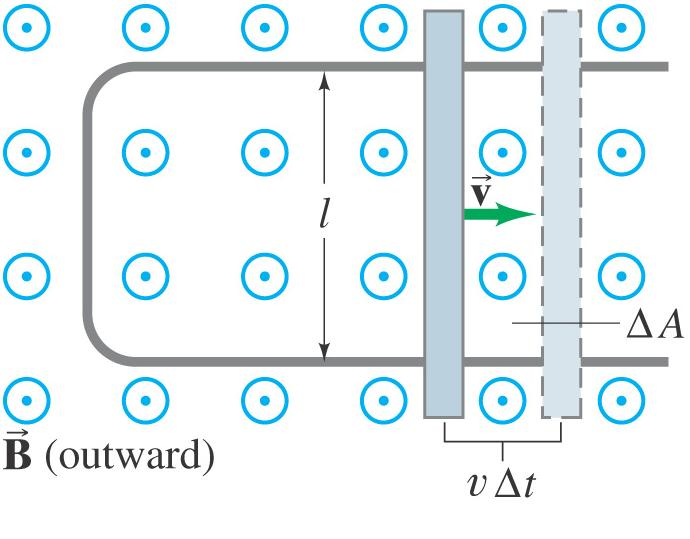
We can see from the diagram above that it is the area, A, that is
increasing.
We can derive the formula for moving conductors from our original equation relating rate of change in flux to induced emf as follows:
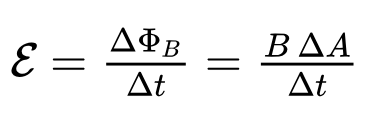
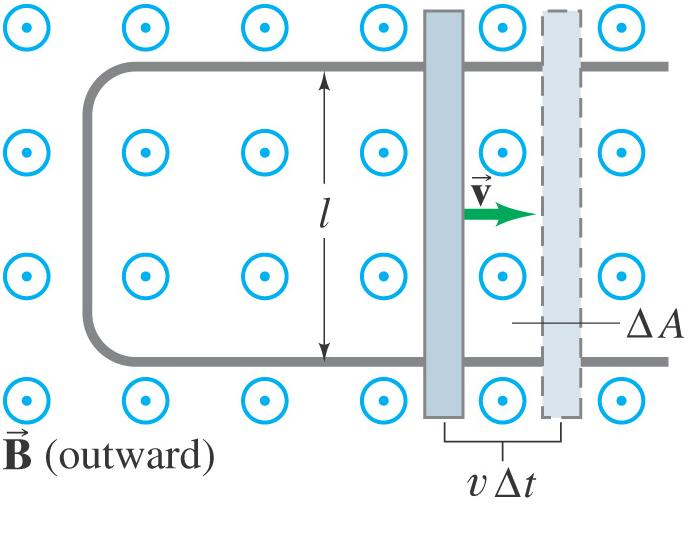
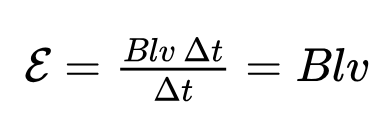
Notice that the area of the above loop is that of a rectangle and is given by A = lw. Therefore the CHANGE in area will be length, l, times CHANGE in width w. The change in width will simply be d = vt (basic kinematics) and we get:
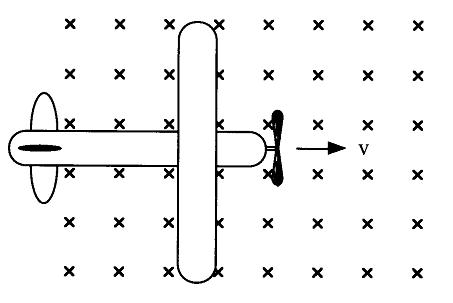
An airplane with a wingspan of 12.0 m travels at right angles through a magnetic field of strength 5.0 x 10⁻³ T. An emf of 1.5 V is induced between the ends of the wingtips. How fast was the airplane moving?
Answer: 25 m/s
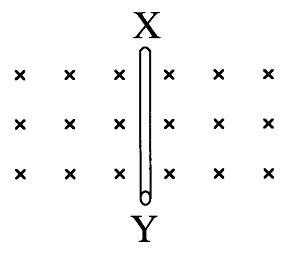
One can induce an emf in the wire XY if one moves the wire:
A. into the page.
B. out of the page.
C. toward X.
D. toward Y.
E. left or right.
Answer: E (best answer)
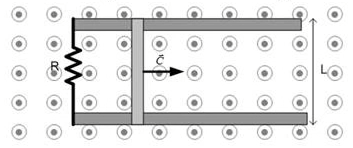
A 1.50 m long metal bar is being pulled to the right at 5.00 m/s on a rail slide within a 0.750 T magnetic field, as shown. R = 10.0 Ω. What is the induced current that is generated in the loop?
Answer: I = 0.563 A