Gene Expression: Transcription, Translation, and Protein Synthesis in Biology
 Call Kai
 Learn
Learn Practice Test
 Spaced Repetition
 Match
Match Flashcards
 Knowt Play
1/47

There's no tags or description
Looks like no tags are added yet.
Name | Mastery | Learn | Test | Matching | Spaced | Call with Kai |
|---|
No analytics yet
Send a link to your students to track their progress
48 Terms
What is translation?
The synthesis of a polypeptide using information from the mRNA.
Where does translation occur?
At the ribosome.
What role does tRNA play in translation?
tRNA carries the amino acid that the mRNA codon codes for and has an anticodon region complementary to mRNA.
What is the function of aminoacyl-tRNA synthetase?
It attaches amino acids to tRNA.
What does it mean for tRNA to be 'charged'?
It means that tRNA is carrying an amino acid.
What are the two subunits of ribosomes in eukaryotes?
Small subunit (40s) and large subunit (60s).
What are the three sites on the large ribosomal subunit?
A site (amino acid site), P site (polypeptide site), and E site (exit site).
What initiates the translation process?
The small ribosomal subunit binds to the mRNA and a charged tRNA binds to the start codon, AUG.
What occurs during the elongation stage of translation?
The next tRNA enters the A site, mRNA is moved through the ribosome, and peptide bonds are formed.
What is translocation in translation?
The process where the tRNA in the A site moves to the P site, and the tRNA in the P site moves to the E site.
What signals the termination of translation?
A stop codon in the mRNA reaching the A site of the ribosome.
What happens when a stop codon is reached?
A release factor hydrolyzes the bond holding the polypeptide to the P site, releasing the polypeptide.
What are the four levels of protein structure?
Primary (chain of amino acids), Secondary (coils and folds), Tertiary (side chain interactions), Quaternary (2+ polypeptide chains interacting).
How do genes influence protein folding?
Genes determine the primary structure, which dictates the final shape of the protein.
What are retroviruses and how do they differ in genetic information flow?
Retroviruses, like HIV, flow information from RNA to DNA using reverse transcriptase.
What is the role of chaperone proteins in protein folding?
They assist polypeptides in folding correctly.
What is the significance of codon charts in translation?
They are used to determine the specific amino acid coded by each mRNA codon.
What occurs during the initiation stage of translation?
The small ribosomal subunit binds to mRNA, and the first tRNA carrying methionine binds to the start codon.
What is the role of the A site in the ribosome?
It holds the next tRNA carrying an amino acid.
What is the role of the P site in the ribosome?
It holds the tRNA carrying the growing polypeptide chain.
What is the exit site (E site) in the ribosome?
It is where the tRNA exits after transferring its amino acid.
What are proteins made of?
Proteins are polypeptides made up of amino acids.
What links amino acids together in proteins?
Amino acids are linked by peptide bonds.
What provides the instructions for making proteins?
Genes.
What is gene expression?
The process by which DNA directs the synthesis of proteins.
What are the two main stages of gene expression?
Transcription and translation.
Where does transcription occur in eukaryotes?
In the nucleus.
Where does transcription occur in prokaryotes?
In the cytoplasm.
What is the role of transcription factors?
They regulate transcription by helping RNA polymerase bind to DNA.
What is the function of messenger RNA (mRNA)?
mRNA carries information from DNA to the ribosomes in the cytoplasm.
What is the role of transfer RNA (tRNA) in translation?
tRNA carries specific amino acids and attaches to mRNA via their anticodon.
What is the function of ribosomal RNA (rRNA)?
rRNA helps form ribosomes and links amino acids together.
What is the template strand in DNA transcription?
The DNA strand that is transcribed to form mRNA.
What is the genetic code?
The sequence of nucleotides in DNA that codes for proteins.
What are codons?
Groups of three nucleotides on mRNA that code for amino acids.
How many different codon combinations exist?
64 different codon combinations.
What is the start codon?
AUG.
What happens during the initiation step of transcription?
RNA polymerase attaches to the promoter region of DNA.
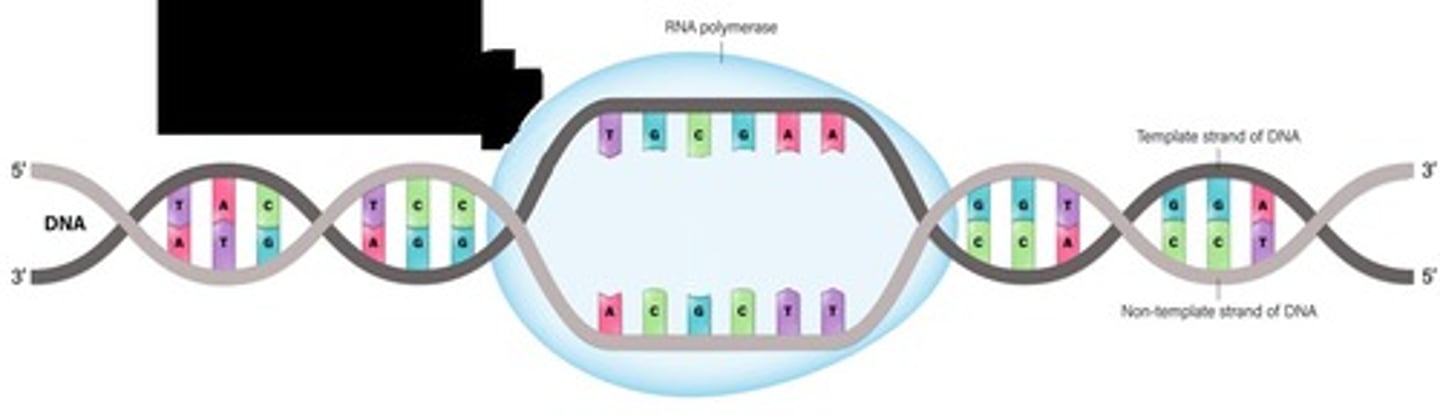
What occurs during the elongation step of transcription?
RNA polymerase adds complementary RNA nucleotides to the growing RNA strand.
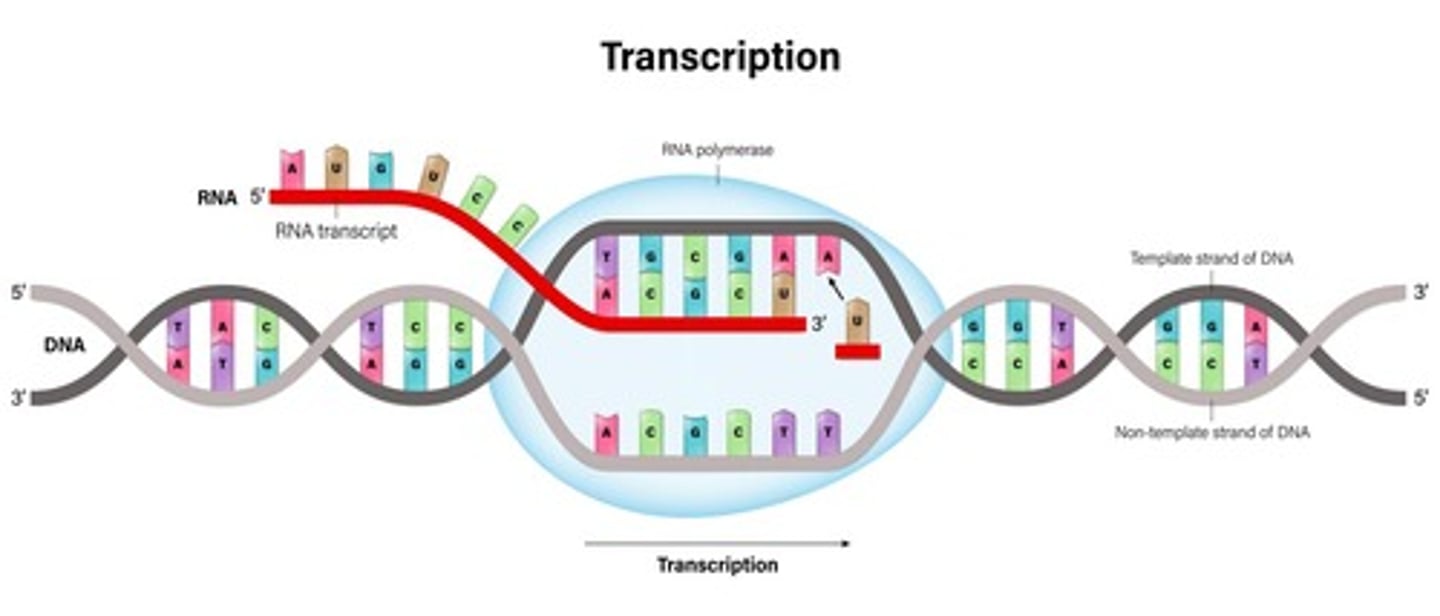
What is the termination step in transcription for prokaryotes?
Transcription proceeds through a termination sequence causing RNA polymerase to detach.
What modifications occur to pre-mRNA in eukaryotes?
5' cap, poly-A tail, and RNA splicing.
What is the purpose of the 5' cap on pre-mRNA?
It helps with ribosomal recognition and protects the transcript from degradation.
What are introns and exons?
Introns are non-coding sequences; exons are coding sequences that are expressed.
What is alternative splicing?
A process where a single gene can code for more than one kind of polypeptide.
What is the overall goal of transcription?
To write down the information from DNA so it can be translated into a protein.
How does initiation of transcription differ between eukaryotes and prokaryotes?
Eukaryotes require transcription factors, while prokaryotic RNA polymerase can bind directly to DNA.
What is the role of RNA polymerase?
To transcribe DNA into RNA.
What is the direction of elongation during transcription?
RNA is elongated in the 5' to 3' direction.