Multi-hazards
 Call Kai
 Learn
Learn Practice Test
 Spaced Repetition
 Match
Match Flashcards
 Knowt Play
1/21

There's no tags or description
Looks like no tags are added yet.
Name | Mastery | Learn | Test | Matching | Spaced | Call with Kai |
|---|
No analytics yet
Send a link to your students to track their progress
22 Terms
What hazards are in New Zealand
Earthquake, volcano, Tsunamis, Landslides, Floods, Drought, Coastal erosion
What are multi-hazards
1) the selection of multiple major hazards that the country faces, 2) the specific contexts where hazardous events may occur simultaneously, cascadingly or cumulatively over time, and taking into account the potential interrelated effects
What complicates multi-hazard assessments
Hazards may be related to each other, and cumulative (cascading), The impacts of elements at risk can be different for differing hazards and occasionally opposing, The differences between hazard characteristics and therefore the methods used to observe and monitor them, Any of the existing measures of hazard quantification need to be adapted to allow for comparison of multiple hazards
5 Types of multi-hazard
Independent, triggering, change conditions, compound, mutual exclusion
Independent multi-hazard
Hazards that occur independently from each other but have spatial or temporal overlap
Triggering multi-hazard
Implies a primary hazard that triggers a secondary hazard
Change conditions multi-hazard
One hazard alters the probability of another hazard by changing the underlying conditions
Compound multi-hazard
Different hazards that are the result of the same primary event
Mutual exclusion multi-hazard
Two hazards that show a negative dependence
Example of independent multi-hazard
Earthquakes and volcanoes at distance from one-another in an active plate boundary environment
Example of a triggering multi-hazard
Eruption can trigger crustal unrest in proximal areas, leading to earthquakes (e.g. Taupo eruption)
Example of change conditions multi-hazard
Earthquake on one fault can enhance the likelihood of an earthquake on a neighbouring fault
Example of a compound multi-hazard
Earthquake can trigger large landslides and river aggradation/flooding
Example of a mutual exclusion multi-hazard
Drought vs flood
How are multi-hazards modeled
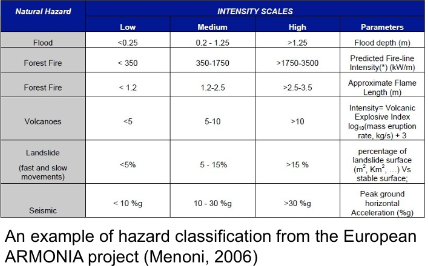
Intensity and frequency thresholds are defined in order to classify the respective hazards into a predefined number of hazard classes (high medium and low), this allows for comparison between hazards
What does developing indices for multi-hazards do
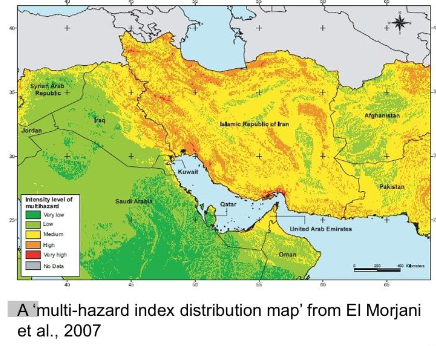
Allows for the comparison of differing parameters, develop indices that are uniquely weighted to reflect the impact of hazards
What types of hazards do these models cover
Only address natural hazards. other models include anthropogenic hazards
What scale do these models cover
Could be local, city, catchment, regional, and global, the larger the scale the more info needed
What focus do these models have
Different resources may be required depending on the focus (different people from different fields may want different info in the model)
What types of multi-hazard models can there be
Quantitative, Semi-quantitative, or qualitative
Characteristics of the Queenstown Lakes District Council
Most rapidly growing region of NZ, rapid pop growth, along with rapid residential, commercial, and industrial growth, Earthquake hazards (strong shaking and fault displacement), Potential for earthquake generated landslides
What is the Queenstown Lakes District Council study aiming to accomplish
A multi-hazard analysis considers the potential occurrence of different natural hazards in the same area of interest