analysis of materials
 Call Kai
 Learn
Learn Practice Test
 Spaced Repetition
 Match
Match Flashcards
 Knowt Play
1/20

There's no tags or description
Looks like no tags are added yet.
Name | Mastery | Learn | Test | Matching | Spaced | Call with Kai |
|---|
No analytics yet
Send a link to your students to track their progress
21 Terms
Amorphous vs crystalline solids
Amorphous solids have no long range order whereas crystalline solids have a repeating order
diffraction relationship between hole and spot
inverse relationship- the smaller the hole the larger the spots in the pattern
reciprocal lattice
A point in reciprocal space whose direction is perpendicular to the (hkl) family of real-space planes, and whose distance from the origin equals 1/d_hkl. It encodes both the orientation and spacing of that plane family in a single vector.
Ewald Sphere
Geometric representation of braggs law drawn in reciprocal space. If a point in reciprocal space lies on the ewald sphere, it means that the related family of planes (hkl) satisifes braggs law
Powder XRD uses
identification of unknown materials- XRD spectrums are all very unique so can operate as a fingerprint against the large database.
phase purity- Can be used to assess the purity of a sample as different phases can be identified quantifiably. can be used to tell you when a reaction is complete.
crystallite size powder XRD
width of peak is determined by crystallite size. smaller crystals give wider peaks so peak width can give you information.
Rietveld Analysis
computational technique which adjusts an estimated structure to data to get the best fit
Single crystal xrd overview
-is only possible if a crystal larger than 0.1 mm can be synthesized
-ewald sphere can be used to determine which spots will appear in diffraction pattern
-the distances and angles between spots in the diffraction pattern tell you about the reciprocal lattice dimensions. These can be used in turn to give dimensions and angles of the unit cell.
Neutron diffraction overview
-similar to XRD but neutron beam is scattered by the nuclei
-no direct relationship between scatter strength and atomic number which means it is good a looking at materials with small nuclei and similar atomic numbers
-the magnetic moment of neutrons interacts with unpaired electrons and can be used to look at magnetic properties of crystals
-neutrons have to be generated by a nuclear reactor making the process very expensive
-they are hard to monochromate which means the neutron beam becomes weak and large samples are necessary.
how electrons interact with samples
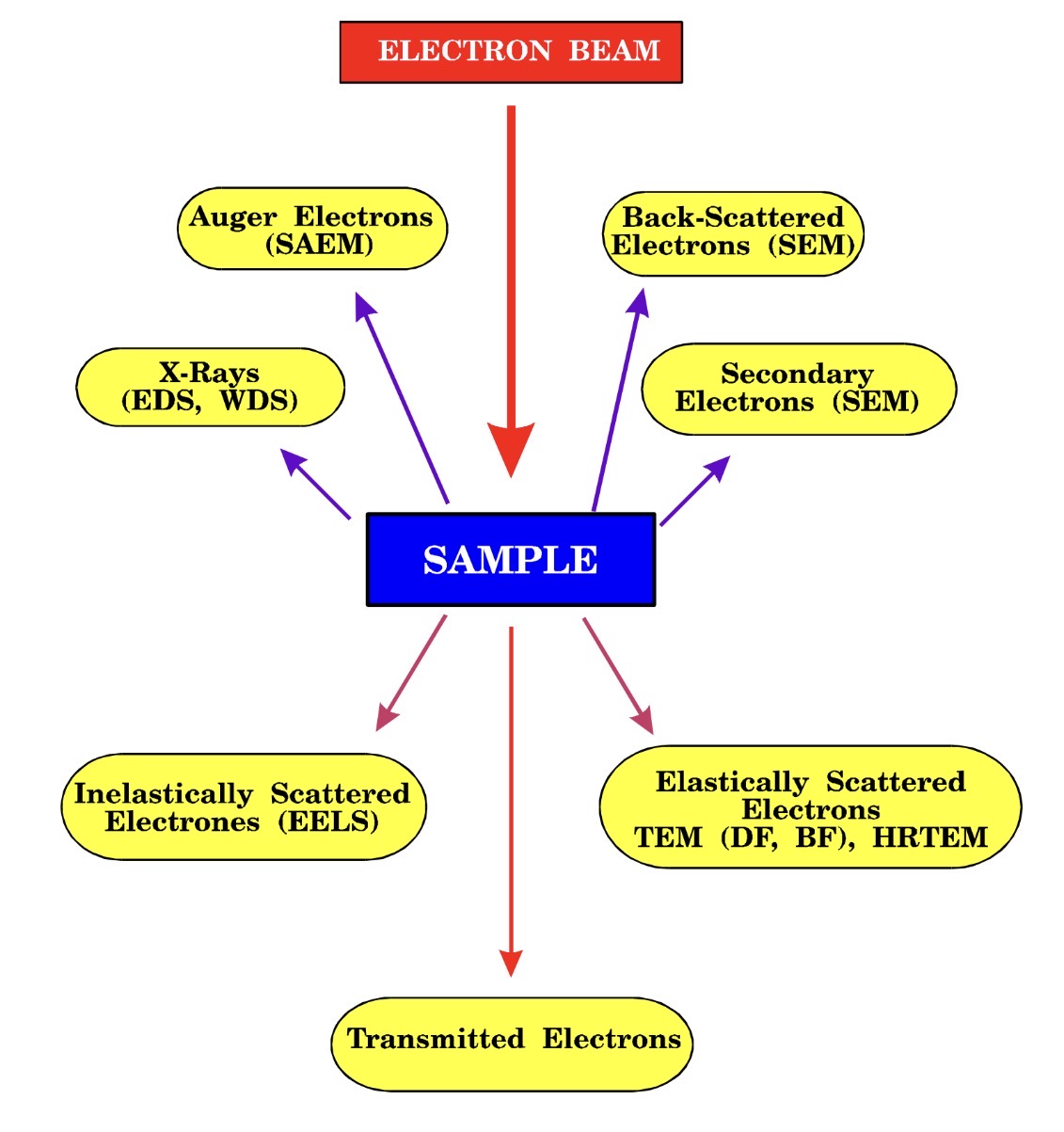
SEM overview
electron beam of 5-30 kV is scanned across the surface of a sample
SEM backscattered electrons
Electrons that are reflected from an elastic collision with the sample. Possess the same energy as the incident electrons
-
SEM secondary electrons
-come from inelastic collisions with the sample. low energy electrons of roughly 10-50 eV.
-Images taken using these electrons can be show more surface detail as they come from close to the surface