BIO 540 EXAM 3 Flashcards (Thermoregulation, Water Balance, & Reproduction)
 Call Kai
 Learn
Learn Practice Test
 Spaced Repetition
 Match
Match Flashcards
 Knowt Play
1/101

There's no tags or description
Looks like no tags are added yet.
Name | Mastery | Learn | Test | Matching | Spaced | Call with Kai |
|---|
No analytics yet
Send a link to your students to track their progress
102 Terms
Endothermy
Maintain an appreciable difference between body temperature and ambient temperature, due to cellular respiration.
Homeothermy
Maintain relatively stable body temperature (able to outcompete other organisms, more resistant to extreme temperatures)
Endotherms
Contain structures within nasal passage (respiratory turbinates) that are intermittent countercurrent heat and water exchangers (enabling increased ventilation rates and high resting O2 consumption)
Ectotherms
Lack respiratory turbinates, have relatively low lung ventilation and O2 consumption rates, and relatively narrow nasal passages.
Evolution of Endothermy
Two late Permian fossil lineages of Synapsids have respiratory turbinates, whereas dinosaurs did not have them.
Energy costs of Endothermy
High energetic costs; as the difference between TB and TA increases, more heat is lost.
Newton's Law of Cooling
Heat loss varies directly proportional to gradient difference between TB and TA (greater difference = greater heat loss)
Thermoregulation
A homeostatic process that maintains steady internal body temperature despite changes in external conditions.
Benefits of Thermoregulation
higher activity levels, faster movement, able to be active in diverse/fluctuating environments, increased niche exploitation, more efficient chemical reactions, enzymatic efficiency
Variation in TB in different mammal clades
Monotremes (lowest, 30-31°C), Marsupials (35-36°C), Insectivores (34-36°C), other Eutherians (36-38°C), Humans (37°C).
Basal Rate of Metabolism
A measure of the minimum cost to maintain normal TB during rest and post absorptive; scales with body mass (allometry)
Field Metabolism
The rate at which an animal expends energy in its natural habitat, measured in KJ/day (resting metabolism + energy used for all other activities)
Energy requirements depend on body size
Aquatic mammals have higher than expected RMR (2x+) due to faster heat transfer in water. Sloths have lower than expected RMR due to slow digestion, low activity
Energetic tradeoffs
High RMR leads to rapid development and population growth, higher energy demand, reproductive costs; low RMR leads to better survival and parental care, slower development, longer digestion;
The brain as an energy drain
Brain size is determined by body size; energy is expended for brain support.
Metabolism-Temperature curves
If TA < TB, lose heat passively via dry heat transfer (i.e., conduction, convection, radiation)
Thermoneutral Zone (TN)
Zone over which the basal rate of metabolism is independent of TA. Range of temps where TB is maintained without expending extra energy on heating or cooling.
Factors that Affect Insulation
Includes piloerection, alteration of blood flow (vasconstriction/vasodilation), Regional Heterothermy, changes in body posture (Behavioral Thermoregulation), fur thickness, and body size
Piloerection
Elevation or flattening of fur; involuntary response to temperature changes ("goose bumps")
Vasoconstriction
Constrict blood vessels in cold temps, reducing convective movement of heat to body surface.
Vasodilation
Dilate blood vessels in warm temps, increasing convective heat movement to body surface.
Variable distribution of fur on body
heat windows are regions with thin fur (e.g., groin area) (example of regional heterothermy)
Behavioral Thermoregulation
Changes in body posture to manage temperature exposure. Warm temps = reduce SA exposure to sun, e.g., camels huddle in long rows facing into sun; cold temps = reduce surface area exposure to wind chill, e.g., curl into ball, tuck nose, huddle in group
Fur thickness & Insulation quality
Positive correlation between fur thickness and insulation quality of fur.
Body size
Primary character influencing basal metabolic rate. Small body = larger surface area exposed relative to volume, heats faster cools faster. Large body = smaller surface area relative to volume, heats slower, cools slower.
Shrink!
Small mammals may seasonally shrink their organs to conserve energy (e.g., Dehnel Effect in shrews: reduce organ mass during winter to reduce energy requirements).
Modes of Increasing Heat Production
Shivering
Nonshivering thermogenesis (NST)
Activity
Regional Heterothermy
Shivering
high frequency, relatively uncoordinated/involuntary contraction of skeletal muscles to convert chemical energy into thermal energy.
Nonshivering Thermogenesis (NST)
Production of heat through metabolic means (increase ion pumping by Sodium-Potassium active transport pump in cell membranes, frees catabolism to permit oxidation of food reserves with immediate release of heat), primarily in brown adipose tissue.
Brown adipose tissue
(brown fat) specialized for heat production, rich in mitochondria with Thermogenin (UCP1), prominnent in cold-acclimated animals, hibernators, neonates.
Norepinephrine
A neurotransmitter and hormone released by sympathetic nervous system that serves as the primary chemical signal triggering nonshivering thermogenesis; release triggered by a drop in temperature.
Thermogenin (UCP1)
A mitochondrial protein in brown fat that generates heat by uncoupling ATP production.
Regional Heterothermy
the ability to maintain different temperatures in different parts of the body at the same time; common to all mammals.
Countercurrent heat exchange
Mechanisms allowing blood to flow to coldest part of extremity without loss of heat; related to vasodilation/vasoconstriction.
Rete Mirabile
("wonderful net") Complex network of veins and arteries, allows increased thermoregulation efficiency; efficient countercurrent exchange; commonly found in limbs and brain.
Strategies for Coping with Extreme Temperatures
Heterothermy
Hypothermia
Daily Torpor
Estivation
Hibernation
Heterothermy
The ability of an animal to vary its body temperature in response to environmental conditions; fluctuating TB = energy conservation strategy.
Hypothermia
Controlled lowering of TB, approaching TA; conserves energy.
Daily Torpor
TB lowered for only part of each day; reduces food intake demands and lowers heat loss; e.g., common in bats and some rodents.
Estivation
Summer sleep; state of dormancy during hot/dry conditions; common in small, desert mammals; conserves energy & water.
Hibernation
Seasonal lowering of TB in relation to cold temperatures and/or low food availability.
Shallow hibernation
Periods of sleep with moderate TB reduction (e.g., raccoons, skunks, badgers, bears).
Deep hibernation
TB drops within 2-3°C of TA; sleep bouts (entry, deep sleep, arousal); e.g., bats, ground squirrels, woodchucks/marmots.
Responses to High Heat Loads
1. Behavioral Thermoregulation
2. Alter insulation (e.g., shedding fur)
3. Cyclic TB (allow body temp to fluctuate daily/seasonally)
4. Hyperthermia
5. Evaporative cooling
Hyperthermia
Controlled elevation of TB to tolerate high TA.
Evaporative cooling
Water loss to reduce body temperature; e.g., panting, sweating, or licking.
Vertebrate Kidney
filtration reabsorption system; excrete waste as hypertonic urine relative to blood
Loop of Henle
Part of kidney tubule which forms long loop in medulla of kidney from which water and salts are reabsorbed into the blood. Longer LOH = more concentrated urine.
Antidiuretic Hormone (ADH)
Produced by Hypothalamus and released by posterior Pituitary; key hormone regulating kidney function; regulates water balance in the body.
ADH & Dehydration
ADH production increases; increases permeability of end of distal tube & collecting duct of Loop of Henle, increasing the multiplier effect; concentrates urine.
ADH & Hydration
ADH production decreased; not released; multiplier effect decreases; distal tube & collecting duct of Loop of Henle permeability is lowered; [Urine] decreases; extra water leaves the body.
Strategies for Water Regulation in Arid Habitats
1. Consume wet food
2. Thermoregulation (e.g., Hyperthermia)
3. Periodic trips to water holes/rivers
4. "Water Independence"
Water Independence
Rely on water via cellular respiration (metabolic water); diet mainly seeds = high in carbohydrates = can extract large concentrations of water via Catabolism. Long LOH relative to body size; dry feces
Water independent mammal
Survives without drinking water by relying on metabolic water, water in food; adaptations to minimize water loss: concentrated urine, dry feces, nasal countercurrent system; common in desert environments, rodents
Strategies to Reduce Water Loss via Respiration
1. Heat exchange systems
2. Forage at night
3. Rest in burrow during day
Heat exchange systems
Exhale air cooler than TB results in condensation of water before air leaves nasal passage (regional heterothermy = nasal passages).
Forage at night
Respiratory water loss lowest; increase metabolism in accordance with low night TA thereby increasing metabolic water production & need to obtain more seeds.
Rest in burrow during day
Plug entrance with soil; Lower TA and higher humidity in burrow relative to above ground = lower respiratory water loss.
Lactation & Water Loss
Tremendous seasonal loss of water for females; recycle as much water as possible (behavioral adaptation, e.g., ingest urine & feces of young) and/or drink frequently.
Mammalian Reproduction Strategy
Relatively few intrauterine young (high survival rate compared to other species); nourish neonates with milk; young remains with mother until weaned; greater amount of energy invested per young
Cost of lactation
Breeding females required more energy.
Follicle Stimulating Hormone (FSH)
Secreted by the pituitary; triggers follicle growth.
Luteinizing Hormone (LH)
Secreted by the pituitary; triggers ovary to secrete Estrogen.
Estrogen
Hormone that regulates the reproductive cycle and promotes the development of female reproductive tissues and traits.
Corpus Luteum
Spongy body which forms in place of ruptured follicle; secretes Progesterone for uterine wall preparation.
Progesterone
Prepares and maintains the uterus for pregnancy; secreted by Corpus Luteum.
Corpus Albicans
Nonfunctional, fibrous remnant of Corpus Luteum after it regresses if no fertilization occurs.
Feedback from Mammaries
Stimulates Prolactin (stimulates milk production) release and inhibits Gonadotropin (hormones that regulate reproductive organs, gametes).
Major Parts of Embryonic Membranes
1. Yolk Sac
2. Amnion
3. Allantois
4. Chorion
Yolk Sac
Part of primitive intestine lying external to embryo; forms from Endoderm.
Amnion
Forms from Ectoderm and Mesoderm around the embryo; filled with serous fluid; prevents shock/desiccation
Allantois
Out-pocket from the hindgut of embryo; movement of nutrients and O2.
Chorion
Outer embryonic layer (Ectoderm); envelopes entire assemblage, contains villi; contact with uterine wall
Placenta
Includes embryonic membranes & lining of uterine wall (Endometrium).
Endometrium
Mucous membrane lining the uterus; thickens during menstrual cycle.
Diffuse placenta
Villi scattered over entire surface of chorion; increased surface area for absorption; e.g., lemurs, perissodactyls, some artiodactyls.
Polycotyledonary placenta
Islands of villi scattered over chorion; e.g., Bovids (cattle, bison, sheep, goats)
Zonary placenta
Band of villi encircle center of Blastocyst; e.g., carnivores
Discoidal placenta
Regional restriction of villi; e.g., most mammals, rodents, primates, humans
Nondeciduate placenta
Loose-fitting of villi with Endometrium; pull-free without disrupting endometrium during parturition; e.g., whales, ungulates
Deciduate placenta
Close-fitting of villi-endometrium; pull free & cause erosion of Endometrium during parturition; e.g., rodents, carnivores
Choriovitelline placenta
Blastocyst lies in the Endometrium depression; does Not embed; e.g., Marsupials
Chorioallantoic placenta
Villi, blastocyst rests against Endometrium at Allantois-Chorion contact point, specialized regions, longer gestation; e.g., Eutherian mammals
Chorioallantoic Placenta Types in order of most layers to least
Epitheliochorial
Syndesmochorial
Endotheliochorial
Hemochorial
Hemoendothelial
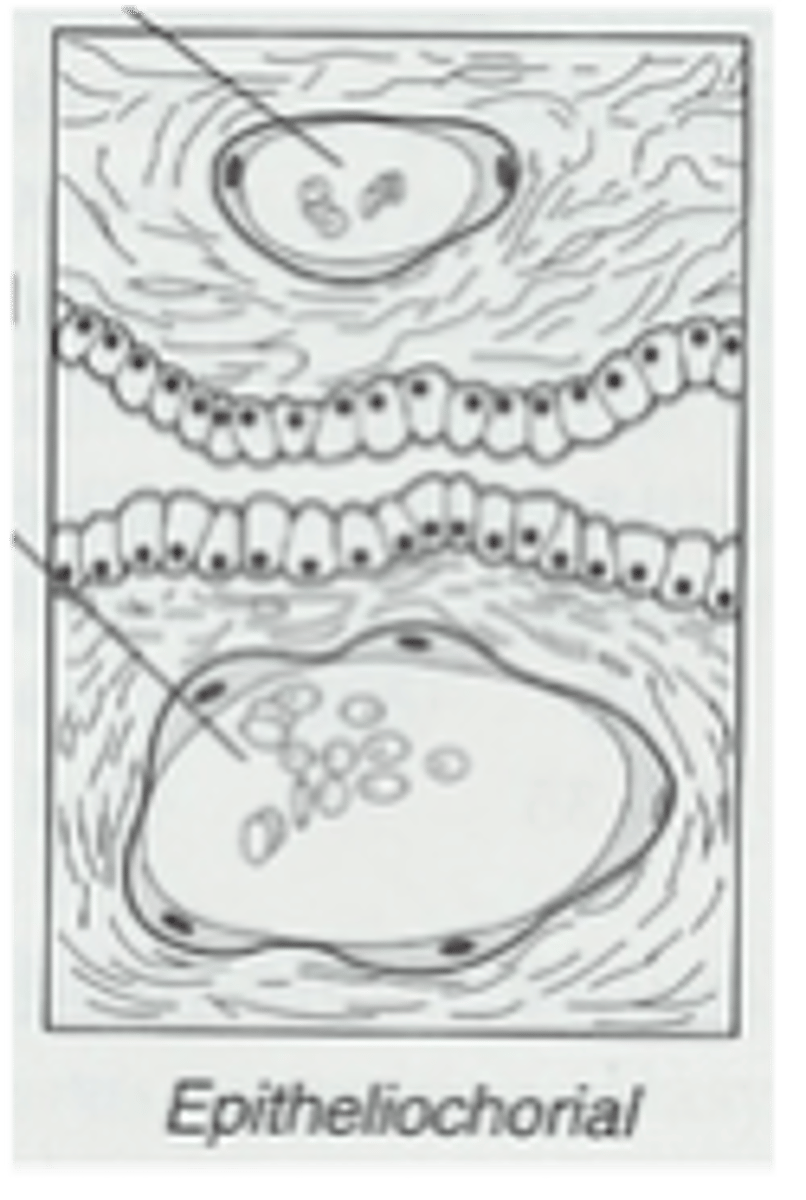
Epitheliochorial placenta
Epithelial cells of chorion in contact with epithelial cells of uterus, villi in pockets in endometrium (most layers); e.g., lemurs, cetaceans, equids, suids
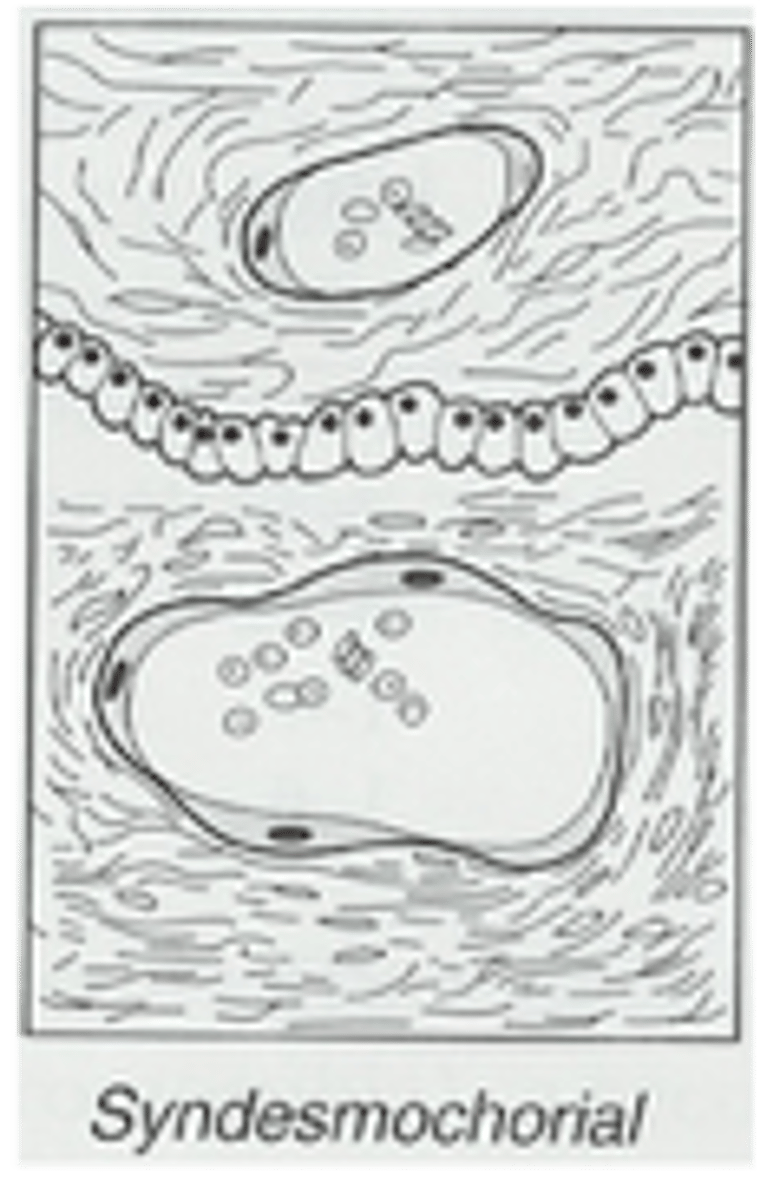
Syndesmochorial placenta
Lacking uterine epithelial barrier; contact uterine tissue; e.g, Artiodactyls
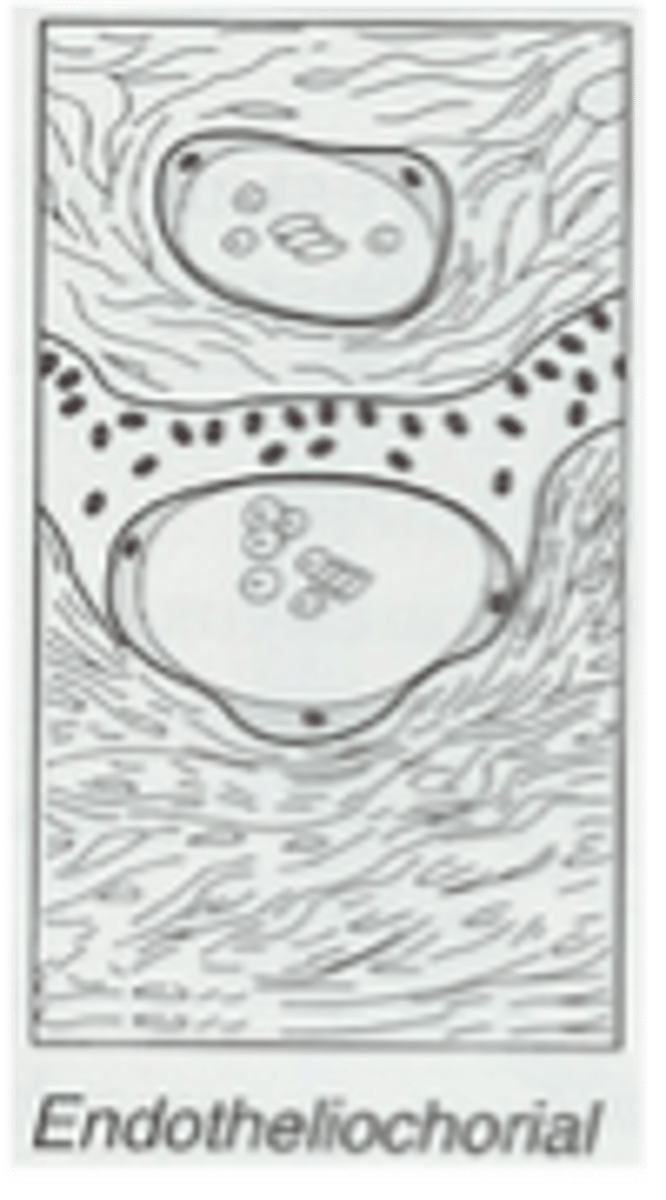
Endotheliochorial placenta
Epithelial cells of chorion in contact with lining of uterine capillaries; e.g., Carnivores
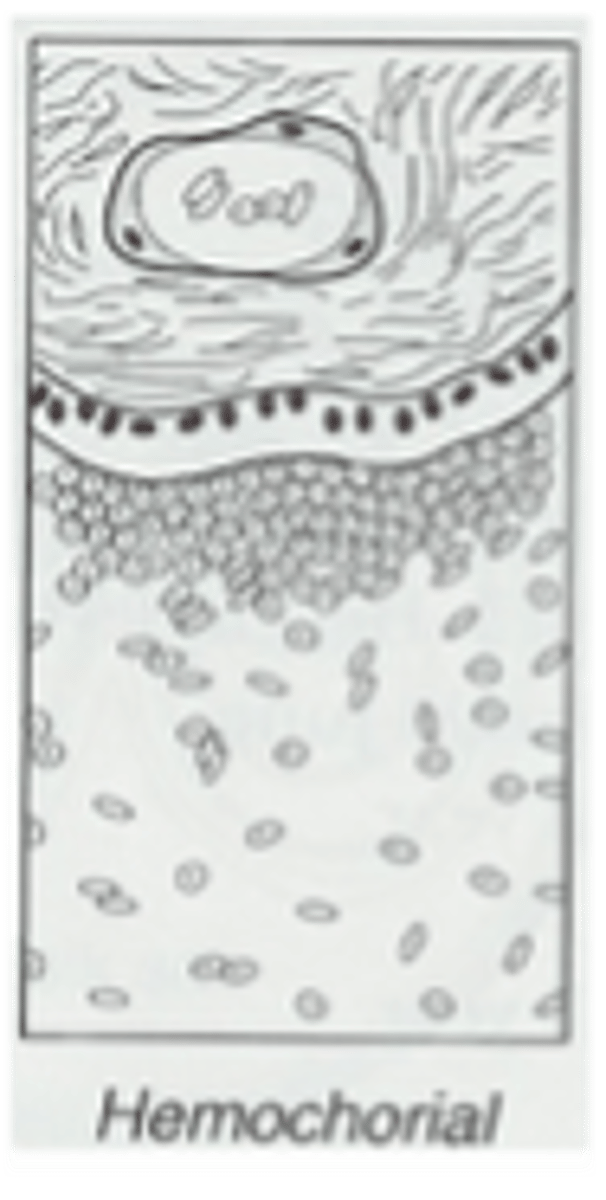
Hemochorial placenta
Villi in direct contact with maternal blood; e.g., insectivores, bats, higher primates, humans
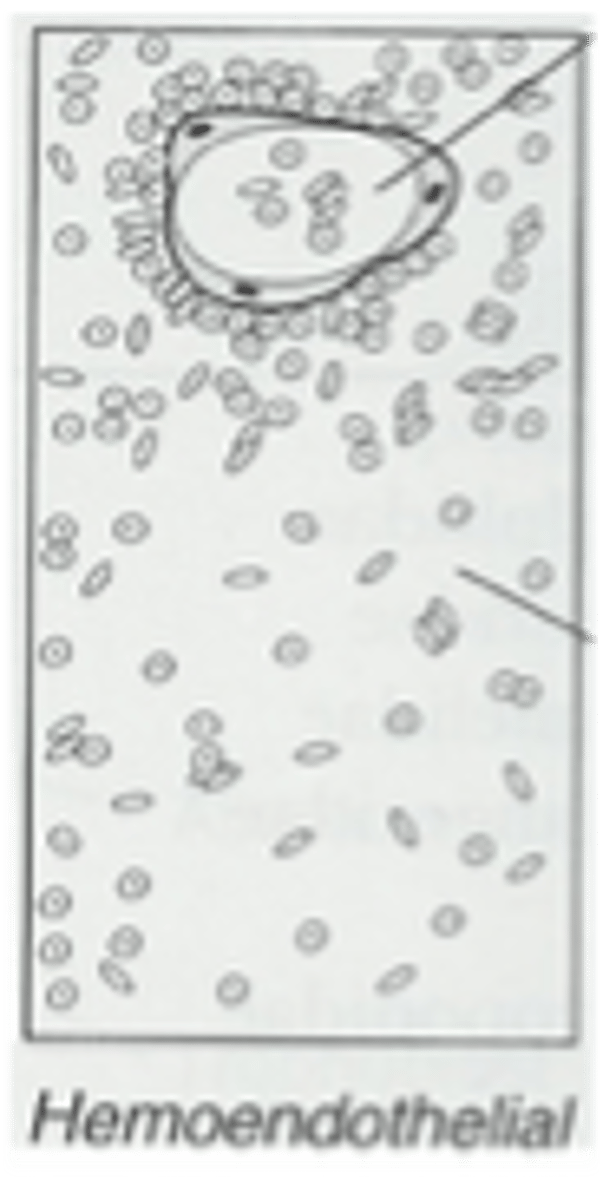
Hemoendothelial placenta
Lining of villi blood vessels only barrier to maternal blood; e.g., lagomorphs, some rodents
Continuous Embryonic Development
Ova fertilized in oviduct; Zygote begins Mitosis, descends towards uterus; zygote reaches uterus, blastocyst stage as implanting into endometrium; placental connection; uterus to embryo; continual development until parturition
Deviations from Continous Development
Delayed Fertilization
Delayed Development
Delayed Implantation
Delayed Fertilization
Ovulation and fertilization delayed until an extended time after copulation; viable sperm retained in female; ovulation occurs months after copulation; common to temperate bats
Delayed Development
Blastocyst embeds into the endometrium and then becomes dormant; e.g., common in bats
Delayed Implantation
Blastocyst forms but does not embed and ceases to develop; floating blastocyst remains dormant for weeks to a year; e.g., weasels, seals, bears
Types of Breeding Seasons
Continuous: year-round breeding; Restricted: optimal timing for mating and birth.
Influences on Puberty & Reproduction
Light
Temperature
Nutrition
Precipitation
Social Effects/Density
Lee-Boot Effect
psuedo-pregnancy induced among crowded females
Whitten Effect
synchronized ovarian cycles when male introduced into population of females
Bruce Effect
implantation blocked; pregnancy aborted if females exposed to strange new male;
Blastocyst
Early mammalian embryo (hollow ball of cells); implants into uterus.