Physics- wave nature of light
 Call Kai
 Learn
Learn Practice Test
 Spaced Repetition
 Match
Match Flashcards
 Knowt Play
1/27

There's no tags or description
Looks like no tags are added yet.
Name | Mastery | Learn | Test | Matching | Spaced | Call with Kai |
|---|
No analytics yet
Send a link to your students to track their progress
28 Terms
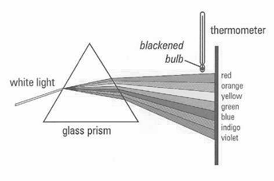
how is infra-red radiation detected
thermometer with blackened bulb, positioned at the region just beyond the red light
why does diffraction not occur when light passes through a window
the window is too wide relative to wavelength of light. diffraction occurs when the width of the gap is of the same order as the wavelength of the the wave
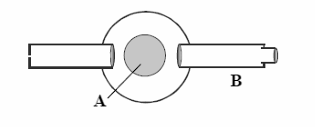
Name the parts labelled A and B of the spectrometer shown in the diagram.
A: Turntable B: Telescope
List three conditions necessary for an observer to see a rainbow
Observer’s back to sun / sunlight / (suspended) droplets of water / proper angle of viewing.
list a pair of complementary colours
red and cyan / green and magenta / blue and yellow
The diffraction effects of sound waves are noticeable in everyday life, whereas the diffraction effects of light waves are not. Explain why.
Sound has a long wavelength (typical of everyday objects), whereas light has a short wavelength. Diffraction occurs when the width of the gap is of the same order as the wavelength of the wave.
State one application of stress polarisation
Checking for defects in materials.
Describe an experiment that demonstrates the wave nature of light.
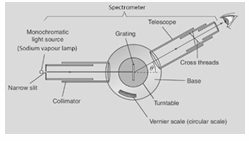
Apparatus – Spectrometer, monochromatic light source, diffraction grating. Procedure – • Shine light through grating. • View the light through the telescope, rotate telescope. Observation – There is interference pattern of bright and dark fringes. Conclusion – As only waves undergo the phenomena of interference it can be concluded that light is a wave motion.
what is dispersion
Dispersion is the splitting up of white light into its constituent colours.
what is diffraction
the spreading out of a wave into its geometric shadow as it passes through a gap, or around an obstacle, of roughly the same width as its wavelength.
why is a spectrum not formed at the central (zero order) image.
constructive interference occurs for all wavelengths at the same point, resulting in no separation of colours
describe how to detect infrared radiation
Apparatus – Thermometer with blackened bulb, white light source, prism Procedure – • Shine the narrow beam of white light through the prism. • Position the thermometer at the region just beyond the red light. Observation – The temperature rises is seen on the thermometer.
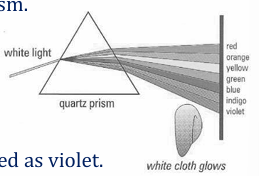
Describe how to detect ultraviolet radiation
Apparatus – White cloth washed in detergent, white light source, quartz prism. Procedure – • Shine the narrow beam of white light through the prism. • Position the cloth at the region just beyond the violet light. Observation – The cloth will fluoresce. Conclusion – The ultraviolent light is absorbed by the detergent and reemitted as violet.
Can a diffraction grating which diffracts light also diffract X-rays? Justify your answer.
No. The spacing between lines in such a grating is too large for diffraction to occur. The line spacing must be similar to the wavelength of the radiation for diffraction to occur.
what is meant by interference
Interference is when two or more waves (from different sources) overlap, forming a single resultant wave (of different amplitude).
name the types of electromagnetic radiation from lowest to highedst frequency
radio waves
microwaves
infrared
visible light
ultraviolet
x-rays
gamma rays
What primary colours of light (i) are absorbed and (ii) are reflected when white light shines on a red book?
(i) green and blue (ii) red
What colour would a red book appear to be if colour filters were used so that the book was illuminated (i) with green light and (ii) with red light?
(i) black
(ii) red
what is polarisation
when the direction of vibration is restricted to one plane
Describe how polarisation can be demonstrated in the laboratory.
Apparatus – Two pieces of Polaroid, light source.
Procedure – • Shine light through both pieces of Polaroid. • Rotate Polaroid relative to the other through 90°.
Observation – There is a change in intensity of the light passing through the pieces of Polaroid decreasing to zero as the rotation reaches 90°.
Conclusion – As only transverse waves undergo the phenomena of polarisation it can be concluded that light is a transverse wave motion.
give an application for stress polarisation
checking for defects in materials
Explain with the aid of a labellled diagram, Young’s double slit experiment
• Diffraction occurs at each slit, which means the slits act as coherent wave sources, separated by roughly the same distance as the wavelength of visible light. Interference occurs between these source waves, resulting in regions of destructive interference (showing up as darkness on the screen) and constructive interference (bright fringes on the screen).
• Constructive interference is when the resultant wave is of greater amplitude than source waves, which equates to brightness. This occurs when their path difference from the wave sources is 𝑛𝜆.
• Destructive interference is when the resultant wave is of smaller amplitude than source waves, which equates to darkness. This occurs when their path difference is (𝑛 + 1 2 )𝜆.
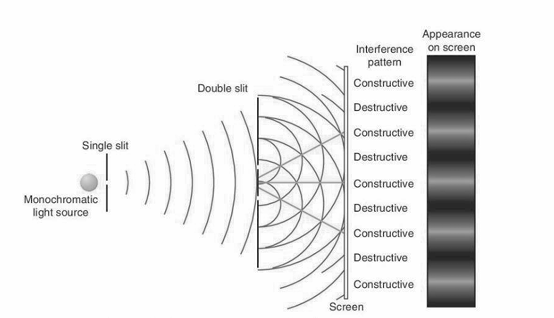
explain how youngs double slit experiment confirms that light is a wave
Since only waves can exhibit diffraction and interference, the observation of these phenomena in light confirms its wave nature.
What is a diffraction grating?
It is a slide with a of series of (transparent) gaps.
Why are radio waves not observed to undergo diffraction when incident on a diffraction grating of 600 lines per mm?
Diffraction occurs when the width of the gap is of the same order as the wavelength of the wave. The wavelength of the radio waves are too long compared to the distance between the slits in the grating.
What is meant by dispersion?
the splitting up of white light into its constituent colours
give an example of light undergoing dispersion
a rainbow
Give two differences between what is observed when a narrow beam of light undergoes dispersion as it passes through a prism, and what is observed when a narrow beam of light undergoes dispersion as it passes through a diffraction grating.
Longer wavelengths of light (red) are deviated least in a prism, whereas they are deviated the most in a grating. There are many spectra observable with a grating, whereas there is only one with a prism