B3.1 Gas Exchange (Plants Only)
 Call Kai
 Learn
Learn Practice Test
 Spaced Repetition
 Match
Match Flashcards
 Knowt Play
1/11

There's no tags or description
Looks like no tags are added yet.
Name | Mastery | Learn | Test | Matching | Spaced | Call with Kai |
|---|
No analytics yet
Send a link to your students to track their progress
12 Terms
Waxy Cuticle
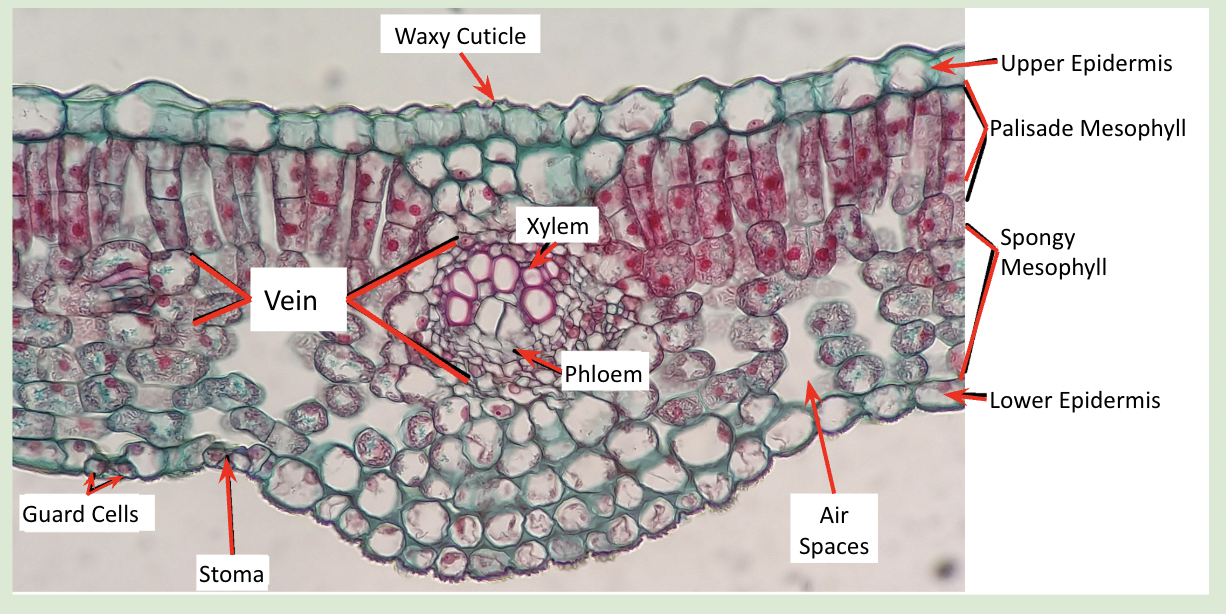
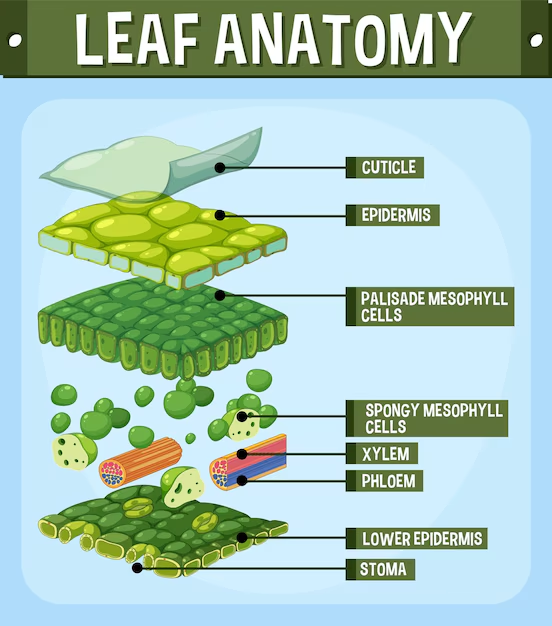
Waxy cuticle: The waxy cuticle covers the epidermis cells and reduces the evaporation of water from the leaf.
Epidermis
Epidermis: The epidermis provides protection for the mesophyll cells within the leaf. Epidermal cells are transparent, allowing light to reach the mesophyll cells where photosynthesis is carried out.
Vein
Veins: Veins provide support for the leaf. They contain xylem and phloem tissue.
Xylem
Xylem transports water and minerals from the roots.
Phloem
Phloem transports nutrients up and down the plant.
Spongy Mesophyll
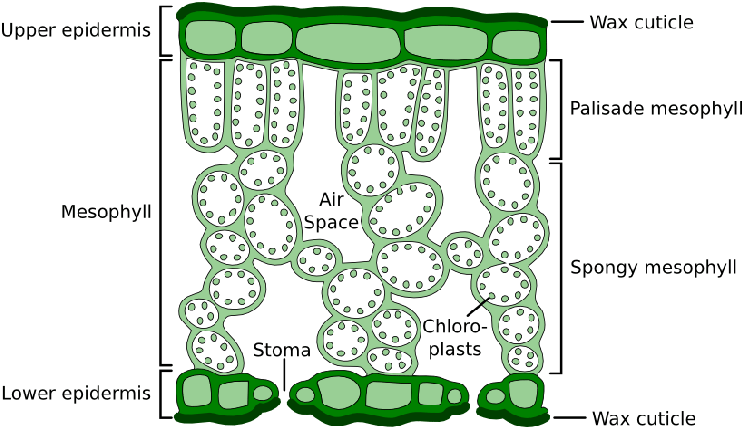
Spongy mesophyll: The irregular shape of spongy mesophyll cells increases the surface area for gas exchange. The spongy mesophyll cells are surrounded by air spaces.
Air spaces: Air spaces around spongy mesophyll cells facilitate the diffusion of gases between the surrounding atmosphere and the mesophyll cells.
Stoma / Stomata
Stomata: Stomata are pores which allow gases to enter and exit the leaf. Stomata are usually more common on the lower epidermis of the leaf. The stomata are open and closed by guard cells.
Guard Cells
The stomata are open and closed by guard cells.
two bean shapes cells surrounding the stomata
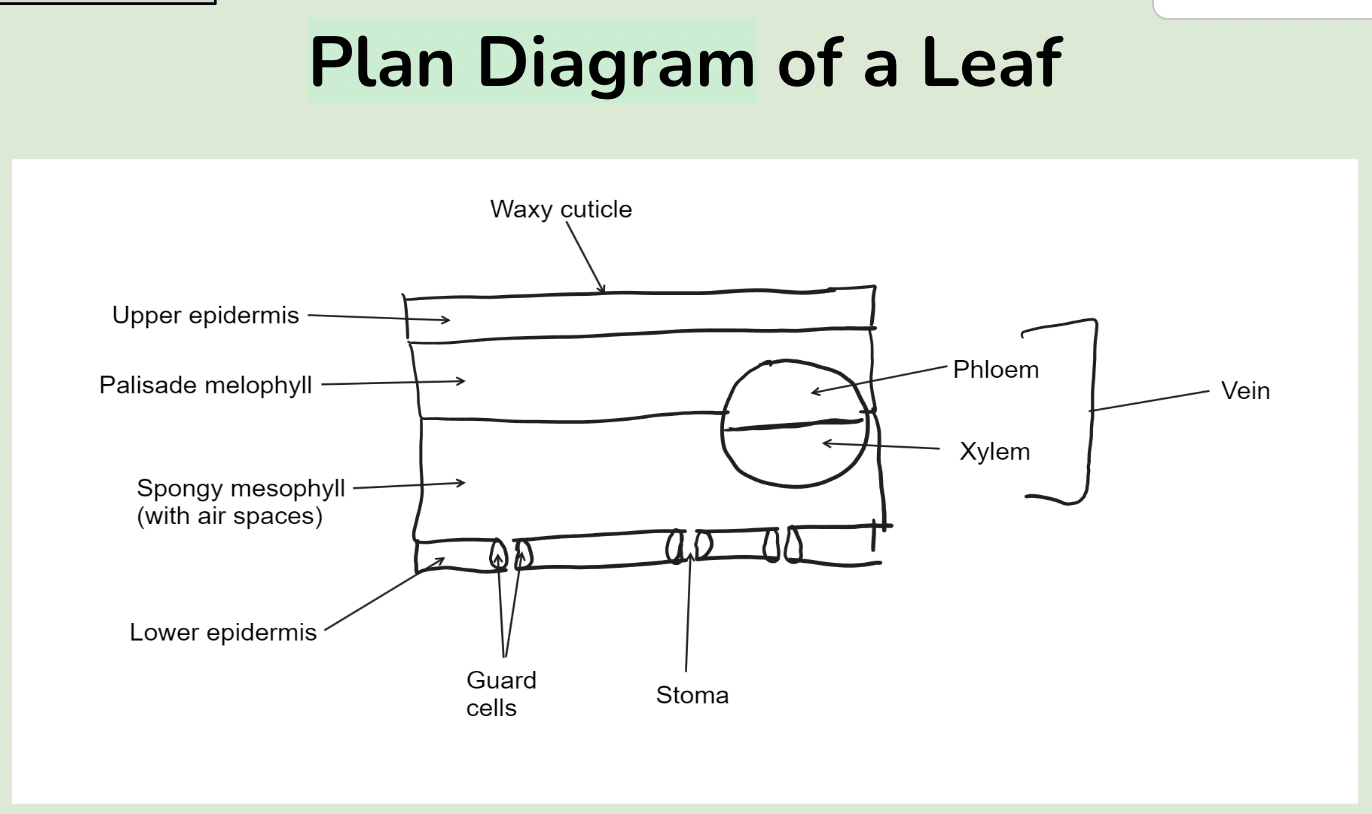
Plan Diagram
Transpiration
Transpiration is the movement of water through a plant, and its evaporation from aerial parts of the plant such as leaves.
Transpiration is an inevitable consequence of gas exchange, as water in mesophyll cells evaporates, and diffuses through the open stomata.
Water diffuses from the high concentration of water particles within the air spaces of the spongy mesophyll to the low concentration of water particles in the atmosphere.
The following factors affect the rate of transpiration:
Light intensity: As light intensity increases, more stomata open. If there are more open stomata, then more water can diffuse out of the leaf, increasing the rate of transpiration.
Temperature: As the temperature increases, the water particles gain kinetic energy, and move faster. Faster moving water particles diffuse through the stomata of the leaf at a faster rate. Additionally, higher temperatures increase the rate of evaporation, which also increases the rate of transpiration.
Humidity: As humidity increases, the concentration of water outside the leaf increases. This decreases the concentration gradient between the inside and outside of the leaf. Water particles will diffuse slower, resulting in a slower rate of transpiration.
Air flow (wind): As air flows past the leaf, it moves water vapour away from the leaf, reducing the concentration of water outside the stomata of a leaf. This increases the concentration gradient, resulting in an increase in the rate of transpiration.
Humidity
Humidity is the concentration of water vapor present in the air. It indicates how wet or damp the atmosphere is and plays a critical role in weather forecasting, climate, and human comfort.
Stomatal Density
Stomatal density is the number of stomata per unit area of a leaf.
a microscope with a graticule can be sued to calculate it
graticule = A microscope graticule (or reticle) is a glass disc with an engraved scale or grid that fits inside a microscope's eyepiece. It provides a visual ruler overlaid on your specimen, allowing you to measure the actual size of cells or particles