Epidemiology Module 8
 Call Kai
 Learn
Learn Practice Test
 Spaced Repetition
 Match
Match Flashcards
 Knowt Play
1/15

There's no tags or description
Looks like no tags are added yet.
Name | Mastery | Learn | Test | Matching | Spaced | Call with Kai |
|---|
No analytics yet
Send a link to your students to track their progress
16 Terms
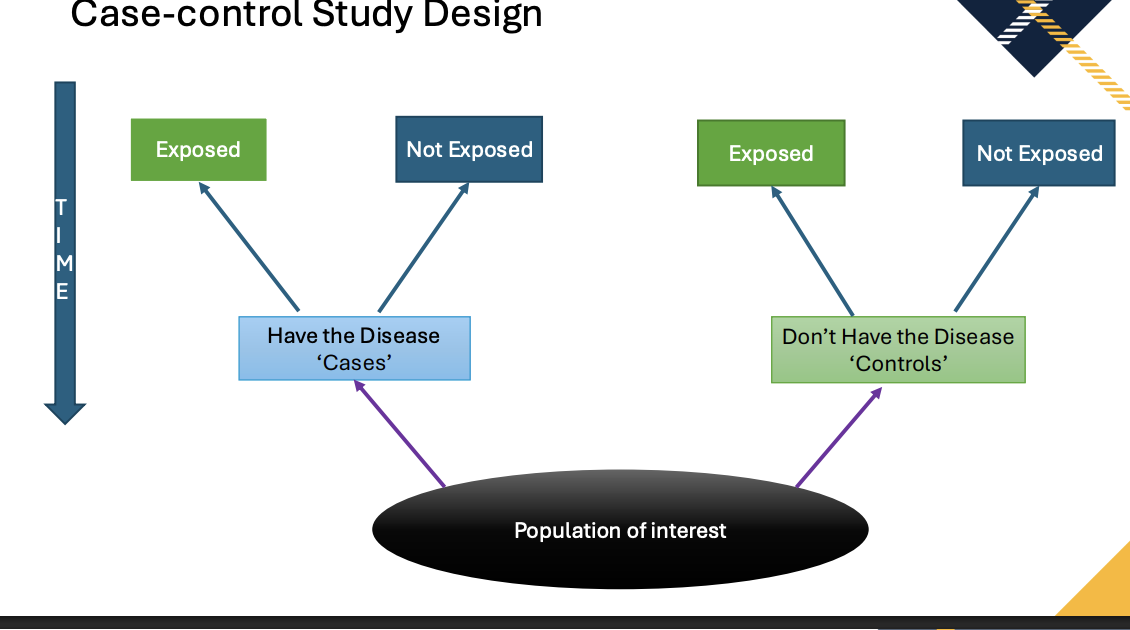
What is a case control study?
A case-control study is a study in which a group of persons with a disease (cases) and a comparison group of persons without the disease (controls) are compared with respect to their history of past exposures to factors of interest
How are the groups chosen and compared in case control studies?
Study population selected on the basis of the presence or absence of the disease or outcome in question
Break participants into two groups:
Cases (with disease)
Controls (without disease)
Groups are compared to determine the presence of specific exposures or risk factors
Use interviews, records, surveys, or assay of biologic specimens to determine past exposures
Selection of Cases
Establish a case definition
Ensure homogeneity of cases
Identify source population from various records
Ensure cases are representative of the general population
Selection of Control
Should stem from the same population as the cases
Meet same inclusion criteria as the cases (minus the disease)
Matching
Each case is paired with control that is similar in demographic and background variables
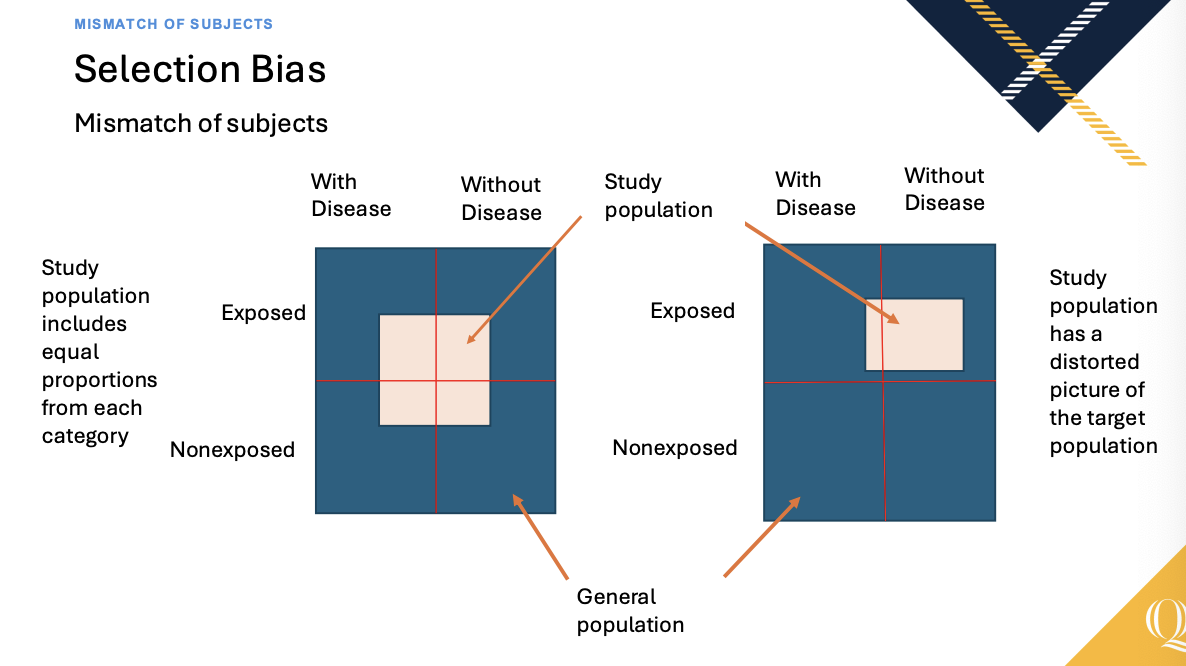
Selection Bias
Mismatch of subjects
Measurement Bias
Error that occurs due to poor measurement (classification) of study variables
Non-differential: misclassification between groups is approximately equal
Differential: misclassification differs between groups
Observer Bias
Error that comes from the process of observing and recording
Recall Bias
Error that occurs when participants have issues with remembering things correctly → self-reporting issues
Confounding Bias
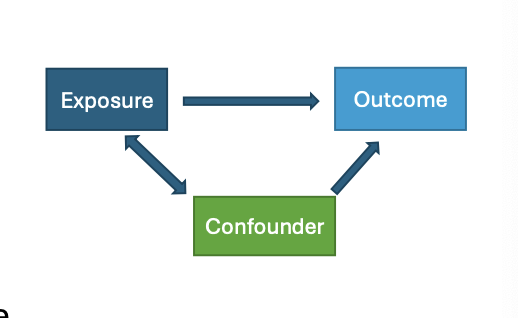
Distortion of the exposure-disease/outcome association
Confusion or mixed effects that were not accounted for
May compete with the exposure of interest in explaining the outcome
Confounder Properties
A confounder must be associated with the exposure under study
Confounder must also be a risk factor for the disease
Confounder cannot be intermediate variable in the causal pathway between the exposure of interest and the disease
If the variable is caused by the exposure → intermediate variable
Ex: smoking → lung disease (intermediate) → lung cancer
If the variable causes both the exposure and the outcome and is not caused by the exposure → confounder
Ex: exposure is coffee drinking, outcome is lung cancer, confounder is smoking
Analysis of a Case Control Study
Odds Ratio
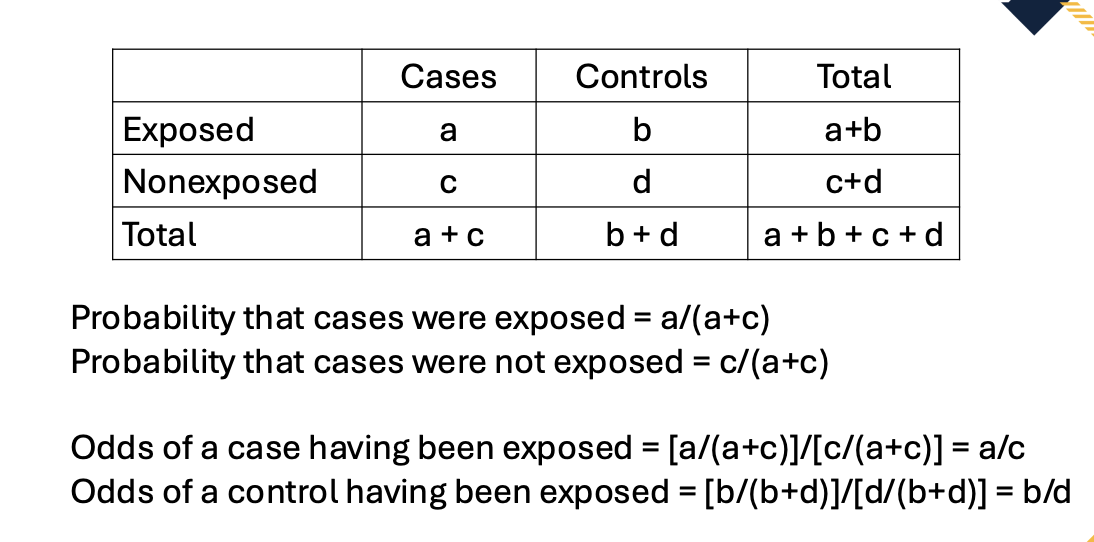
Exposure odds ratio
The ratio of the odds of the exposure among cases divided by the odds of the exposure among the control
(a/c)/(b/d) → ad/bc
Disease odds ratio
The ratio of the odds of disease among the exposed divided by the odds of disease among the non-exposed
Interpretation of Odds Ratio
OR =1 → risk in exposed = risk in non-exposed (no association)
OR > 1 → risk in exposed > risk in non-exposed (positive association)
Larger the OR: stronger the association
OR < 1 → risk in exposed < risk in non-exposed (negative association)
Smaller the OR: larger the association
Advantages of Case Control Studies
Quick and less expensive than prospective cohort studies
If exposures of interest are relatively common, require a much smaller sample size than cohort studies
Minimal ethical issues
Useful for studying rare outcomes or those with long latency periods
Multiple exposures or risk factors can be examined for a single outcome
Disadvantages of Case Control Studies
Not as reliable
Susceptible to biases
Cause and effect
Less useful for rare risk factors
Cannot confirm different levels or types of disease
Control of extraneous variables is limited
Finding comparison groups can be difficult
Cannot determine the rate of disease