SENSATION AND PERCEPTION
 Call Kai
 Learn
Learn Practice Test
 Spaced Repetition
 Match
Match Flashcards
 Knowt Play
1/128

There's no tags or description
Looks like no tags are added yet.
Name | Mastery | Learn | Test | Matching | Spaced | Call with Kai |
|---|
No analytics yet
Send a link to your students to track their progress
129 Terms
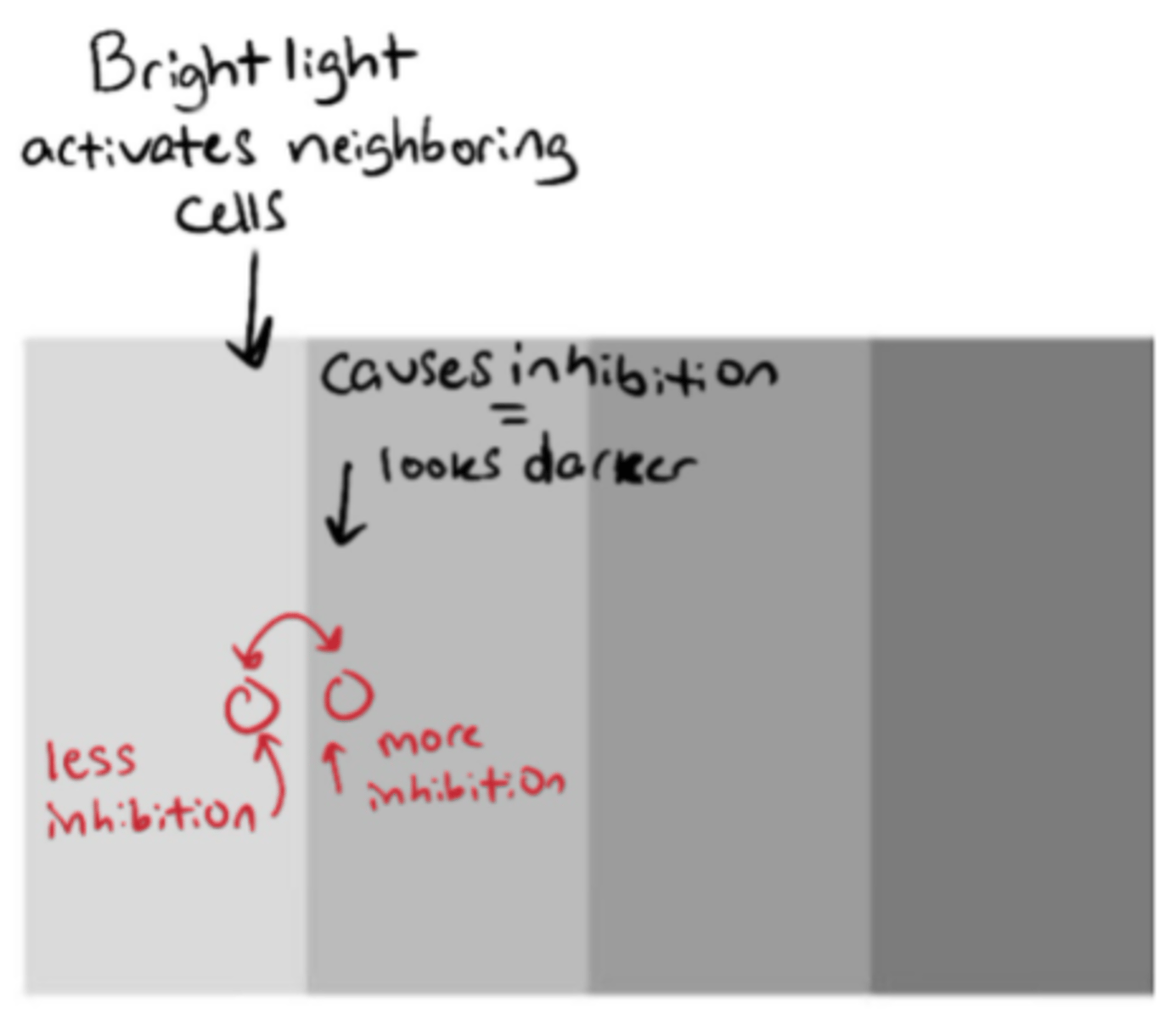
lateral inhibition
the reduction of activity in one neuron by activity in neighboring neurons
Mach bands
illusion caused by lateral inhibition where edges between light and dark look extra bright or extra dark.
wavelength
the distance between the peaks of electromagentic waves (in electromagnetic spectrum range is from short gamma to long radio)
retina
Network of neurons that covers the back of the eye and contains photoreceptors
rod and cone
Rods
Photoreceptors for nighttime/scotopic vision; see in black-and-white, are colorblind, and are mostly found in the periphery.
Cone
Photoreceptors for daytime/photopic vision; allow color vision and better visual acuity. They are mostly found in the fovea. Types: L/red, M/green, S/blue.
optic nerve
the nerve that carries neural impulses from the eye to the brain
macular degeneration
Age-related damage to the macula/fovea that destroys central vision and creates a blind spot when looking directly at something.
Retinitis pigmentosa
A genetic/degenerative condition that damages the peripheral retina, especially the rods, causing loss of peripheral vision and tunnel vision.
blind spot
area in the retina with no photoreceptors wher ethe optic nerve leaves the eye
presbyopia
Age related farsightedness caused by hardening of lens; near vision gets worse because the near point increases with age.
Myopia
nearsightedness: can see near and cannot see far
hyperopia
farsightedness: can see far but cannot see near
bipolar, horizontal, amacrine cells
middle-layer retina cells that help process visual information between photoreceptors and ganglion cells.
Why dim stars are easier to see in the periphery
Dim stars are easier to see off to the side because the periphery has rods, which are better at detecting faint light. The fovea has cones, which need more light.
What is neural convergence?
Neural convergence is when many neurons synapse onto one neuron. This combines signals, which can increase sensitivity but reduce detail. Example: many photoreceptors send signals to fewer ganglion cells in the retina
Hermann grid illusion
grey blobs perceived at the intersections of a white grid on a black background. The grey blobs disappear when looking directly at an intersection. This happens because of lateral inhibition: the intersections receive more surrounding light, causing more inhibition, so they look darker. The spots disappear when you look directly at them because the fovea has smaller receptive fields and sees the area more clearly.
What is a receptive field?
the region of the retina that must receive illumination in order to obtain a response
Center-surround (excitatory vs inhibitory)
A receptive field has an excitatory center and an inhibitory surround. Light in the center increases firing, while stimulation of the surround causes a decrease in firing.
center-surround antagonism
neuron responds best to a spot of light that is the size of the excitatory center. When light becomes large enough to cover the inhibitory surround, it counteracts the center's excitatory response and firing decreases.
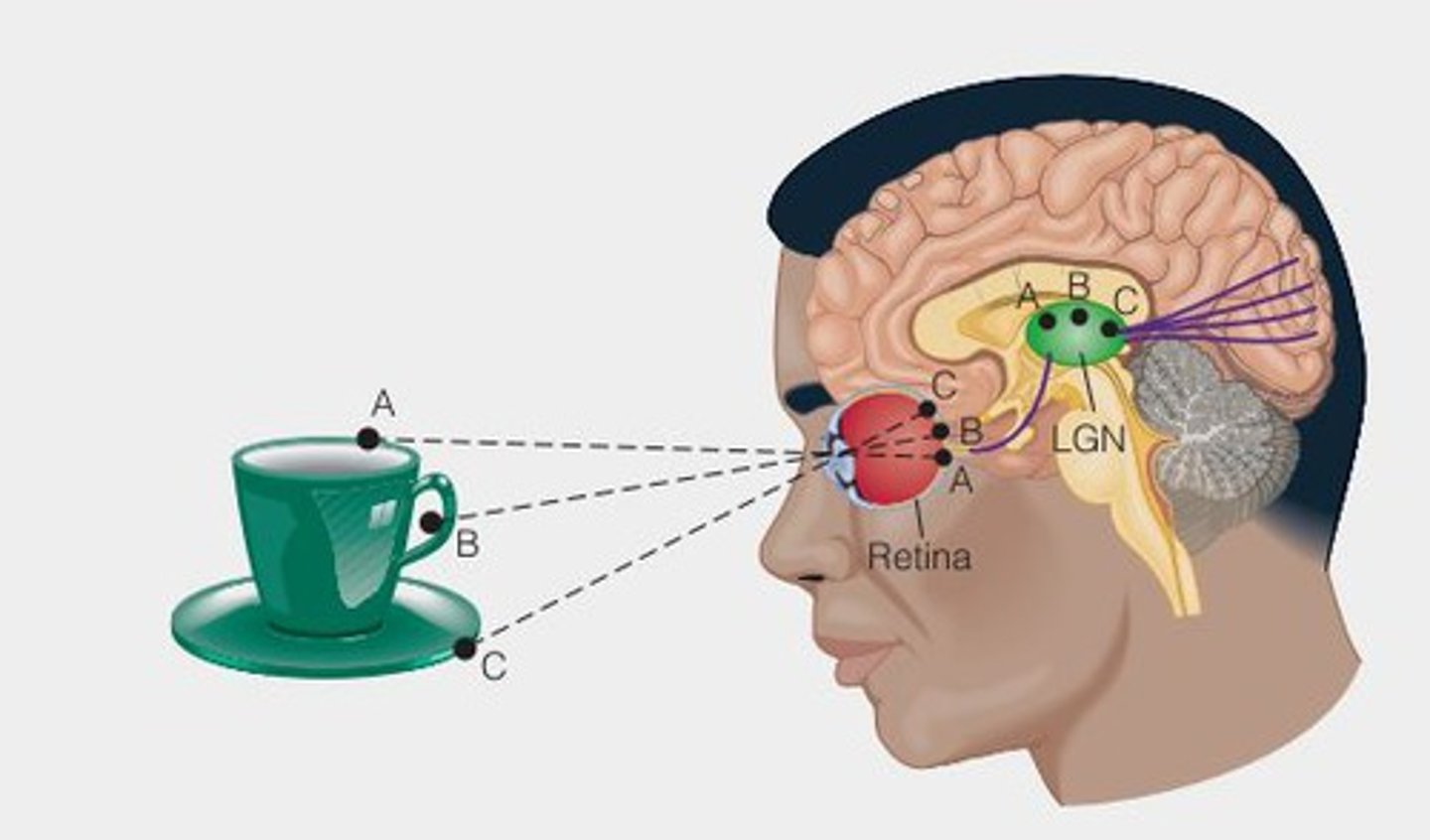
What is LGN (Lateral geniculate nucleus) ?
The LGN is a relay station in the thalamus that receives visual information after the optic chiasm and sends it to V1/primary visual cortex.
Visual information is flipped: the left LGN processes the right visual field, and the right LGN processes the left visual field.
The LGN has 6 layers, keeps information from each eye organized, and separates visual signals into pathways like parvo and magno before sending them to cortex.
superior colliculus
structure involved in controlling eye movements
striate cortex
The visual receiving area of the cortex, located in the occipital lobe where brain prcoesses raw input.
simple cortical cells
cells with side-by-side receptive fields that respond best to a vertical line, bar, or edge
orientation tuning curve
An orientation tuning curve shows how strongly a V1 neuron fires to different line/bar orientations. A neuron fires most for its preferred orientation and fires less as the bar tilts away from that orientation. Different V1 neurons prefer different orientations, helping the brain process edges, shapes, and contours.
inferotemporal cortex
The cortex of the inferior temporal lobe, that respond to complex visual stimuli (shapes, obejcts, faces)
- OBJECT RECOGNITION
sensory coding
how neurons represent environmental charactersitics ex: color, brightness, movement
LANGUAGE NS USES TO TRANSLATE OUTSIDE INTO NEURAL SIGNALS
sensory coding: specifity coding
a single neuron responds to specific stimulus ex. grandmother cell: one neuron fires only when you see a specific face
sensory coding: population coding
large groups of neurons work together to represent complex stimuli ex. color perception(three types of cones), orientation of lines
retinotopic map
the retinal image in the neurons of the primary visual cortex
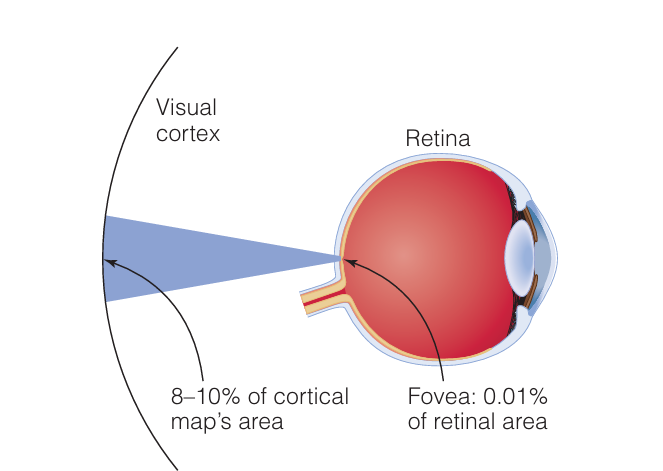
cortical magnification
the large amount of cortical area devoted to a specific region in the visual field (Large area on cortex to small fovea)
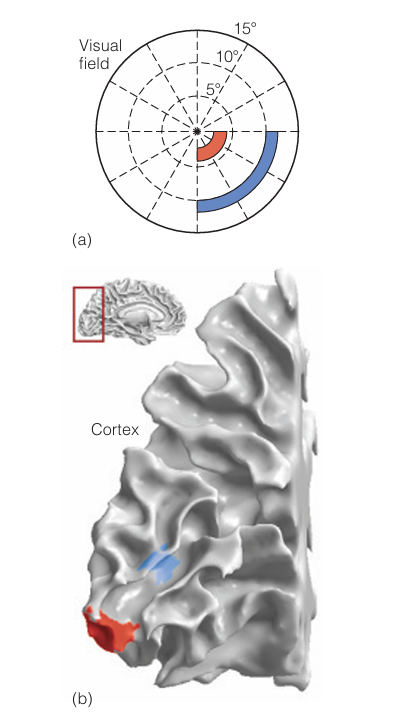
brain imaging (fMRI)
measures changes in blood flow (more active = more blood flow)
Robert Dougherty mapped cortical magnifciation in visual cortex.
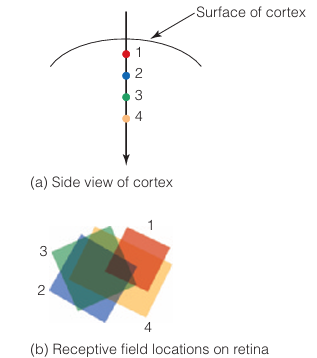
What do location columns in the striate cortex represent?
Neurons that responds to stimuli from the same spot on retina.
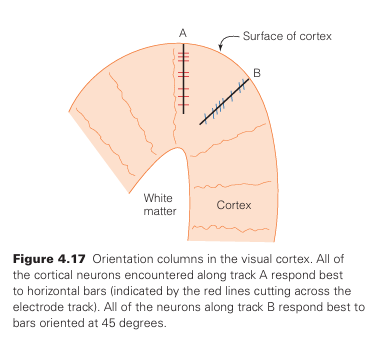
What do orientation columns represent?
Neurons that respond best to a particular line orientation (vertical, diagonal, horizontal) at a spefic retinal location.
What is the what (ventral) pathway?
Pathway from the striate cortex to the temporal lobe that helps you know what an object is
What is the where(dorsal) pathway?
Pathway from the striate cortex to the parietal lobe that helps you know where an object is
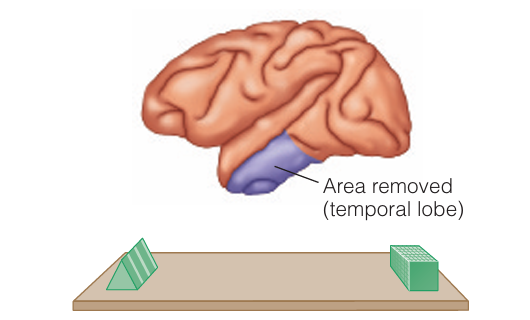
In Ungerleider and Mishkin’s experiment, removing part of the temporal lobe made the ________ discrimination task difficult.
object
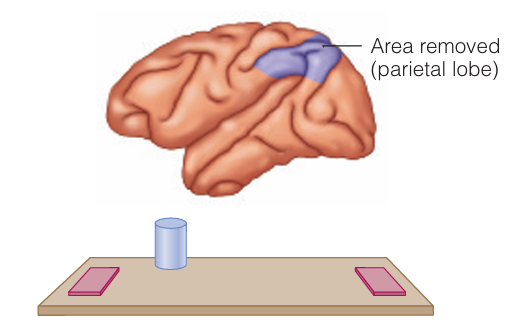
Removing part of the parietal lobe made the ________ discrimination task difficult.
landmark
What is the “what” pathway also called and where is located?
Ventral pathway; located at temporal lobe at upper part of brain
What is the “where” pathway also called and where is located?
Dorsal pathway; located at parietal lobe at lower part of brain
neuropsychology
study of the behavioral effects of brain damage in brains
double dissociations
Two people: In one person damage to one area of the brain causes fucntion A to be absent while function B is present and in other person alternating areas are damaged causing function B to be absent while A is present.
example of double dissociation
ungerleider and miskin monkey study with temportal lobe damage and parietal lobe damage (temporal unable to discriminate objects while parietal unable to disciminate landmarks and vice versa)
how (action) pathway is also called what? and does what?
dorsal stream/pathway: specialized for how an action is carried out
akinetopsia
motion blindness; mother is difficult/impossible to percieve
What information does motion provide about objects?
Motion reveals properties of objects, such as their speed, direction, and structure.
How does motion affect attention
Motion attracts attention by highlighting changes in environment
how does motion help us understand events
motion provides cues about interactions, actions, and intentions in our surroundings
What can motion tell us about speed and direction?
It allows us to judge velocity, heading, and predict impending collisions.
How does motion help distinguish objects?
It separates objects from their background and reveals 3D structure.
What is biological motion?
The ability to interpret movement patterns from living organisms, like walking
What is optic flow?
The visual pattern of movement (blurring, expansion) as we move through environment HELPS GUIDE NAVIAGTION
What is motion parallax?
depth cue where closer objects move faster than distant ones (ex driving in car and looking out of window, fences and stop signs look fast zip by while mountain or the moon barely moves.)
What is the aperture problem?
When viewing motion through a small window, the brain cannot determine true direction without combining signals.
What is the barber pole illusion?
a motion illusion where stripes appear to move upard endlessly because of the context of the shape of the pole
What is apparent motion?
The illusion of continuous movement created by flashing seperate stationary images (in example from lecture: Seems like object is moving right and left but flashing from different position)
What is waterfall illusion?
A motion aftereffect where, after staring at downwrd motion a stationary image appears to move upward. Motion detectors for different directions (up and down)
First you are balanced (staring at nothing), then you see waterfall is moving down so down motion detector fires, gets tired because of firing
then after that image is not moving down detector is tired and responds less UP detector is stronger brain thinks its moving up
What is implied motion
Static images that suggest movement because the activate the mvoement areas in the brain like MT+
Which brain areas process motion?
V1: detects local motion signals
MT: integrates signals into global motion
MST: processes optic flow
STS: interprets biological motion
What happens when MT is damaged?
Akinetopsia (motion blindness)
what is illusory motion?
the perception of motion when stimuli is not moving
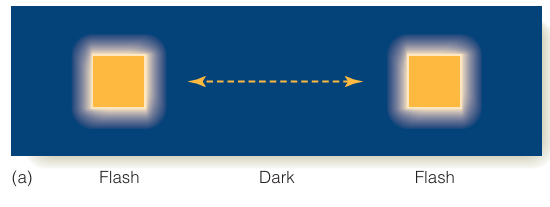
apparent motion is
two stimuli alternate creating the illusion of one stimulus moving back and forth between two locations
induced motion occurs when
motion of one object causes a nearby stationary object to appear to move
motion aftereffects
viewing a moving stimulus causes a stationary stimulus to appear to move
waterfall illusion is also called
Translational Motion Aftereffect
what is the waterfall illusion?
staring at the waterfall going in one direction makes surrounding objects appear as if they are going in opposite direction
optic array
structure created by surfaces, textures, contours of the environment
optic flow
flow of stimuli in environment that creates movement of objects (blurring, expanding, etc)
What does the reichardt detector detect?
local motion (movement from a small part of the visual field)
what does the delay unit do in the reichardt detector model?
slows down signal from A so it matches with B
what does the output unit (directionally selective cell) do?
compares/multiplies signals from A and B ONLY when signals arrive together
Why is the Reichardt detector direction-selective?
It only fires strongly when activation happens in the correct order
A → B produces motion signal, but B → A does not.
what is the aperture problem?
When a neuron views motion through a small receptive field (aperture) it only detects local movement (rightward), makign the actual direction of the motion ambiguous.
How does the brain solve the aperture problem?
Combing signals from multiple neurons to integrate information to gain global motion
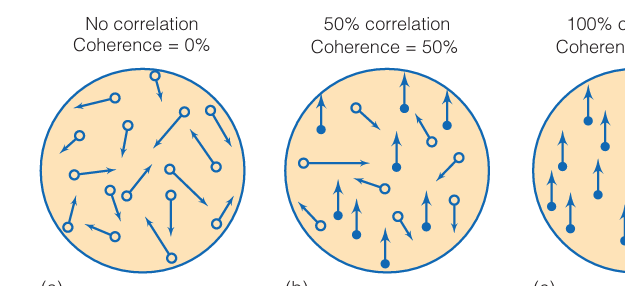
motion coherence
percentage of moving dots/parts are moving in the same direction together.
Middle temporal (MT) area
speicalized for processing information about motion
MT lesioning effects
Motion perception is severely impaired. Monkeys and humans with MT damage struggle to judge direction of movement (monkeys with dot displays). (loss of function)
MT deactivating effects
Temporary disruption of MT activity causes difficulty perceiving motion (temporary impairment)
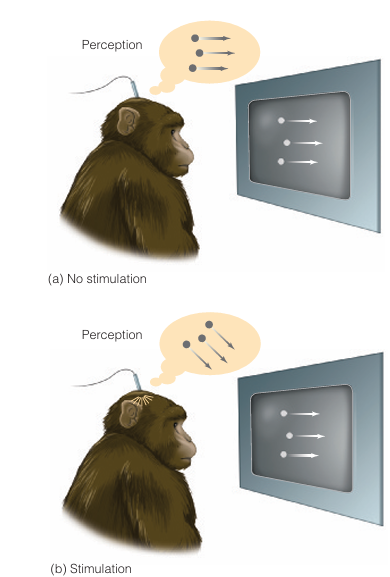
MT stimulating effects
Artificial stimulation biases motion perception. For example, stimulating neurons tuned to “leftward motion” makes subjects report seeing leftward motion even in random dot patterns. (altered/bias perception)
what is the method of TMS (transcranial magnetic stimulation)
temporarily disrupts function of area with magnetic field
What does it mean for a single neuron to only view motion through its receptive field?
The neuron only responds to info within receptive field whihc is small and can only see fragment of of moving object/stimulus. Can make direction ambiguous —> aperture problem , solution—> integrate many neurons in MT
what are point light walkers?
lights placed on the joints of people to film patterns created by lights. movement of these dots creates connection to person moving.
what is biological motion?
ability to interpret movement from biological creatures through stimuli (ex. moving dots)

what is implied motion?
a still picture depicts an action involving motion
What are chromatic colors?
red, green , blue
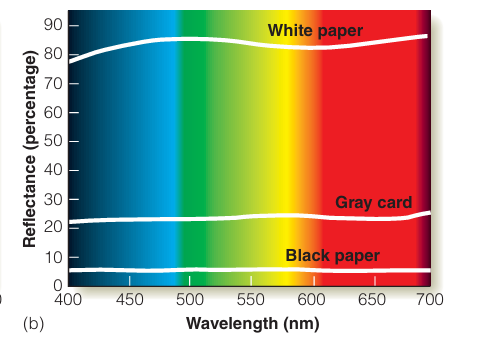
selective reflection
selective reflection
Some wavelengths are reflected more than other and this helps create the color of the object.
what is the difference between reflectance and transmission in color perception?
reflectance: the proportion of light that a surface reflects (color we percieve depends on wavelengths that are reflected) and transmission: the proportion of light that passes through a material, transparent/translucent objects (glass/liquids) transmit certain wavelengths that determine their color
what is reflectance?
proportion of light that a solid SURFACE reflects.
what is transmission?
proportion of light that passes THROUGH a material.
what is color mixing?
happens when different colors combine, and the color you perceive depends on which wavelengths of light reach your eyes.
What type of color mixing is mixing paints?
subtractive
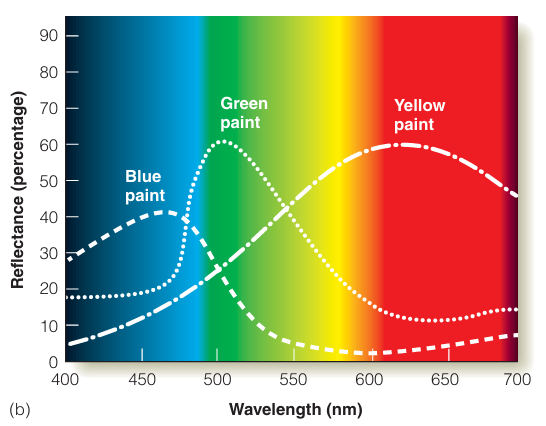
what is subtractive color mixing?
paints absorb wavelengths ex: Blue paint + yellow paint = green, Blue paint and yellow paint each absorb some wavelengths. When mixed, the main wavelengths still reflected in common are medium wavelengths, which we see as green.
Reflectance curve for white, gray, black paper
White: absorbs all, gray: some, black: little to none
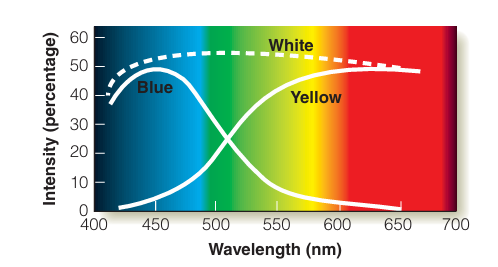
what is additive color mixing?
lights adding wavelength together ex. yellow is mid and long wavelength, blue is short wavelength so alltogether it is white.
Young-Helmholtz theory
trichromatic theory of color vision; we percieve color because of three types of cones: l,m,s red,green,blue
Physiological Evidence for Trichromatic Theory
discovery of three types of cones was made using microspectrophotometry, which made it possible to direct a narrow beam of light into a single cone receptor. By presenting light at wavelengths across the spectrum, it was determined that there were three types of cones
metamers
a pair of lights (or colors) that look identical to the human eye even though they are physically different in their wavelength composition.
ex: pure 580nm and a mix of red and green light appears the same even through ratio is different END PRODUCT IS WHAT MATTERS
What is a monochromat?
A person with only one type of functioning cone receptor (or none). They see the world in shades of gray, have poor visual acuity, and are highly light-sensitive.
What is a dichromat
A person with only two cone types: they can percieve color byt range is limited. Can have protanopia (missing long wavelength) or deuteranopia (missing medium-wavelength cones) or tritanopia (missing short wavelength)