Spontaneous recovery, neurogenesis, and neuroplasticity
 Call Kai
 Learn
Learn Practice Test
 Spaced Repetition
 Match
Match Flashcards
 Knowt Play
 Podcast
1/32

There's no tags or description
Looks like no tags are added yet.
Name | Mastery | Learn | Test | Matching | Spaced | Call with Kai | Chat |
|---|
No analytics yet
Send a link to your students to track their progress
33 Terms
What are the three types of neurons found in mammals? (morphology)
Multipolar neurons
Most motor neurons and CNS neurons are this type
More than 1 process extending from the cell body
Bipolar neurons
2 processes extending from the cell body
found in retinal and olfactory pathways
Pseudounipolar neurons
Make up most sensory neurons
Before afferent nerves enter to the SC via the dorsal root, there is a ganglion
Ganglions are a collection of cell bodies from these psuedonunipolar neurons
1 process extending from cell body that splits into two processes
Which neuron sends info and which receives?
Sending info = presynpatic neuron
Receiving = postsynaptic neuron.
The presynaptic neuron releases neurotransmitters from its axon terminals, which bind to receptors on the dendrites of the postsynaptic neuron, transmitting the signal and conveying the action potential.
Describe the process of the generation of an action potential
The generation of an action potential involves the rapid depolarization of the neuron's membrane due to the influx of sodium ions (Na+$), followed by repolarization through the efflux of potassium ions (K+). This process occurs when the membrane potential reaches a threshold, triggering voltage-gated ion channels to open and initiate the rapid change in electrical potential.
What is the resting potential of a neuron?
-70mV
What is the threshold potential of a neuron?
The minimum membrane potential that must be reached for an action potential to occur is -55mV.
Note that a subthreshold stimuli will not result in an action potential
The speed of an action potential depends on… (3)
The thickness of the axon
Larger diameter = faster propagation
Presence of myelin sheath
Myelin increases propagation speed (saltatory conduction)
Integrity of myelin
eg. MS is a demyelinating disease where previously insulated axons lose their current and speed of AP transmission
Excitatory vs Inhibitory neurotransmitters cause an influx of what ions?
Excitatory neurotransmitters typically cause an influx of sodium ions (Na+), while inhibitory neurotransmitters generally cause an influx of chloride ions (Cl−).
Describe a focal seizure
A focal seizure is a type of seizure that originates in a specific area of the brain, leading to localized symptoms.
These can include motor, sensory, or emotional disturbances, depending on the affected brain region and may or may not lead to loss of consciousness.
What is a seizure?
A seizure is a sudden, uncontrolled electrical disturbance in the brain that causes changes in behaviour, movements, feelings, or consciousness. Seizures can vary greatly in intensity and duration.
What is a primary generalized seizure?
A primary generalized seizure is a type of seizure that involves both hemispheres of the brain from the onset and results in a loss of consciousness.
It is believed to begin in the thalamus of the brain (this is the focal area of the seizure), and the simultaneous electrical signal is sent to all parts of the brain due to the thalamus’ role as the relay centre
What is a secondary generalized seizure
A secondary generalized seizure is a type of seizure that begins as a focal seizure and then spreads to both hemispheres of the brain, leading to a loss of consciousness.
It begins in an area that is closely connected to the thalamus. The electrical signal is sent to the thalamus, which then gets relayed to all other parts of the brain.
The main difference is that the the thalamus is still involved, but it isnt the focal area
Explain what tonic, clonic, grand mal, atonic, and myoclonic all mean
Tonic = tight, frozen posture
The seizure hits the motor strip of the brain, resulting in increased tone and rigidity
Clonic = rhythmic shaking
Clonus is rhythmic movement
Grand mal = mixed - might start in tonic, then move to clonic
it can also be just tonic or just clonic too
Atonic = loss of muscle tone
person is standing, then suddenly collapses due to sudden loss of muscle tone/flaccidity
Myoclonic = jerking/twitching of muscle - idiopathic
What are the three short term mechanisms of spontaneous recovery
The three short-term mechanisms of spontaneous recovery include:
Resolution of diaschisis: The temporary loss of function in areas of the brain connected to the damaged area, which may recover as inflammation decreases.
Edema: Reduction of swelling in the brain after an injury can lead to restoration of function.
Denervation supersensitivity: If nerve connections are lost, remaining connections may become more sensitive, enhancing their responsiveness.
What is neurogenesis
Neurogenesis is the process by which new neurons are formed in the brain, primarily occurring in the hippocampus, amygdala, and lateral walls of the lateral ventricles. This process plays a crucial role in learning, memory, and overall brain plasticity.
/Neural stem cells differentiate into what?
Neuronal progenitor cells
mature and become neurons
Glial progenitor cells
further divide into different types of glial cells (astrocytes and oligodendrocytes)
These cells support the function of neuron cells in the CNS and PNS
What is microglia vs macroglia?
Microglia are the brain's immune cells, responsible for responding to injury and infection, while macroglia include astrocytes and oligodendrocytes, which support neurons and maintain homeostasis.
Microglia = removal of pathogens, contributes to synaptic/dendritic pruning
Macroglia = astrocytes, oligodendrocytes, ependymal cells, and radial glia
Astrocytes provide metabolic support and maintain the blood-brain barrier
Senses neurotransmitter levels in the synapses and releases molecules that directly influence the neurotransmitter activity by providing metabolic support
Oligodendrocytes are responsible for myelinating the nerve cells in the CNS (similar to schwann cells in the PNS)
Ependymal cells produce CSF (found in ventricles)
Radial glia are progenitor cells involved in neurogenesis
Define neuroplasticity
Neuroplasticity is the brain's ability to reorganize itself by forming new neural connections throughout life. This process allows the brain to adapt to new experiences, learn from injuries, and recover from trauma.
It is the mechanism by which the brain encodes experience and learns new behaviours. It is also the mechanism by which the damaged brain relearns lost behaviour in response to rehabilitation.
“Either functional or structural changes that occur in the adult brain in order to adjust to perturbations in the external environment or internal milieu… The extent of plastic reorganization is conditional on the relevance of the alterations for the individual, and can either result in beneficial or maladaptive behavioural consequences…
The functional/structural changes that occur in the adult brain can occur at what three levels?
Chemical
Structural
Functional
Neuroplasticity is dependent on what?
Experience
the more relevant the experience is to the individual, the more likely it will result in a change
Eg. If there's a type of smell in the environment
You'll habituate to the smell if you live in that space - this is neuroplasticity
Eg. Internal pain - such as a hangnail
You habituate to it the rest of the day (unconcerned)
More attuned to other types of pain though if you are cognitively concerned with it
Internal milieu - internal being (how you feel about things)
What does it mean to say that neurplasticity can either result in beneficial or maladaptice behavioural consequences?
It means that changes in the brain due to neuroplasticity can lead to positive outcomes, such as improved skills or recovery from injury, or negative outcomes, such as maladaptive behaviours or reinforcing harmful habits.
It can strengthen both desirable and undesirable habits (eg. requiring certain substances to function is a result of neurplasticity)
But this means there are opportunities to promote beneficial changes via therapeutic techniques (fake it till you make it = neuroplasticity therapy that can result in more permanent changes! - This works by triggering positive neurons that lead to positive emotions)
How does neuroplasticity occur chemically? In other words, what is chemical plasticity?
Refers to the increased/decreased frequency of action potentials that lead to active or dormant synapses - relates to neurotransmitters and receptors
This affects:
the efficiency of ion exchange
the number of neurotransmitters released
the number of receptors on the postsynaptic neuron
How does neuroplasticity occur structurally? In other words, what is structural plasticity?
Aka. dendritic and axonal plasticity
Dendritic plasticity: changes in the number of dendrites and spines
More dendrites = dendritic arborization/sprouting
less dendrites = dendritic pruning (enabled by microglia)
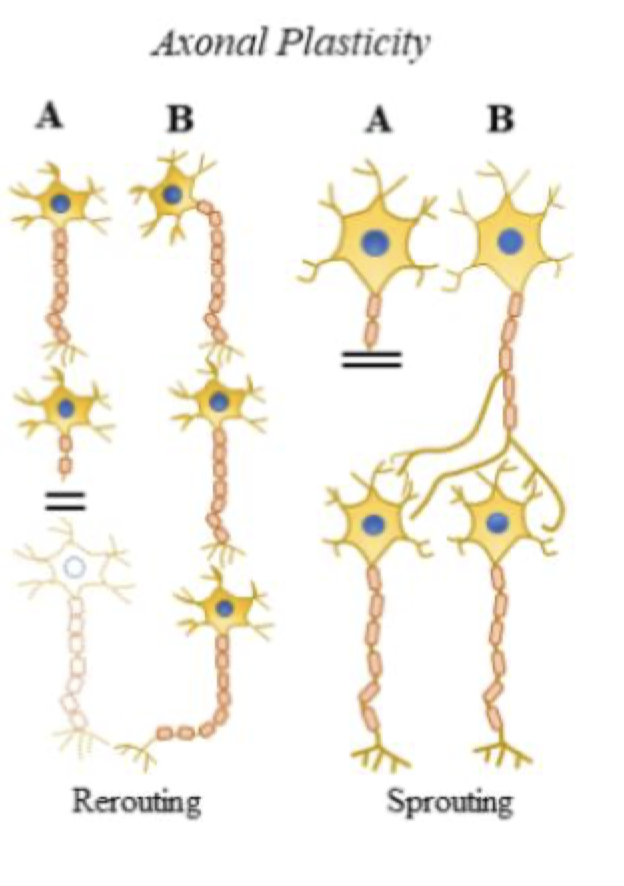
Axonal plasticity: rerouting or sprouting of new axons to neurons that are not innervated
What is synaptogenesis?
The formation of new synapses between neurons, crucial for learning and memory.
How does neuroplasticity occur functionally? In other words, what is functional plasticity?
Aka. topographical re-mapping, cortical re-mapping, or vicariation
An intact cortical area takes on a function previously performed by the lesioned area
The ability of different brain regions to take on new functions or compensate for damaged areas. It involves the reorganization of existing neural pathways to improve function.
Neural and behavioural events interact
What is “experience-dependent synaptic potentiation”?
A process where synapses increase their strength and efficiency in response to activity and experience, enhancing learning and memory. Simultaneous activation of neurons increases synaptic strength, forming stronger neural connections
“Neurons that fire together, wire together.”
What is an example of experience-dependent synaptic potentiation?
Example: Learning to feel your phone vibrate
At first, your phone vibrates randomly throughout the day.
Each time it happens, you feel the vibration and then look at your phone to read a message.
Two groups of neurons are active together:
Touch/vibration sensation
Attention + expectation of a message
Because these neurons fire at the same time repeatedly, their connection strengthens.
What happens over time
Eventually, even a slight sensation (or sometimes no vibration at all) can make you think your phone buzzed.
Your brain has “wired together” the sensation and the expectation.
What’s going on in the brain
Repeated pairing → stronger synapse (experience-dependent potentiation)
Stronger synapse → easier activation in the future
Easier activation → faster, sometimes automatic responses
Describe short-term potentiation
When there is increased firing of action potentials, short-term improvements in the efficiency of firing action potentials are observed temporarily (occurs at the chemical level)
STP is achieved through the temporal enhancement of a synaptic connection, which then quickly decays to its initial state
This enhancement lasts for 20-40 minutes
After you do something repeatedly, the increase in neurotransmitter release and uptake results in a short-lived strengthening of synaptic transmission, leading to temporary increased signalling between neurons.
Does this persist to long-term potentiation?
What is long-term potentiation?
Synaptic, dendritic, and axonal plasticity remain for much longer durations than STP. Structural and functional changes have occurred
Persistent firing and strengthening of synapses during STP lead to long-lasting synaptic, dendritic, and axonal plasticity.
Repeated stimulation from STP causes a PERMANENT change in the connection to achieve LTP
think sustained memories, learning, skill acquisition
The more APs, the more likely it becomes permanent
How does this theory of neuroplasticity correlate with CIMT?
CIMT encourages the use of an affected limb, which enhances synaptic connections and promotes functional recovery by activating neuroplastic processes.
Repetitive, structured task performance with the affected UE, with restraint of the unaffected UE, results in changes in the motor cortex by acquisition of new motor skills
Why must CIMT candidates have 20 degrees active wrist extension and 10 degrees of active finger extension?
If they don’t have enough ROM, they will use compensatory movements to perform tasks, which hinders the targeted use of the affected limb and may prevent effective neuroplastic changes.
What are the goals of CIMT?
To minimize learned non-use
To have new synaptic connections occur
To reorganize adjacent cortical areas
To optimize the use of undamaged contralateral areas
What factors impact neural recovery?
Age/brain development
If an injury occurs in an area of the brain that is well developed and functionally mature, the injury will cause the same problems in adults and children
If a fully developed brain area is injured → kids and adults show similar problems.
If an injury occurs in an area of the brain that is well developed and functionally mature, but is related/adjacent to areas that are not fully mature, immature areas may assume function of injured areas (topographical reorganization)
If nearby areas are still developing → a child’s brain may adapt and shift functions (topographical reorganization).
If an injury occurs in an area that is not fully developed/mature, and no other area is available to assume function during normal maturation
Injured areas may develop and recover fully…OR
Injured areas may appear fully recovered, and difficulties may not be seen in infancy, but may be seen in adulthood (this emphasizes the importance of understanding medical history)
If the injured area isn’t developed yet →
the brain may recover well, or
problems may appear later when that skill is needed.
Lesion
Size
Small lesions (and superficial lesions) have a greater chance of full recovery than large
Depth
involvement of superificial vs deeper structures
Area
Some areas have increased circulation, some have decreased circulation
More circulation is better recovery
Speed of development
Slow developing lesion can result in less functional loss
How do people end up developing tumours the size of baseballs without noticing?
Tumour grows at a rate in which as it starts to compress on the surrounding tissue, other neurons are able to compensate and rewire such that the person doesn't notice that there's a change
Duration and severity of the ischemic attack
The longer someone is having a lack of oxygen and blood to the brain, the more detrimental the effects will be
Anything longer than 2 minutes can have severe and permanent damage
Environment
enriching environments facilitate stimulation and recovery
How much can someone recover in the confines of a stable and predictable hospital environment
Timing of treatment
We should start therapy after a lesion, but not too soon
Other
social support, financial support, emotional health, client ability to participate in activities (cognitive, emotional, and physical barriers)
What are the 10 principles of plasticity?
Use it or lose it
If you don’t use a skill or brain pathway, it weakens over time.
Use it and improve it
The more you practice something, the stronger those brain connections get.
Specificity
You improve what you practice.
👉 Practicing piano helps piano skills—not basketball.
Repetition matters
You need a lot of practice to create lasting brain changes.
Intensity matters
Practice has to be challenging enough to make a difference.
Time matters
When you train or rehab matters—there are better windows for change, especially after injury.
Salience matters
The activity has to be meaningful or important to you for your brain to really change.
Age matters
Younger brains are generally more flexible, but adults can still change too.
Transference
Training one skill can help improve related skills.
Interference
Learning one thing can sometimes get in the way of learning something else.