ABHP Part 2 Concepts
 Call Kai
 Learn
Learn Practice Test
 Spaced Repetition
 Match
Match Flashcards
 Knowt Play
1/222

There's no tags or description
Looks like no tags are added yet.
Name | Mastery | Learn | Test | Matching | Spaced | Call with Kai |
|---|
No analytics yet
Send a link to your students to track their progress
223 Terms
Mechanisms by which tritium is produced in nuclear reactors.
Ternary fission of uranium
Neutron capture reactions with boron and lithium
Activation of deuterium in water
High-energy neutron capture reactions with structural materials
Protective Action Guides (PAG) Definition
PAGs offer guidance for protective actions in emergencies, not strict numeric criteria, focusing on context-specific factors.
What are the assumptions for using the Gaussian function for radioactive airborne release?
Continuous point source
Weather conditions do not vary over time or location.
Wind velocity is constant.
The released material behaves as particulates.
The terrain is flat.
Based on the Protective Action Guidelines (PAGs) by Environmental Protection Agency, who, among the following, should receive KI based on a projected thyroid dose of 5 cGy? Explain.
a. 10 year old middle school student
b. Pregnant school teacher
c. 25 year old female volunteer teacher
d. 60 year old male teacher
e. One month infant
a, b, e
List two properties of Cs-137 that makes it an important radionuclide of concern from a soil contamination perspective.
Long half-life of about 30 years.
Emits gamma radiation, which is penetrating and detectable.Can accumulate in living organisms.
Highly soluble in water which makes it easy to bind and cycle through the food chains
What are three major environmental transport mechanisms for cesium?
Leaching through the soil layers
Root uptake by plants
Soil erosion and surface runoff
Besides contamination levels, what factors influence soil cleanup decisions?
Land use, remediation feasibility, regulations, and cost.
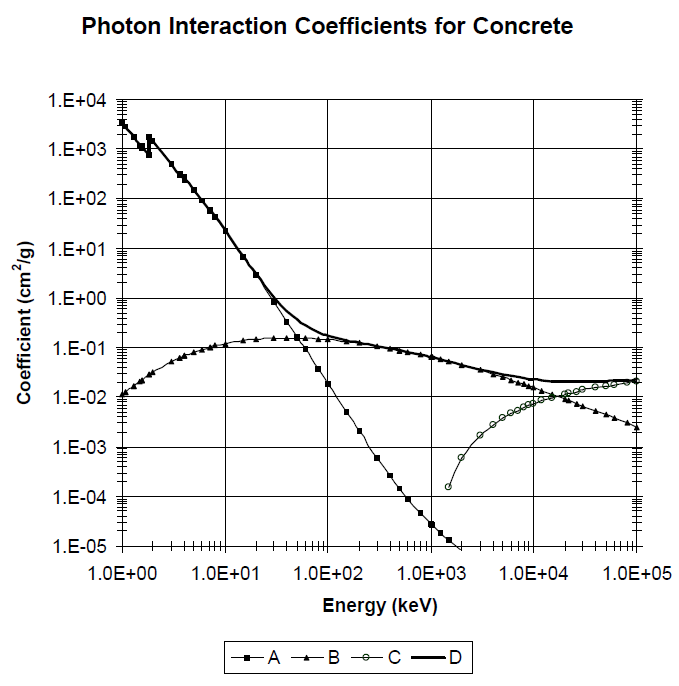
Name the interaction coefficient that each of the curves (A, B, C, D) represents. Be sure that you indicate the proper name for the interaction coefficient.
Curve A: Photoelectric effect mass attenuation coefficient
Curve B: Compton scatter mass attenuation coefficient
Curve C: Pair production mass attenuation coefficient
Curve D: Total mass attenuation coefficient
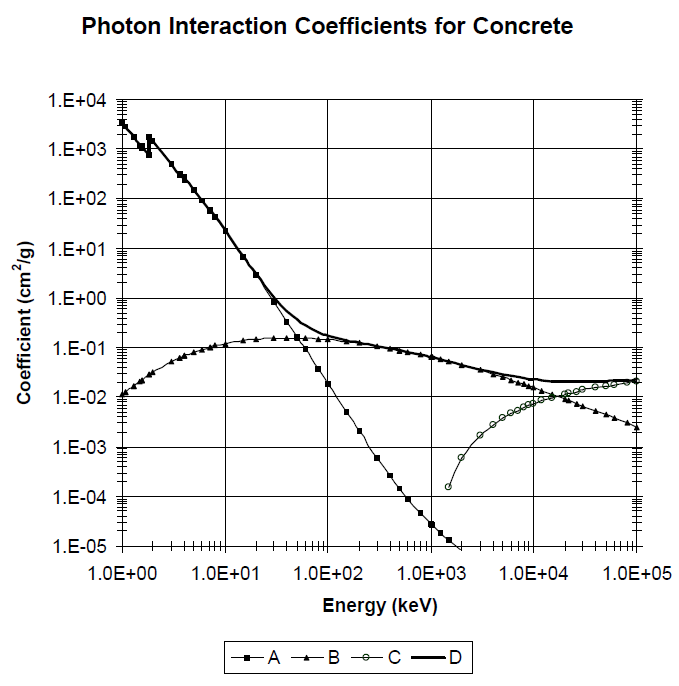
For curve A, explain why there is a sharp increase in the curve at about 2 keV.
At approximately 2 keV, there is a sharp increase in curve A due to the photoelectric effect becoming more dominant, as this energy range corresponds to the binding energy of inner-shell electrons in atoms. This results in a significantly higher probability of photon absorption and electron ejection, leading to increased attenuation.
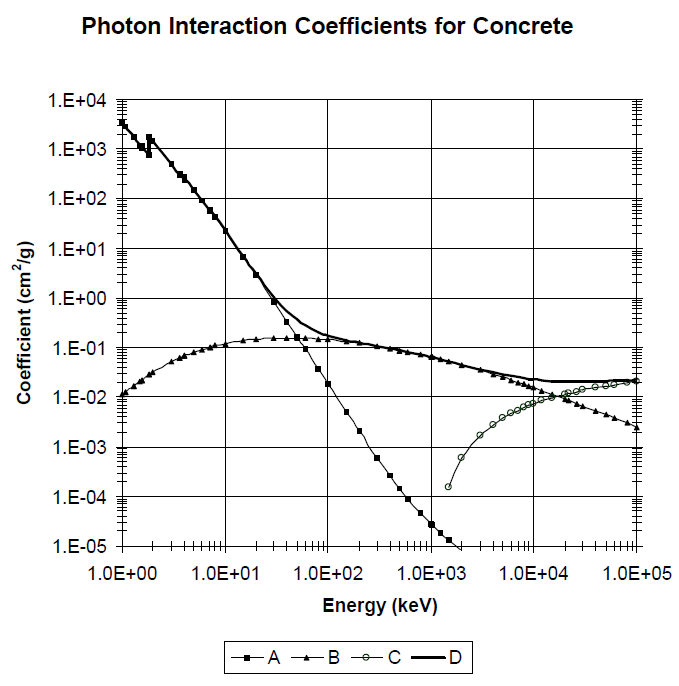
For curve C, describe the process involved and explain why the curve does not exist below approximately 1.02 MeV.
Curve C represents pair production, this process cannot occur below 1.02 MeV because that is the minimum energy required to create the mass of the electron-positron pair.
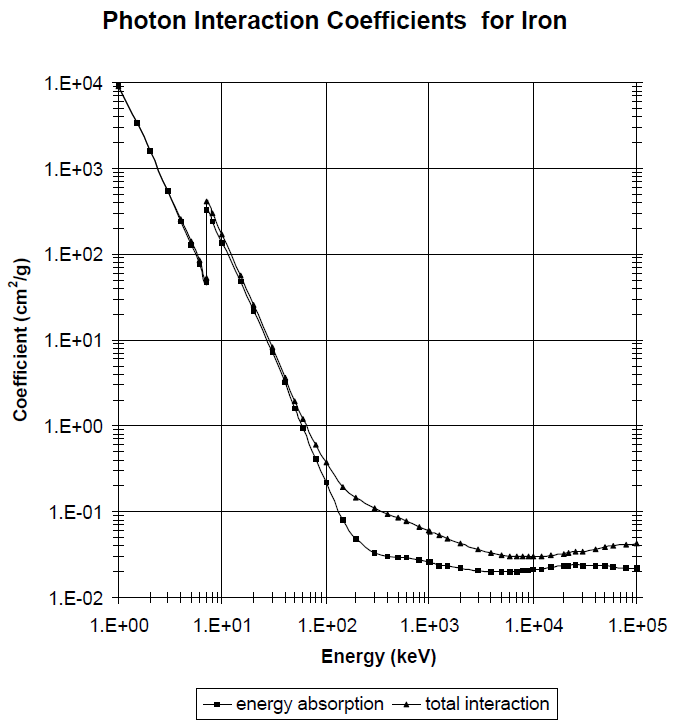
Explain why the two curves in Fig. 4.2 are very similar below 50 keV.
For lower energies, the total attenuation coefficient is almost identical to the photoelectric attenuation coefficient. Compton scattering contributes very little, and pair production is not possible below 1.02 MeV.
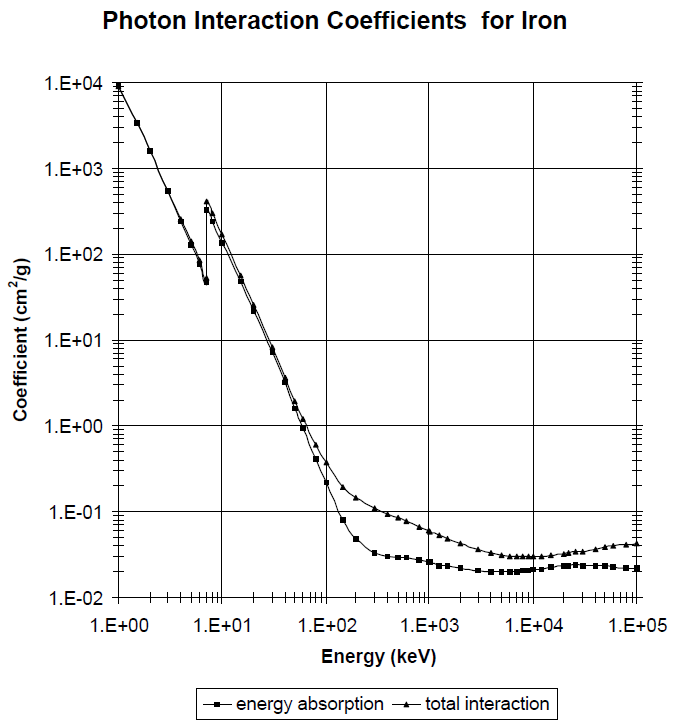
Explain why the two curves in Fig. 4.2 are different above 50 keV. Include a discussion of region in both curves.
Above 50 keV, the photons are no longer exclusively interacting with the matter via photoelectric effect. The total mass attenuation coefficient now includes the effects due to Compton scattering (dominant over 200 keV) and pair production (possible above 1.02 MeV; dominant above ~10 MeV).
List four symptoms that you would expect in a person exposed to a 2-Gy acute whole body dose without medical intervention.
Symptoms may include nausea, vomiting, fatigue, low white blood count, and hematopoietic syndrome.
Identify six factors that affect a tissue’s response to ionizing radiation.
Physical factors: 1) dose 2) dose-rate, 3) type of radiation
LET Biological factors: 4) age, 5) sex, 6) Circadian cycle during irradiation, 7) cell-cycle phase, 8) presence of oxygen, 9) mitotic rate of cells, 10) specialization of cell, etc.
Oxygen Enhancement Ratio (OER)
The ratio of dose without oxygen to the dose with oxygen needed to achieve the same effect.
Why may tritium air-sample and urine-bioassay doses differ?
Breathing-zone differences, monitor interference, tritium form assumptions, non-equilibrium urine samples, and individual metabolism.
Compare tritium air monitoring methods.
Flow-through Ionization chambers: real-time, less sensitive
Tritium bubbler: sensitive, not-real timeUse of desiccant media: relatively accurate, slow/not real-time
Assume an I-131 patient cannot be treated as an outpatient. State two restrictions that would allow you to release her from the hospital.
The Total Effective Dose Equivalent is not likely to exceed 500 mrem to any other individual
Written instructions shall be provided if the Total Effective Dose Equivalent is likely to exceed 100 mrem
What additional instructions for a released/outpatient I-131, if any, would you provide if the patient had:
A 15 month old child at home?
A 15 year old child at home?
Additional instruction would include guidance on the interruption or discontinuation of breast-feeding and information on the potential consequences of failure to follow the guidance.
No special instructions are required other than those mentioned above.
Calculations show an I-131 patient can be released as an outpatient. What three general requirements could you apply to minimize dose to members of her family?
Minimize time in proximity to family members.
Maintain distance from other person, including separate sleeping arrangements.
Take precautions to reduce spread of contamination, to include but not limited to, exclusive-use bathroom, sharing same bedding, towels, eating utensils, etc.
Based on the fetal dose estimate of 21.7 rad that you calculated, what are the risks to the unborn child?
NCRP Report 174, Preconception and Prenatal Radiation Exposure: Health Effects and Protective Guidance, provides detailed examination of the risks to the fetus from ionization radiation exposures.
No lethal effects are expected for 6-13 weeks post conception. LD50 > 2 Gy (200 rad)
Growth retardation is possible at 0.25-0.5 Gy (25-50 rad) for 6-13 weeks post conception but such effects are a low probability.
Actions to reduce or eliminate exposure to a fetus for a pregnant patient
Consider alternatives to x-ray imaging, such as ultrasound or MRI.
Use the lowest effective radiation dose if x-ray is necessary.
Minimize use of fluoroscopy and utilize lower intensity or pulsed approach to minimize exposure.
Limit the area exposed to radiation by employing shielding techniques.
Collimate the beam to reduce size of the effective area
As the RSO for the facility, list three other actions or notifications you should recommend if an emergency room patient has x-rays and fluoroscopy procedures done.
Notify the patient's physician about the potential fetal exposure risks.
Report the exposure incident to the appropriate regulatory body or personnel within the facility.
Document the radiation dose received and any pertinent information.
Train hospital personnel on the importance of questions about pregnancy or testing for non-emergency situations prior to diagnostic exposure.
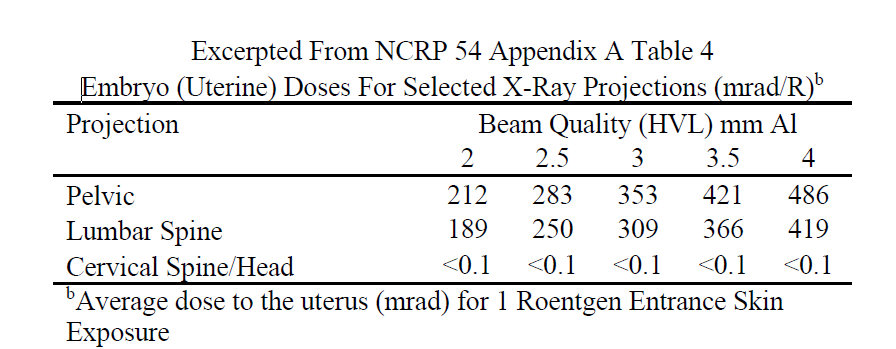
Explain why the ratio of uterus dose to ESE increases as the HVL increases (as shown in NCRP 54 Table 4).
As the half-value layer (HVL) increases, less radiation is attenuated by the patient, leading to a higher dose of radiation being absorbed by the uterus relative to the entrance skin exposure (ESE), which results in an increased ratio.
List four factors that may influence plant uptake of uranium.
Soil chemistry
Plant species
Uranium chemical form
Environmental condition
List five possible exposure pathways from an Uranium mill site
Inhalation and ingestion of airborne dust.
Ingestion of contaminated ground water.
Ingestion of contaminated plants grown in contaminated soil.
Consumption of milk and meat from animals that inhale and ingest dust
Consumption of milk and meat from animals that feed on contaminated vegetation or plants grown in contaminated soil.
Your organization is offering bioassay monitoring to residents concerned about their internal exposure from a uranium mill site. List two methods of determining the concentration of uranium in the body, and an advantage and disadvantage of each method.
Urine bioassay: A non-invasive method to measure uranium concentration through urine samples. Advantage: Easy to collect and analyze. Disadvantage: May not reflect long-term body burden due to excretion variability.
Fecal Analysis: A method to measure uranium concentration by analyzing fecal matter.
Advantage: Can provide information on recent exposure levels.
Disadvantage: Requires careful collection and may be less convenient for individuals.In vivo monitoring: A method that involves using direct measurement techniques, such as gamma spectroscopy, to assess uranium concentration in the body.
Advantage: Has higher MDA compared to urine and fecal.
Disadvantage: Requires the individual to be present for on-site counting
Define DAC
The maximum allowable concentration of airborne radioactive material in air for reference man, doing light work, for 2000 hours which results in an intake of one Annual Limit of Intake.
List six conditions that could affect the accuracy of ion chamber measurements
Temperature
Pressure
Humidity
Electromagnetic Interference
Uniformity of radiation field
Degradation of ion chamber electronic components
You are the Senior Health Physicist at a commercial nuclear power plant. Plant management is considering a new demineralizer system and you are tasked with performing the radiological design review and ALARA evaluation.
Name four documents (i.e. Federal Regulations, facility documents, etc.) that will be needed to perform this evaluation.
Radiation Work Permits (RWPs)
Pertaining regulations such as 10 CFR 20 and 10 CFR 50
Technical specifications, and system design descriptions
ALARA Program, and previous ALARA evaluations
List and describe four items that you should consider when evaluating the demineralizer system at a commercial nuclear power plant from an ALARA perspective.
The contamination levels and dose rates on the demineralizer system
Estimated work load (person-hours)
Shielding and PPEs
Contamination monitors
Methods to minimize exposure to personnel during maintenance of the demin at a commercial nuclear power plant.
Use of remote handling techniques to reduce direct exposure.
Scheduling maintenance during low operation periods to limit personnel exposure.
Implementation of time restrictions on tasks to minimize duration of exposure.
Utilization of appropriate shielding to protect personnel during maintenance activities.
Use mockups to train individuals to become more proficient to reduce time spent near the source.
What do the letters AMAD stand for?
Activity Median Aerodynamic Diameter
Briefly describe the dosimetric significance of AMAD.
Refers to the particle size distribution of aerosolized radioactive materials. It is significant in dosimetry as it helps predict the deposition and absorption of particles in the respiratory system, influencing radiation dose estimates.
What are the Emergency Classifications established by the US NRC for grouping off-normal events or conditions at nuclear power plants? List them in ascending order of severity.
Unusual Event 2. Alert 3. Site Area Emergency 4. General Emergency
What type of sampling medium(s) would be needed to determine radioiodine concentration independently of noble gas concentration?
Appropriate inorganic absorbed medium is needed to reduce adsorption of noble gases relative to radioiodine. Media such as silver zeolite and silver alumina have higher rejection efficiency for noble gases and higher retention efficiency for radioiodines. Media such as activated charcoal, while efficient at collecting radioiodine, also collect noble gases, so are not appropriate.
What type of exposure is most important in a noble gas plume?
External exposure from immersion in the plume.
I-131 reactor accident: key pathway?
Food chain ingestion, especially milk.
How can KI be utilized and how does it help?
Potassium iodide (KI) is administered orally to saturate the thyroid with stable iodine, thereby blocking uptake of radioactive iodine such as I-131. This reduces thyroid dose and subsequent cancer risk. It is most effective when taken prior to or shortly after exposure and provides protection only to the thyroid.
According to the Protective Action Guidelines by the Environmental Protection Agency, what groups of individuals would be prescribed KI at a postulated thyroid dose of 5 rem?
According to the PAG, the intervention threshold of postulated thyroid dose of 5 rem applies to 1) pregnant and lactating women, and 2) infants, children and adolescent (birth – 18 years old)
According to NCRP 165, what dose is used as a decision point for emergency responders during lifesaving operations?
50 rad (0.5 Gy) cumulative absorbed dose.
Not a dose limit—a decision point where the Incident Commander determines whether responders continue or withdraw.
The facility owner is contemplating a design goal of 0.1 mrem/hour for the office area across the hallway. Provide your justification as to why that is or is not appropriate.
The 0.1 mrem/hour design goal is not appropriate for a permanently occupied space for individuals who are not radiologically monitored. The average worker works approximately 2,000 hours per year and with a design goal of 0.1 mrem/hour would result in 200 mrem per year which is greater than the 10 CFR 20.1301 dose limits for individual members of the public of 0.1 rem in any one year.
The population groups that contributed to the development of risk models from external, whole body radiation to humans:
Life span survivor study (Atomic Bomb Survivors)
Medical worker studies after exposure to x-rays (early studies, typically pre-1940)
Define Relative Risk
The ratio of the probability of an event occurring in the exposed group to that occurring in non-exposed group.
Define Excess Risk
The portion of the RR accounted for by the particular risk factor under study, and is given as RR-1.
Define Attributable Risk
The risk of a specified health effect assumed to result from a specified exposure.
What is the criteria for tubehead leakage for diagnostic x-ray machines?
For x-ray therapy equipment operating below 500 kV, NCRP 15, Structural Shielding Design and Evaluation, permits leakage air kerma up to 10 mGy in any 1 hour at 1 m from the equipment.
Why may a detector calibrated to Cs-137 give inaccurate readings for 50 kVp x-rays?
Energy dependence—instrument calibrated at 662 keV may not respond accurately at ~15–20 keV.
What type of dosimetry is required for low-energy x-ray applications?
Dosimeters calibrated for low-energy photon response (not just Cs-137)
What is a key limitation of ion chambers when measuring low-energy x-rays?
Their response may be inaccurate if not calibrated or corrected for low-energy photon fields.
Why must detector energy response be verified before use?
Different photon energies interact differently, affecting detector accuracy.
Why might EPDs underestimate dose in low-energy x-ray fields?
Because they are often optimized for higher-energy photons and may not detect low-energy radiation effectively.
What is a key dosimetry challenge with low-energy x-rays?
Limited penetration and strong energy dependence.
What does DAC stand for?
Derived Air Concentration
What is the primary radiation emitted by Am-241?
Alpha particles with a 60 keV gamma photon.
Why is Pu-239 a criticality concern?
It is fissile.
Why is I-131 especially hazardous to children?
High thyroid uptake and increased radiosensitivity.
What is the critical exposure pathway for I-131 following reactor accidents?
Milk ingestion
What radionuclide is commonly associated with long-term environmental contamination after reactor accidents?
Cs-137.
What is the principal gamma energy of Cs-137?
662 keV
What radionuclide emits two major gammas near 1.2–1.3 MeV?
Co-60
What are the principal gamma energies of Co-60?
1173 keV and 1332 keV
What is the principal gamma energy of Tc-99m?
140 keV
What is the principal gamma energy of Tc-99m?
140 keV
Why is HT less hazardous than HTO?
HT is poorly absorbed and largely exhaled
What radionuclide is commonly associated with low-energy x-ray calibration?
Fe-55
When should thyroid bioassay for I-131 typically be performed?
about 24 hours after intake
What are the advantages of direct thyroid counting?
Noninvasive, rapid, repeatable, and directly measures thyroid uptake
Why is thyroid counting for I-131 performed near 24 hours after intake?
Thyroid uptake is near maximum around 24 hours after intake.
What confidence level is associated with 1.645?
One-sided 95% confidence (5% Type I error).
What is a Type I error in radiation detection?
False positive—detecting activity when none exists
What is a Type II error in radiation detection?
False negative—failing to detect real activity.
Why does low background improve bioassay sensitivity?
Smaller statistical fluctuations make weak signals easier to detect.
What is the simplified conceptual form of the critical level equation?
LC ≈ 1.645√B
What statistical relationship governs radiation counting uncertainty?
σ = Sqrt(N)
What confidence level is associated with 1.645?
One-sided 95% confidence (5% Type I error).
Used for a one-tailed 95% confidence level
1.645
What z-score is commonly used for 99% confidence?
2.58
What confidence level is associated with 2.58?
99% confidence.
What statistical distribution is commonly assumed in counting statistics?
Poisson distribution
What is the practical meaning of a 5% Type I error?
There is a 5% probability of concluding activity is present when it is not.
What happens to the Type II contribution when β = 50%?
The Type II z-score becomes zero, so the detection limit equals the critical level.
What happens to the Type II contribution when β = 50%?
The Type II z-score becomes zero, so the detection limit equals the critical level.
How can I-131 be selectively collected in the presence of Xe-133?
Use silver-impregnated media to adsorb iodine while noble gases pass through.
What tissue depth is used for shallow dose equivalent (SDE)?
7 mg/cm²
What tissue depth is used for lens dose equivalent (LDE)?
300 mg/cm²
What tissue depth is used for deep dose equivalent (DDE)?
1000 mg/cm²
What is one advantage of OSL dosimeters?
They can be reread multiple times
What type of detector material is commonly used in OSL dosimeters?
Aluminum oxide (Al2O3)
What happens to electrons during irradiation of an OSL dosimeter?
Electrons are excited from the valence band to the conduction band.
What are electron traps in OSL materials?
They are defect sites that capture and hold excited electrons, allowing for the measurement of absorbed radiation.
How is stored dose information released in OSL dosimeters?
Light stimulation releases trapped electrons.
What produces luminescence in OSL dosimeters?
Electrons returning from higher energy states to the valence band.
Why is emitted light proportional to radiation dose in OSL?
Higher dose creates more trapped electrons.
Why can OSL dosimeters be reread?
Optical stimulation does not remove all trapped electrons at once.
Name two major advantages of OSL dosimeters over TLDs
OSLs can be reread multiple times
Greater sensitivity and lower detectable dose
What stimulation method is used in TLDs?
Thermal stimulation
Why are ion chamber exposure readings not always identical to TLD dose measurements?
Different locations
Exposure in air and dose equivalent in tissue are related but different quantities
Geometry of the dosimeter and ion chamber survey points
What is the approximate quality factor for alpha particles?
20
What is the approximate radiation weighting factor for alpha particles?
20