general questions
 Call Kai
 Learn
Learn Practice Test
 Spaced Repetition
 Match
Match Flashcards
 Knowt Play
1/10

There's no tags or description
Looks like no tags are added yet.
Name | Mastery | Learn | Test | Matching | Spaced | Call with Kai |
|---|
No analytics yet
Send a link to your students to track their progress
11 Terms
What governs the distribution of the solutes between the aqueous phase and the organic phase?
their relative solubilities
an inorganic salt is more likely to be soluble in the aqueous phase
a neutral organic salt is more likely to be soluble in the organic phase
How can one ascertain whether a layer is the organic phase or the aqueous phase?
add a drop of the mystery layer to 2 mL of water
if the drop dissolves, then it was taken from the aqueous phase
if the drop does not dissolve, then it was taken from the organic phase
Why must extraction mixtures be vented?
since most organic solvents are quite volatile, they evaporate easily — this generates pressure inside the separatory funnel
What three advantages are associated with the thin-layer chromatographic technique?
the very small quantities of sample required
the great ease and rapidity with which it is performed
the good resolution usually obtained
What two limitations are associated with gas-liquid chromatography?
limited to small sample sizes
limited to reasonably volatile samples
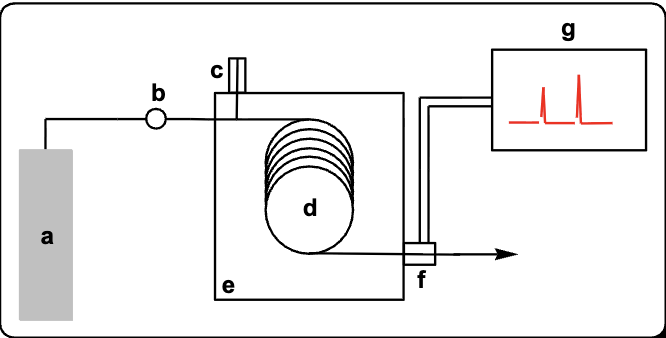
What are the seven basic parts of a gas-liquid chromatograph?
a) source of high-pressure carrier gas (eg helium or hydrogen)
b) gas flow controller
c) heated injector port (gas sample inserted via syringe)
d) column
e) column oven (25º - 300ºC)
f) detector
g) recording device or data station
What three pieces of information are provided in the data table of a gas chromatogram?
peak retention times (RT)
peak areas
percent compositions (AREA%)
What must be available in order for GC analysis to permit compound identification?
authentic samples for the various components in the mixture being analyzed
What are the six items that must be determined in order to establish the sequence of a peptide (or protein)?
cleave all disulfide bridges and alkylate the resulting thiol groups
determine the constituent amino acids (both in kind and in number)
identify the N-terminal amino acid
identify the C-terminal amino acid
fragmentation through partial hydrolysis
identify the locations of any disulfide bridges
What conditions are employed to “completely” hydrolyze a peptide?
acidic solution and high temperature

An enzyme that catalyzes the hydrolysis of a peptide bond at the end of the peptide chain is called?
an exopeptidase