pubhlth 222a - week 2: politics of health policy
 Call Kai
 Learn
Learn Practice Test
 Spaced Repetition
 Match
Match Flashcards
 Knowt Play
1/22

There's no tags or description
Looks like no tags are added yet.
Name | Mastery | Learn | Test | Matching | Spaced | Call with Kai |
|---|
No analytics yet
Send a link to your students to track their progress
23 Terms
constitution - separation of powers
legislation is making the laws
congress
house of rep
senate
judicial interprets & give meaning to the law
supreme court
exective passes the law
pres & vp
3 functions of the constitution
federalism
allocate power between federal government and states
separation of powers
divide powers b/w 3 government branches
protect individual liberties
limit government power
policy definition
authoritative decision
has authority coming from the legislative branch
public policy
policies enacted by legislative, judicial, or executive branches of government
health policy
policies regarding the health or pursuit of health
forms of health policies
laws
legal bindings & penalties
rules or regulations
implementation decisions
judicial decisions
2 categories of health policies
allocative policies
provide net benefits to some distinct group at the expense of others
equivalent to subsidies
direct provision of income, services, or goods to a group of indivd or organizations
regulatory policies
designed to influence the actions, behaviors, & decisions of others by directive
five categories: (1) market entry restrictions, (2) rate or price setting controls on health services providers, (3) quality controls on the provision of health services, (4) market preserving controls, (5) social regulation
health policy —> health determinants —> health
health determinants
physical environments
behavior & biology
social factors
health services
core model of public policymakng process
decision making process
cyclical (not linear) process
political
incremental (small modifications)
3 public policymaking cyclincal phrases
formulation
agenda setting & legislation development
implementation
designing, evaluation, operating, & rulemaking
modification
legislative structure: federal
U.S. senate and house of representatives
committees have jurisdiction over different issues
senate committees vs. House subcommittees
involved in authorizing programs/laws and appropriating resources
legislative structure: state
state senates & assemblies
may have different rules than federal government
professional vs. part-time legislatures
legislative responsibilities
the budget process
medicaid, CHIP, healthcare programs
mandatory vs discretionary spending (medi medi vs NIH & CDC)
4 agenda setting activities
well informed guess
combo of problems, solutions, & political circumstances that flow together to create a policy window
e-cigarettes
part of a broader class of devices known as electronic nicotine delivery systems
battery-powered devices that deliver nicotine vapor, chemicals, & metals
ultrafine particles that can be inhaled deep in the lungs
flavorants (diacetyl)
heavy metals (nickel, tin, & lead)
high vaping taxes up to $17.90
very west (including california) & very east states
7 (+ 4 options) how a bill becomes a law (steps in legislation development)
bill is drafted
bill introduces to representative & senator
bill is read & assigned to a committee by the rep speaker & senate majority leader
bill leaves committee & schedule for debate
bill is passed
both need to pass identical bills OR agree to one of their versions OR bill is amended & branches vote again
bill presented to the president
pres signs bill
congressional in session, bill becomes law after 10 days w/o pres signature
congressional not in session, bill does not become law w/o pres signature
pres vetoes bill but 2/3 in house & senate can override veto
2020 no surprise act timeline
aim to protect patients from large bills when treated by out-of-network providers at in-network facilities
never passed house or senate
was folded into the consolidated appropriations act of 2021 – H.R.133 (big budget bill)
house & senate agrees to w/ amendment
signed by pres & became law
u.s. congress committees that review health policy
ways and means (house)
committee on energy & commerce (house)
committee on appropriations (house)
health, education, labor, and pensions (senate)
committee on finance (senate)
committee on appropriations (senate)
executive orders
issued by the president and do no require congressional approval
3 core roles of courts
constitutional referees
decide whether a branch of government has acted within the scope of its constitutional authority
meaning givers
clarify the meanings of laws
rights protectors
vindicate or reject the legal or constitutional rights of parties
roles are not mutually exclusive
judicial decisions affect public/private sectors
25 states of challenge
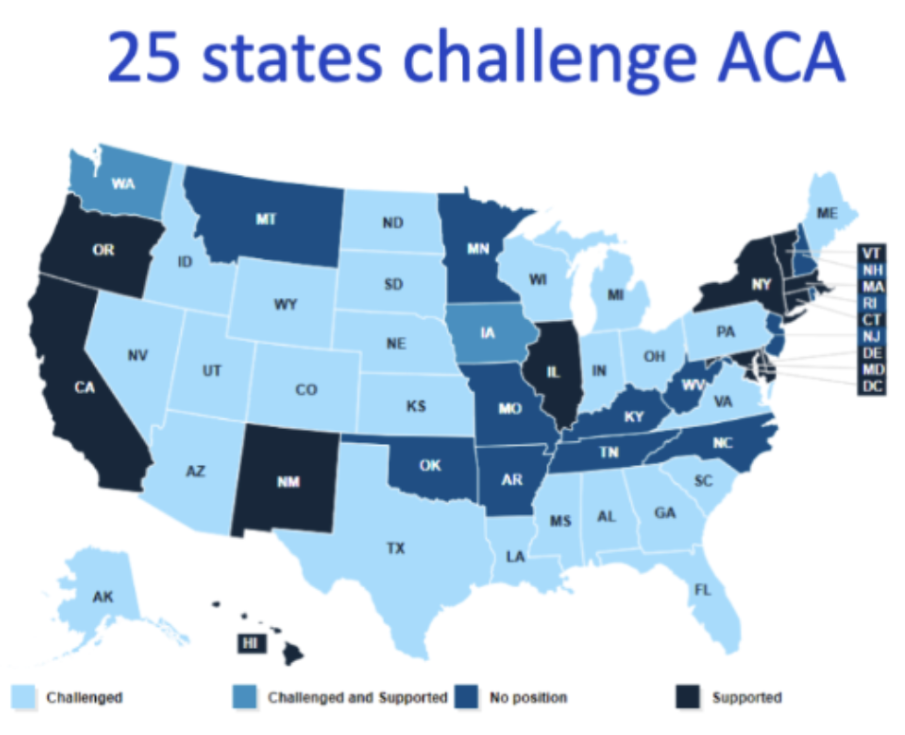
medicare & policy modification
Medicare enacted as part of the SSA Amendments of 1965
Why do you think it took so long (30 years!)?
Political circumstances that may have delayed inclusion of health insurance, and Medicare in particular, in the SSA:
AMA opposition
Truman administration need to divert attention to Korea in 1950
Political prospects for universal health insurance – come to a compromise?
Not passed until Democratic margin in Congress was significantly increased in 1964 (with President Johnson’s election win)