Population Density, Ageing Populations, and Population Policies in Environmental Management
 Call Kai
 Learn
Learn Practice Test
 Spaced Repetition
 Match
Match Flashcards
 Knowt Play
1/330

There's no tags or description
Looks like no tags are added yet.
Name | Mastery | Learn | Test | Matching | Spaced | Call with Kai |
|---|
No analytics yet
Send a link to your students to track their progress
331 Terms
Population density
A measure of the number of people living per unit area, typically expressed in people per square kilometer.
Ageing population
A population with a high percentage of old people (aged 65 years or older).
Median age
The age that divides a population into two equal halves, with half the population being younger and half older.
Stage 5 population pyramid
A demographic representation indicating a population with a high percentage of older individuals and low birth rates.
Life expectancy
The average period that a person may expect to live, which was 46 years in 1950 and 72.6 years in 2019 globally.
Population growth rates
The rate at which the number of individuals in a population increases, which can lead to a high percentage of young or old people.
Antinatalist population policy
A policy aimed at reducing birth rates to slow down population growth.
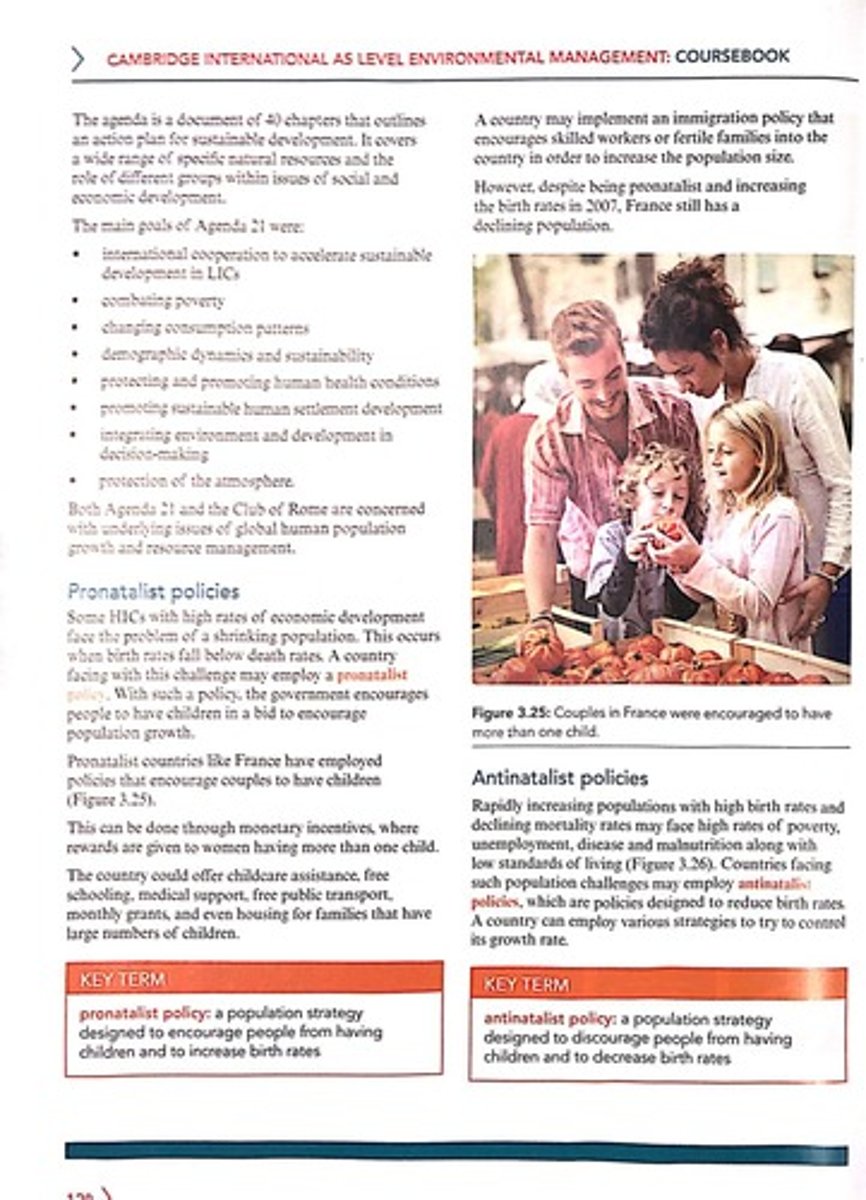
Pronatalist policy
A policy aimed at encouraging higher birth rates to promote population growth.
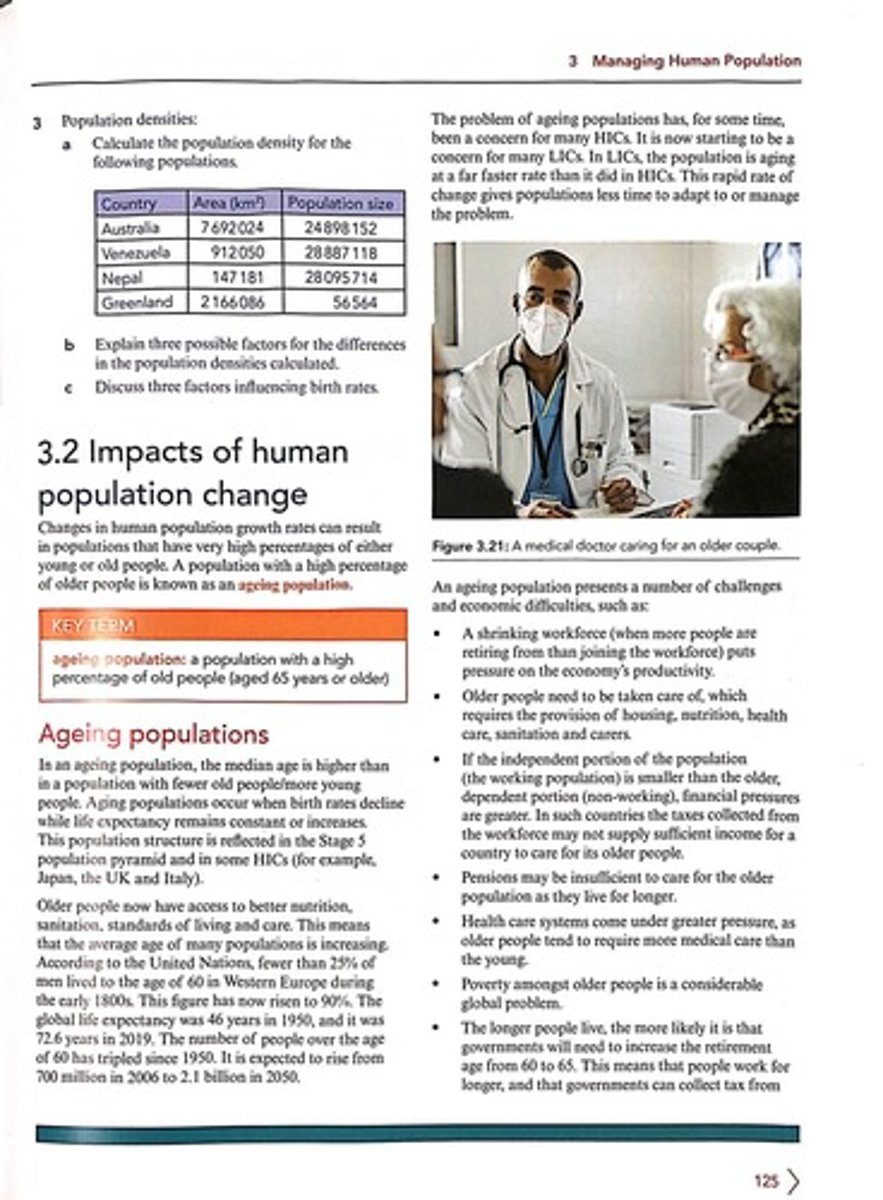
Challenges of ageing populations
Economic difficulties such as a shrinking workforce, increased healthcare needs, and insufficient pensions for older individuals.
Poverty among older people
A significant global issue where older individuals face financial hardships due to insufficient income and rising living costs.
Retirement age
The age at which a person is expected to stop working, which may increase from 60 to 65 due to longer life expectancy.
Healthcare pressure
The increased demand on healthcare systems due to older populations requiring more medical care than younger populations.
Global population over 60
The number of people over the age of 60, which is expected to rise from 700 million in 2006 to 2.1 billion by 2050.
Housing for older populations
The need for adequate housing, nutrition, and care services for an increasing number of older individuals.
Workforce dependency ratio
A measure comparing the working population to the non-working older population, impacting economic productivity.
Economic productivity
The efficiency of production in an economy, which can be affected by a shrinking workforce.
Nutritional standards
The improvements in nutrition that have contributed to increased life expectancy and an ageing population.
Sanitation standards
The level of hygiene and health conditions that have improved, contributing to longer life spans.
Carers for older people
Individuals who provide care and assistance to older populations, which is increasingly necessary as populations age.
Population adaptation
The ability of a population to adjust to changes, such as an ageing demographic, which can be hindered by rapid changes.
Global life expectancy trends
The historical increase in life expectancy, reflecting improvements in healthcare, nutrition, and living standards.
Population structure
The composition of a population in terms of age and sex, which influences demographic trends and policies.
antinatalist
a policy that discourages human reproduction
pronatalist
a policy that promotes human reproduction
youthful population
a demographic trend characterized by a high proportion of young individuals in a population
The Club of Rome
an organization created in 1972 to address crises facing humanity and Earth, focusing on the consequences of population growth
The Limits to Growth
the first report produced by The Club of Rome in 1972 that attracted public attention regarding population growth and environmental issues
UN Agenda 21
a global plan of action adopted in 1992 to curb the impact of humans on the environment
Rio Declaration
a document included in UN Agenda 21 that outlines principles for sustainable development
Statement of Principles for Sustainable Management of Forests
a component of UN Agenda 21 that provides guidelines for forest management
sustainable economic development
economic growth that meets present needs without compromising the ability of future generations to meet their own needs
carrying capacity
the maximum population size that an environment can sustain indefinitely without degrading the environment
accelerating industrialisation
the rapid increase in industrial activity and development within a country or region
rapid population growth
a significant increase in the number of individuals in a population over a short period
widespread malnutrition
a condition resulting from insufficient intake of nutrients across a large segment of the population
depletion of non-renewable resources
the reduction of finite resources that cannot be replenished naturally within a human timeframe
deteriorating environment
the decline in the quality of the natural environment due to human activities
global catalyst for change
an entity or initiative that aims to inspire and facilitate significant changes on a global scale
political, social and economic change
transformations in governance, societal structures, and economic systems that can take time to implement
global policies
strategies or regulations that are intended to be applied universally across different nations
178 governments
the number of governments that adopted the UN Agenda 21 at the 1992 Conference on the Environment and Development
ZERO HUNGER
A goal aimed at ending hunger, achieving food security and improved nutrition, and promoting sustainable agriculture.
DECENT WORK AND ECONOMIC GROWTH
A goal focused on promoting sustained, inclusive and sustainable economic growth, full and productive employment, and decent work for all.
GOOD HEALTH AND WELL-BEING
A goal to ensure healthy lives and promote well-being for all at all ages.
QUALITY EDUCATION
A goal to ensure inclusive and equitable quality education and promote lifelong learning opportunities for all.
GENDER EQUALITY
A goal to achieve gender equality and empower all women and girls.
CLEAN WATER AND SANITATION
A goal to ensure availability and sustainable management of water and sanitation for all.
INDUSTRY, INNOVATION AND INFRASTRUCTURE
A goal to build resilient infrastructure, promote inclusive and sustainable industrialization, and foster innovation.
REDUCED INEQUALITIES
A goal to reduce inequality within and among countries.
SUSTAINABLE CITIES AND COMMUNITIES
A goal to make cities and human settlements inclusive, safe, resilient, and sustainable.
RESPONSIBLE CONSUMPTION AND PRODUCTION
A goal to ensure sustainable consumption and production patterns.
CLIMATE ACTION
A goal to take urgent action to combat climate change and its impacts.
LIFE BELOW WATER
A goal to conserve and sustainably use the oceans, seas, and marine resources for sustainable development.
LIFE ON LAND
A goal to protect, restore and promote sustainable use of terrestrial ecosystems, sustainably manage forests, combat desertification, and halt and reverse land degradation and halt biodiversity loss.
PEACE, JUSTICE AND STRONG INSTITUTIONS
A goal to promote peaceful and inclusive societies for sustainable development, provide access to justice for all, and build effective, accountable, and inclusive institutions at all levels.
PARTNERSHIPS FOR THE GOALS
A goal to strengthen the means of implementation and revitalize the global partnership for sustainable development.
antinatalist policy
A population strategy designed to discourage people from having children and to decrease birth rates.
Antinatalist policies
Policies aimed at reducing birth rates by discouraging childbearing.
Pro-natalist policies
Policies that encourage childbearing and higher birth rates.
Singapore's 'stop at two' policy
An antinatalist policy implemented between 1972 and 1987 that encouraged families to have no more than two children.
Benefits for one-child families
Couples who had only one child received better benefits, housing, education, healthcare, and longer maternity leave.
Fines for second child
Couples who had a second child faced fines and were denied access to benefits available to one-child families.
Successful antinatalist policies
Policies that share common factors such as encouraging later marriage, making contraception available, and improving women's education.
China's population policy
A policy that resulted in an estimated 400 million children not being born, aimed at reducing population growth.
Two-child policy
A policy in China that replaced the one-child policy in 2016, allowing families to have two children.
Sterilisation for couples
Free sterilisation offered to couples who have had children and do not wish to have more.
Impact of declining birth rates
As the number of children declines, the standard of living improves, but it may lead to an ageing population and workforce decline.
Maternity leave for mothers
Mothers with four or more children in Singapore were offered 12 weeks' maternity leave under the pro-natalist policy.
Family planning access
Access to low-cost contraception and family planning services promoted under Singapore's antinatalist policy.
Cultural shift to smaller families
A societal change where families embrace having fewer children, which can lead to population decline.
Children from single-child families
Children in rural areas from single-child families may live in poverty due to having multiple grandparents and parents to care for.
Urban vs. rural families
Urban families may struggle but have greater earning potential compared to their rural counterparts.
Limitations of anti-natalist policies
The negative effects of these policies are often only seen one to two generations later, when the population stabilizes.
Prevalence of modern contraception
Data showing the percentage of women aged 15-49 using modern contraception by country or area, as of 2017.
Government promotion of sterilisation
The Singapore government promoted sterilisation as part of its antinatalist policy.
Economic growth and death rate
As the standard of living improves due to economic growth, the death rate also declines, leading to an ageing population.
Workforce challenges
A declining population makes it difficult to maintain a workforce as older individuals retire and fewer young people are available.
Family Planning Clinic
A facility where couples can receive advice on maintaining a small family, emphasizing the safety and simplicity of family planning.
Club of Rome
An organization that aims to address global issues and promote sustainable development.
LIC
Low Income Country, characterized by a lower level of social and economic development.
HIC
High Income Country, characterized by a higher level of social and economic development.
Population Pyramid
A graphical representation showing the distribution of various age groups in a population.
Dependency Ratio
The ratio of dependents (people younger than 15 or older than 64) to the working-age population (ages 15-64).
Birth Rate
The number of live births per 1,000 people in a population per year.
Infant Mortality Rate
The number of deaths of infants under one year old per 1,000 live births in a given year.
Female Education
The level of education attained by women, which can impact birth rates and population growth.
Contraception Access
The availability of methods to prevent pregnancy, which can influence birth rates.
Population Growth Projection
An estimate of future population size based on current trends, such as birth and death rates.
Cultural Values
Beliefs and practices that influence behaviors, including family size and childbearing.
Industrialisation Level
The extent to which a country has developed its industry, impacting economic growth and population structure.
Geographical Location
The physical position of a country, which can affect its resources and population dynamics.
Natural Resources
Materials or substances occurring in nature that can be exploited for economic gain.
Education Levels
The degree of formal education attained by individuals in a population, influencing economic and social outcomes.
Population Increase Drivers
Factors that contribute to the growth of a population, such as high birth rates and declining death rates.
Housing Demand
The need for residential buildings, which increases with population growth.
Employment Availability
The presence of job opportunities necessary for supporting a growing population.
Poverty Level
The degree to which individuals or groups lack financial resources, often exacerbated by population pressures.
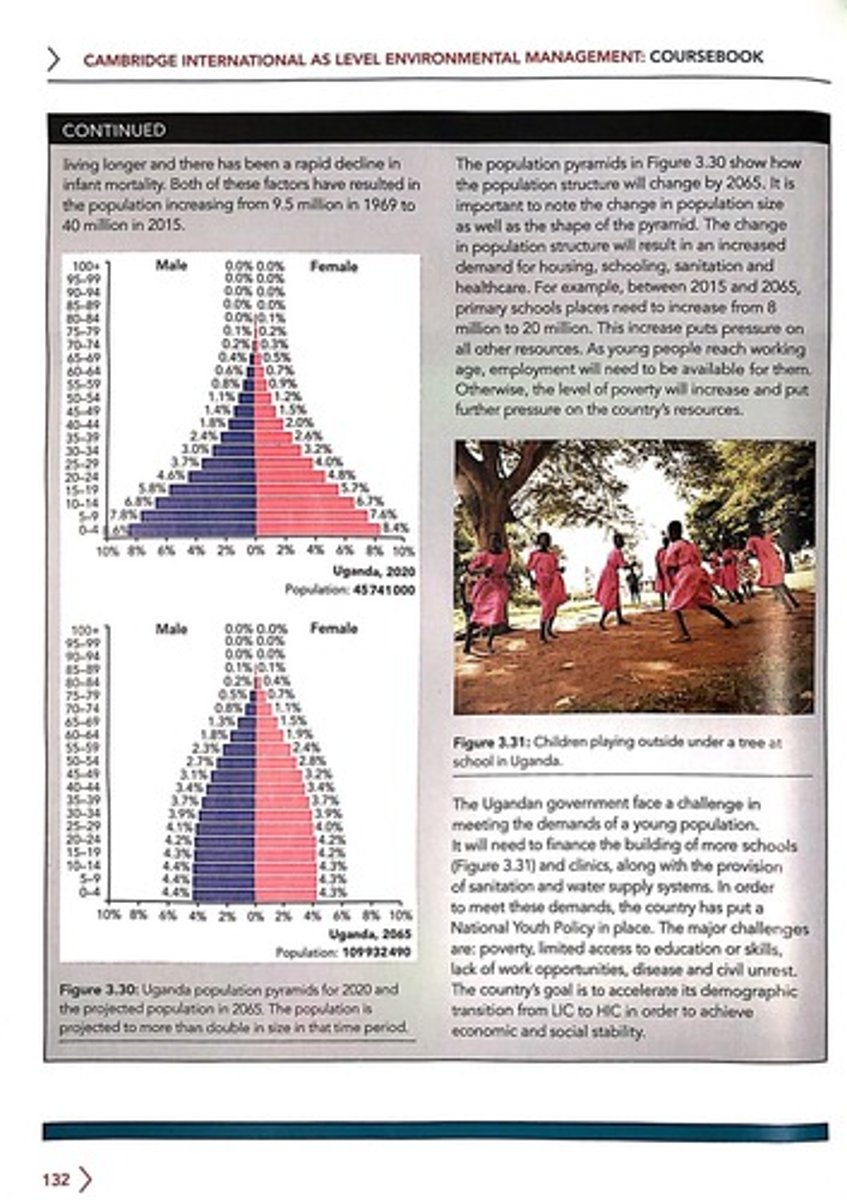
Uganda Population 2020
45741000
Uganda Population 2065
109932490
National Youth Policy
A policy put in place by Uganda to address the needs of its young population.