Questions through the lectures
 Call Kai
 Learn
Learn Practice Test
 Spaced Repetition
 Match
Match Flashcards
 Knowt Play
1/94

There's no tags or description
Looks like no tags are added yet.
Name | Mastery | Learn | Test | Matching | Spaced | Call with Kai | Chat |
|---|
No analytics yet
Send a link to your students to track their progress
95 Terms
List THREE benefits of the normal microbiota for the human host.
Some members of the normal microbiota synthesize vitamins that are needed for host cells.
Some members help with the digestion of food.
Some members prevent the colonization of pathogens and thus protect the host from disease.
Mycoses are often chronic infections and are difficult to treat. Why might this be?
Fungi are eukaryotes just like we are. This means that their cells are very similar to ours, and this makes it challenging to find drugs that will target fungal cells without affecting our body cells.
Which of the following are classified as eukaryotes (select all that apply)?
Molds
Helminths
Bacteria
Yeasts
Viruses
The correct answers are A, B and D. Bacteria are prokaryotes, and viruses are neither prokaryotes nor eukaryotes since they are not composed of cells.
In the scientific name, Klebsiella pneumoniae, “pneumoniae“ is the
Specific epithet.
Species.
Both A and B are correct.
Neither A nor B are correct.
The correct answer is C. Species and specific epithet mean the same thing and refer to the second name in the latinized binomial system.
The microscope used to see details of a 100 nm virus would be a
Brightfield microscope.
Fluorescence microscope.
Phase-contrast microscope.
None of the above.
The correct answer is D. All of the microscopes listed are light microscopes, which do not have sufficient resolving power to see very small objects like viruses.
Which type of microscopy can never be used to observe living cells (select all that apply)?
Transmission electron microscopy
Scanning electron microscopy
Brightfield microscopy
Phase-contrast microscopy
The correct answers are A and B. The process used for preparing specimens for transmission electron microscopy and scanning electron microscopy will kill the cells, and thus you cannot use these types of microscopy to view living cells. In contrast, Brightfield microscopy can be used to view living cells if the cells are naturally pigmented, and phase-contrast microscopy uses a special type of microscope that enables cells to be viewed without staining them first.
What is the purpose of the fixation step when preparing a specimen for Brightfield microscopy?
The fixation step is performed to attach (adhere) the cells to the slide. This ensures that the cells do not get washed off the slide during the staining step.
You are performing a Gram stain on Gram(-) bacteria and you stop after the addition of the alcohol. What is the appearance of the bacteria at this point?
Pink
Colourless
Brown
Purple
The correct answer is B. Gram(-) cells are decolourized by the alcohol treatment and thus would be colourless after this step.
The appearance of Mycobacterium leprae after the cells are stained with an Acid-Fast stain is
Purple
Red
Colourless
Blue
The correct answer is B. Mycobacterium leprae contains mycolic acids in its cell wall and is not decolourized by the acid-alcohol treatment, and thus it is acid-fast.
Which of the following statements is incorrect?
Prokaryotes do not possess DNA
Prokaryotic cell walls containing peptidoglycan
Prokaryotes divide by binary fission
Prokaryotes generally lack organelles
The correct answer is A. All living organisms, including prokaryotes possess DNA, which contains the genetic information of the organism.
What is the medical significance of the glycocalyx?
The glycocalyx protects bacteria from harmful compounds like antibiotics, thus making it more difficult to kill them. It also plays a role in biofilm formation, which enables bacteria to colonize medical implants such as catheters and prosthetics, and it contributes to the virulence of some pathogens by protecting the bacteria from host immune cells.
The structure used by spirochetes for motility is called a(n)
flagellum
pilus
fimbria
axial filament
The correct answer is D.
Mycoplasma species are unusual in that they do not have a cell wall. What structural feature helps to protect the cells from lysis?
Mycoplasma contain sterols in their plasma membrane, and the presence of this lipid protects the cells from lysis.
Genes on plasmids can confer several advantages to bacterial cells that harbour them. Give ONE example of an advantage that can be conferred by plasmids and their associated genes.
Any of the following:
They can confer resistance to antibiotics
They can enable toxin production by pathogens,
They can provide tolerance to heavy metals
They can enable the metabolism of unique nutrients
Which type of endocytosis is characterized by the uptake of fluid and dissolved nutrients?
Pinocytosis
Which of the following is generally found in eukaryotic plasma membranes and not prokaryotic plasma membranes? (select all that apply)
Integral protein
Sterols
Phospholipids
Glycolipids
B and D
Which organelle receives protein cargo from the rough ER for sorting and shipping to the final destination?
Golgi complex
Which of the following contains 70S ribosomes (select all that apply)?
Bacteria
Chloroplasts
Rough endoplasmic reticulum
Nucleus
Mitochondria
A, B, E
This group of microorganisms can grow well at 37°C and includes most human pathogens
Mesophiles
Which of the following is capable of spoiling salt-cured foods like salted fish and meats?
Acidophiles
Psychrophiles
Thermophiles
Halophiles
D
Which group of organisms is killed by atmospheric oxygen?
Obligate aerobes
Facultative anaerobes
Obligate anaerobes
Aerotolerant anaerobes
C
A culture medium in which the exact composition is unknown due to the presence of ill-defined components would be called a
Complex medium
Differential medium
Selective medium
Defined medium
A
A culture medium on which only Gram(+) organisms grow and an orange halo surrounds Streptococcus pyogenes colonies would be called an enrichment medium. Is this statement true or false? Briefly explain your answer
This statement is false. Based on the description given, the medium would be a selective and differential medium. An enrichment medium is one that allows for the growth of a very small numbers of a desired type of organism to detectable levels.
What is the purpose of the streak plate method?
It is used to obtain a pure culture of a specific bacterium present within a mixture.
It is used to promote the growth of different types of microbes.
It is used to isolate a microbe present in very small numbers within a sample.
It is used to promote the formation of biofilms from a mixture.
A
Which of the following pairs is mismatched?
Lag phase – bacterial cells within the population are preparing to divide by synthesizing necessary enzymes and other molecules.
Log phase – the population of cells are actively dividing, doubling the population with each generation.
Stationary phase – the rate of bacterial cell death is greater than the rate of cell birth generated by binary fission.
Death phase – bacterial cells within the population die at a constant rate as a result of nutrient depletion and toxic waste build up
The correct answer is C. Stationary phase is when the rate of cell division equals the rate of cell death, and hence there is no net increase or decrease in the number of cells in the population.
What is the main advantage of the direct microscopic count over the SPC for monitoring microbial growth?
The direct microscopic count enables the rapid measurement of microbial growth since it does not rely on culturing of the microbe being enumerated. In contrast, the SPC takes longer to obtain results since the microbe being enumerated must first be cultured.
Why are the plate counts obtained with the SPC method usually reported as the number of CFUs rather than the number of cells?
The colonies that are counted in the SPC method can arise either from a single cell or a group of cells, depending on the cell arrangement of the microbe. To account for this, the counts are reported as "colony-forming units" or "CFUs".
Sanitation refers to the destruction of vegetative microbes on inanimate objects. Is this statement true or false? Briefly explain your answer
The statement is false. Sanitation is the lowering of microbial counts on eating and drinking utensils to safe levels. The destruction of vegetative microbes on inanimate surfaces is referred to as disinfection.
A(n) _______________________ uses steam under pressure for sterilization.
Autoclave
This type of radiation does not have penetrating power and thus can only be used to sterilize surfaces and air
Ultraviolet (UV) radiation
Soaps are primarily used as _____
Degerming agents
Which of the following is an effective antiseptic? (select all that apply)
Quats
Glutaraldehyde
Iodine
Sodium hypochlorite
A and C
Indicate the relative resistance (from highest to lowest) of the following organisms to chemical agents: mycobacteria, viruses with lipid envelopes, endospores, gram-negative bacteria, Gram-positive bacteria.
Endospores > Mycobacteria > Gram-negative bacteria > Gram-positive bacteria > Viruses with lipid envelopes
In bacteria, a gene is defined as a sequence of nucleotides in RNA that codes for a functional product. Is this statement true or false?
The statement is false. A gene refers to a sequence of nucleotides in DNA (deoxyribonucleic acid) that codes for a functional product.
In replication, this enzyme is responsible for joining the newly added nucleotides to the 3' end of the growing DNA strand.
DNA polymerase
In translation, the molecule that recognizes specific codons and transports amino acids is the
tRNA
mRNA
rRNA
sRNA
tRNA
A mutation that causes a change in the codon reading frame on an mRNA molecule is called this.
Frameshift mutation
Distinguish between horizontal gene transfer and vertical gene transfer.
Horizontal gen transfer involves the transfer of DNA from one cell to another of the same generation. It occurs via transformation, transduction and conjugation. Vertical gene transfer is the transfer of DNA from a cell to its offspring. It occurs during cell division
TRUE or FALSE: Simple transposons carry genes for their own transposition as well as genes that confer properties such as antibiotic resistance.
False
Define the term superinfection.
A superinfection is an infection that occurs following treatment with a broad-spectrum antibiotic. The treatment kills off most of the normal microbiota and creates an opportunity for opportunistic pathogens that are unaffected by the antibiotic to grow uncontrolled.
Penicillin functions by inhibiting this enzyme involved in peptidoglycan biosynthesis.
Transpeptidase (Penicillin binding protein)
Cephalosporins inhibit peptidoglycan synthesis in the same manner as penicillins. Is this statement true or false?
The statement is True. Cephalosporins and penicillins are both members of the β-lactam class of antibiotics, and thus they both inhibit the transpeptidase enzyme involved in the formation of peptide crosslinks during peptidoglycan synthesis.
Which of the following inhibits the synthesis of mycolic acids in mycobacterial cell walls?
Bacitracin
Vancomycin
Teixobactin
Ethambutol
D. Ethambutol
Which of the following antibiotics does NOT interfere with protein synthesis in bacteria?
Tetracyclines
Streptogramins
Carbapenems
Aminoglycosides
Carbapenems
Which of the following antibiotics is associated with the development of superinfections?
Glycylcyclines
Oxazolidinones
Tetracyclines
Macrolides
A. Glycylcyclines, C. Tetracyclines
Which of the following antibiotics injures the plasma membrane? (select all that apply)
Daptomycin
TMP-SMZ
Rifampin
Polymyxin B
A and D
This refers to two drugs working together to produce a result that is greater than the effect of each drug on its own.
Drug synergism
Which of the following is NOT an example of antibiotic misuse?
Prescribing an antibacterial agent for treating a viral infection
Using an antibiotic prescribed to someone else
Using antibiotics as animal growth promotants
Finishing the full regime of an antibiotic treatment
D. Finishing the full regime of an antibiotic treatment
Mycoses are more difficult to control than bacterial infections – why?
Fungi are eukaroyotes like humans, and thus there are limited treatment options that will selectively target the pathogen without having toxic effects on the host.
Which of the following is not found in fungal cell walls?
Glucans
Peptidoglycan
Chitin
Mannans
Peptidoglycan
This group of fungal mycoses is caused by dermatophytes
Cutaneous
Why do polyenes damage fungal plasma membranes without damaging our own cell plasma membranes?
Polyenes disrupt fungal plasma membranes by binding to ergosterol in the membranes. Animal cell membranes contain cholesterol instead of ergosterol, and thus are not affected by these drugs.
Some protozoa can produce a __________________, which provides protection against adverse environmental conditions and enables parasitic protozoa to survive outside their host
Cyst
The sexual reproduction of Plasmodium takes place in this host
Mosquito
True or False: In helminth life cycles, the organism that harbors the adult sexually reproductive phase of the parasite is called the intermediate host
This answer is false. The organism that harbours the adult sexually reproductive phase of the parasitic helminth is called the definitive host. In contrast, the intermediate host harbours the larval (developmental) stage of the helminth.
The head of a tapeworm is called
Scolex
The infective stage of D. immitis is
The eggs
The larvae
The adult worm
The larvae, eggs and adult worm
The larvae
This arthropod vector is responsible for transmitting malaria
Mosquito
Viruses have few or no enzymes of their own (ie, they have no enzymes for energy (ATP) generation or protein synthesis). Thus, they must take over the host cell biosynthetic machinery to reproduce. This has implications for the development of antiviral drugs – can you explain why?
It is more difficult to find drugs that are selectively toxic to viruses – ie, drugs that prevent viral multiplication without affecting the function of host cells.
TRUE or FALSE: Helical and isosahedral are terms used to describe the shape of the viral envelope
This is FALSE. These terms are used to describe the shape of the vireo capsid or protein coat.
The mechanism by which an enveloped virus leaves a host cell is called this
Budding
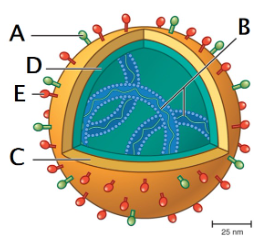
In the diagram of the influenza virus, what are the structures labeled
A:
B:
C:
D:
E:
A: NA spike
B: RNA
C: Envelope
D: Capsid
E: HA spike
TRUE or FALSE: SARS-CoV-2 consists of a single ssRNA molecule that is bound to the nucleocapsid protein and is surrounded by a lipid envelope
True
This enzyme is packaged by retroviruses and is required for synthesizing DNA from an RNA template
Reverse transcriptase
This enzyme is used by retroviruses to produce DNA from an RNA template
Reverse transcriptase
Distinguish between signs and symptoms of disease, and provide an example of each
Signs are the objective changes in the body that can be observed and measured by someone else. An example is fever.
Symptoms are the subjective changes in the body that cannot be observed by someone else. An example is abdominal cramps.
In this type of symbiotic relationship, one organism benefits at the expense of the other.
Parasitism
Members of the normal microbiota can benefit the host by preventing the overgrowth of harmful pathogens. This is referred to as _____________________.
Microbial antagonism or competitive exclusion
Which of Koch’s postulates requires modification for study of a human disease?
The microbe is found in all cases of the disease.
The microbe is isolated from the diseased host and grown in pure culture.
When the microbe is introduced into a healthy, susceptible host, the same disease occurs.
The same microbe is obtained from the newly diseased host. When cultured, the isolate shows the same traits as the original microbe
When the microbe is introduced into a healthy, susceptible host, the same disease occurs.
This term refers to a disease that occurs in higher numbers than what is normally expected in a population in a given area
Epidemic
A period of illness is preceded by a(n)
Period of convalescence.
Incubation period.
Prodromal period.
Period of decline
Incubation period
Transmission of a pathogen through air over a distance > 1 meter is an example of
Vector transmission.
Direct contact transmission.
Droplet transmission.
Vehicle transmission
Vehicle transmission
What is an emerging infectious disease?
An emerging infectious disease is a disease that is new within a population, or one that has existed previously but is rapidly increasing in incidence or geographical range
The degree or extent to which an organism can cause disease is called this
Virulence
Which of the following is NOT a portal of entry for pathogens?
Mucous membrane of the respiratory tract
Mucous membrane of the digestive canal
Blood
Parenteral route
Blood
Contributing to the invasiveness of Streptococcus pyogenes is a cell surface protein called ________________________.
M protein
Exotoxins that attack liver cells are called ______________________
Hepatotoxins

The general structure of cholera toxin, an A-B toxin, is shown below. Indicate the region of the toxin that would interact with host cell surface receptors.
B region
The ability of some microbes, such as Trypanosoma or Giardia to alter their surface molecules and evade destruction by the host's antibodies is called ___________
Antigenic variation
Cytopathic effects are changes observed in host cells due to ________ infections.
A. Helminth
B. Bacterial
C. Protozoan
D. Viral
D. Viral
Which bacterial pathogen is associated with both pharyngitis and scarlet fever?
Streptococcus pyogenes (Group A streptococci)
What feature of the Mycobacterium tuberculosis cell wall contributes to its pathogenicity and resistance to antimicrobial agents?
The high concentration of mycolic acids, which make the cells impermeable to antibiotics and protects them from the host defence responses
This type of microbial disease of the lower digestive system results from ingestion of food containing a pre-formed microbial toxin and is characterized by a rapid onset of signs and symptoms
Intoxication
Which bacterial pathogens discussed in this module do NOT cause meningitis?
Clostridium botulinum, Clostridium tetani
Why is meningitis caused by the pathogen L. monocytogenes frequently associated with ingestion of refrigerated foods?
Listeria monocytogenes is able to grow at refrigeration temperatures, resulting in high numbers of the bacteria in the food during storage
TRUE or FALSE: Poliomyelitis is transmitted from person to person by the fecal-oral route
True
What are the recommended precautions for avoiding exposure to WNV?
When outdoors, use DEET-containing insect repellent, wear light-coloured clothing, and wear clothing that covered exposed areas (pants, long sleeved shirts, socks, a hat)
How is cystitis usually treated?
Treatment usually involves administering a fluoroquinolone antibiotic.
Non-gonococcal urethritis is most commonly caused by
Chlamydia trachomatis
Septic shock caused by Gram-negative bacteria is due to release of ________________________ in the blood when the bacteria lyse
Endotoxin
This type of rash is characteristic of the early stages of Lyme disease
Erythema migrans
A patient develops sores on their face around their nose. The sores are red in colour, and a few days later they erupt and form light-coloured crusts. What disease does the patient have
Nonbullous impetigo