Dev. Lec. 13 - Risk and resilience in development
0.0(0)
Studied by 2 people Call Kai
 Learn
 Practice Test
 Spaced Repetition
 Match
 Flashcards
 Knowt Play
Card Sorting
1/22

Earn XP
23 Terms
1
New cards
Risk factors
stressors that increase likelihood of maladjustment in children, typically factors outside child that threaten basic needs
* typically present **before** development of problems
* (objective) threats of basic needs of child (e.g., lack of
safety, resources, social contact)
* examples: poverty, family adversity, discrimination, natural catastrophies
* Risk factors can be present at different (interacting!) levels
* typically present **before** development of problems
* (objective) threats of basic needs of child (e.g., lack of
safety, resources, social contact)
* examples: poverty, family adversity, discrimination, natural catastrophies
* Risk factors can be present at different (interacting!) levels
2
New cards
Microsystem
individual + settings (family, peers, school)
3
New cards
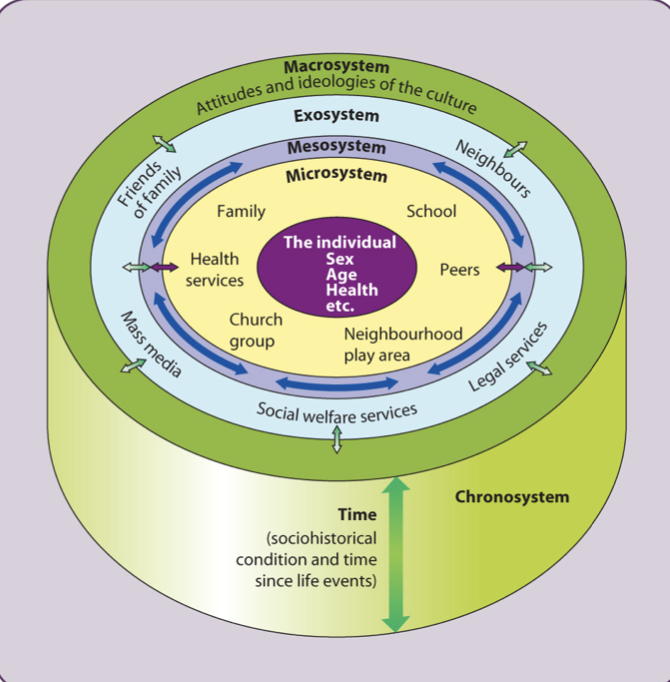
The 5 different systems in **Bronfenbrenner**’s Ecological model
* microsystem
* meosystem
* exosystem
* macrosystem
* chronosystem
* meosystem
* exosystem
* macrosystem
* chronosystem
4
New cards
meosystem
relations between Microsystem with Exosystem (e.g., Family - school)
5
New cards
exosystem
Neighbours, media, wider family
6
New cards
chronosystem
era, cohort effects
7
New cards
Protective - vulnerability factors
moderate the effects of risk factors
8
New cards
protective vs. vulnerability factors
* Protective factors *increase* chance of adaptive development
* Vulnerability factors *decrease* chance of adaptive development
* Vulnerability factors *decrease* chance of adaptive development
9
New cards
Cumulative models of risk factors
simply add # riskfactors from different domains; predicts surprisingly well
0-1 vs. 8+ risk factors: 30 IQ difference
0-1 vs. 8+ risk factors: 30 IQ difference
10
New cards
**Equifinality**
multiple risk factors can lead to the same problem
11
New cards
**Multifinality**
risk factor can have multiple effects
12
New cards
inhibited temperament
shy, emotionally reserved with strangers, easily over-aroused
13
New cards
characteristics of children who **internalize** problems
* inhibited temperament
* withdrawn
* *Later*: cognitive- and attentional characteristics: overestimate dangers; exaggerate possible negative outcomes, selective attention for threat
* withdrawn
* *Later*: cognitive- and attentional characteristics: overestimate dangers; exaggerate possible negative outcomes, selective attention for threat
14
New cards
withdrawn
child wants to participate but does not dare
15
New cards
protective factor for children who **internalize** problems
high effortful control, internal locus of control (“I have difficulties, but I can handle them”
16
New cards
environmental characteristics of children who **internalize** problems + a protective factor
* exposure to (strong) negative events
* Family factors: avoidant coping style, low sociability
* Protective factor: positively challenging father
* Family factors: avoidant coping style, low sociability
* Protective factor: positively challenging father
17
New cards
characteristics of children who **externalize** problems
* Disinhibited temperament > triggers negative reactions
* Relatively weak self-control
* Relatively weak self-control
18
New cards
vulnerability factors for children who **externalize** problems
* Low empathy in family; Dysfunctional family
* Bad neighborhood; Bad friends
* Other factors, e.g., perceived inequalities/ discrimination
* Bad neighborhood; Bad friends
* Other factors, e.g., perceived inequalities/ discrimination
19
New cards
protective factors for children who **externalize** problems
Positive role-model, positive challenge, goal, etc
20
New cards
Increased chance of developing problem when parent(s) have problem, e.g., child of father with alcohol problem and/or depressed mother > increased chance of developing problem(s). Why?
– Genetics
– Prenatal factors (e.g., substance use; stress during pregnancy)
– Problems Parent(s) > e.g., no job, divorce \n – Social learning \n – Other factors (loss of job, divorce, bad neighborhood)
These factors often cluster and interact
– Prenatal factors (e.g., substance use; stress during pregnancy)
– Problems Parent(s) > e.g., no job, divorce \n – Social learning \n – Other factors (loss of job, divorce, bad neighborhood)
These factors often cluster and interact
21
New cards
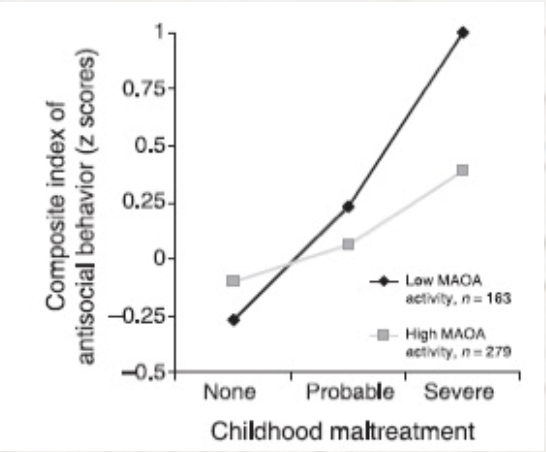
True moderation (**interaction-models**)
Only presence of **both** “risk- environment” (maltreatment) **and**“risk-gene”\* (MAO-A allele coding for low activity) strongly increases risk of later anti-social behavior in men (X chromosome).
22
New cards
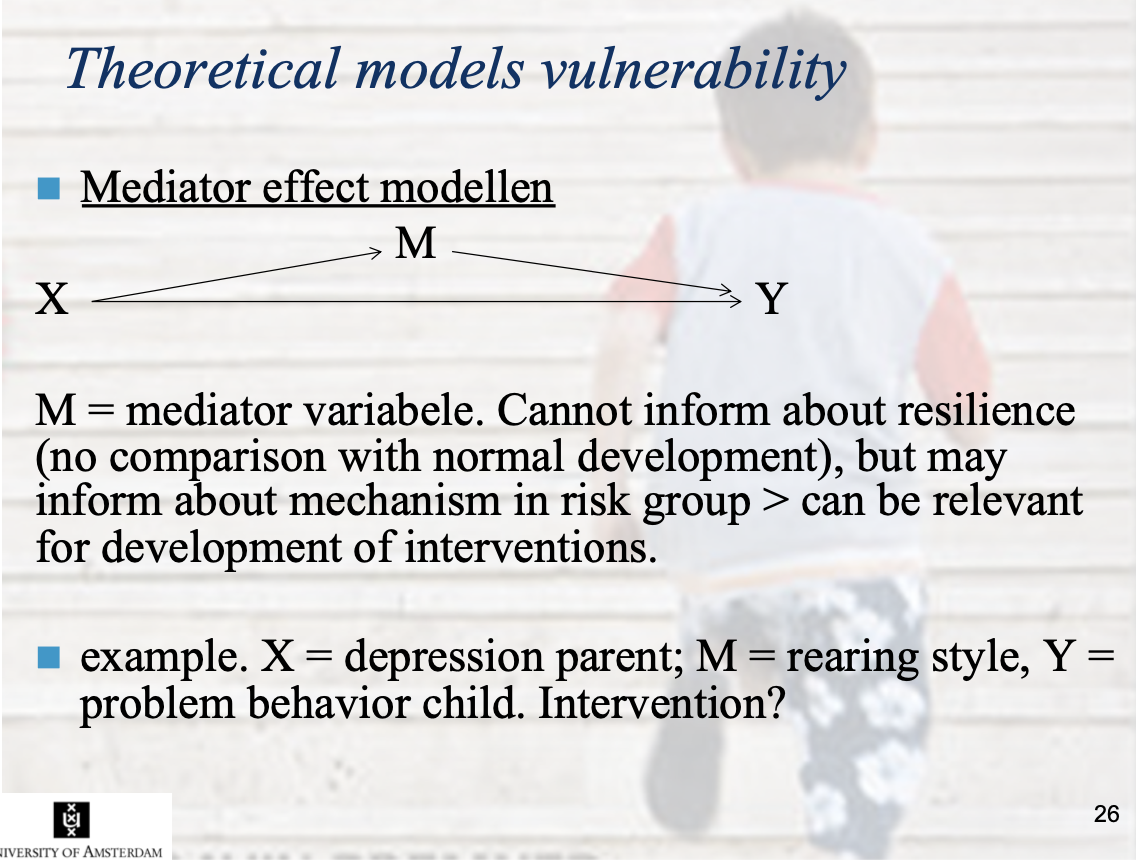
Mediator effect model
M = mediator variabele. Cannot inform about resilience (no comparison with normal development), but may inform about mechanism in risk group > can be relevant for development of interventions.
23
New cards
types of interventions
**Health promotion**: e.g. Posters, anti-alcohol -adds (little effect); much more effective: increase price and minimum age
**Universal prevention** for all (e.g., school-based prevention);
**Selective prevention** for risk-group (e.g., personality-based intervention); \n **Indicative prevention**: for beginning problems (e.g. Brief motivational interview for heavy drinking students)
**Treatment** > another course (new ways to directly interfere with processes in addiction, which improve therapy, Wiers et al 2018)