IBM Ch Past CH2
 Call Kai
 Learn
Learn Practice Test
 Spaced Repetition
 Match
Match Flashcards
 Knowt Play
1/120

There's no tags or description
Looks like no tags are added yet.
Name | Mastery | Learn | Test | Matching | Spaced | Call with Kai |
|---|
No analytics yet
Send a link to your students to track their progress
121 Terms
Ratio Analysis
Quantitative managmeent tool comparing financial figures to judge a firm’s financial performance
What Does Ratio Analysis Require
Applying figures of the final accounts: balance sheet and profit + loss account
How to assess if financial performance improved
Comparing current figures with historical figures and/or comparing to rival businesses
Purposes of ratio analysis
Examine a financial position
Assess financial performance
Compare real figures against projected/budgeted figures
Aid decision making
Historical Comparisons
Comparing the same ratio of two different time periods, showing trends and financial performance over time
Inter-Firm Comparisons
Comparing the same ratios of different businesses in the same industry, showing their relative financial performance
When financial ratios are used
Only with rivals in of similar size in the same industry
Types Of Profability Ratios
Gross profit margin
Profit margin
Return on capital employed (ROCE)
Profability Ratios
Profit in relation to other figures i.e. revenue, sales, equity
Profit
Financial surplus earnings of a firm after costs have been deducted
Limtation of profitability ratios
Only applies to profit-orientated businesses
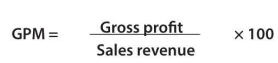
Gross Profit Margin
Firm’s gross profit as a percentage of its revenue
ways to raise sales revenue (PM & GPM)
↓ selling price of products (w/ many substitutes)
↑ selling price of products (w/ few substitutes or loyal customers)
↑ marketing strategies
Alternative revenue streams
ways to reduce direct costs (PM & GPM)
↓ direct material costs; cheaper suppliers/materials
May ↓ brand rep
↓ direct labour costs; ↓ staff, flexitime
Net Profit Margin
Percentage of sales turnover turned into profit

Sales Turnover (Revenue)
Total sales over a given period (financial year)
PM vs GPM
Profit margin covers both cost of sales (direct cost) and expenses (indirect cost) while GPM does not = better measurement of profitability
ways to reduce costs (PM)
Preferential payment terms with trade creditors and suppliers
Negotiate cheaper rent
Reduce indirect costs
Gross Profit Calculation
GP = Net Sales (Revenue) - Cost of Goods Sold (COGS)
how to think about the profitability ratios
For 50% GPM, every $100 in revenue, $50 goes to COGS and $50 is company profit
For 40% PM, every $100 in revenue, the company keeps $40 after paying all expenses
For 30% ROCE, every $100 invested, the company generates $30 of profit back
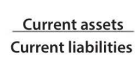
For 2.5 CR, the company has $2.5 of current assets for every $1 of current liabilities
Return on capital employed (ROCE) (Key Ratio)
Financial performance of a firm based on capital invested
Capital emloyed
CE = Owners’ equity (Net worth) + noncurrent liabilities
Owner’s equity Formula
OE = Total assets - total liabilities
ROCE General Rule
Should be ↑ than interest rate of commercial banks because if not, just deposit it at the bank.
Hence, ROCE needs to be high for investors to choose the company over banks
Which profit is ROCE used for
Net Profit before tax and interest for better historical comparisons
Liquidity Ratios
Firm’s ability to pay its short term liabilities from its current assets
Why Liquidity Ratios Are Sought After
Helps creditors and financial lenders know if they’re getting their money back
Helps shareholders and potential investors know if the firm can pay its debts
Liquid Assets
Assets that can be turned into cash quickly, without losing value
Current Ratio (CR)
Firm’s ability to cover shorrt terms debts in the next 12 months of the balance sheet
Where Current Ratio Should Be Generally & Why
1.5-2.0 because some current assets may be unable to be sold without losing value & shows that there is sufficienct working capital
<1.0: that short term debts > liquid assets
>2.0: business may have too much cash (better spent on trade) or too many debtors (more likely for bad debts or customers defaulting) or too much stock (↑ stock and insurance costs)
Exceptions include Supermarkets w/ 2.1 CR because they need all the stock or biotechnology who has >3.0 due to lengthiness of developing drugs
Working Capital
WC = current asset - current liabilities
Significance of WC
Positive WC = potential to invest and grow
Negative WC = possible problems paying creditors and suppliers or lead to bankruptcy
How to improve CR
Raising value of current assets and reducing value of current liabilities
Acid Test Ratio (Quick Ratio)
Current ratio but without the value of stocks
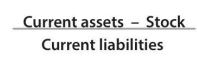
Why ATR Is Used Over CR
When stocks are hard to convert quickly i.e. semi finished goods or highly expensive stock
Where ATR Should Be Generally
1:1 otherwsie working capital difficulties or liquidity crisis
>1 means that firm is keeping too much cash
Liquidity Crisis
Firm is unable to pay its short term debts
Which Liquidity Ratios are wanted by which stakeholders
All use both to know a company will not be able to pay them back
All use both to track liquidity which helps in predicting financial stability
All use both to compare against industry averages
Trade Creditors & Short term Debtors use ATR because stock may be hard to turn to cash quickly
Investors & Shareholdrrs use CR for management efficiency (firm is investing enough cash or not)
Long Term Debtors look at current ratio to assess WC management
How to iprove ATR
↑ amount/price of current assets
↓ amount of current liabilities
Sell fixed assets and lease back to turn into cash
Debt (invoice) factoring - selling all invoices to a 3rd party
Uses Of FInancial Ratios
Employees & trade unions to assess chances of pay rises & job security
Managers & directors to assses chances of management bonsues or identify areas of improvement
Trade creditors to see if debts can be paid back
Shareholders to compare firm’s ROI vs other investments
Financies to see if loans can be paid back
Local community for potential job opportunities or securing spnosohip deals to local projects
Limitations of Financial Ratio Analysis
Do not indicate current or future financial situation
Changes externally not affecting internal workings can still change financial ratios
No universal standard to reporting final ccounts
Qualitative factors ignored
Differing organisatioal objectives between businesses
How to improve ROCE
Pay off long term debt - reduces Capital Employed = ↑%
Net Profit
Net Revenue - all expenses
Investment
Purchase an asset with potential for future financial benefits
Investment appraisal
Quantitative techniques that calculate financial costs and benefits of an investment decision
2 main methods of investment appraisal
Payback period, average rate of return, net present value (HL)
Payback Period
# of time for an investment project to earn enough to repay initial investment cost
Payback period formula
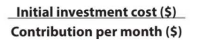
How to calculate PBP with variable contribution
Use cumulative cash flow method
Advantages of using PBP
Simplest and quickest out of all three
Useful for firms with liquidty problems
Lets firms see if an asset can break even before being replaced
Allows different investments projects with different costs
Helps managers assess projects that’ll yield quick returns
Disadvantages of using PBP
Contribution/month is unlikely to be constant
Focused on time and not profits
Encourages short term approach to investing
Not siutable for businesses like property developers who are unlikely to receive pay back for a long time
Prone to errors
Average rate of return ARR
Average profit of an investment project as a % of # invested
ARR formula
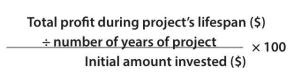
Main function of ARR
Helps managers compare return on diffferent investment projects
Real return of ARR + example
ARR is compared against base interest reate in the economy
Mcdonald’s project is 7% and savings interest rate is 3%, real rate of return is 4%
Advantage of ARR
Easy comparisons of estimated returns on different investment projects
Disadvantages of ARR
Inogres net cash flows
Prone to forecasting errors if considering seasonal factors
Needs a project’s useful life span before calculating
Need of many time based forecasts = ↑ errors bc of ↑ time prediciting
Qualitative investment appraisal methods
PORSCHE
Projections - intuition
Objectives
Risk profile - risk-adverse business or not
State of the economy
Corporate image
Human relations - how it affects staff
External shocks - external influences
Cumulative net cash flow
Sum of investment project’s net cash flow for a year + net cash flow of all previous years
Reminders about quantitative investments
Quality & Reliability of data
Changes in interest rates: affects potential gains of a project
Does not capture all relevant costs and benefits
Capital expenditure
Finance spent on fixed assets
Resons for capital expenditure
Add extra production capacity
Improve efficiency by using better technologies
Replace worn out or obsolete capital equipment and machinery
Comply with changing legislation and regulations
Chllenges of capital expenditure
High cost
Limited sources of finance
Feasability of some investments
Revenue expenditure
Finance spent on daily operations and payment of indirect costs
Collateral
Financial guarantee for securing external loan capital to invest for business growth
Fixed assets
Items of monetary value that have long term function for businesses
Sources of finance
Where or how businesses obtain funds
Internal sources of finance
Money or funds coming from within the business
Types of internal sources of finance
Personal funds (for sole traders)
Retained profit
Sale of assets
Personal funds
Entrepreneur’s own savings
Retained Profit
Profits that a businesss keeps after paying taxes or dividends
Sale of assets
Businesses selling their dormant (unused) assets
Main uses for internal source of finance
Personal funds: Main source of finance for sole traders
Retained profit: Capital expenditure
Sale of assets: If businesses relocate or fight liquidity issues
External sources of finance
Money or funds coming from outside businesses
Types of external sources of finance
Share capital
Loan capital
overdrafts
trade credit
crowdfunding
leasing
microfinance providers
business angels
Share Capital
Money raised from selling shares in a LLC
Share issue (share placement)
exisintg publicly held companies raising finance by selling more shares
Loan capital
med-long sources of finance obtained from commercial lenders
mortgages
secured loans for the purchase of proeprty (land or buildings)
business development loans
highly flexible loans to meet needs of the borrower to develop an aspect of the business
Debentures
Long term loans where holders receive paymentrs regardless of a business’ loss/profit before shareholders are paid dividends
Purpose of debentures
Allows postopnes payments to ease firm’s cash flow problems
Debentures ownership in companies
Debenture holders do not have ownership or voting rights.
Overdrafts
Financial service to allow a business to take more money than available in the account
Whne overdrafts are suitable
When firms need large cash outflow orwhen products are sold on trade credit and are awaiting customer payment
Disadvantage of overdrafts
Overdrafts are repayable on demand (demand immediate payment) by the lender
Trade credit
Allows a firm to postpone payments from the date of the purchase.
Usually allows 30-60 days to pay
Helps ease cash flow problems
Crowdfunding
Raising finance from a large number of indvidusals to finance a new business venture or project
Heavily regulated to protect donors and prevent fraudulent business activites
Start ups often use crowdfunding but often results in loss of ownership and conotrol
Leasing
Cont4ract between lessor and lessee that allows lessee to hire assets by paying rental income to the lessor (leagl owner)
Suitable for owners without enough capitals
Dis/advantages of Leasing
+: Increases cash for other purposes
+: Responsibility of repairs + maintenance is on the lessor
+: Can be classed as business expense to reduce tax bill
-: More expensive that buying in the longterm
Sale and leaseback
Selling a fixed asset (to raise finance) and immediately leasing the property back
Hire Purchase (HP)
Firms pay creditors in instalments (12-24 months) and prpoerty is legally owned by the creditor until all payments are paid.
Generally requires a down payment
Lender can repossess asset if buyer defaults
Microfinance providers
Enables disadvantaged members to gain access to financial services for the purpose of eradicating poverty
Business angels
Wealthy individuals who invest money in businesses
Dis/advantages of business angels
+: Finances firms who are unable to secure finance from banks, shareholders or other investors
+: Business angels’ experience and financial backing massively helps the business
-:Likely to take proactive role in the business venture and will take control from teh owner
-Might have to buy out the bsuiness angel if they wish for control and ownership
Dis/advantages of microfinance providers
+Gives access to people who otherwise cannot get finance
+Creates new job opportunities
+Buyers are less likely to pull children out of schoool and receive better access to healthcare services
-Unethical due to profiting from the poor and unemployed
-Limited finance due to risk of defaulting
-Not all poor ppl qualify due to business seeking profit
Business Angels’ criteria for investing
Return on investment; needs high return due to unprofitable nature of startups
Business plan: the purpose or goals of the businesss venture that help with the business’ direction and identity. ↑ Creatvity = ↑ growth potential
People: People that are part o of the business
Track record: history of the business and its management i.e. earning history and track record of payament
Short term sources of finance
Sources available for <12 months (or fiscal year) to pay for daily/routine business operations
Long term sources of finance
Sources availalble for >12 months (or fiscal year) for purchasing fixed assets or financing expansion
Factors related to choosing financial sources
SPACED
Size and status of firm: ↑ size = ↑ ease of raising finance
Purpose of finance: different sources are more suitable for different needs
Amount required:
Cost of finance: purchase cost of assets and associated costs, ↑ costs ≈ need LTSOF
External factors: Interest rate & stock market volatillity affect confidence levels
Duration: Long term capital expenditure = LTSOF etc