Astronomy quizzes
 Call Kai
 Learn
Learn Practice Test
 Spaced Repetition
 Match
Match Flashcards
 Knowt Play
1/393

There's no tags or description
Looks like no tags are added yet.
Name | Mastery | Learn | Test | Matching | Spaced | Call with Kai |
|---|
No analytics yet
Send a link to your students to track their progress
394 Terms
This term is used to describe rocks on the Earth of extra-terrestrial origin
Meteorite
In Southern Australia, the Sun will reach the highest point in the sky closest to this date.
December solstice
The Ecliptic is another term for the Celestial Equator. A line in the sky directly above the Earth's equator
False
Ancient Greeks inferred the spherical Earth by observing
The shadow of the Earth during every lunar eclipse
On December 21st, locations north of the Arctic circle will experience
24 hours of darkness
The term used to describe the slow change in the orientation of the Earth's axis
precession
What is the name given to the path of the Sun and planets across the celestial sphere?
Ecliptic
This number represents the period (time) of the Earth's revolution.
365.25
The angular altitude of Polaris (the north star) when viewed from the northern hemisphere is equal to
The observer's latitude
During which season (in the US) is the Earth closest to the sun?
Winter
On or about March 21st the sun will shine directly on the
Equator
Which of the following is NOT a classification of meteorites?
Tektite
Perihelion (when the Earth is close to the Sun) occurs in which Northern Hemisphere Season?
Winter
In the continental US, the Sun will reach the highest point in the sky closest to this date
Summer solstice
On December 21st locations south of the Antarctic circle will experience
24 hours of light
Which of the following are NOT units smaller than a degree?
an hour
Debris deposited globally in the geologic record at the end of the Cretaceous period was enriched in this element supporting the hypothesis of an asteroid impact leading to the extinction of non-avian dinosaurs.
Iridium
Which of the following may be used to determine if a crater was formed from asteroid impact rather than volcanic eruption?
ALL
Glass from melted rocks, High pressure minerals, Shatter cones, Enrichment of rare earth metals
On this day the Sun will shine directly on the tropic of Cancer.
June solstice
What is the point on the celestial sphere above the Earth's axis of rotation?
Celestial pole
The grid system used to indicate locations in the sky
Right Ascension and Declination
Aphelion (when the Earth is furthest from the Sun) occurs closest to which calendar date?
July 4th
During this type of eclipse one edge of the Moon may appear to dim slightly
Penumbral lunar
This term is used to describe a partial shadow of an object:
Penumbra
Lunar eclipses may happen each month when the Moon is on the opposite side of the Earth from the Sun
False
This is the term used to describe the complete shadow of an object:
Umbra
This type of eclipse only happened during a new moon.
Total solar
Select the conditions necessary for an annular solar eclipse
New moon at apogee
Lunar eclipse can only happen during this phase of the moon.
Full
Which statement correctly describes the term "node" as it applies to orbits and eclipses.
The node is the point where the plane of the Moon's orbit around Earth intersects the plane of the Earth's orbit around the Sun
Select the conditions necessary for a total solar eclipse
new moon at perigee
What is the point on the celestial sphere directly above an observer?
Zenith
Which planet could NEVER be seen on the meridian at midnight?
Mercury
The TWO primary reasons for the Earth to experience warmer summertime temperature.
Longer days, more direct sun angle
From your experience with simulations, which of the following will NOT affect impact crater size?
(All) Projectile velocity, Projectile mass, Impact angle, Projectile Density
Meteorites are frequently magnetic
True
The length of the sidereal day (one exact rotation of the Earth) is precisely 24 hours.
False
As seen from your current location, when will an upright flagpole cast no shadow because the Sun is directly above the flagpole?
Never from your current location
What is the North/South line that passes directly above an observer and extends to each horizon?
Meridian
What time does the new moon set?
6 PM
If the moon was rising at 3 AM what does it look like?
Waning crescent
What time is the third quarter moon on the meridian?
6 AM
What time does the first quarter moon set?
Midnight
If the moon was setting at 6 AM, what does it look like?
Full moon
What time does the full moon rise?
6 pm
What time does the third quarter moon set?
Noon
Lunar eclipses may happen each month when the Moon is on the opposite side of the Earth from the Sun.
False
Select the conditions necessary for an annual solar eclipse
New moon at apogee
Which of the following would make you weigh half as much as you do right now?
Take away half of the Earth's mass
The force of gravity on an object may best be described by this property
Weight
The apparent backward motion of the planets in their path across the sky
Retrograde
This term describes the incorrect Earth centered solar system
Geocentric
This statement: "A line segment connecting a planet and the Sun will sweep sectors of equal area in equal time."
Kepler's second law
Kepler proposed that the planets orbit the sun in this geometric path.
Ellipse
This law of motion indicates the shape of planetary orbits.
Kepler's first law
This Astronomer/Astrologer made many careful measurements of the stars and planets, his student went on to establish planetary motion.
Tycho
In the second century this astronomer used self designed tools to accurately measure the position of stars and create an accurate star map.
Hipparchus
What time does the full moon reach the meridian?
Midnight
What time does the new moon set?
6 PM
With no change in mass, according to Newton's law of Gravity, if the distance of a planet from the Sun tripled, the force of gravity would ...
Decrease by 9 times
Rocket propulsion (hot gasses being ejected from a nozzle at high speed) producing thrust is an example of this law of motion.)
Newton's third law
This law of motion established a mathematical relationship between the distance and the orbital period of planets.
Kepler's third law
Which of the following was NOT an important assumption made by Eratosthenes?
The Earth is an oblate spheroid
This law of motion indicates that an object at rest will stay at rest and an object in motion will stay in motion unless acted on by an external force.
Newton's first law
The Geometric principle that was essential to Eratosthenes' calculation
Alternate interior angles are congruent
This Italian astronomer built and used a telescope to observe the Sun, Moon, planets and stars.
Galileo
Using Geometry, this scientist was the first to measure the circumference of the Earth.
Eratosthenes
With evidence of volcanoes, a rocky surface, large fields of sand dunes, and sedimentary rocks, this planet has the most identified similarities to Earth.
Mars
This planet orbits the Sun in approximately 3 months at a distance less than half of the distance between the Sun and Earth.
Mercury
Which of the following is NOT believed to be part of the internal heat source for planets?
Nuclear fusion
Cyclonic (spinning) storms and weather systems have been detected on all of these planets except
Mercury
Of the terrestrial planets, this planet has the thickest atmosphere. (Greatest atmospheric pressure)
Venus
Few large impact craters are found on Venus. The leading hypothesis for this observation is:
Recent volcanism has covered impact history
Strong geologic evidence for running water has been detected on these two terrestrial planets.
Mars and Earth
Regarding the three terrestrial planet moons. The terrestrial planets with moons are:
Earth and Mars
Which of the following terrestrial bodies do NOT show evidence of volcanism?
All (mercury, venus, earth, mars)
This planet located 1.5 A.U. from the Sun has a rotation period slightly greater than 24 hours.
Mars
All of the following are part of the 2006 definition of a planet EXCEPT
The object maintains a distance of 1 AU from the Sun
Which atmospheric component is NOT significant as a "green-house" or atmospheric warming gas?
Argon
All of the following are considered Terrestrial planets EXCEPT
Titan
This terrestrial planet has the highest density leading astronomers to believe that it has a large core relative to the size of the planet.
Mercury
Unlike all of the other planets, this planet rotates clockwise when viewed from the north pole.
Venus
Carbon Dioxide is a common gas in terrestrial atmospheres typically released by volcanoes. This is not as common in Earth's atmosphere because...
Photosynthesis of green plants has removed carbon dioxide
Due to recent mathematical modeling, it appears likely that the planets were not always in their current configuration. Which planet was likely the most distant from the Sun for the first billion years of the history of the solar system?
Uranus
The Kuiper belt is located:
Beyond the orbit of Neptune
This moon of Saturn is know for active geology with geysers that contribute ice to Saturn's rings.
Enceladus
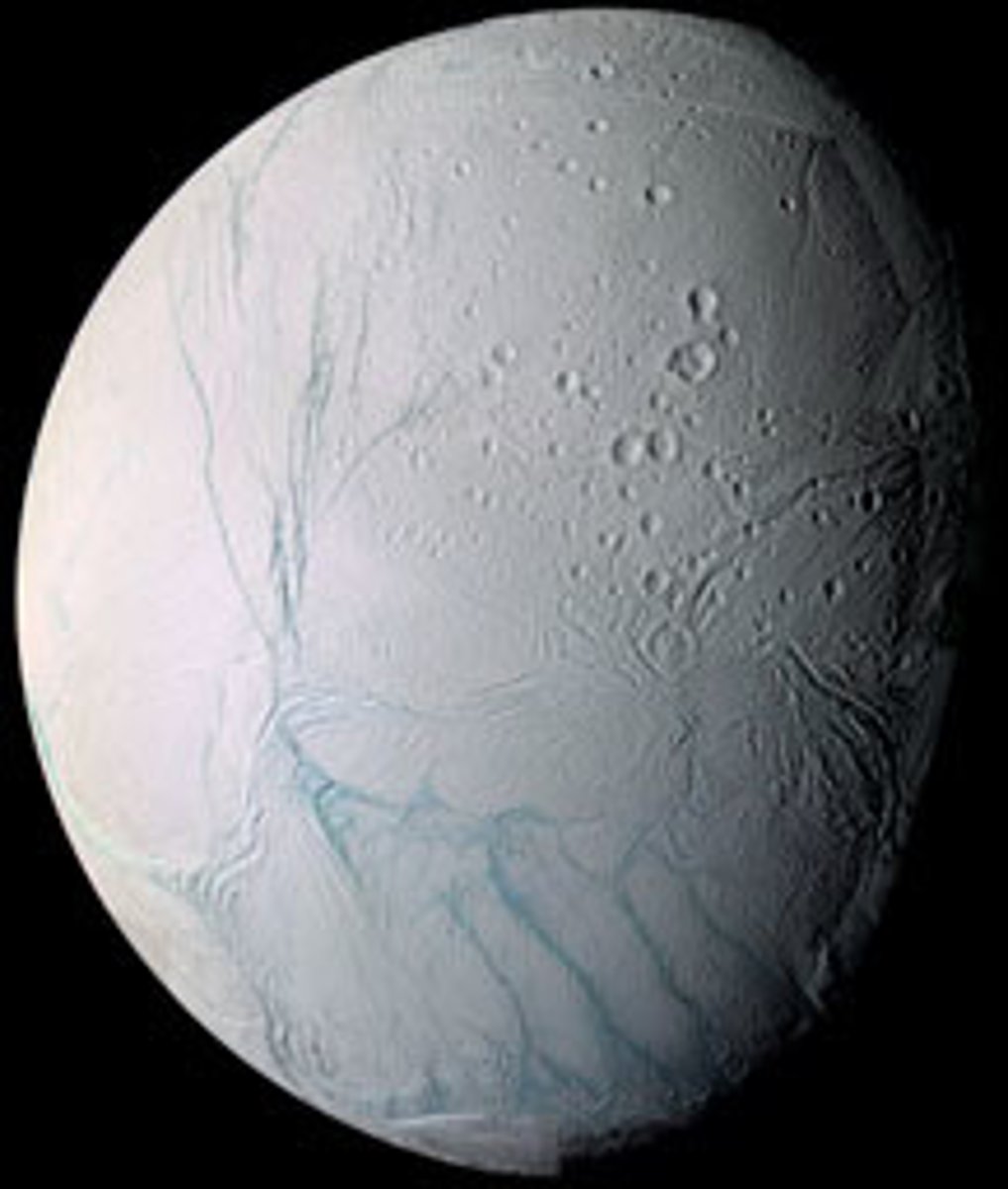
Geysers of water and ice from this moon have been seen adding material to Saturn's rings.
Enceladus
This statement is NOT true about ring systems:
Ring particles have uniform orbital periods (similar to a LP record inner and outer particles complete orbits at the same rate)
Gravitational interactions between moons and ring particles can change the shape and organization of planetary rings.
True
Near Earth Asteroids Itokawa and Bennu are best described as:
Rubble Piles- conglomeration of rocks weakly held together by gravity
Completing one orbit of the Sun in 84 years, this ringed planet "rolls" around the Sun due to its highly tilted axis.
Uranus
This atmospheric gas is believed to give Uranus and Neptune their distinctive blue/green color
Methane
With more water than found in all of Earth's oceans, this moon of Jupiter is slightly smaller than Earth's Moon.
Europa
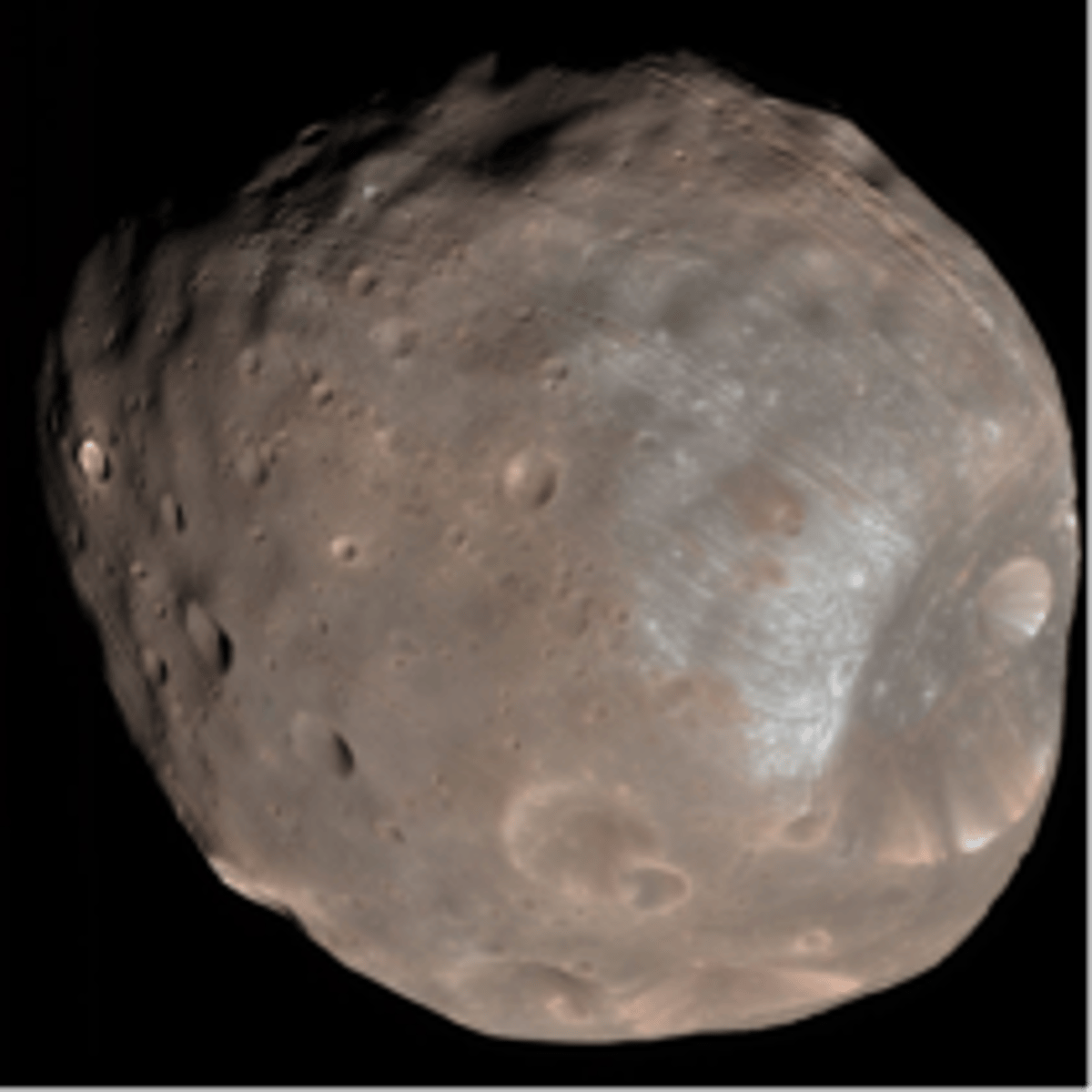
This small moon of Mars is thought to be a captured asteroid from the Main Belt group.
Phobos
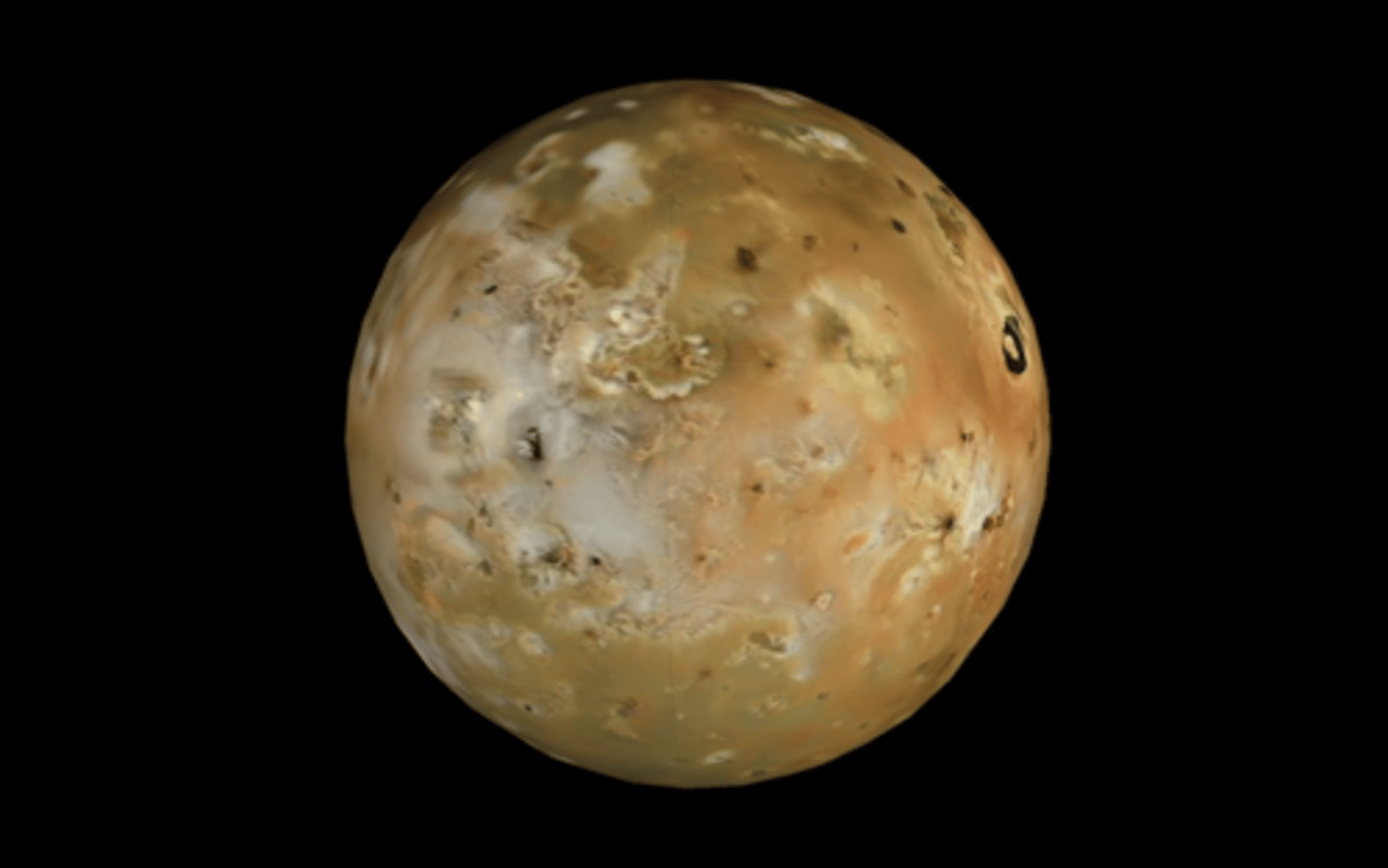
This moon of Jupiter is known to be the most volcanically active object in the solar system.
Io
Which Jovian planet does NOT have rings?
All have rings
Rain, Rivers and Lake on Titan are likely composed of:
Methane and other hydrocarbons
This evidence supports the hypothesis that the Jovian planets have an electrically conductive liquid interior.
Strong magnetic fields
The cause of the extreme volcanism on Jupiter's moon Io.
Orbital resonance and tidal heating
When visited by the New Horizons space probe in 2015 planetary scientists observed all of the following on the dwarf planet Pluto except:
A heavily cratered surface