Back Muscles

0.0(0)
Studied by 0 people
call kaiCall Kai
learnLearn
examPractice Test
spaced repetitionSpaced Repetition
heart puzzleMatch
flashcardsFlashcards
GameKnowt Play
Card Sorting

1/24

flashcard set

Earn XP

Description and Tags

Baby got Back

Last updated 3:57 PM on 6/7/26
Name
Mastery
Learn
Test
Matching
Spaced
Call with Kai

No analytics yet

Send a link to your students to track their progress

25 Terms
1
New cards
<p>Back Muscle Organization</p>

Back Muscle Organization

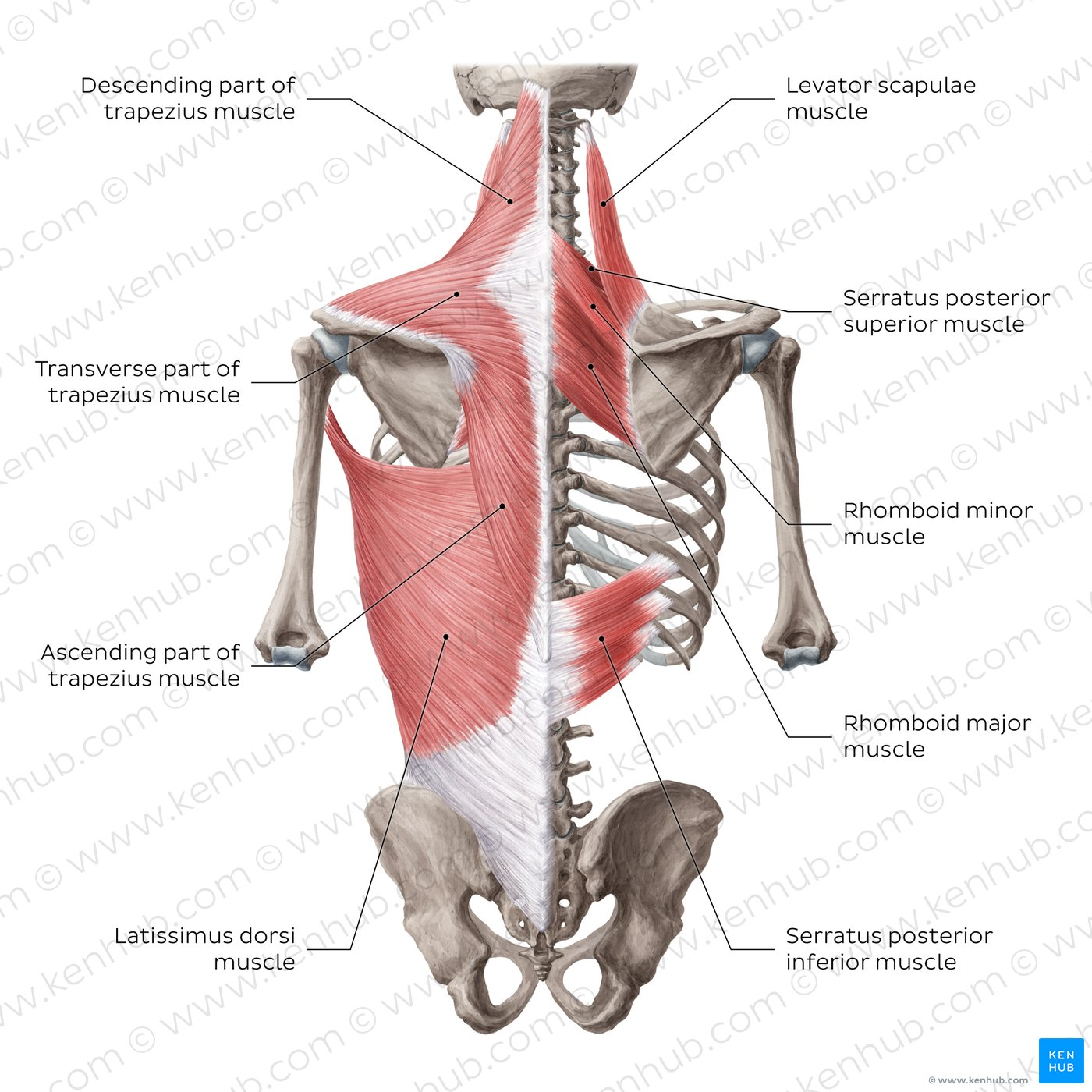
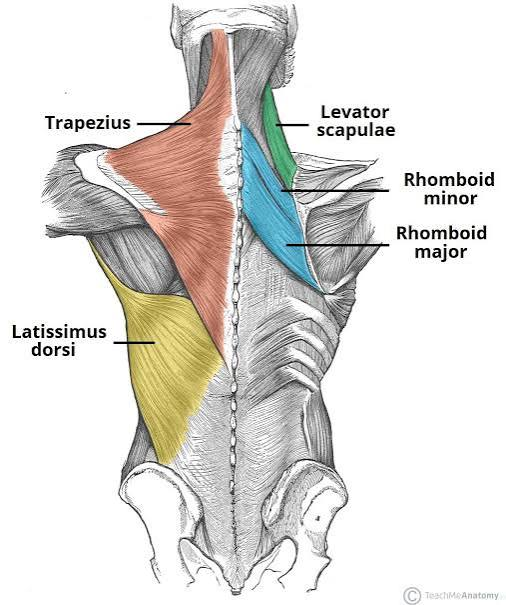
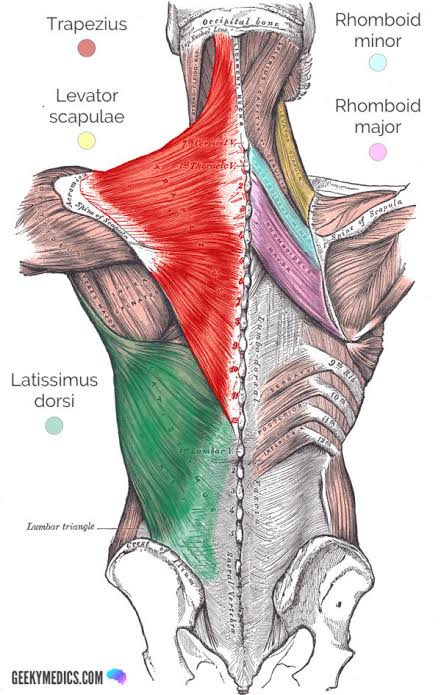
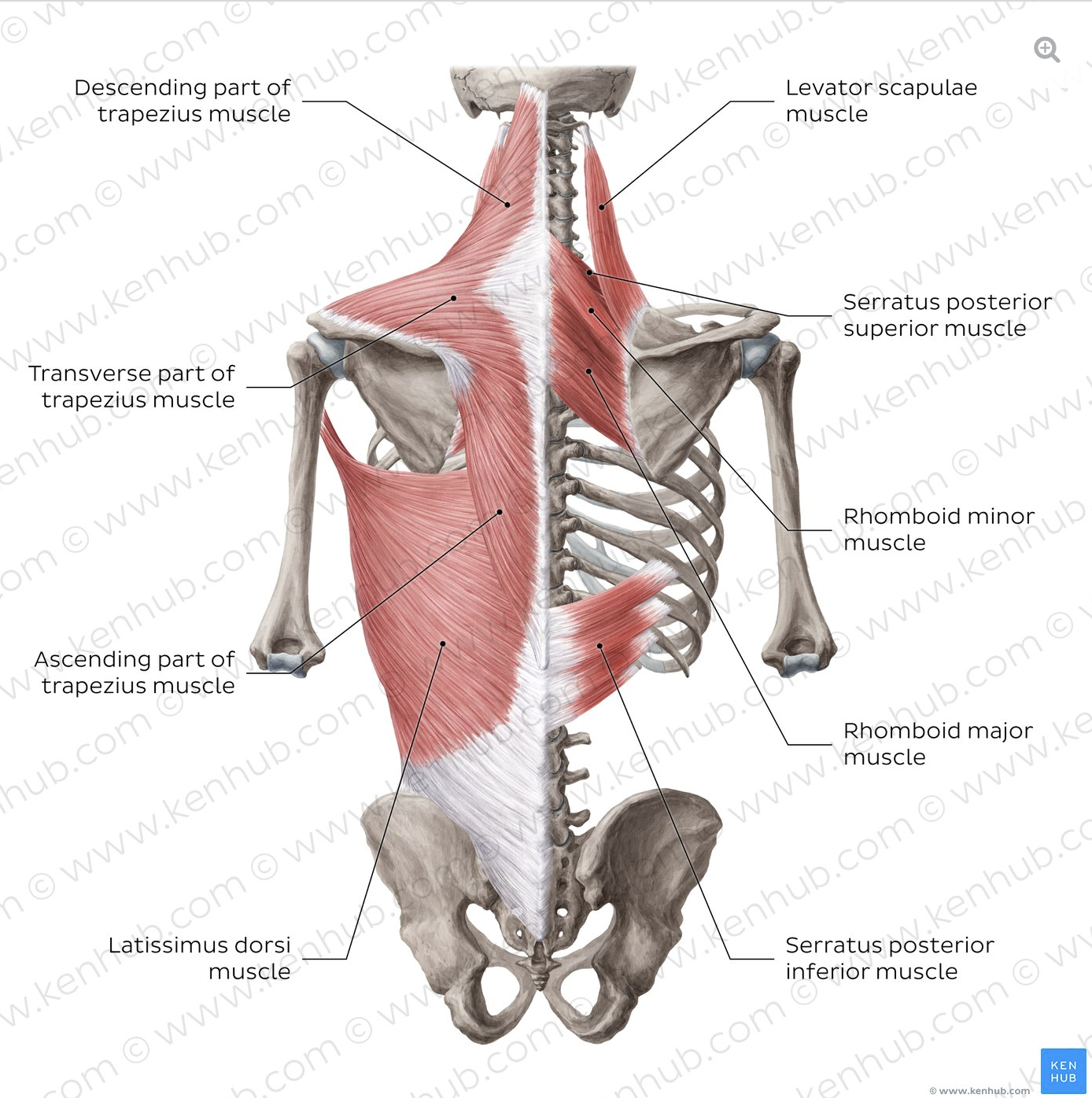
Extrinsic/Superficial Back Muscles (immigrant muscles of the upper limb that lie superficially in the back)

  • superficial layer:

    • trapezius

    • latissimus dorsi

    • levator scapulae

    • rhomboid major

    • rhomboid minor

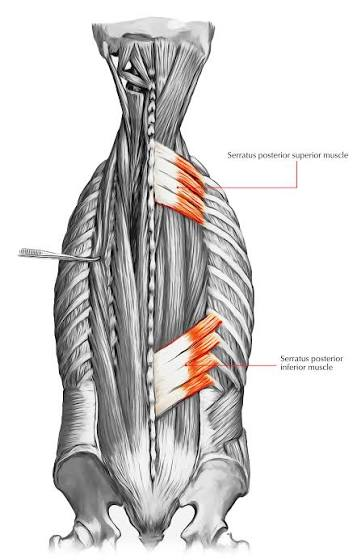
  • intermediate layer:

    • serratus posterior superior

    • serratus posterior inferior

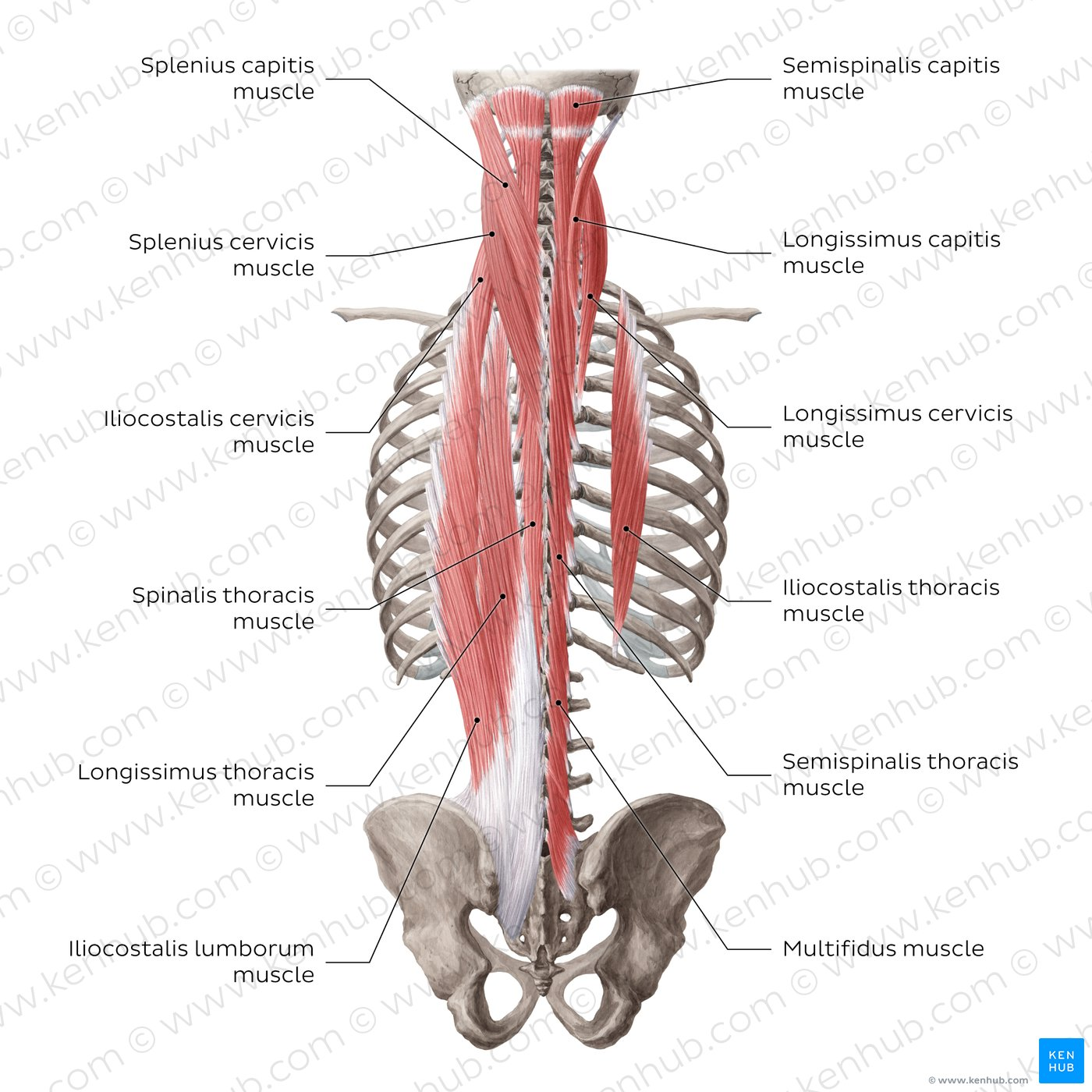
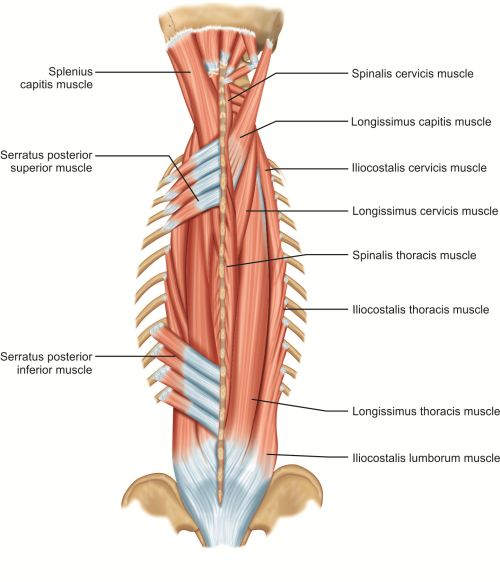
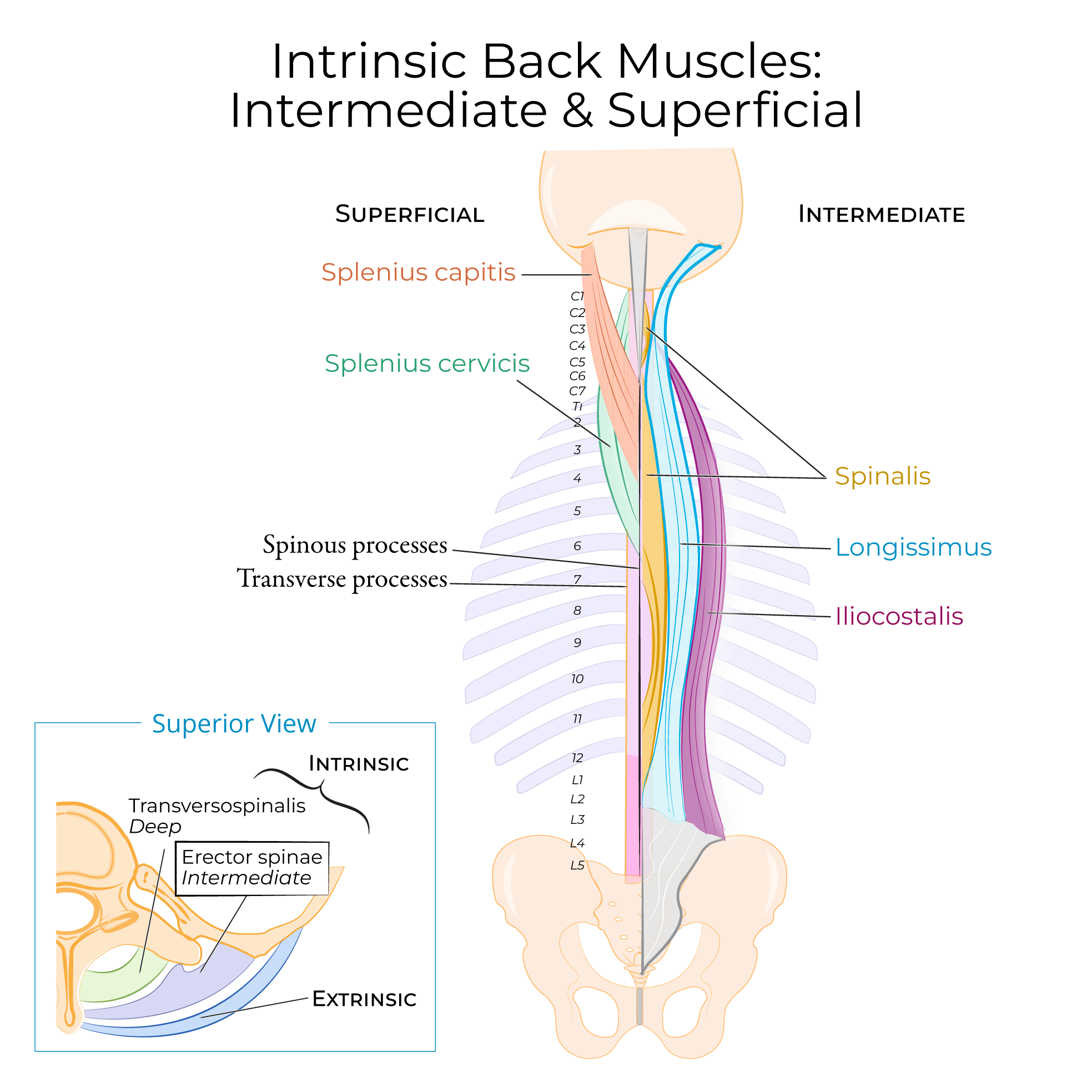
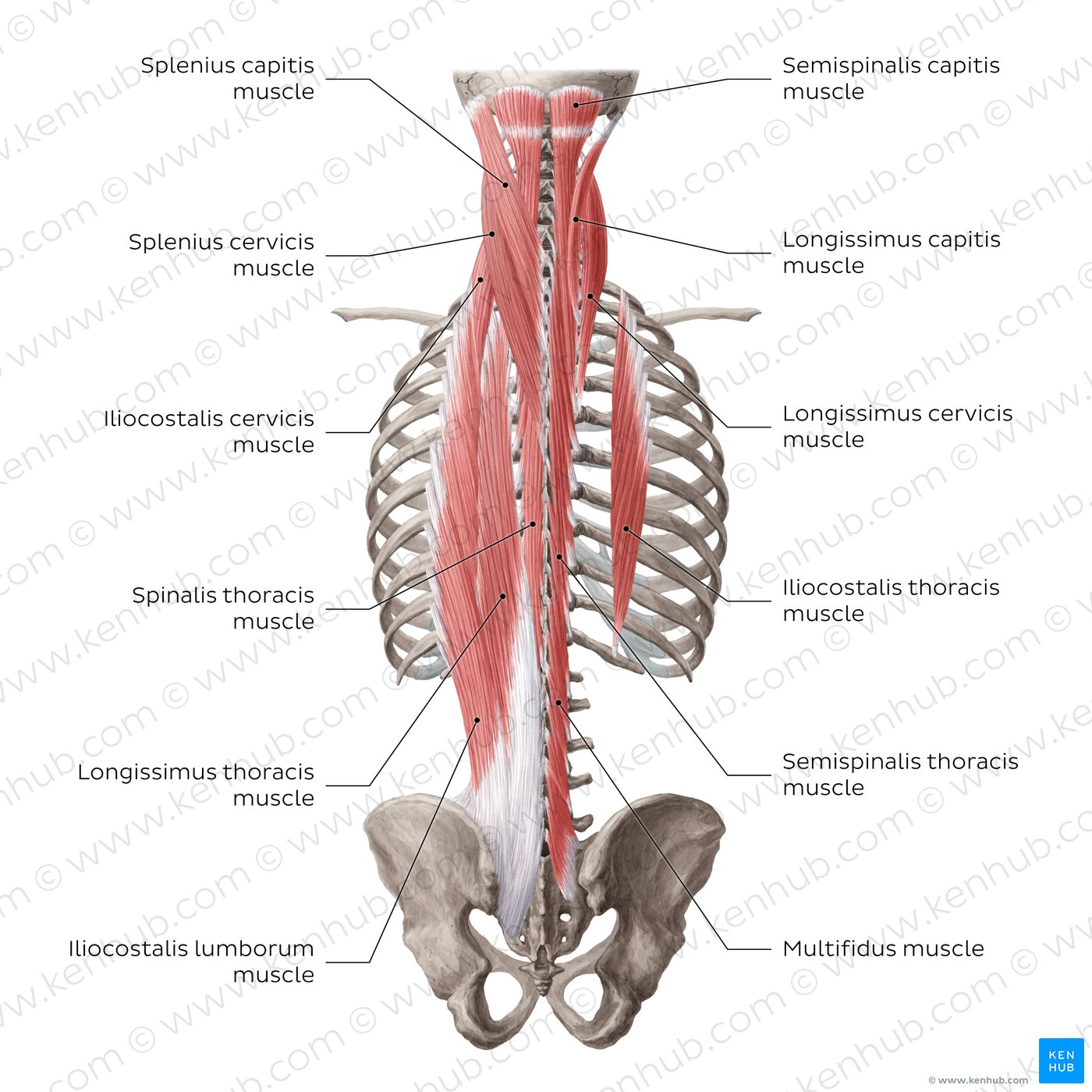
Intrinsic/Deep Back Muscles (true muscles of the back that lie deep to the thoacolumbar fascia)

  • superficial layer:

    • splenius capitis

    • splenius cervicis

    • erector spinae muscles:

      • iliocostalis

      • longissimus

      • spinalis

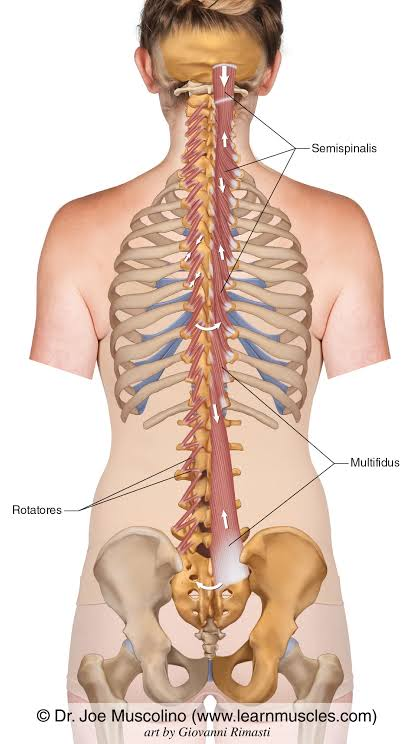
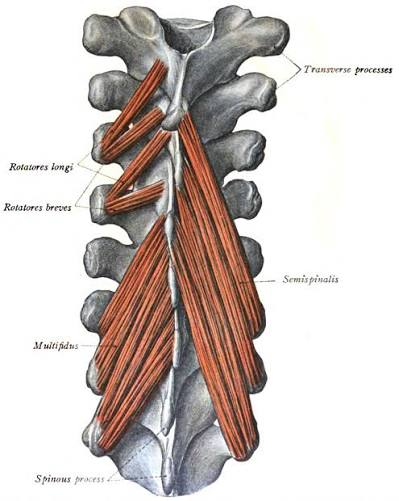
  • deep layer:

    • transversospinals:

      • semispinalis

      • multifidus

      • rotatores

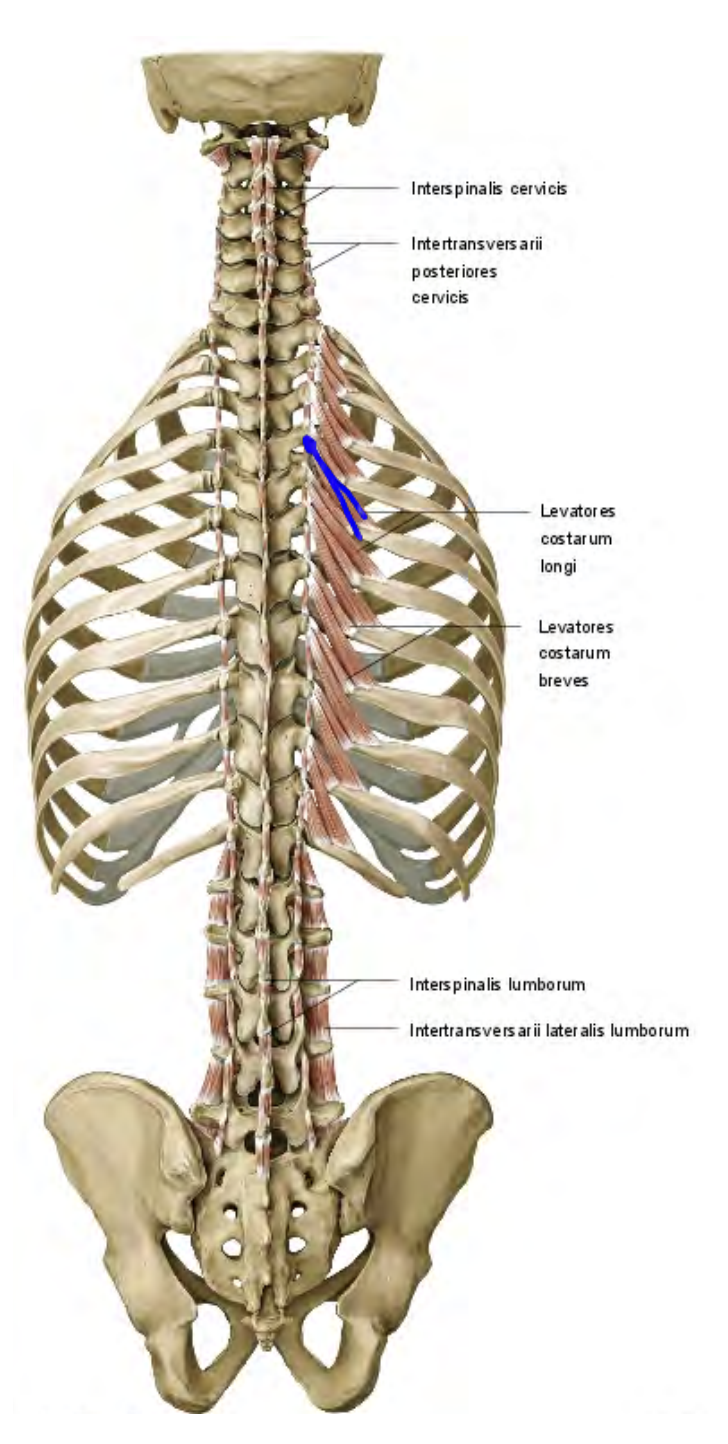
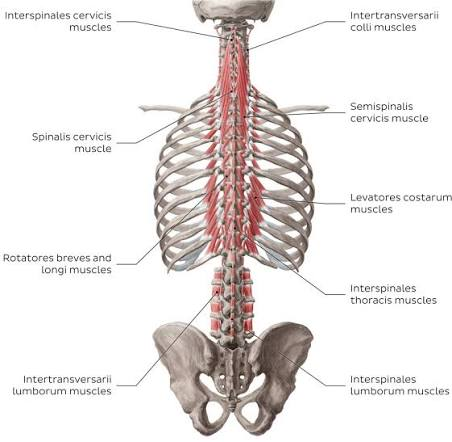
  • deepest layer:

    • interspinales

    • intertransversarii

<p><strong>Extrinsic/Superficial Back Muscles </strong>(immigrant muscles of the upper limb that lie superficially in the back)</p><ul><li><p>superficial layer:</p><ul><li><p>trapezius</p></li><li><p>latissimus dorsi</p></li><li><p>levator scapulae</p></li><li><p>rhomboid major</p></li><li><p>rhomboid minor</p></li></ul></li></ul><p></p><ul><li><p>intermediate layer:</p><ul><li><p>serratus posterior superior</p></li><li><p>serratus posterior inferior</p></li></ul></li></ul><p></p><p><strong>Intrinsic/Deep Back Muscles </strong>(true muscles of the back that lie deep to the thoacolumbar fascia)</p><ul><li><p>superficial layer:</p><ul><li><p>splenius capitis</p></li><li><p>splenius cervicis</p></li><li><p>erector spinae muscles:</p><ul><li><p>iliocostalis</p></li><li><p>longissimus</p></li><li><p>spinalis</p></li></ul></li></ul></li></ul><p></p><ul><li><p>deep layer:</p><ul><li><p>transversospinals:</p><ul><li><p>semispinalis</p></li><li><p>multifidus</p></li><li><p>rotatores</p></li></ul></li></ul></li></ul><p></p><ul><li><p>deepest layer:</p><ul><li><p>interspinales</p></li><li><p>intertransversarii</p></li></ul></li></ul><p></p>
2
New cards
<p>trapezius</p>

trapezius

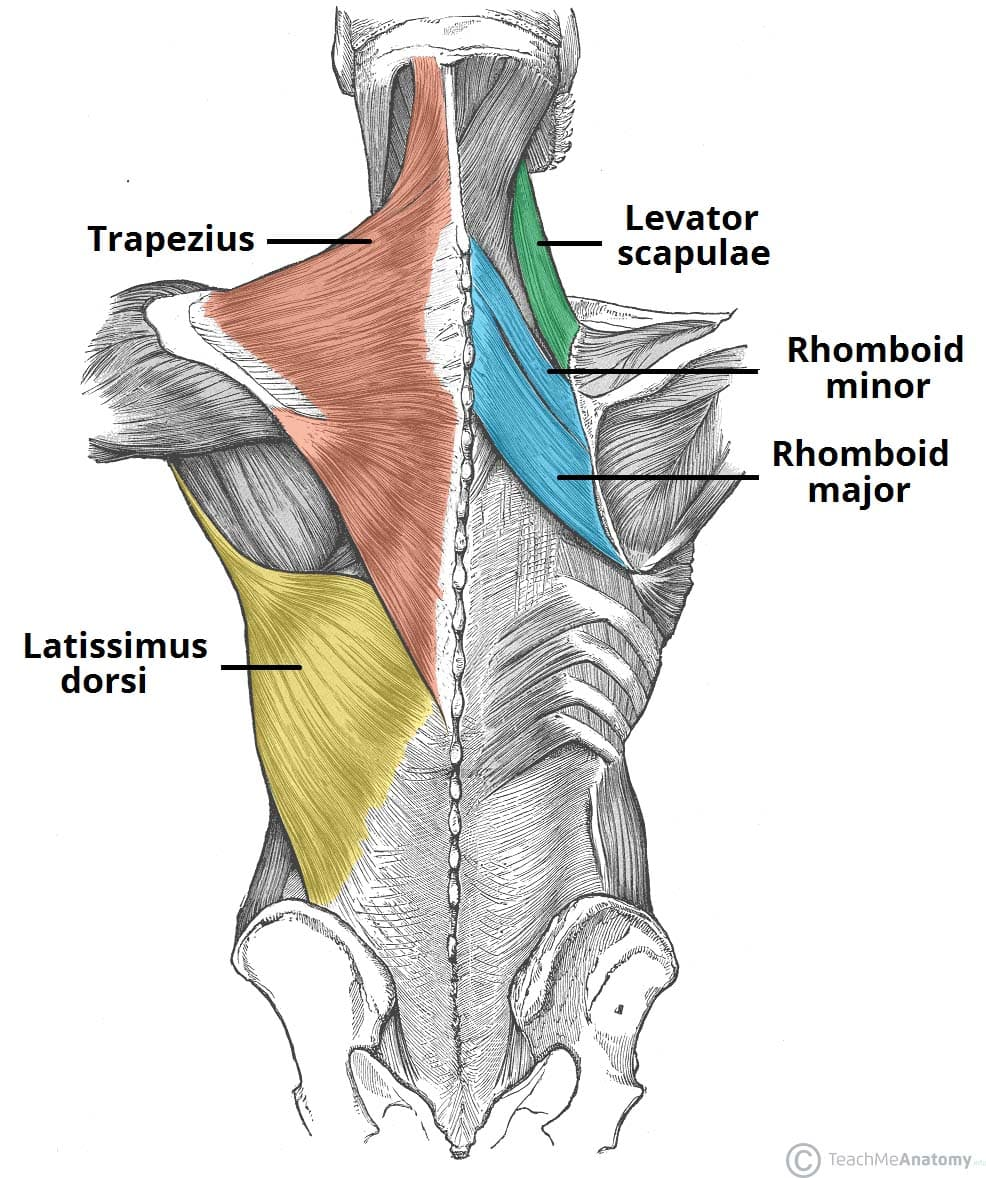
  • a large, triangular, paired muscle on the posterior aspect of the neck and thorax

  • has many attachment points, spanning from the skull and vertebral column to the shoulder girdle

  • part of the superficial layer of extrinsic muscles of the back, along with lat dorsi, rhomboid major and minor, and levator scapulae

origin → descending part (superior fibres): medial third of the superior nuchal line, external occipital protuberance, nuchal ligament

→ transverse part (middle fibres): medial acromial margin, superior crest of spine of scapula

→ ascending part (inferior fibres): spinous processes and supraspinous ligaments of vertebrae T4-T12

insertion → descending part: lateral third of clavicle

→ transverse part: medial acromial margin, superior crest of spine of scapula

→ ascending part: lateral apex of the medial end of scapular spine

action → descending part: draws scapula superomedially at the scapulothoracic joint, extends the head and neck and ipsilaterally flexes the head and neck at the atlantooccipital joint, rotates the head contralaterally at the atlantoaxial joint

→ transverse part: draws the scapula medially at the scapulothoracic joint

→ ascending part: draws the scapula inferomedially at the scapulothoracic joint

innervation → motor innervation: accessory nerve (CN XI)

→ motor/sensory: anterior rami of spinal nerves C3-C4 via cervical plexus

blood supply → descending part: occipital artery

→ transverse part: superficial or transverse cervical artery

→ ascending part: dorsal scapular artery
<ul><li><p>a large, triangular, paired muscle on the posterior aspect of the neck and thorax</p></li><li><p>has many attachment points, spanning from the skull and vertebral column to the shoulder girdle</p></li><li><p>part of the superficial layer of extrinsic muscles of the back, along with lat dorsi, rhomboid major and minor, and levator scapulae</p></li></ul><p></p><p>origin → descending part (superior fibres): medial third of the superior nuchal line, external occipital protuberance, nuchal ligament</p><p>→ transverse part (middle fibres): medial acromial margin, superior crest of spine of scapula</p><p>→ ascending part (inferior fibres): spinous processes and supraspinous ligaments of vertebrae T4-T12</p><p>insertion → descending part: lateral third of clavicle</p><p>→ transverse part: medial acromial margin, superior crest of spine of scapula</p><p>→ ascending part: lateral apex of the medial end of scapular spine</p><p>action → descending part: draws scapula superomedially at the scapulothoracic joint, extends the head and neck and ipsilaterally flexes the head and neck at the atlantooccipital joint, rotates the head contralaterally at the atlantoaxial joint</p><p>→ transverse part: draws the scapula medially at the scapulothoracic joint</p><p>→ ascending part: draws the scapula inferomedially at the scapulothoracic joint</p><p>innervation → motor innervation: accessory nerve (CN XI)</p><p>→ motor/sensory: anterior rami of spinal nerves C3-C4 via cervical plexus</p><p>blood supply → descending part: occipital artery</p><p>→ transverse part: superficial or transverse cervical artery</p><p>→ ascending part: dorsal scapular artery</p>
3
New cards
<p>latissimus dorsi</p>

latissimus dorsi

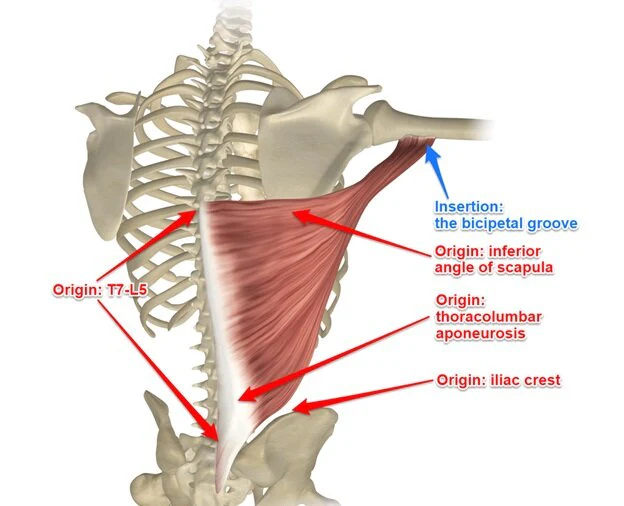
  • the widest muscle in the body!

  • relatively thin, covers almost all mack muscles at the posterior trunk except trapezius

  • functionally belongs to the muscles of scapular motion:

    • pulls the inferior angle of the scapula in various directions, producing movements of the shoulder joint, internal rotation, adduction, and extension of the arm

  • acts as an accessory muscle of respiration, assisting in deep inspiration and expiration by elevating or depressing the ribs

  • one of the main stabilizers of the spine during movement

  • divided into a vertebral part, iliac part, costal part, and scapular part

origin → vertebral part: spinous processes of T7-T12, thoracolumbar fascia

→ iliac part: posterior third of crest of ilium

→ costal part: ribs 9-12

→ scapular part: inferior angle of scapula

insertion → intertubercular sulcus (bicipital groove) of the humerus, between pectoralis major and teres major (Lady between two Majors)

action → arm internal rotation, arm adduction, and arm extension at the shoulder joint; assists in respiration

innervation → thoracodorsal nerve (C6-C8)

blood supply → thoracodorsal artery, perforating arteries of the 9th-11th posterior intercostal arteries, 1st-3rd lumbar arteries
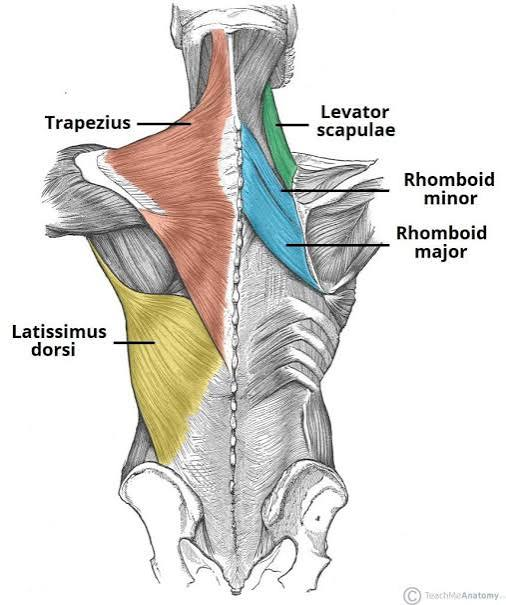
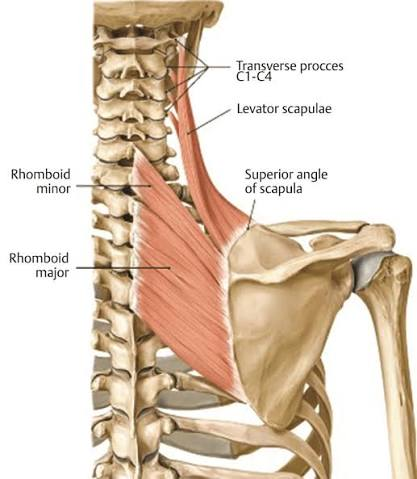
<ul><li><p>the widest muscle in the body!</p></li><li><p>relatively thin, covers almost all mack muscles at the posterior trunk except trapezius</p></li><li><p>functionally belongs to the muscles of scapular motion:</p><ul><li><p>pulls the inferior angle of the scapula in various directions, producing movements of the shoulder joint, internal rotation, adduction, and extension of the arm</p></li></ul></li><li><p>acts as an accessory muscle of respiration, assisting in deep inspiration and expiration by elevating or depressing the ribs</p></li><li><p>one of the main stabilizers of the spine during movement</p></li><li><p>divided into a vertebral part, iliac part, costal part, and scapular part</p></li></ul><p></p><p>origin → vertebral part: spinous processes of T7-T12, thoracolumbar fascia</p><p>          → iliac part: posterior third of crest of ilium</p><p>          → costal part: ribs 9-12</p><p>          → scapular part: inferior angle of scapula</p><p>insertion → intertubercular sulcus (bicipital groove) of the humerus, between pectoralis major and teres major (Lady between two Majors)</p><p>action → arm internal rotation, arm adduction, and arm extension at the shoulder joint; assists in respiration</p><p>innervation → thoracodorsal nerve (C6-C8)</p><p>blood supply → thoracodorsal artery, perforating arteries of the 9th-11th posterior intercostal arteries, 1st-3rd lumbar arteries</p><p></p>
4
New cards
<p>levator scapulae</p>

levator scapulae

  • anatomically belongs to the superficial layer of extrinsic back muscles, functionally belongs to the muscles of scapular motion along with rhomboid major and minor, serratus anterior, and serratus posterior superior and inferior

  • main function is to elevate the scapula

  • acts in conjunction with trapezius, lat dorsi, the rhomboids, and pec major and minor to inferiorly rotate the glenoid cavity, stabilize the spine, and extend and laterally flex the neck

origin → transverse processes of vertebrae C1-C4

insertion → medial border of scapula (from superior angle to root of spine of scapula)

action → draws scapula superomedially and rotates glenoid cavity inferiorly at the scapulothoracic joint, laterally flexes the neck (ipsilateral) and extends the neck at the cervical joints

innervation → anterior rami of the nerves C3 and C4, dorsal scapular nerve (branch of C5)

blood supply → transverse cervical and ascending cervical arteries (branches of the thyrocervical trunk)
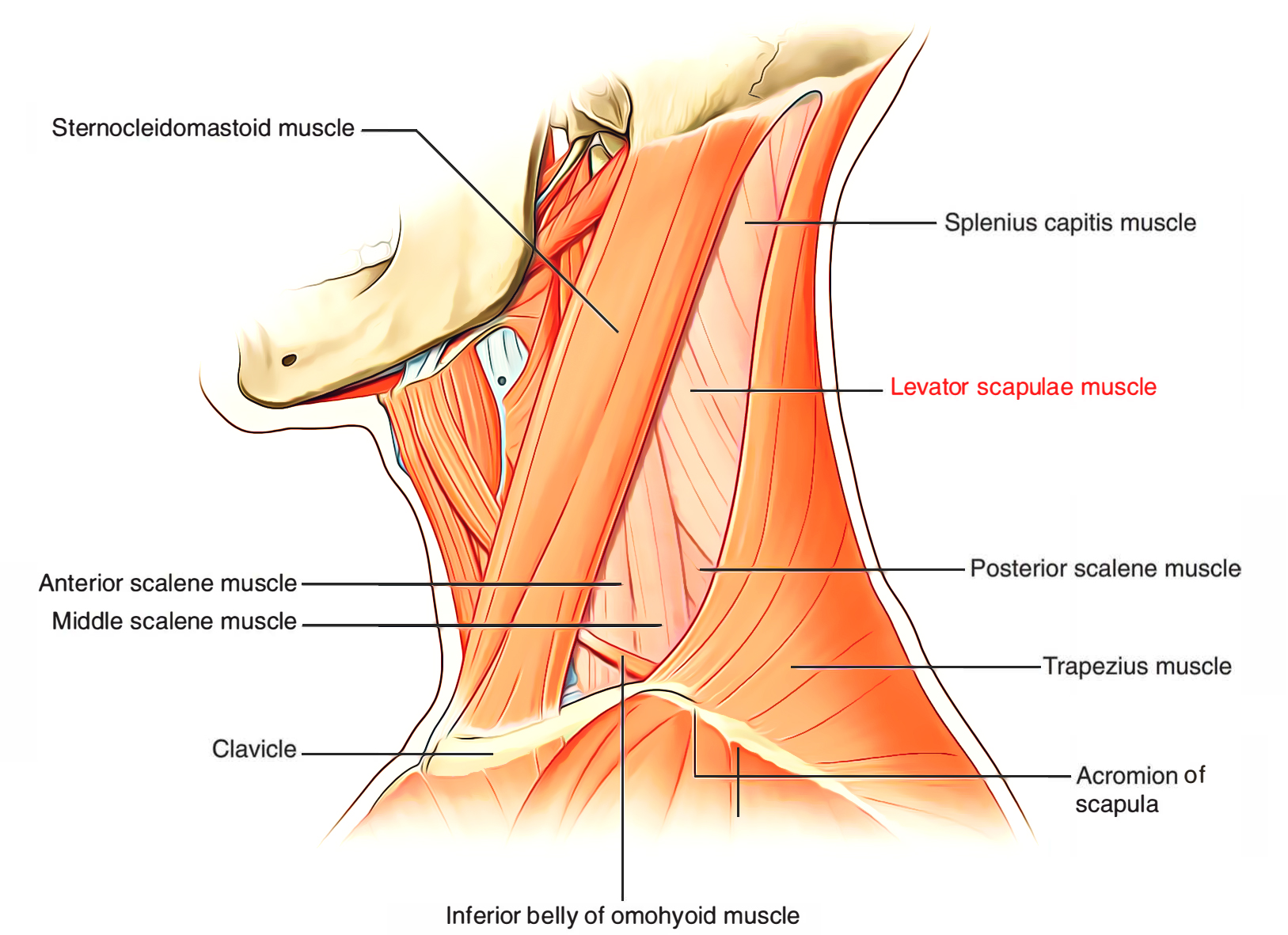
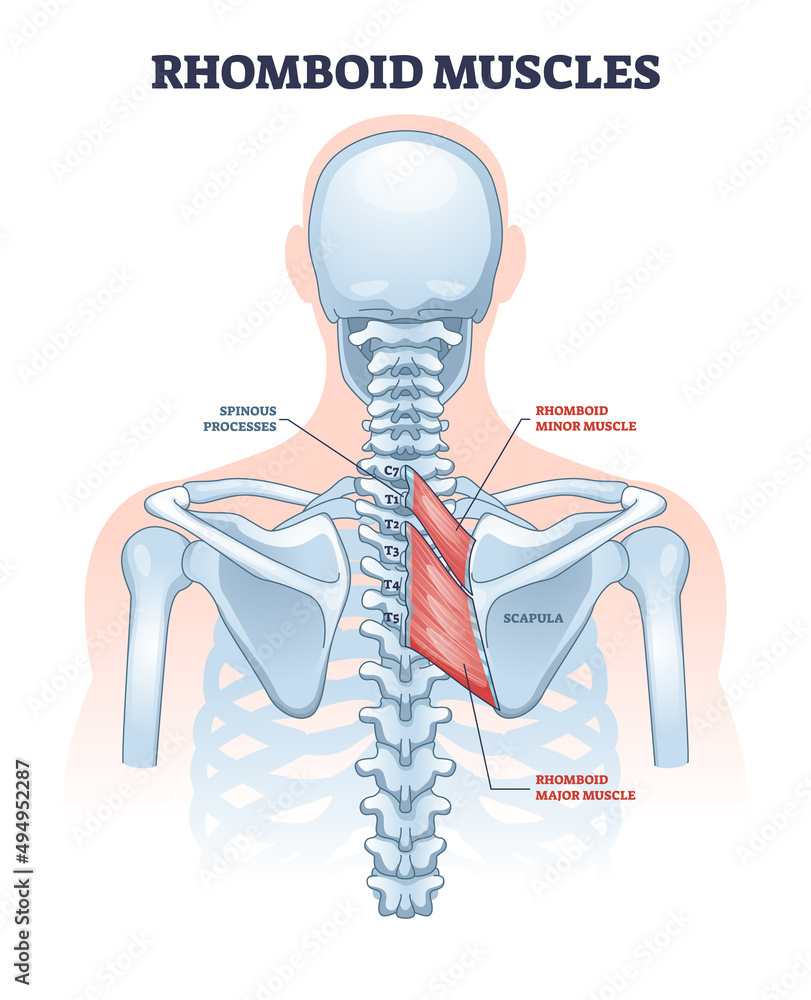
<ul><li><p>anatomically belongs to the superficial layer of extrinsic back muscles, functionally belongs to the muscles of scapular motion along with rhomboid major and minor, serratus anterior, and serratus posterior superior and inferior</p></li><li><p>main function is to elevate the scapula</p></li><li><p>acts in conjunction with trapezius, lat dorsi, the rhomboids, and pec major and minor to inferiorly rotate the glenoid cavity, stabilize the spine, and extend and laterally flex the neck</p></li></ul><p></p><p>origin → transverse processes of vertebrae C1-C4</p><p>insertion → medial border of scapula (from superior angle to root of spine of scapula)</p><p>action → draws scapula superomedially and rotates glenoid cavity inferiorly at the scapulothoracic joint, laterally flexes the neck (ipsilateral) and extends the neck at the cervical joints</p><p>innervation → anterior rami of the nerves C3 and C4, dorsal scapular nerve (branch of C5)</p><p>blood supply → transverse cervical and ascending cervical arteries (branches of the thyrocervical trunk)</p>
5
New cards
<p>rhomboid minor</p>

rhomboid minor

  • the rhomboids are two bilateral, superficial muscles in the upper back

  • they are functionally similar

    • they retract the scapula superomedially and rotate the glenoid cavity

    • they are important for stabilizing the scapula into position and reinforcing the shoulder

origin → nuchal ligament, spinous process of vertebrae C7-T1

insertion → root (medial end) of spine of scapula

action → draws the scapula superomedially and rotates the glenoid cavity inferiorly at the scapulothoracic joint, supports the position of the scapula

innervation → dorsal scapular nerve (C4-C5)

blood supply → dorsal scapular artery, deep branch of transverse vervical artery, dorsal branch of upper 5 or 6 posterior intercostal arteries
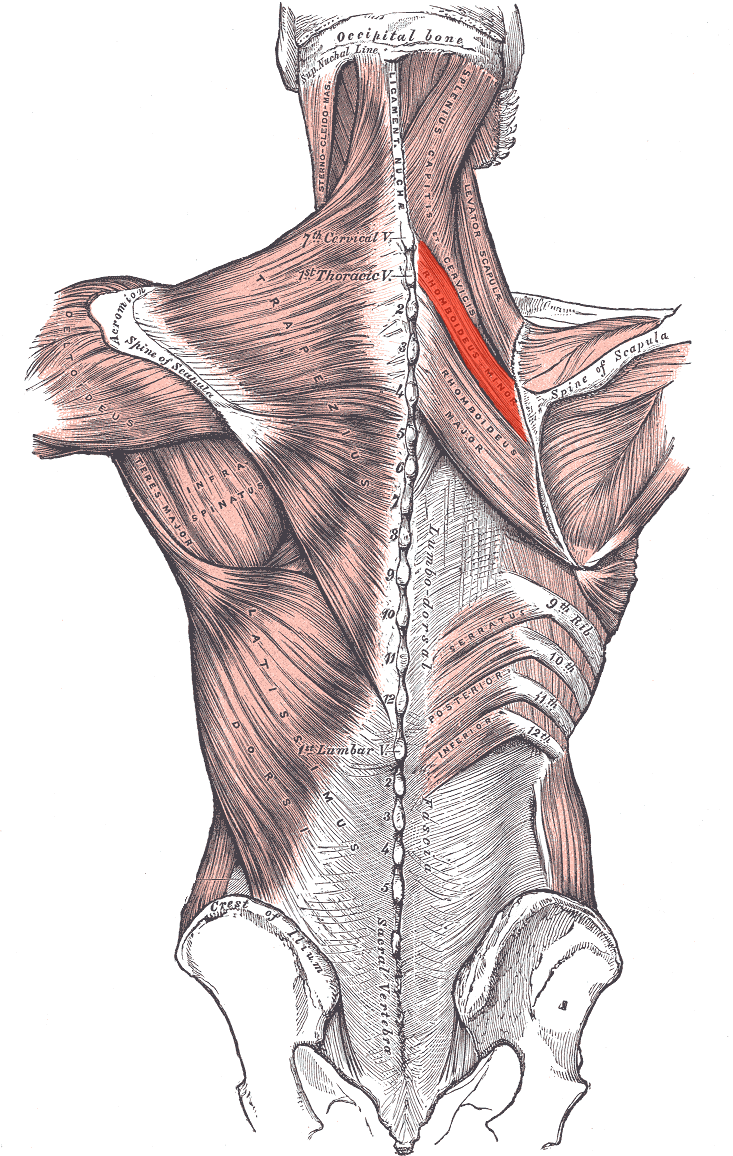
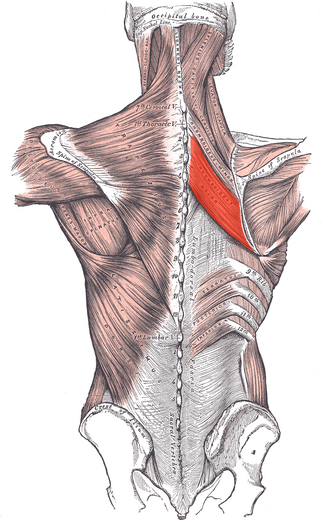
<ul><li><p>the rhomboids are two bilateral, superficial muscles in the upper back</p></li><li><p>they are functionally similar</p><ul><li><p>they retract the scapula superomedially and rotate the glenoid cavity</p></li><li><p>they are important for stabilizing the scapula into position and reinforcing the shoulder</p></li></ul></li></ul><p></p><p>origin → nuchal ligament, spinous process of vertebrae C7-T1</p><p>insertion → root (medial end) of spine of scapula</p><p>action → draws the scapula superomedially and rotates the glenoid cavity inferiorly at the scapulothoracic joint, supports the position of the scapula</p><p>innervation → dorsal scapular nerve (C4-C5)</p><p>blood supply → dorsal scapular artery, deep branch of transverse vervical artery, dorsal branch of upper 5 or 6 posterior intercostal arteries</p>
6
New cards
<p>rhomboid major</p>

rhomboid major

origin → spinous process of vertebrae T2-T5

insertion → medial border of the scapula (from the inferior angle to the root of the spine of scapula)

action → draws the scapula superomedially and rotates the glenoid cavity inferiorly at the scapulothoracic joint, supports the position of the scapula

innervation → dorsal scapular nerve (C4-C5)

blood supply → dorsal scapular artery, deep branch of transverse vervical artery, dorsal branch of upper 5 or 6 posterior intercostal arteries
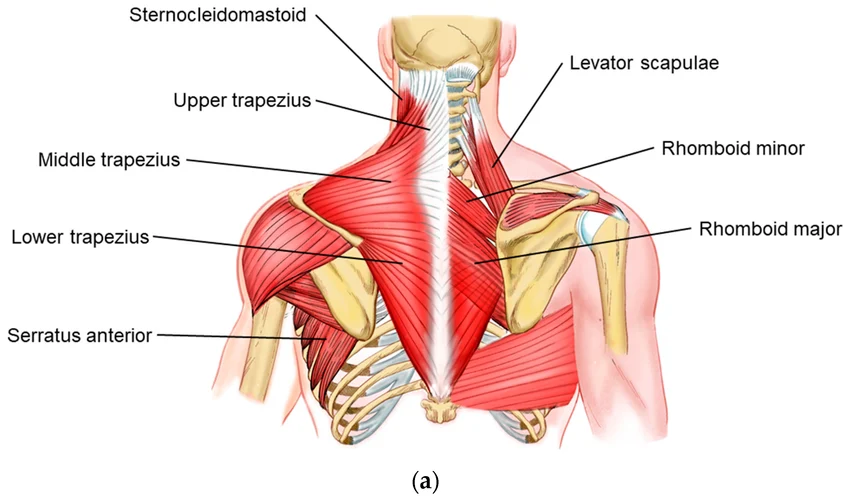
<p>origin → spinous process of vertebrae T2-T5</p><p>insertion → medial border of the scapula (from the inferior angle to the root of the spine of scapula)</p><p>action → draws the scapula superomedially and rotates the glenoid cavity inferiorly at the scapulothoracic joint, supports the position of the scapula</p><p>innervation → dorsal scapular nerve (C4-C5)</p><p>blood supply → dorsal scapular artery, deep branch of transverse vervical artery, dorsal branch of upper 5 or 6 posterior intercostal arteries</p>
7
New cards
<p>serratus posterior superior</p>

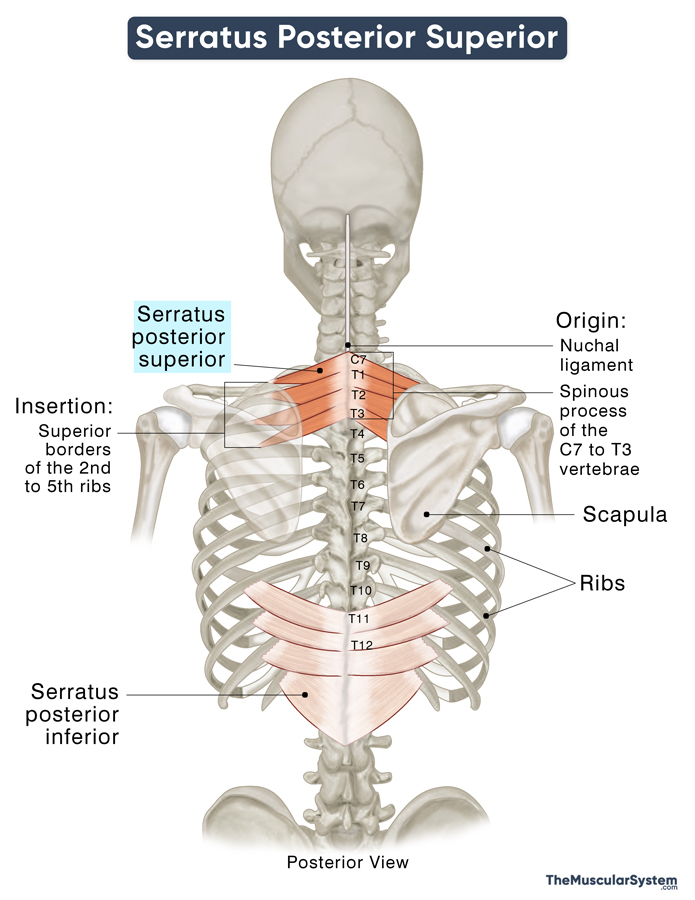
serratus posterior superior

  • the serratus posterior muscles (superior and inferior) extend obliquely from the vertebral column to the rib cage

  • main function is facilitation of respiration

  • serratus posterior superior elevates the ribs

origin → nuchal ligament, spinous processes of vertebrae C7-T3

insertion → superior borders of ribs 2-5

action → elevates ribs

innervation → 2nd-5th intercostal nerves

blood supply → posterior intercostal arteries
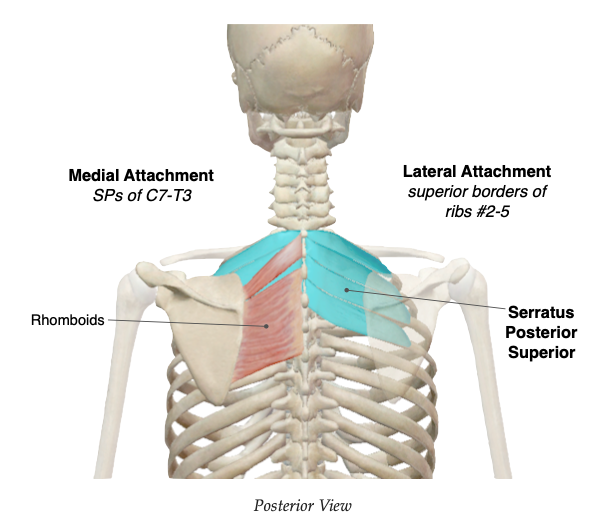
<ul><li><p>the serratus posterior muscles (superior and inferior) extend obliquely from the vertebral column to the rib cage</p></li><li><p>main function is facilitation of respiration</p></li><li><p>serratus posterior superior elevates the ribs</p></li></ul><p></p><p>origin → nuchal ligament, spinous processes of vertebrae C7-T3</p><p>insertion → superior borders of ribs 2-5</p><p>action → elevates ribs</p><p>innervation → 2nd-5th intercostal nerves</p><p>blood supply → posterior intercostal arteries</p>
8
New cards
<p>serratus posterior inferior</p>

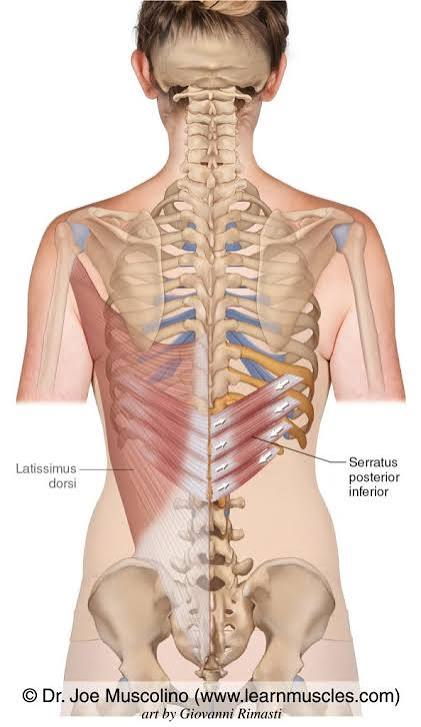
serratus posterior inferior

  • primary function is facilitation of respiration

  • serratus posterior inferior depresses the ribs

origin → spinous processes of vertebrae T11-L2

insertion → inferior borders of ribs 9-12

action → depresses ribs, draws ribs inferoposteriorly

innervation → anterior rami of spinal nerves T9-T12 (aka 9th-11th intercostal nerves + subcostal nerve)

blood supply → posterior intercostal arteries, subcostal artery, upper lumbar arteries
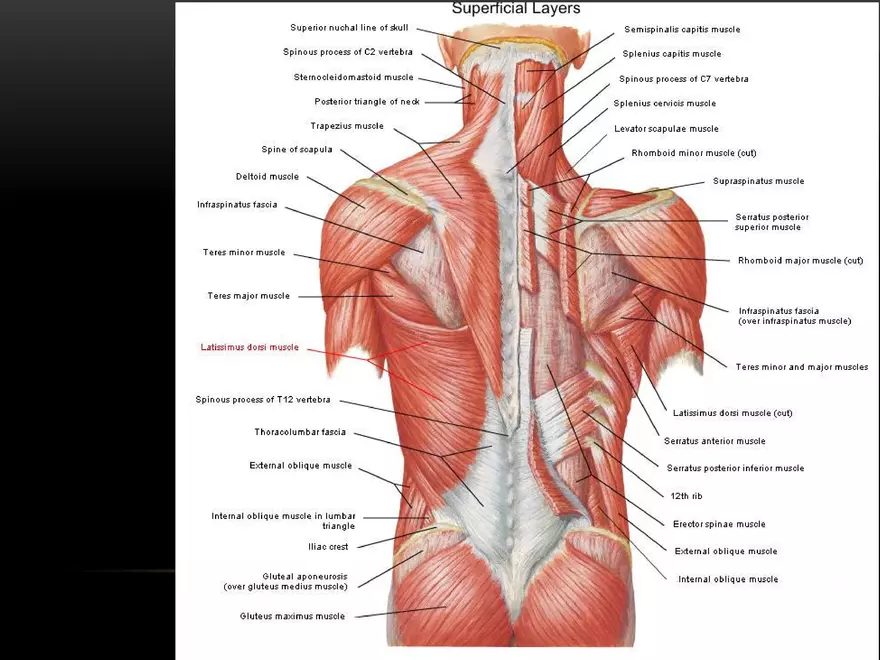
<ul><li><p>primary function is facilitation of respiration</p></li><li><p>serratus posterior inferior depresses the ribs</p></li></ul><p></p><p>origin → spinous processes of vertebrae T11-L2</p><p>insertion → inferior borders of ribs 9-12</p><p>action → depresses ribs, draws ribs inferoposteriorly</p><p>innervation → anterior rami of spinal nerves T9-T12 (aka 9th-11th intercostal nerves + subcostal nerve)</p><p>blood supply → posterior intercostal arteries, subcostal artery, upper lumbar arteries</p>
9
New cards
<p>splenius capitis</p>

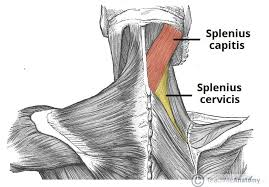
splenius capitis

  • an intrinsic muscle of the neck in the superficial layer

  • extends from the spinous process of the last cervical vertebrae and first three thoracic vertebrae to the occipital and temporal bones

  • acts as an extensor and lateral flexor of the neck and assists with rotation

origin → spinous process of vertebrae C7-T3, nuchal ligament

insertion → lateral superior nuchal line of occipital bone, mastoid process of temporal bone

action → bilateral contraction: extends head/neck

→ unilateral contraction: lateral flexion and rotation of the head (ipsilateral)

innervation → lateral branches of posterior rami of spinal nerves C2-C3

blood supply → muscular branches of occipital artery
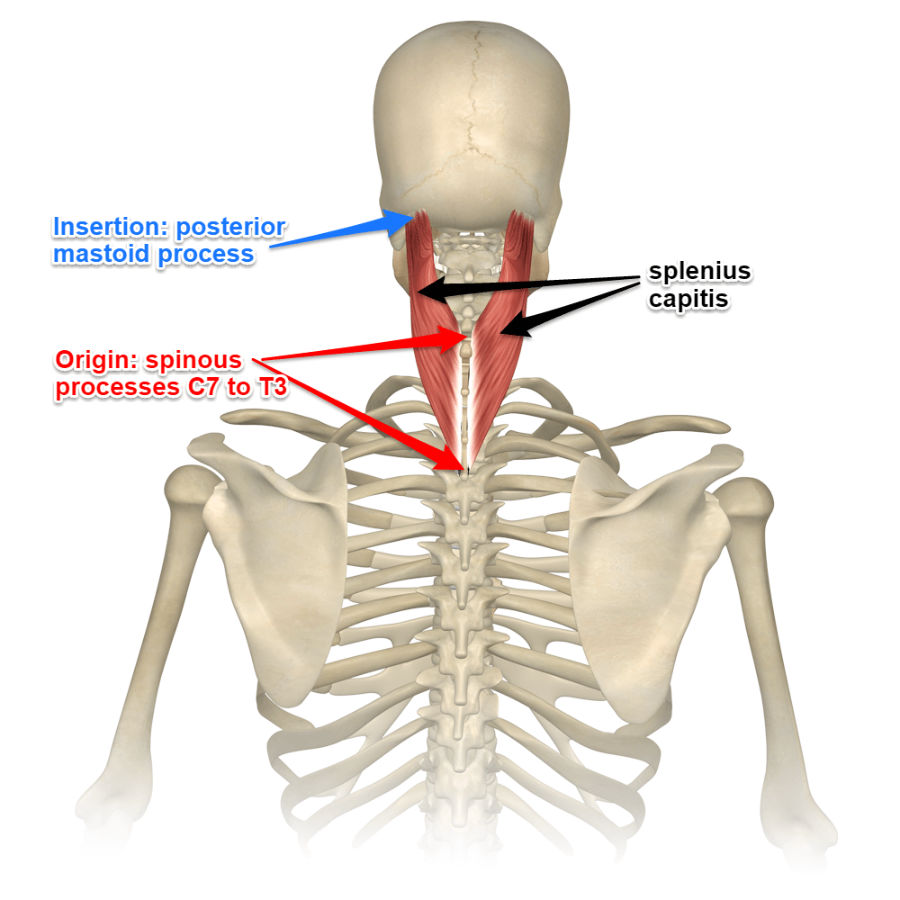
<ul><li><p>an intrinsic muscle of the neck in the superficial layer</p></li><li><p>extends from the spinous process of the last cervical vertebrae and first three thoracic vertebrae to the occipital and temporal bones</p></li><li><p>acts as an extensor and lateral flexor of the neck and assists with rotation</p></li></ul><p></p><p>origin → spinous process of vertebrae C7-T3, nuchal ligament</p><p>insertion → lateral superior nuchal line of occipital bone, mastoid process of temporal bone</p><p>action → bilateral contraction: extends head/neck</p><p>          → unilateral contraction: lateral flexion and rotation of the head (ipsilateral)</p><p>innervation → lateral branches of posterior rami of spinal nerves C2-C3</p><p>blood supply → muscular branches of occipital artery</p>
10
New cards
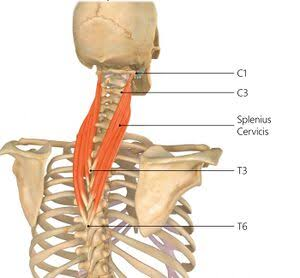
<p>splenius cervicis</p>

splenius cervicis

  • a paired back muscle found in the prevertebral space of the neck

  • forms the superficial layer of deep (intrinsic) back muscles together with splenius capitis

  • coordinates position of the head an neck during various movements ie. standing up from seated by producing lateral flexion, rotation, and extension of the neck

origin → spinous processes of T3-T6 vertebrae

insertion → transverse processes of C1-C3 vertebrae

action → unilateral contraction: lateral flexion and rotation of neck (ipsilateral)

→ bilateral contraction: extension of the neck

innervation → lateral branches of posterior rami of lower cervical spinal nerves

blood supply → vertebral, occipital, superior intercostal, deep cervical, transverse cervical arteries
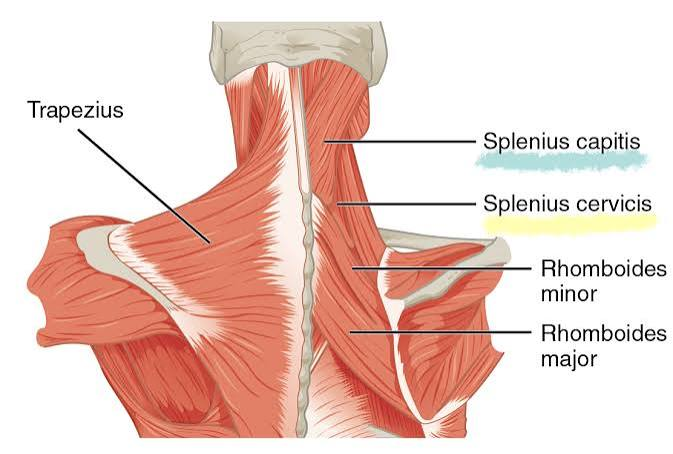
<ul><li><p>a paired back muscle found in the prevertebral space of the neck</p></li><li><p>forms the superficial layer of deep (intrinsic) back muscles together with splenius capitis</p></li><li><p>coordinates position of the head an neck during various movements ie. standing up from seated by producing lateral flexion, rotation, and extension of the neck</p></li></ul><p></p><p>origin → spinous processes of T3-T6 vertebrae</p><p>insertion → transverse processes of C1-C3 vertebrae</p><p>action → unilateral contraction: lateral flexion and rotation of neck (ipsilateral)</p><p>           → bilateral contraction: extension of the neck</p><p>innervation → lateral branches of posterior rami of lower cervical spinal nerves</p><p>blood supply → vertebral, occipital, superior intercostal, deep cervical, transverse cervical arteries</p>
11
New cards
<p>iliocostalis</p>

iliocostalis

  • part of the erector spinae group

  • the erector spinae are divided into longitudinal cords, with iliocostalis composing the lateral and longissimus and spinalis making up the intermediate and medial cords

  • iliocostalis is horizontally divided into 3 regions according to their origin: iliocostalis cervicis, thoracis, and lumborum

origin → cervicis: angle of ribs 3-6

→ thoracis: angle of ribs 7-12

→ lumborum: lateral crest of sacrum, medial end of iliac crest, thoracolumbar fascia

insertion → cervicis: transverse processes of vertebrae C4-C6

→ thoracis: angles of ribs 1-6, transverse process of vertebra C7

→ lumborum: angle of ribs 5-12, transverse processes of vertebrae L1-L4 (+ adjacent thoracolumbar fascia)

action → bilateral contraction extends the spine, unilateral contraction laterally flexes the spine (ipsilateral)

innervation → lateral branches of posterior rami of spinal nerves

blood supply → cervicis: occipital, deep cervical, and vertebral arteries

→ thoracis: dorsal branches of posterior intercostal and subcostal arteries

→ lumborum: dorsal branches of the lumbar and sacral arteries
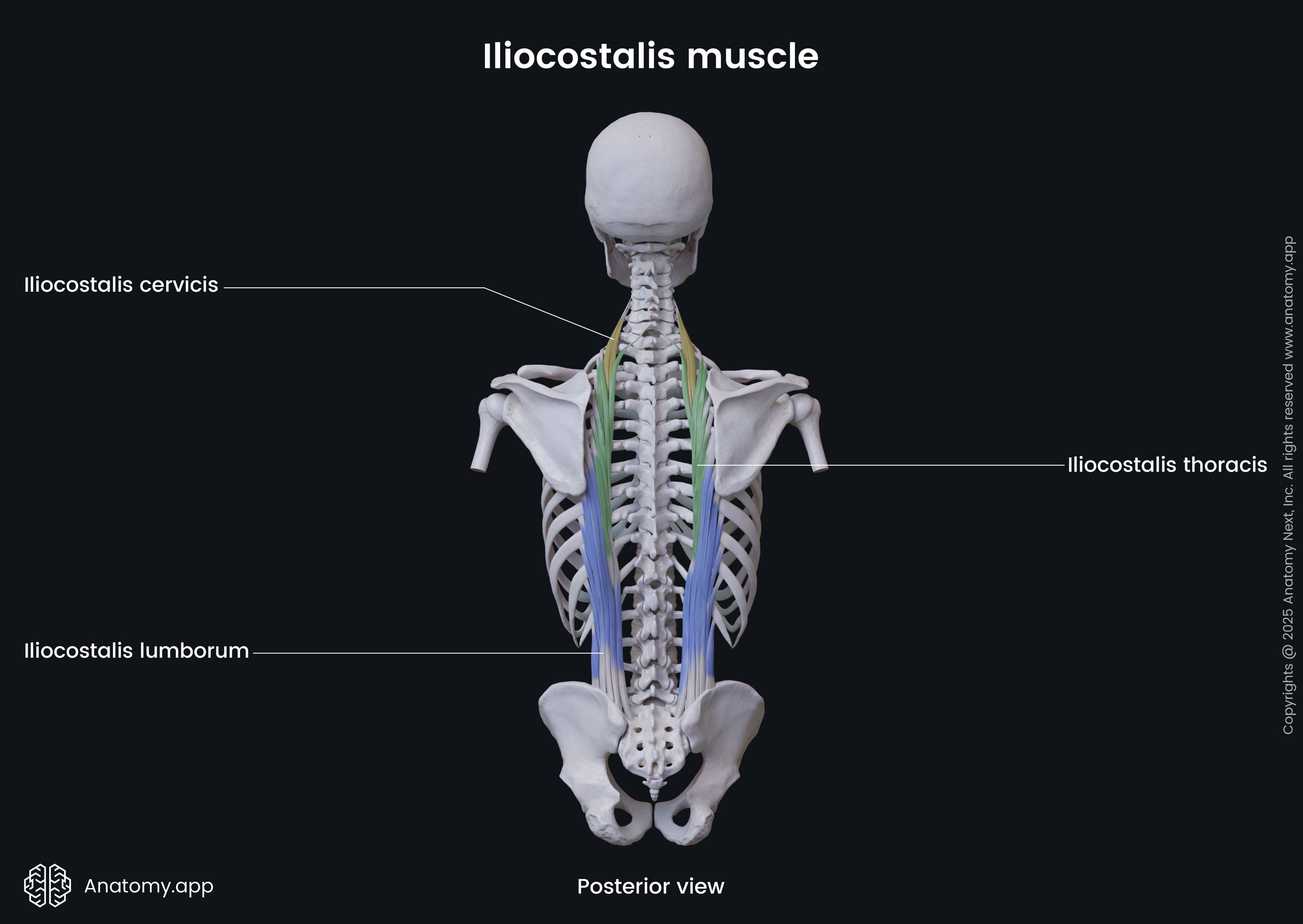
<ul><li><p>part of the erector spinae group</p></li><li><p>the erector spinae are divided into longitudinal cords, with iliocostalis composing the lateral and longissimus and spinalis making up the intermediate and medial cords</p></li><li><p>iliocostalis is horizontally divided into 3 regions according to their origin: iliocostalis cervicis, thoracis, and lumborum</p></li></ul><p></p><p>origin → cervicis: angle of ribs 3-6</p><p>          → thoracis: angle of ribs 7-12</p><p>          → lumborum: lateral crest of sacrum, medial end of iliac crest, thoracolumbar fascia</p><p>insertion → cervicis: transverse processes of vertebrae C4-C6</p><p>               → thoracis: angles of ribs 1-6, transverse process of vertebra C7</p><p>               → lumborum: angle of ribs 5-12, transverse processes of vertebrae L1-L4 (+ adjacent thoracolumbar fascia)</p><p>action → bilateral contraction extends the spine, unilateral contraction laterally flexes the spine (ipsilateral)</p><p>innervation → lateral branches of posterior rami of spinal nerves</p><p>blood supply → cervicis: occipital, deep cervical, and vertebral arteries</p><p>                     → thoracis: dorsal branches of posterior intercostal and subcostal arteries</p><p>                     → lumborum: dorsal branches of the lumbar and sacral arteries</p>
12
New cards
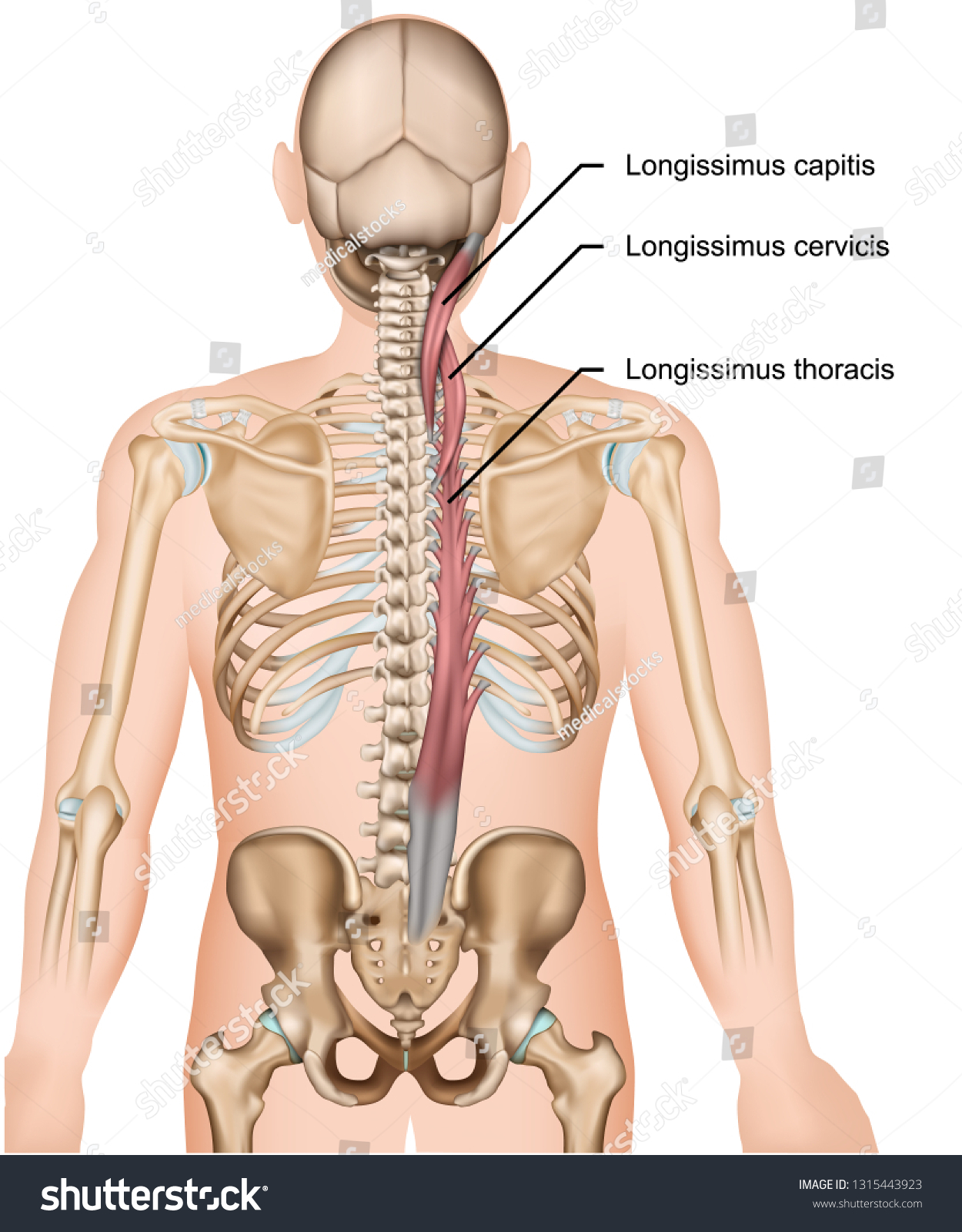
<p>longissimus</p>

longissimus

  • thickest, longest, and most central of the spinal erectors

  • divided into 3 parts based on their superior attachments and location (capitis, cervicis, thoracis)

origin → capitis: transverse processes of vertebrae C4-T5

→ cervicis: transverse processes of vertebrae T1-T5

→ thoracis lumbar part: lumbar intermuscular aponeurosis, medial part of sacropelvic surface of ilium, posterior sacroiliac ligament

→ thoracis thoracic part: spinous and transverse processes of vertebrae L1-L5, median sacral crest, posterior surface of sacrum and posterior iliac crest

insertion → capitis: mastoid process of temporal bone

→ cervicis: transverse processes of vertebrae C2-C6

→ thoracis lumbar part: accessory and transverse processes of vertebrae L1-L5

→ thoracis thoracic part: transverse process of vertebrae T1-T12, angles of ribs 7-12

action → entire muscle: bilateral contraction extends the spine, unilateral contraction laterally flexes the spine (ipsilateral)

→ longissimus capitis only: bilateral contraction extends the head and neck, unilateral contraction laterally flexes and rotates the head (ipsilateral)

innervation → lateral branches of posterior rami of spinal nerves

blood supply → longissimus capitis and cervicis: vertebral artery, deep cervical artery, occipital artery, transverse cervical artery

→ longissimus thoracis: superior intercostal, posterior intercostal and subcostal arteries; lateral sacral and median sacral arteries
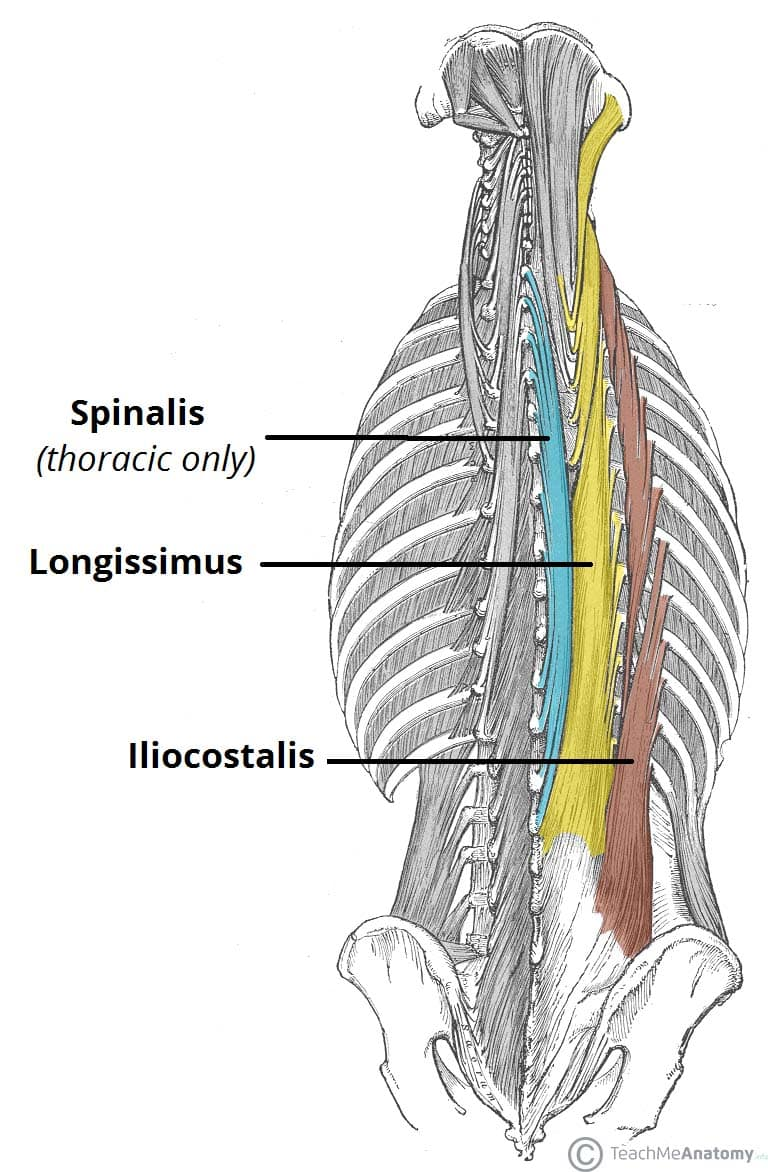
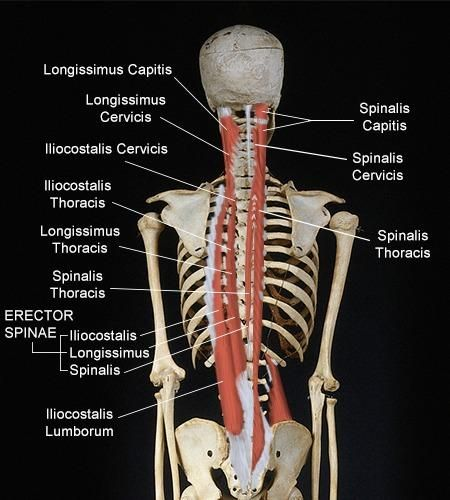
<ul><li><p>thickest, longest, and most central of the spinal erectors</p></li><li><p>divided into 3 parts based on their superior attachments and location (capitis, cervicis, thoracis)</p></li></ul><p></p><p>origin → capitis: transverse processes of vertebrae C4-T5</p><p>          → cervicis: transverse processes of vertebrae T1-T5</p><p>          → thoracis lumbar part: lumbar intermuscular aponeurosis, medial part of sacropelvic surface of ilium, posterior sacroiliac ligament</p><p>          → thoracis thoracic part: spinous and transverse processes of vertebrae L1-L5, median sacral crest, posterior surface of sacrum and posterior iliac crest</p><p>insertion → capitis: mastoid process of temporal bone</p><p>               → cervicis: transverse processes of vertebrae C2-C6</p><p>               → thoracis lumbar part: accessory and transverse processes of vertebrae L1-L5</p><p>               → thoracis thoracic part: transverse process of vertebrae T1-T12, angles of ribs 7-12</p><p>action → entire muscle: bilateral contraction extends the spine, unilateral contraction laterally flexes the spine (ipsilateral)</p><p>           → longissimus capitis only: bilateral contraction extends the head and neck, unilateral contraction laterally flexes and rotates the head (ipsilateral)</p><p>innervation → lateral branches of posterior rami of spinal nerves</p><p>blood supply → longissimus capitis and cervicis: vertebral artery, deep cervical artery, occipital artery, transverse cervical artery</p><p>                     → longissimus thoracis: superior intercostal, posterior intercostal and subcostal arteries; lateral sacral and median sacral arteries</p>
13
New cards
<p>spinalis</p>

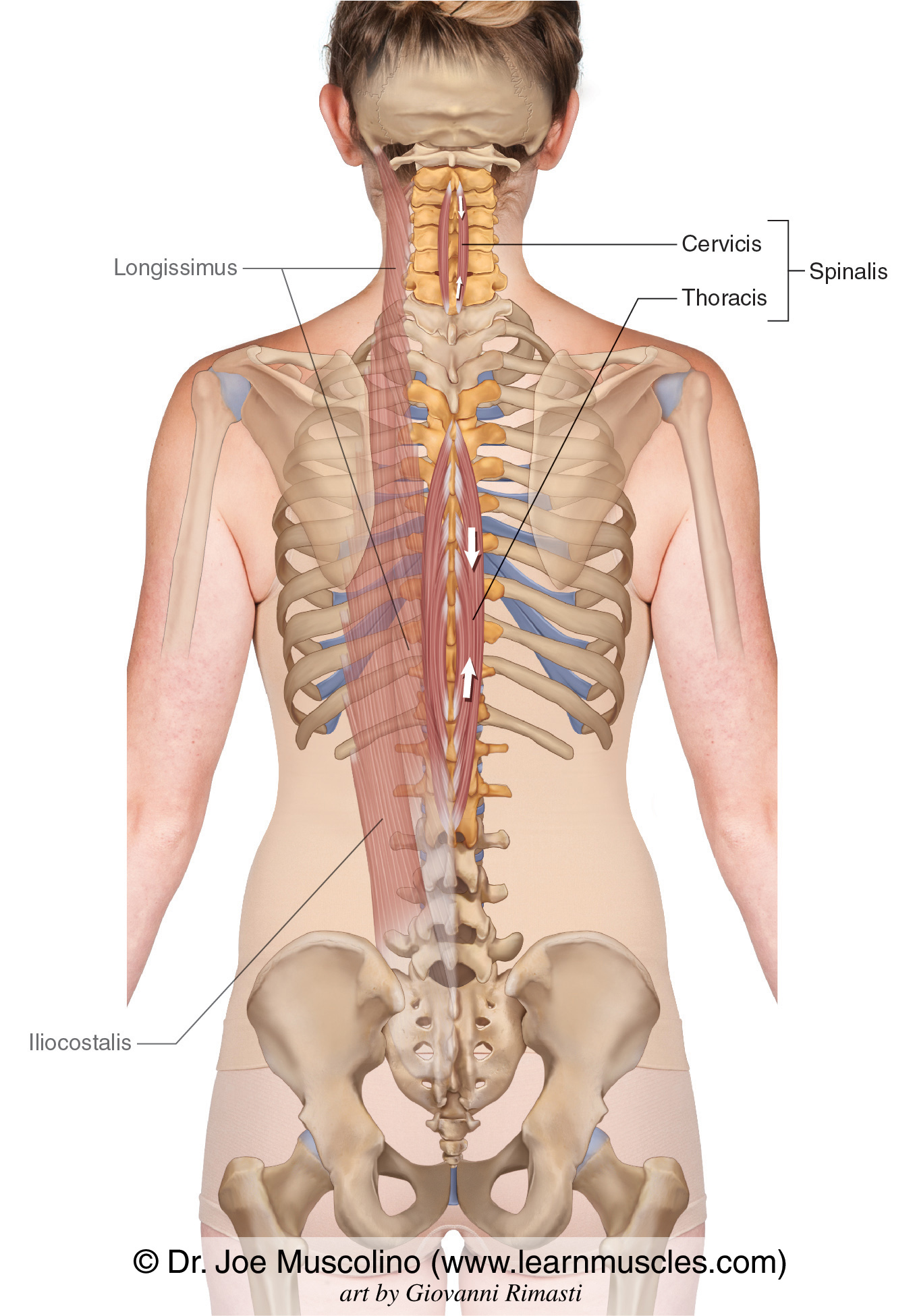
spinalis

  • the most medial of the spinal erectors

  • made of 3 parts: capitis, cervicis, and thoracis

origin → capitis: spinous processes of C7-T1 vertebrae

→ cervicis: spinous processes of C7-T1 vertebrae; nuchal ligament

→ thoracis: spinous processes of T11-L2

insertion → Capitis: occipital bone (midline)

→ cervicis: spinous processes of C2-C4 vertebrae

→ thoracis: spinous processes of T2-T8 vertebrae

action → bilateral contraction extends the head, cervical, and thoracic spine; unilateral contraction laterally flexes the cervical and thoracic spine (ipsilateral)

innervation → lateral branches of posterior rami of spinal nerves

blood supply → posterior branch of intercostal artery, deep cervical artery, muscular branches of vertebral artery
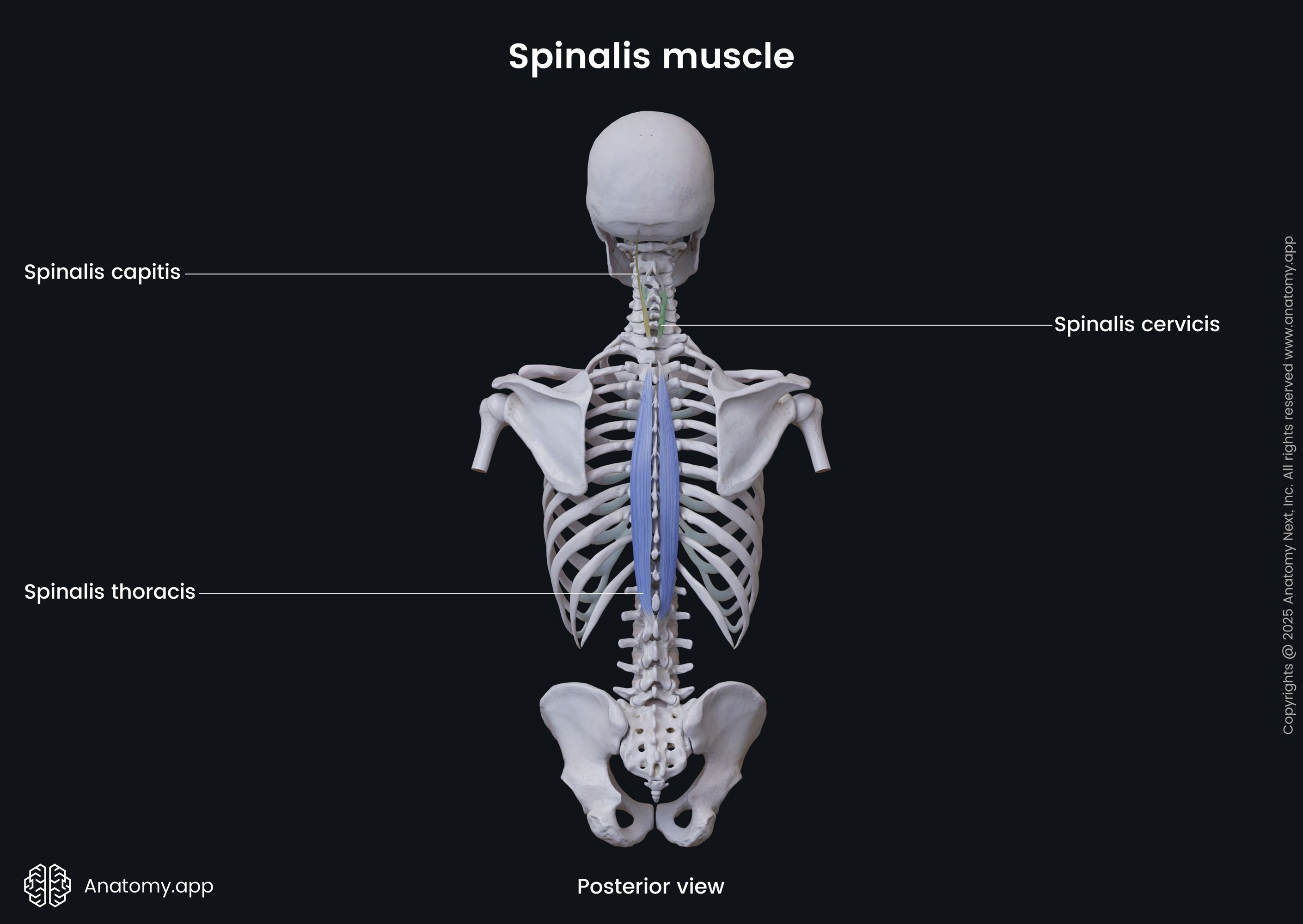
<ul><li><p>the most medial of the spinal erectors</p></li><li><p>made of 3 parts: capitis, cervicis, and thoracis</p></li></ul><p></p><p>origin → capitis: spinous processes of C7-T1 vertebrae</p><p>          → cervicis: spinous processes of C7-T1 vertebrae; nuchal ligament</p><p>          → thoracis: spinous processes of T11-L2</p><p>insertion → Capitis: occipital bone (midline)</p><p>               → cervicis: spinous processes of C2-C4 vertebrae</p><p>               → thoracis: spinous processes of T2-T8 vertebrae</p><p>action → bilateral contraction extends the head, cervical, and thoracic spine; unilateral contraction laterally flexes the cervical and thoracic spine (ipsilateral)</p><p>innervation → lateral branches of posterior rami of spinal nerves</p><p>blood supply → posterior branch of intercostal artery, deep cervical artery, muscular branches of vertebral artery </p>
14
New cards
<p>semispinalis capitis</p>

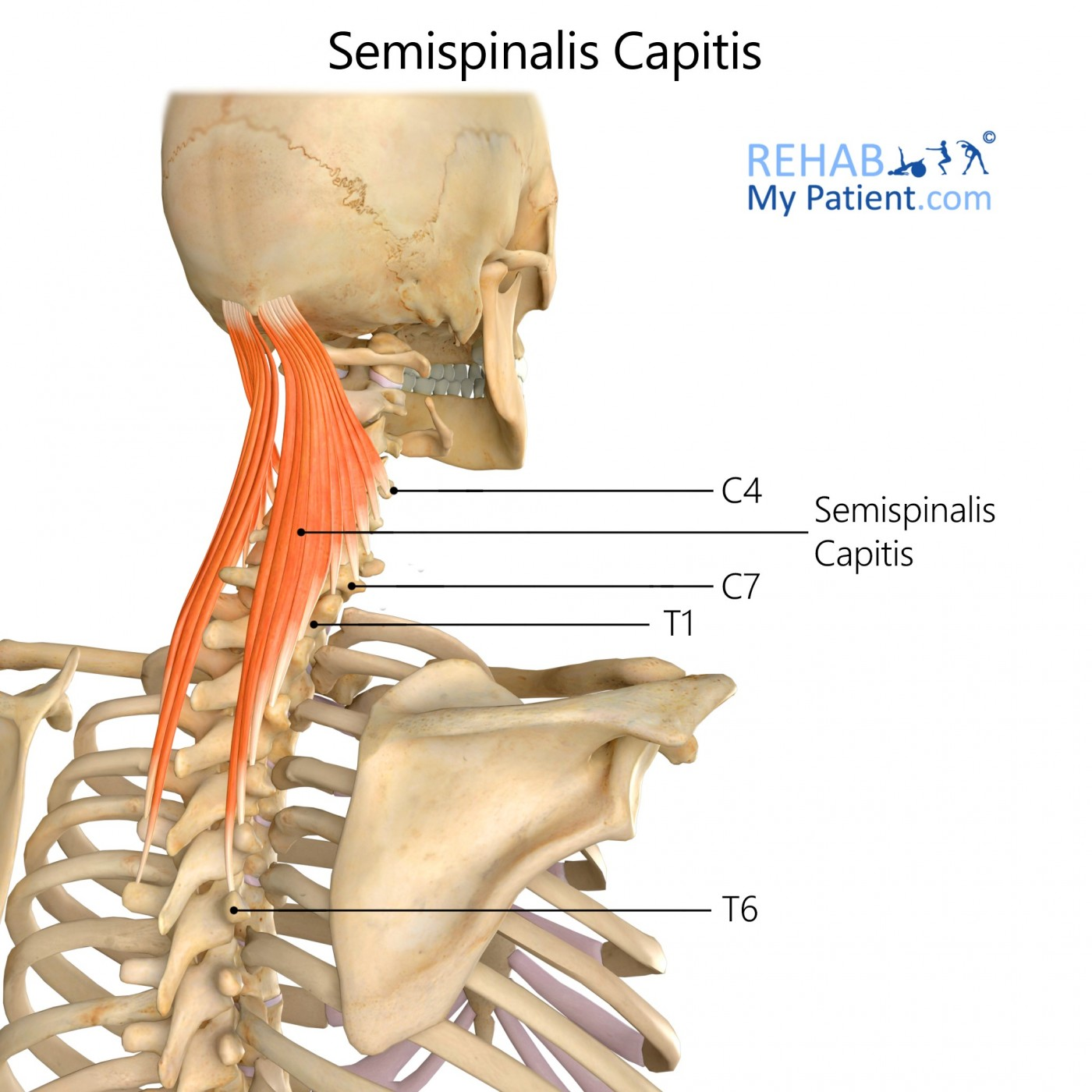
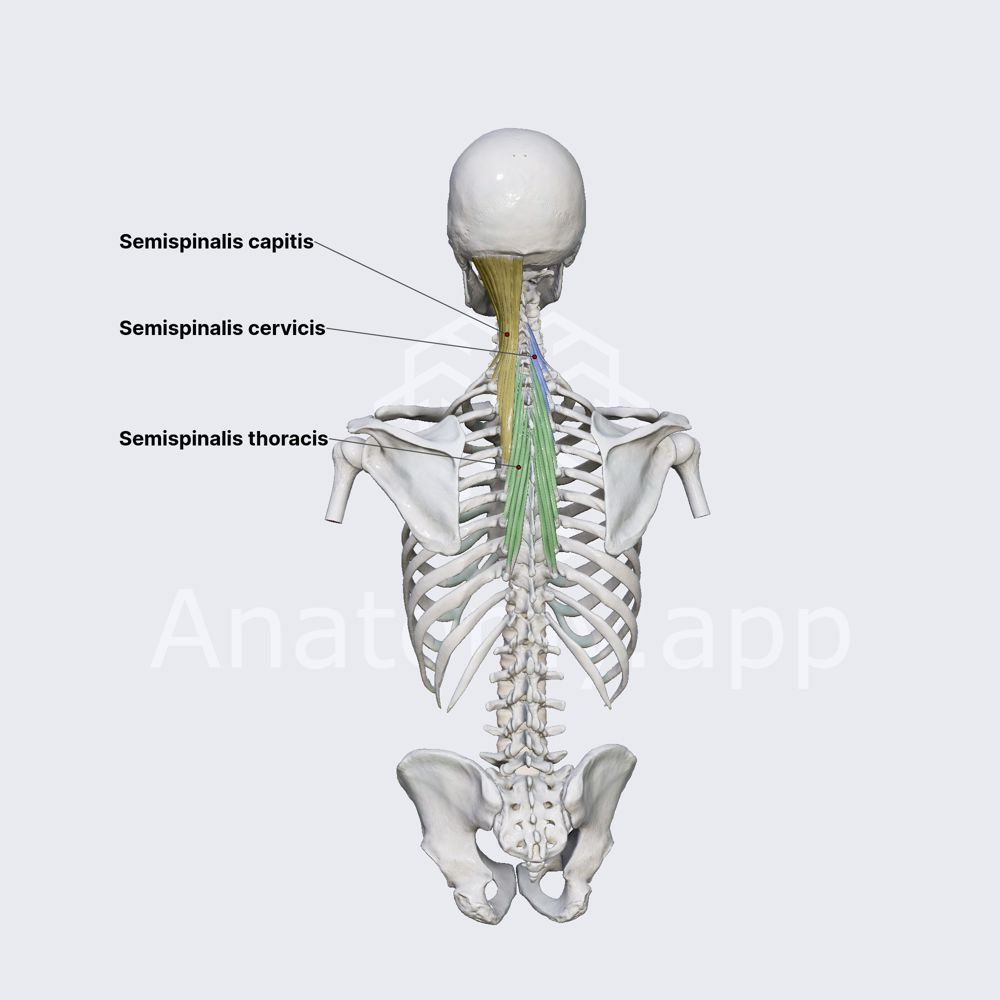
semispinalis capitis

  • a long, paired muscle in the deep layer of back muscles

  • forms the superior and largest component of the 3 part semispinalis muscle

origin → articular processes of vertebrae C4-C7, transverse processes of T1-T6

insertion → between superior and inferior nuchal lines of occipital bone

action → bilateral contraction: extends head, cervical, and thoracic spine

→ unilateral contraction: lateral flexion of the head, cervical, and thoracic spine (ipsilateral), and rotation of head, cervical, and thoracic spine (contralateral)

innervation → descending branches of greater occipital nerve (C2) and spinal nerve C3

blood supply → occipital artery
<p></p><ul><li><p>a long, paired muscle in the deep layer of back muscles</p></li><li><p>forms the superior and largest component of the 3 part semispinalis muscle</p></li></ul><p></p><p>origin → articular processes of vertebrae C4-C7, transverse processes of T1-T6</p><p>insertion → between superior and inferior nuchal lines of occipital bone</p><p>action → bilateral contraction: extends head, cervical, and thoracic spine</p><p>           → unilateral contraction: lateral flexion of the head, cervical, and thoracic spine (ipsilateral), and rotation of head, cervical, and thoracic spine (contralateral)</p><p>innervation → descending branches of greater occipital nerve (C2) and spinal nerve C3</p><p>blood supply → occipital artery</p>
15
New cards
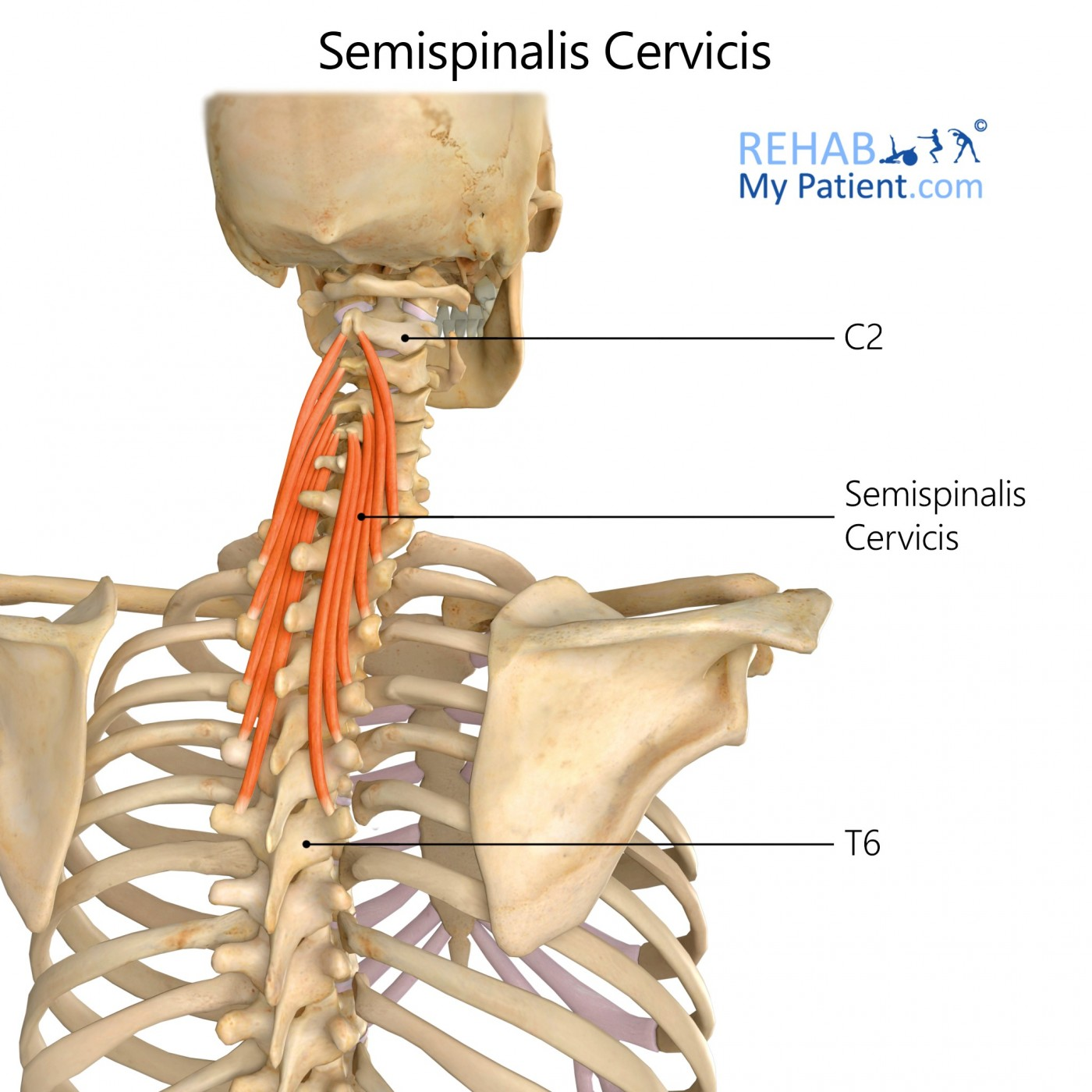
<p>semispinalis cervicis</p>

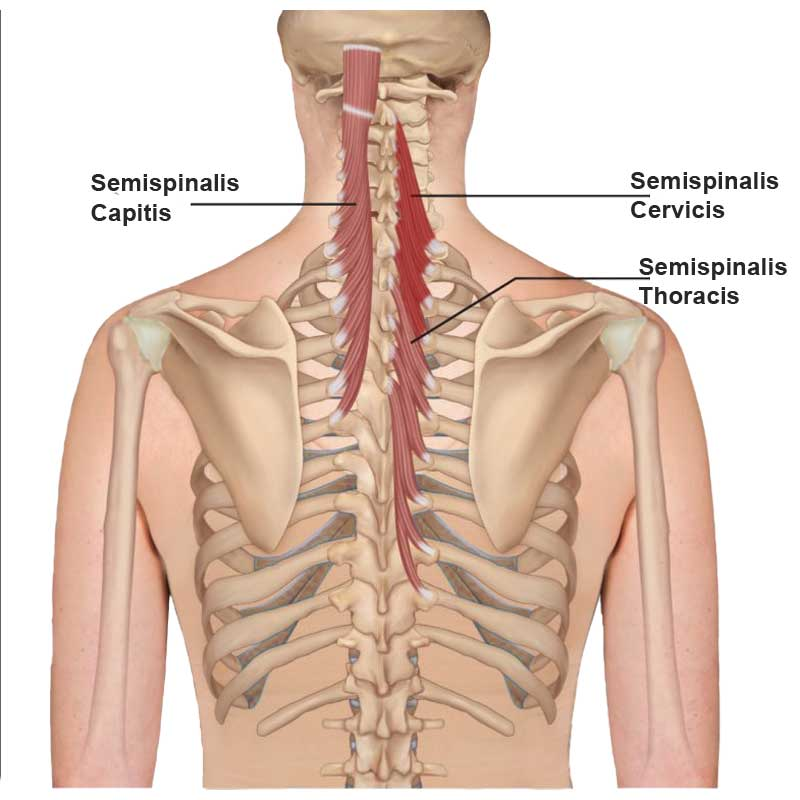
semispinalis cervicis

  • comprises the long semispinalis muscle along with semispinalis capitis and thoracis

  • belongs to the spinotransverse group of deep back muscles along with rotatores and multifidus

  • cojoint function of the semispinalis muscles is movements of the vertebral column

origin → transverse processes of vertebrae T1-T6

insertion → spinous processes of vertebrae C2-C5

action → bilateral contraction: extension of the head, cervical, and thoracic spine

→ unilateral contraction: lateral flexion of head, cervical, and thoracic spine (ipsilateral), and rotation of the head, cervical, and thoracic spine (contralateral)

innervation → medial branches of posterior rami of spinal nerves

blood supply → occipital, deep cervical, and vertebral arte
<ul><li><p>comprises the long semispinalis muscle along with semispinalis capitis and thoracis</p></li><li><p>belongs to the spinotransverse group of deep back muscles along with rotatores and multifidus</p></li><li><p>cojoint function of the semispinalis muscles is movements of the vertebral column</p></li></ul><p></p><p>origin → transverse processes of vertebrae T1-T6</p><p>insertion → spinous processes of vertebrae C2-C5</p><p>action → bilateral contraction: extension of the head, cervical, and thoracic spine</p><p>           → unilateral contraction: lateral flexion of head, cervical, and thoracic spine (ipsilateral), and rotation of the head, cervical, and thoracic spine (contralateral)</p><p>innervation → medial branches of posterior rami of spinal nerves</p><p>blood supply → occipital, deep cervical, and vertebral arte</p>
16
New cards
<p>semispinalis thoracis</p>

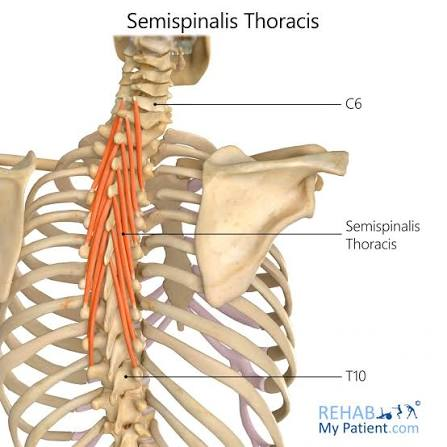
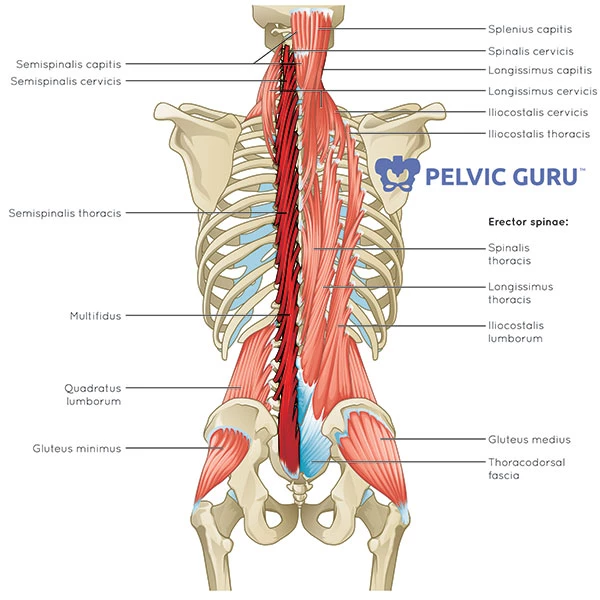
semispinalis thoracis

  • consists of 5 fasicles bridging over 5-6 vertebral levels between the transverse and spinous processes of certain cervical and thoracic vertebrae

  • supports the same movements at the head and neck as semispinalis capitis and cervicis

origin → transverse processes of vertebrae T6-T10

insertion → spinous processes of vertebrae C6-T4

action → bilateral contraction extends the head, cervical and thoracic spine; unilateral contraction laterally flexes the head, cervical and thoracic spine (ipsilateral) and rotates the head, cervical and throacic spine (contralateral)

innervation → medial branches of the posterior rami of spinal nerves

blood supply → dorsal branches of posterior intercostal arteries
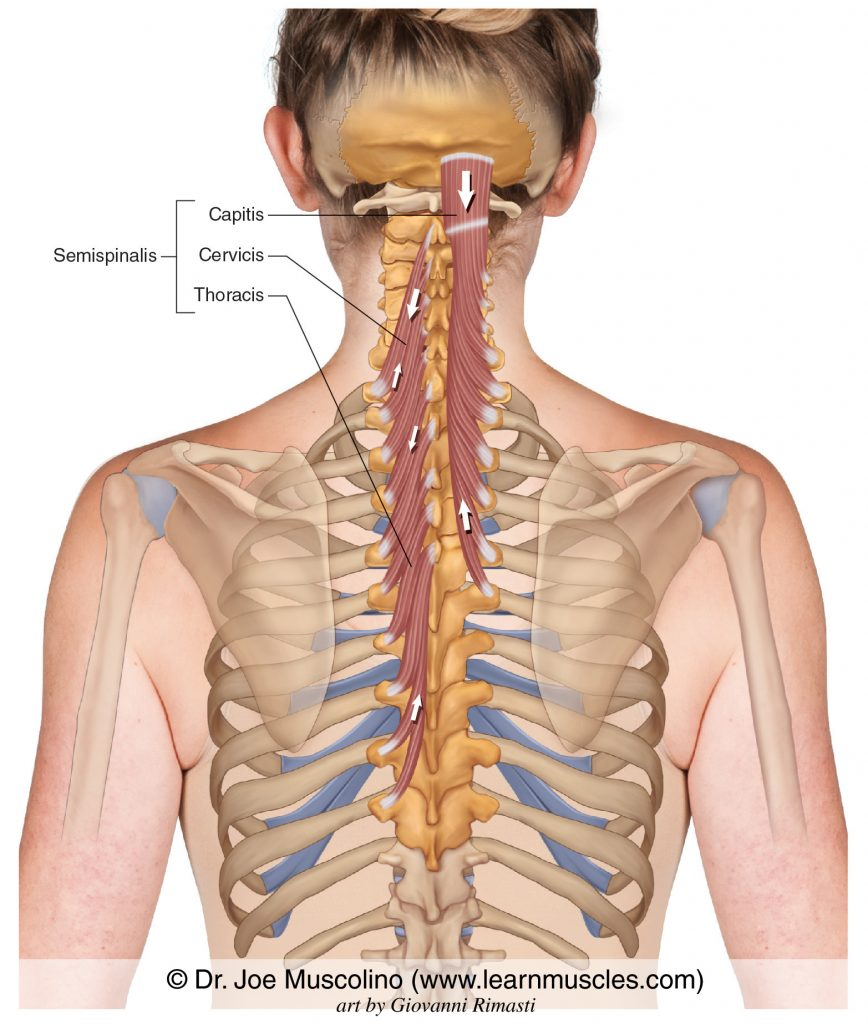
<ul><li><p>consists of 5 fasicles bridging over 5-6 vertebral levels between the transverse and spinous processes of certain cervical and thoracic vertebrae</p></li><li><p>supports the same movements at the head and neck as semispinalis capitis and cervicis</p></li></ul><p></p><p>origin → transverse processes of vertebrae T6-T10</p><p>insertion → spinous processes of vertebrae C6-T4</p><p>action → bilateral contraction extends the head, cervical and thoracic spine; unilateral contraction laterally flexes the head, cervical and thoracic spine (ipsilateral) and rotates the head, cervical and throacic spine (contralateral)</p><p>innervation → medial branches of the posterior rami of spinal nerves</p><p>blood supply → dorsal branches of posterior intercostal arteries</p>
17
New cards
<p>multifidus</p>

multifidus

  • a group of short, triangular muscles that compose the transversospinal group along with semispinalis and rotatores

  • the thickest muscles in the transversospinal group, shorter than semispinalis but longer than rotatores

  • found on either side of the vertebral column, extending from the cervical to lumbar spine

  • divided into cervical, thoracic, and lumbar regions

origin → cervicis: superior articular processes of vertebrae C4-C7

→ throacis: transverse processes of throacic vertebra

→ lumborum: mammillary processes of lumbar vertebrae, posterior aspect of sacrum, posterior superior iliac spine of ilium and posterior sacroiliac ligament

insertion → lateral aspect and tips of spinous processes of vertebrae 2-5 levels above origin

action → bilateral contraction extends the spine, unilateral contraction laterally flexes the spine (ipsilateral) and rotates the spine (contralateral)

innervation → medial branches of posteior rami of spinal nerves

blood supply → vertebral artery, deep cervical artery, occipital artery, posterior intercostal arteries, subcostal artery, lumbar arteries, lateral sacral arteries
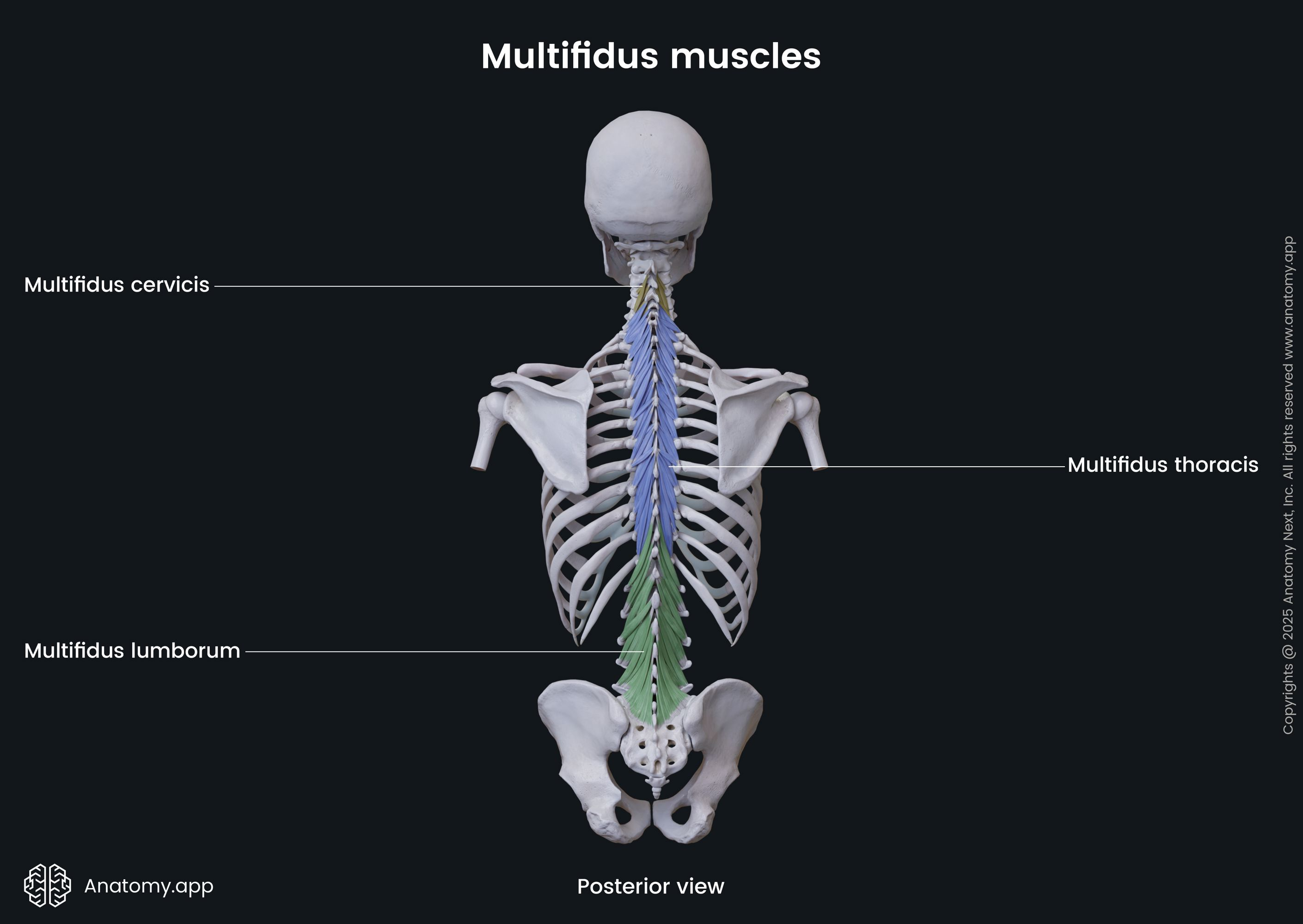
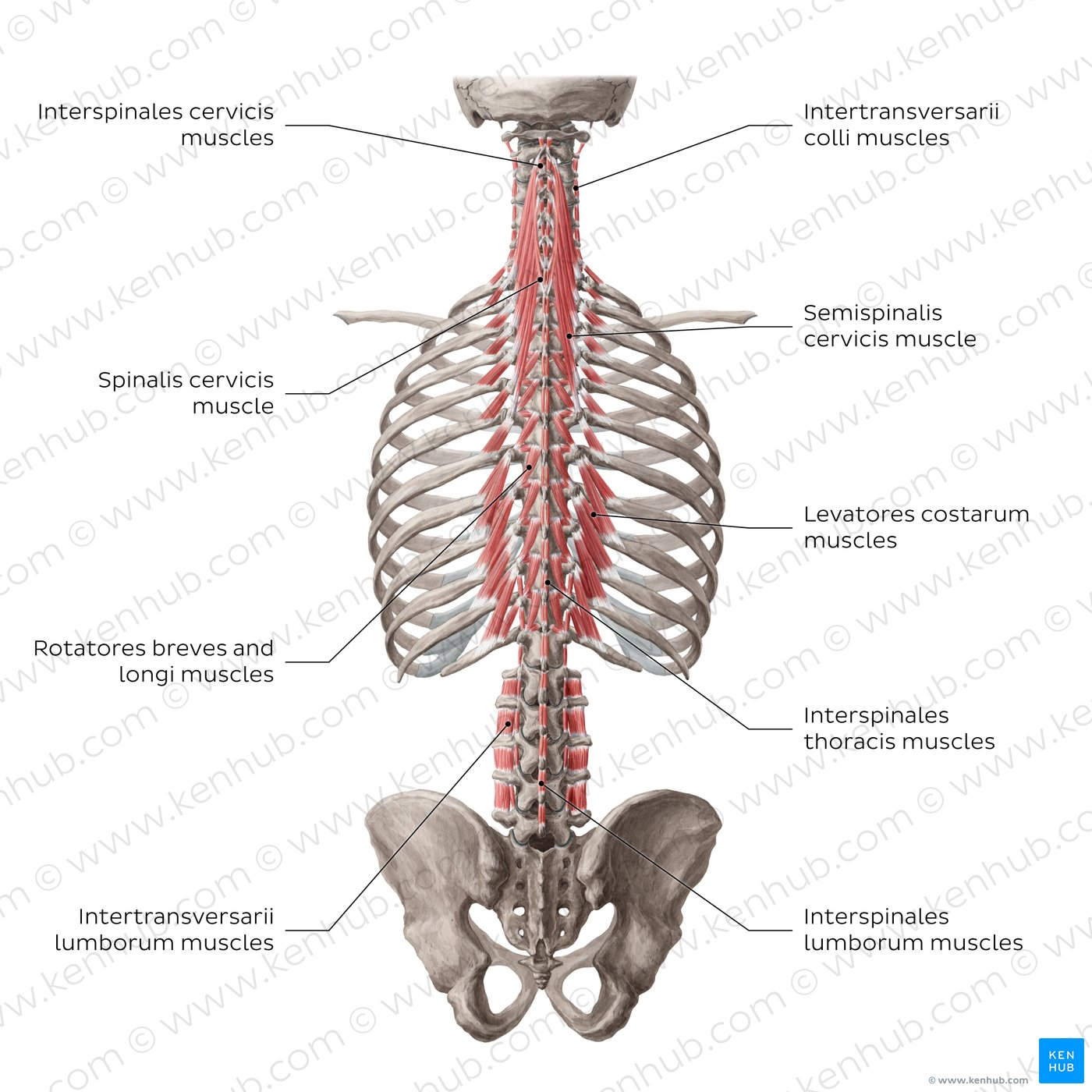
<ul><li><p>a group of short, triangular muscles that compose the transversospinal group along with semispinalis and rotatores</p></li><li><p>the thickest muscles in the transversospinal group, shorter than semispinalis but longer than rotatores</p></li><li><p>found on either side of the vertebral column, extending from the cervical to lumbar spine</p></li><li><p>divided into cervical, thoracic, and lumbar regions</p></li></ul><p></p><p>origin → cervicis: superior articular processes of vertebrae C4-C7</p><p>          → throacis: transverse processes of throacic vertebra</p><p>          → lumborum: mammillary processes of lumbar vertebrae, posterior aspect of sacrum, posterior superior iliac spine of ilium and posterior sacroiliac ligament</p><p>insertion → lateral aspect and tips of spinous processes of vertebrae 2-5 levels above origin</p><p>action → bilateral contraction extends the spine, unilateral contraction laterally flexes the spine (ipsilateral) and rotates the spine (contralateral)</p><p>innervation → medial branches of posteior rami of spinal nerves</p><p>blood supply → vertebral artery, deep cervical artery, occipital artery, posterior intercostal arteries, subcostal artery, lumbar arteries, lateral sacral arteries </p>
18
New cards
<p>rotatores</p>

rotatores

  • stabilizers, extensors, and rotators of the spine

  • a short set of muscles located laterally along the vertebral column part of the transversospinal group

  • rotatores thoracis are the most developed, colli and lumborum are often inconsistent

  • further divided into rotatores breves and longi based on fibre length

origin → breves: transverse processes of vertebrae T2-T12

→ longi: transverse processes of throacic vertebrae

insertion → breves: laminae/spinous processes of vertebrae (1 level above origin)

→ longi: laminae/spinous processes of vertebrae (2 levels above origin)

action → bilateral contraction extends the thoracic spine; unilateral contraction rotates the thoracic spine (contralateral)

innervation → medial branches of posterior spinal nerves

blood supply → dorsal branches of posterior intercostal and lumbar arteries
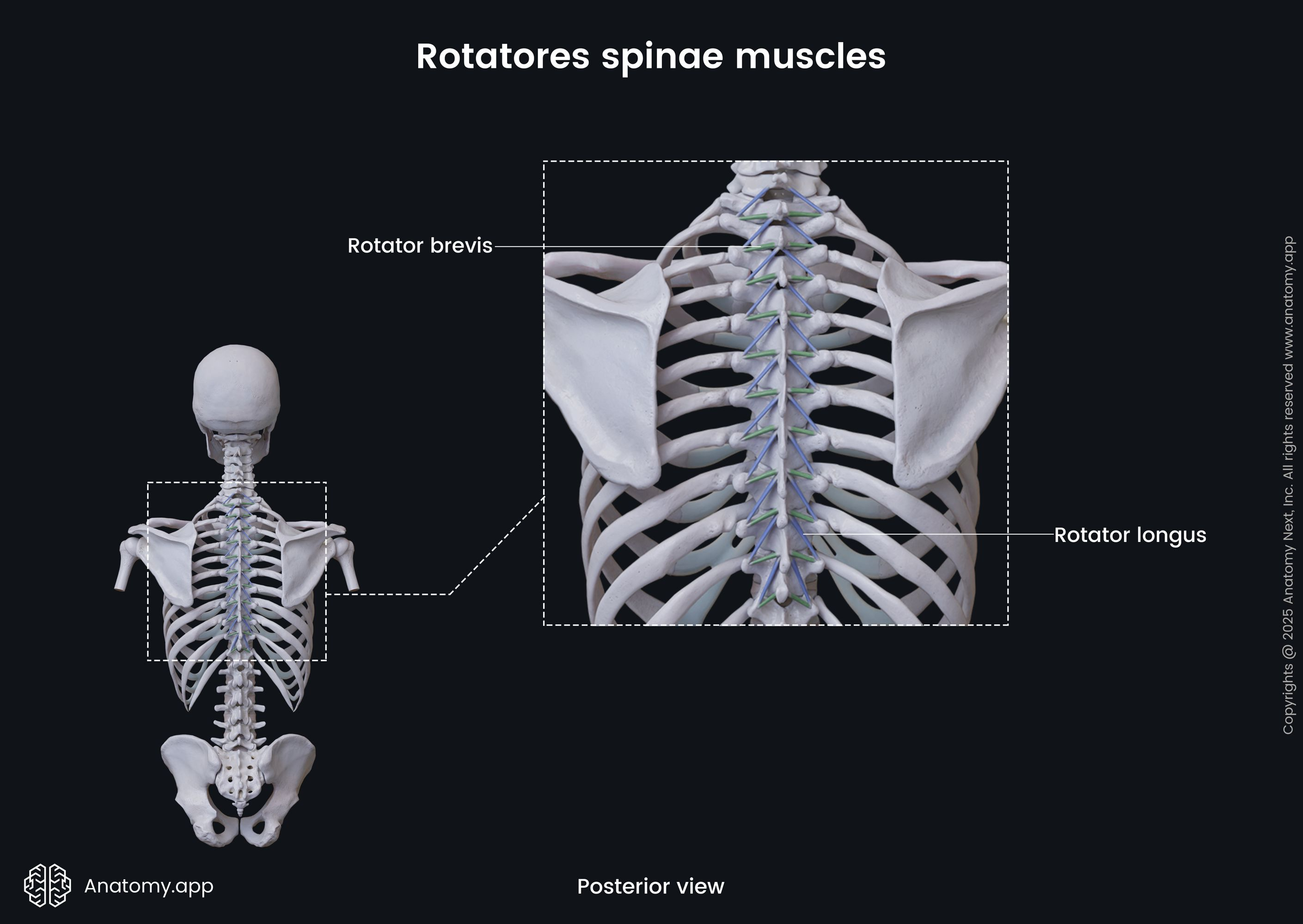
<ul><li><p>stabilizers, extensors, and rotators of the spine</p></li><li><p>a short set of muscles located laterally along the vertebral column part of the transversospinal group</p></li><li><p>rotatores thoracis are the most developed, colli and lumborum are often inconsistent</p></li><li><p>further divided into rotatores breves and longi based on fibre length</p></li></ul><p></p><p>origin → breves: transverse processes of vertebrae T2-T12</p><p>          → longi: transverse processes of throacic vertebrae</p><p>insertion → breves: laminae/spinous processes of vertebrae (1 level above origin)</p><p>               → longi: laminae/spinous processes of vertebrae (2 levels above origin)</p><p>action → bilateral contraction extends the thoracic spine; unilateral contraction rotates the thoracic spine (contralateral)</p><p>innervation → medial branches of posterior spinal nerves</p><p>blood supply → dorsal branches of posterior intercostal and lumbar arteries</p>
19
New cards
<p>interspinales</p>

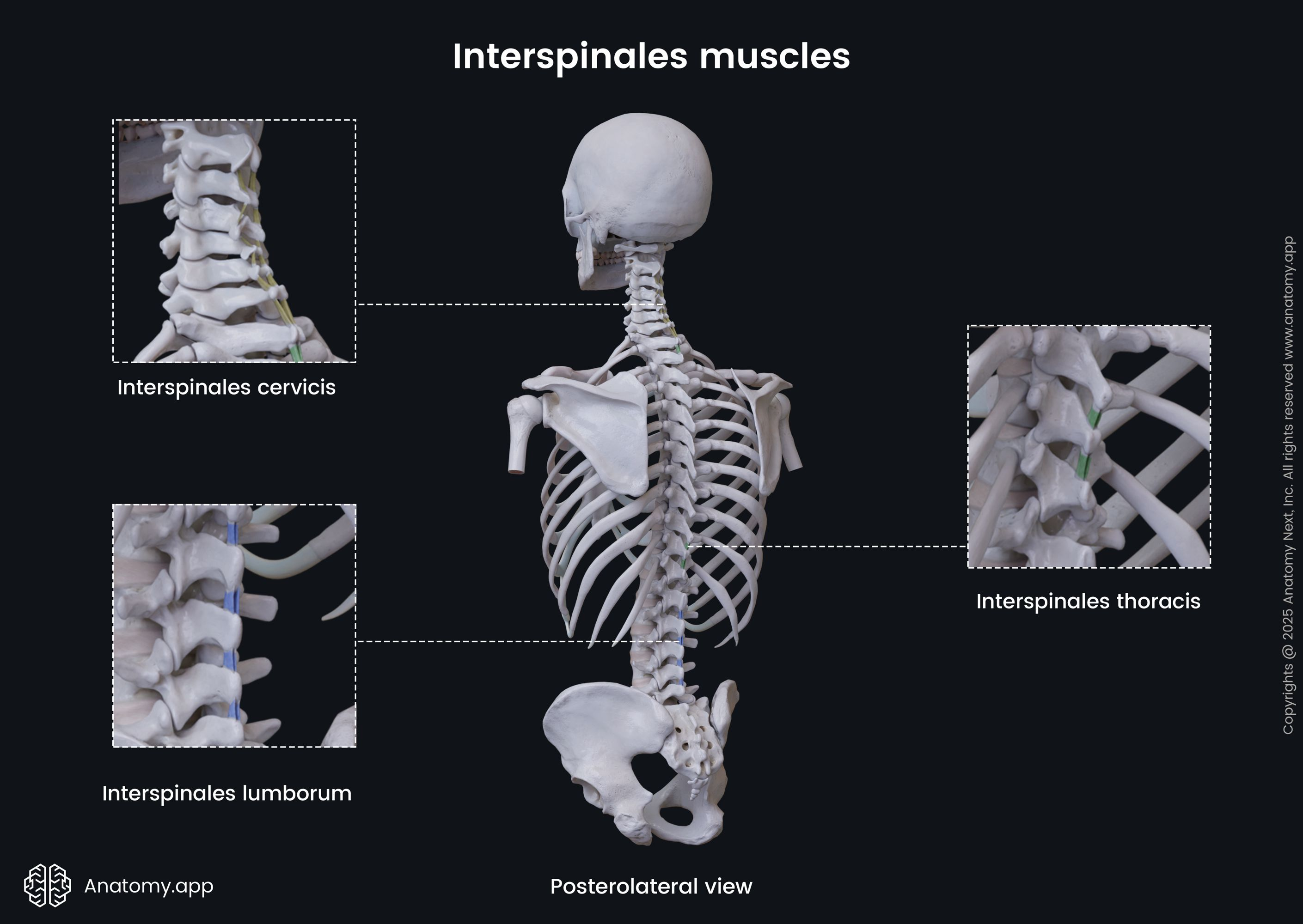
interspinales

  • short, paired muscles in the deepest layer of intrinsic back muscles

  • span the entire length of the vertebral column but are only properly developed in the cervical and lumbar spine, and are often underdeveloped or completely absent in the thoracic region

  • interspinales aid other intrinsic back muscles in extension of the spine, and act as spine stabilizers to maintain normal posture

origin → cervicis: superior aspect of spinous processes of vertebrae C3-T1

→ thoracis: superior aspect of spinous processes of vertebrae T2, T11, & T12 (variable)

→ lumborum: superior aspects of spinous processes of vertebrae L2-L5

insertion → cervicis: inferior aspect of spinous processes of vertebrae C2-C7

→ throacis: inferior aspect of spinous processes of vertebrae T1, T10, & T11

→ lumborum: inferior aspects of spinous processes of vertebrae L1-L4

action → extension of cervical and lumbar spine

innervation → posterior rami of spinal nerves

blood supply → cervicis: vertebral artery, deep cervical artery, occipital artery, transverse cervical artery

→ thoracis: superior intercostal artery, posterior intercostal arteries, subcostal artery

→ lumborum: lumbar arteries
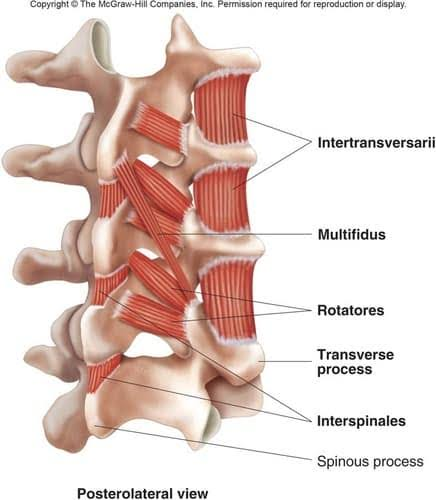
<ul><li><p>short, paired muscles in the deepest layer of intrinsic back muscles</p></li><li><p>span the entire length of the vertebral column but are only properly developed in the cervical and lumbar spine, and are often underdeveloped or completely absent in the thoracic region</p></li><li><p>interspinales aid other intrinsic back muscles in extension of the spine, and act as spine stabilizers to maintain normal posture</p></li></ul><p></p><p>origin → cervicis: superior aspect of spinous processes of vertebrae C3-T1</p><p>          → thoracis: superior aspect of spinous processes of vertebrae T2, T11, &amp; T12 (variable)</p><p>          → lumborum: superior aspects of spinous processes of vertebrae L2-L5</p><p>insertion → cervicis: inferior aspect of spinous processes of vertebrae C2-C7</p><p>               → throacis: inferior aspect of spinous processes of vertebrae T1, T10, &amp; T11</p><p>               → lumborum: inferior aspects of spinous processes of vertebrae L1-L4</p><p>action → extension of cervical and lumbar spine</p><p>innervation → posterior rami of spinal nerves</p><p>blood supply → cervicis: vertebral artery, deep cervical artery, occipital artery, transverse cervical artery</p><p>                     → thoracis: superior intercostal artery, posterior intercostal arteries, subcostal artery</p><p>                     → lumborum: lumbar arteries</p>
20
New cards
<p>intertransversarii </p>

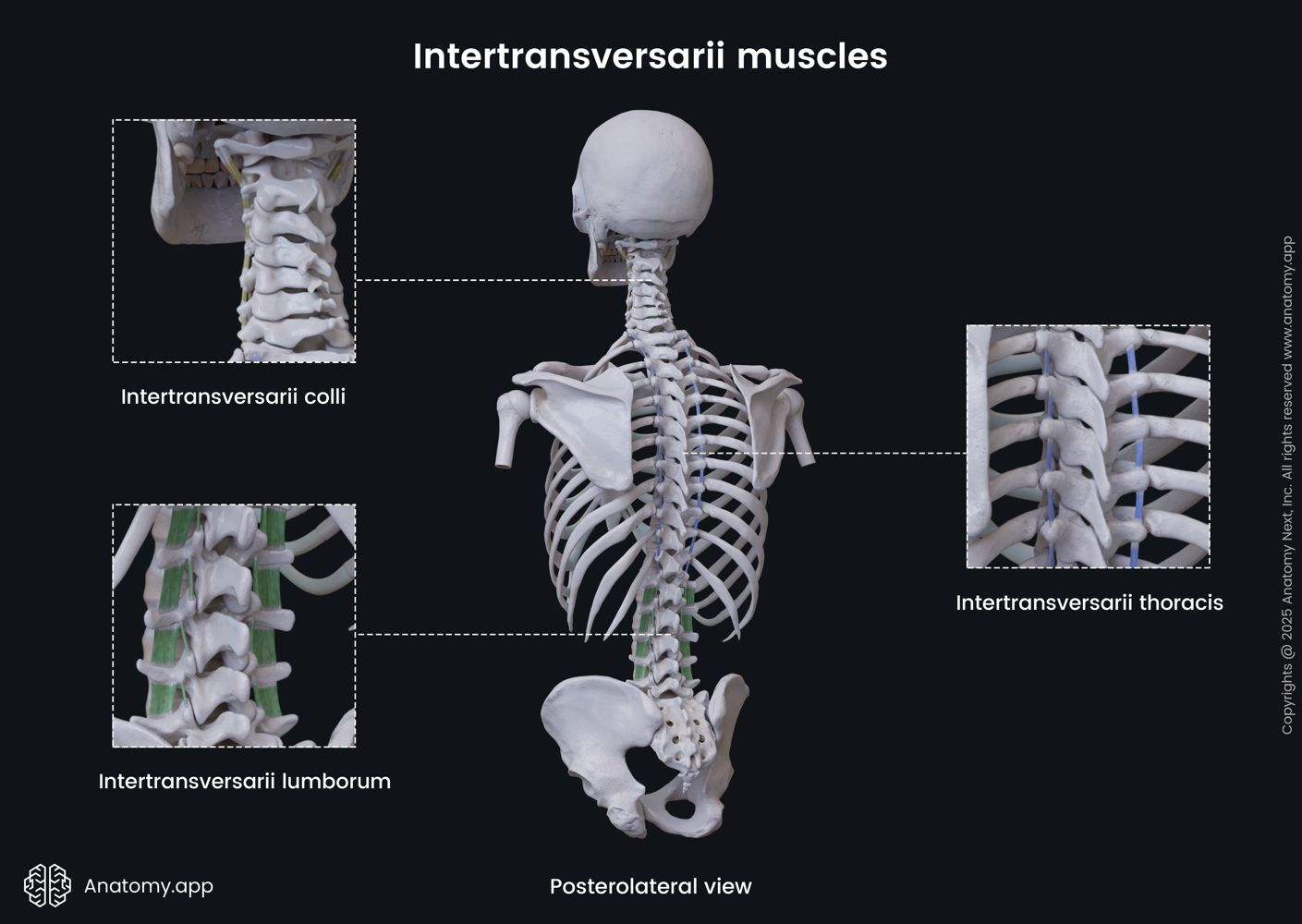
intertransversarii

  • short muscles that connect adjacent transverse processes of vertebrae

  • small muscular slips are present in the thoracic region, but they are mostly present in the cervical and lumbar region

  • the lumbar intertransversarii consist of 4 pairs of muscles on either side of the vertebral column, and each pair has a medial and lateral component (intertransversarii laterales lumborum and mediales lumborum)

  • in the cervical region, they are divided into anterior and posterior parts

origin → colli: transverse processes of cervical vertebrae

→ lateral lumbar: transverse and accessory processes of vertebrae L1-L4

→ medial lumbar: accessory processes of vertebrae L1-L4

insertion → colli: transverse processes of adjacent vertebrae

→ lateral lumbar: transverse processes of succeeding vertebrae

→ medial lumbar: mammillary processes of succeeding vertebrae

action → colli: assists in lateral flexion of the cervical spine, stabilizes cervical spine

→ lumborum: assists in lateral flexion of lumbar spine, stabilizes lumbar spine

innervation → anterior rami of spinal nerves

blood supply → colli: occipital, deep cervical, vertebral arteries

→ lumbar: dorsal branches of lumbar arteries
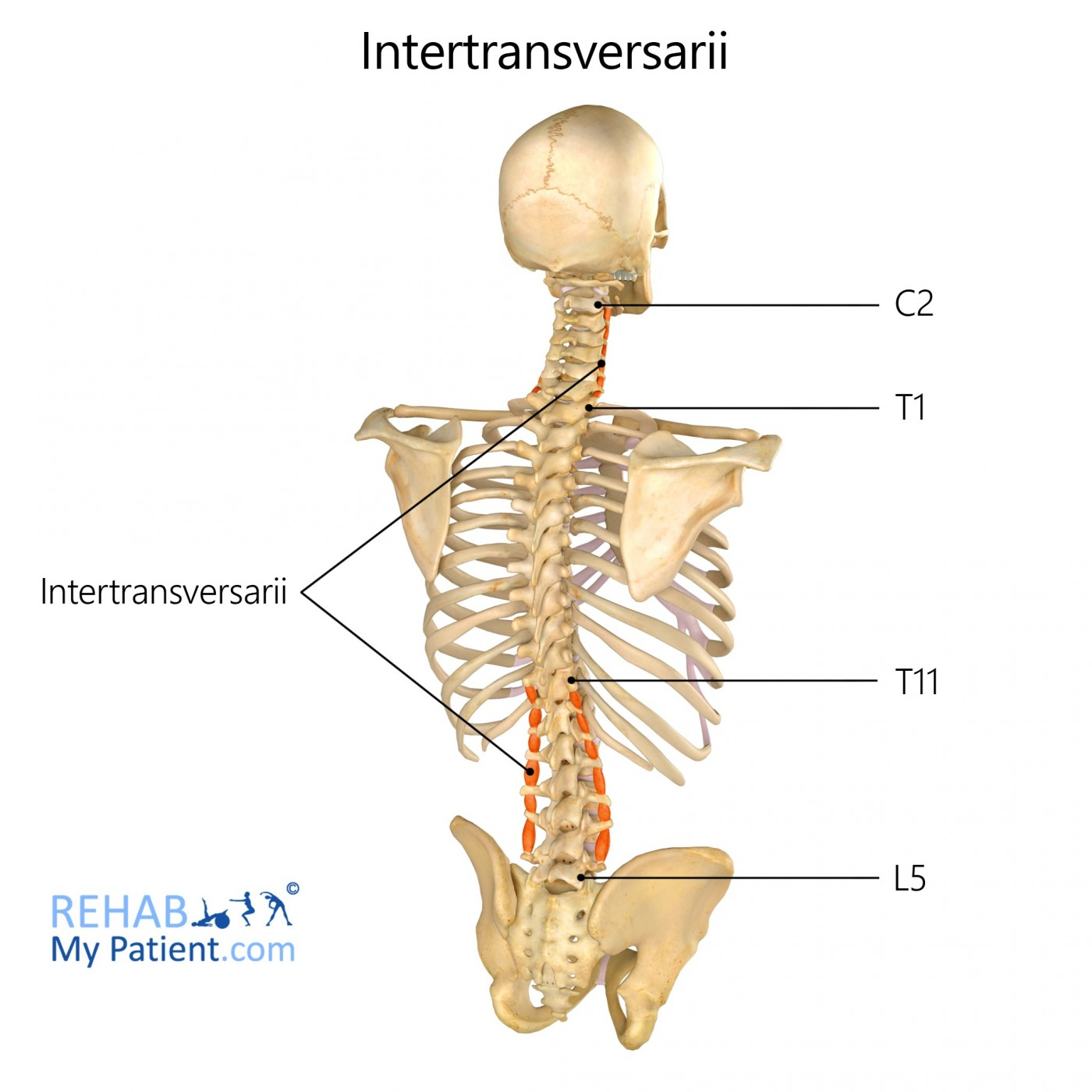
<ul><li><p>short muscles that connect adjacent transverse processes of vertebrae</p></li><li><p>small muscular slips are present in the thoracic region, but they are mostly present in the cervical and lumbar region</p></li><li><p>the lumbar intertransversarii consist of 4 pairs of muscles on either side of the vertebral column, and each pair has a medial and lateral component  (intertransversarii laterales lumborum and mediales lumborum)</p></li><li><p>in the cervical region, they are divided into anterior and posterior parts</p></li></ul><p></p><p>origin → colli: transverse processes of cervical vertebrae</p><p>          → lateral lumbar: transverse and accessory processes of vertebrae L1-L4</p><p>          → medial lumbar: accessory processes of vertebrae L1-L4</p><p>insertion → colli: transverse processes of adjacent vertebrae</p><p>               → lateral lumbar: transverse processes of succeeding vertebrae</p><p>               → medial lumbar: mammillary processes of succeeding vertebrae</p><p>action → colli: assists in lateral flexion of the cervical spine, stabilizes cervical spine</p><p>           → lumborum: assists in lateral flexion of lumbar spine, stabilizes lumbar spine</p><p>innervation → anterior rami of spinal nerves</p><p>blood supply → colli: occipital, deep cervical, vertebral arteries</p><p>                     → lumbar: dorsal branches of lumbar arteries</p>
21
New cards
<p>extrinsic back superficial layer</p>

extrinsic back superficial layer

  • superficial layer:

    • trapezius

    • latissimus dorsi

    • levator scapulae

    • rhomboid major

    • rhomboid minor

<ul><li><p>superficial layer:</p><ul><li><p>trapezius</p></li><li><p>latissimus dorsi</p></li><li><p>levator scapulae</p></li><li><p>rhomboid major</p></li><li><p>rhomboid minor</p></li></ul></li></ul><p></p>
22
New cards
<p>extrinsic back muscles intermediate layer</p>

extrinsic back muscles intermediate layer

  • intermediate layer:

    • serratus posterior superior

    • serratus posterior inferior

<ul><li><p>intermediate layer:</p><ul><li><p>serratus posterior superior</p></li><li><p>serratus posterior inferior</p></li></ul></li></ul><p></p>
23
New cards
<p>intrinsic back muscles superficial layer</p>

intrinsic back muscles superficial layer

  • superficial layer:

    • splenius capitis

    • splenius cervicis

    • erector spinae muscles:

      • iliocostalis

      • longissimus

      • spinalis

<ul><li><p>superficial layer:</p><ul><li><p>splenius capitis</p></li><li><p>splenius cervicis</p></li><li><p>erector spinae muscles:</p><ul><li><p>iliocostalis</p></li><li><p>longissimus</p></li><li><p>spinalis</p></li></ul></li></ul></li></ul><p></p>
24
New cards
<p>intrinsic back muscles deep layer (transversospinals)</p>

intrinsic back muscles deep layer (transversospinals)

  • deep layer:

    • transversospinals:

      • semispinalis

      • multifidus

      • rotatores

<ul><li><p>deep layer:</p><ul><li><p>transversospinals:</p><ul><li><p>semispinalis</p></li><li><p>multifidus</p></li><li><p>rotatores</p></li></ul></li></ul></li></ul><p></p>
25
New cards
<p>intrinsic back muscles deepest layer</p>

intrinsic back muscles deepest layer

  • deepest layer:

    • interspinales

    • intertransversarii

<ul><li><p>deepest layer:</p><ul><li><p>interspinales</p></li><li><p>intertransversarii</p></li></ul></li></ul><p></p>