KIN224 FINAL
 Call Kai
 Learn
Learn Practice Test
 Spaced Repetition
 Match
Match Flashcards
 Knowt Play
1/523

There's no tags or description
Looks like no tags are added yet.
Name | Mastery | Learn | Test | Matching | Spaced | Call with Kai |
|---|
No analytics yet
Send a link to your students to track their progress
524 Terms
An enzyme found within saliva is salivary
A. pepsin.
B. nuclease.
C. amylase.
D. protease.
E. pancreatase.
C. amylase.
Which sequence indicates the correct pathway for blood in the arterial flow of the upper appendage?
A. Axillary artery - subclavian artery - radial artery - ulnar artery
B. Subclavian artery - brachial artery - axillary artery - radial artery
C. Axillary artery - brachial artery - subclavian artery - ulnar artery
D. Subclavian artery - axillary artery - brachial artery - ulnar artery
E. Brachial artery - subclavian artery - axillary artery - radial artery
D. Subclavian artery - axillary artery - brachial artery - ulnar artery
Which sympathetic pathway involves a preganglionic neuron that synapses with a ganglionic neuron in a sympathetic trunk ganglion, but the postganglionic axon does not leave the trunk via a gray ramus?
A. Splanchnic nerve pathway
B. Adrenal medulla pathway
C. Postganglionic sympathetic nerve pathway
D. Spinal nerve pathway
E. None of the choices is correct.
C. Postganglionic sympathetic nerve pathway
The postganglionic axons from the superior mesenteric ganglion innervate
A. the distal half of the duodenum.
B. part of the pancreas.
C. part of the small intestine.
D. the proximal part of the large intestine.
E. All of the choices are correct.
E. All of the choices are correct.
The postganglionic parasympathetic fibers that are controlled by pelvic splanchnic nerves innervate the
Large intestine
Reproductive organs
Salivary glands
Pupillary constrictor muscles
Urinary bladder
Ureters
A. b, c, e
B. c, d, f
C. a, c
D. a, b, e, f
E. a, d, e
D. a, b, e, f
The cranial nerve that supplies parasympathetic innervation to the thoracic organs is
A. CN VI.
B. CN IX.
C. CN III.
D. CN II.
E. CN X.
E. CN X.
The prevertebral ganglion that receives axons that originate in the L1-L2 segments of the spinal cord is the _____ ganglion.
A. hepatic
B. celiac
C. inferior mesenteric
D. splenic
E. superior mesenteric
C. inferior mesenteric
Consider a basketball player whose heart is racing during the final moments of a game. With seconds on the clock, she makes a jump shot. Her excitement is a function of her ________ nervous system, and her movements are a function of her _______ nervous system.
A. sympathetic; parasympathetic
B. sympathetic; somatic
C. parasympathetic; sympathetic
D. somatic; parasympathetic
E. somatic; sympathetic
B. sympathetic; somatic
Cholinergic receptors that are always excitatory in the presence of ACh are called __________ receptors.
A. beta
B. catecholamine
C. muscarinic
D. nicotinic
D. nicotinic
Activation of parasympathetic fibers in pelvic splanchnic nerves leads to
A. increased smooth muscle motility in the digestive tract.
B. no effect on the digestive tract.
C. decreased smooth muscle motility in the digestive tract.
A. increased smooth muscle motility in the digestive tract.
When norepinephrine is released from postganglionic neurons, its targets are
A. cholinergic receptors on preganglionic sympathetic neurons.
B. adrenergic receptors on effectors such as smooth muscle.
C. adrenergic receptors on preganglionic sympathetic neurons.
D. cholinergic receptors on effectors such as cardiac muscle.
B. adrenergic receptors on effectors such as smooth muscle.
Which sympathetic pathway is responsible for activating the esophagus, heart, lungs, and thoracic blood vessels?
A. Splanchnic nerve pathway
B. Adrenal medulla pathway
C. Postganglionic sympathetic nerve pathway
D. Spinal nerve pathway
E. None of the choices is correct.
C. Postganglionic sympathetic nerve pathway
In an autonomic motor pathway, the first cell in the two-neuron chain is the ______ neuron.
A. posterior
B. preganglionic
C. terminal
D. primary
E. postganglionic
B. preganglionic
The autonomic nervous system has ___________ lower motor neuron(s) in each pathway.
A. one
B. four
C. two
D. three
C. two
The diameter of many blood vessels is controlled exclusively by the ________ nervous system, and decreases in the activity of this system result in _________.
A. parasympathetic; vasoconstriction
B. somatic; vasoconstriction
C. parasympathetic; vasodilation
D. sympathetic; vasoconstriction
E. sympathetic; vasodilation
E. sympathetic; vasodilation
The sympathetic division is also called what?
A. Craniolumbar division
B. Thoracolumbar division
C. Thoracosacral division
D. Craniosacral division
B. Thoracolumbar division
The preganglionic axons of CN VII extend to the
A. pterygopalatine, submandibular, and otic ganglia.
B. pterygopalatine and submandibular ganglia.
C. submandibular ganglion.
D. pterygopalatine ganglion.
E. otic ganglion.
B. pterygopalatine and submandibular ganglia.
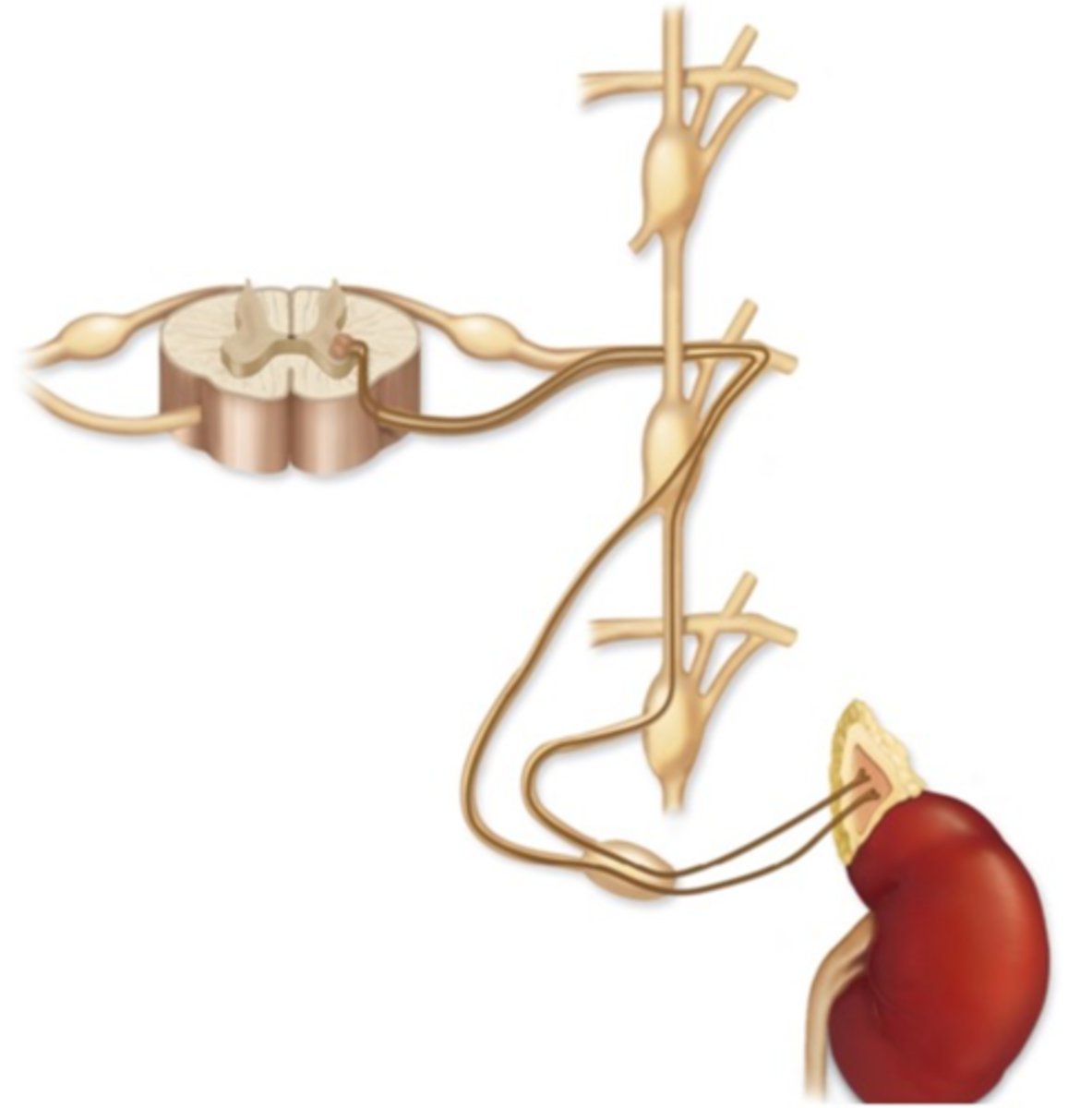
Which type of pathway is illustrated?
A. Postganglionic sympathetic nerve pathway
B. Spinal nerve pathway
C. Splanchnic nerve pathway
D. Raynaud nerve pathway
E. Adrenal medulla pathway
E. Adrenal medulla pathway
Match the nerve with examples of the parasympathetic effector organs it innervates.
CN X (vagus)
Thoracic and most abdominal viscera Correct
CN VII (facial)
Lacrimal and salivary glands Correct
Pelvic splanchnic nerves
Most pelvic viscera Correct
CN III (oculomotor)
Ciliary muscles in the eye Correct
Drag each of the following labels into the appropriate box to identify which division of the autonomic nervous system is identified by the given function
Hormone ___________ is the process that deals with enzymatic degradation of hormones and removal of the hormone from the blood by excretion or uptake into the target cells.
A. binding
B. synthesis
C. elimination
D. balance
C. elimination
Hyperglycemia (high blood glucose levels) would cause the pancreas to _________ insulin secretion, and hypoglycemia (low blood glucose levels) would cause the pancreas to _________ insulin secretion.
A. increase; increase
B. decrease; decrease
C. increase; decrease
D. decrease; increase
C. increase; decrease
Target organs regulate the pituitary through feedback loops. Most often, this takes the form of
A. All of the choices are correct.
B. direct nervous stimulation.
C. positive feedback.
D. negative feedback inhibition.
D. negative feedback inhibition
Which hormone group is not secreted by the adrenal cortex?
A. Glucocorticoids
B. Mineralocorticoids
C. Corticosteroids
D. Gonadocorticoids
E. No exceptions; all choices are secreted by the adrenal cortex
E. No exceptions; all choices are secreted by the adrenal cortex
Thyroid-stimulating hormone (TSH) is secreted by the
A. anterior pituitary, and it targets follicular cells of the thyroid gland.
B. thyroid gland, and it targets cells of the parathyroid gland.
C. hypothalamus, and it targets cells of the anterior pituitary gland.
D. hypothalamus, and it targets cells of the posterior pituitary gland.
E. posterior pituitary, and it targets parafollicular cells of the thyroid gland.
A. anterior pituitary, and it targets follicular cells of the thyroid gland.
Aldosterone promotes the homeostasis of ions by causing the kidneys to
A. develop greater filtering ability.
B. conserve sodium and excrete potassium.
C. excrete sodium and potassium.
D. conserve sodium and potassium.
E. excrete sodium and conserve potassium.
B. conserve sodium and excrete potassium.
Which hormone induces its target cells to take up glucose, thereby lowering blood glucose levels?
A. Glucagon
B. Insulin
C. Somatotropin
D. Pancreatic polypeptide
E. Somatostatin
B. Insulin
Where is the pituitary gland located?
A. Within the sella turcica of the sphenoid bone
B. On the posterior surface of the thyroid gland
C. Within the third ventricle of the brain
D. Between the cerebrum and cerebellum, inferior to the occipital lobe
E. On the tracheal surface, inferior to the larynx
A. Within the sella turcica of the sphenoid bone
Which of the following has both endocrine and exocrine functions?
A. Thyroid gland
B. Pineal gland
C. Anterior pituitary gland
D. Pancreas
D. Pancreas
Which of the following hormones primarily affects the reproductive organs?
A. Melatonin
B. Adrenocorticotropic hormone
C. Growth hormone
D. Follicle-stimulating hormone
E. Thyrotropin
D. Follicle-stimulating hormone
Protein hormones are
A. lipid-soluble.
B. soluble in both water and lipids.
C. soluble in neither water nor lipids.
D. water-soluble.
D. water-soluble.
Tropic hormones
A. function in only one sex.
B. function only under certain environmental conditions.
C. block the actions of hormones that endocrine glands secrete.
D. stimulate certain endocrine glands to secrete hormones.
D. stimulate certain endocrine glands to secrete hormones.
Parathyroid hormone release depends on blood levels of calcium. Such an endocrine reflex is said to be initiated by
A. neural stimulation.
B. hormonal stimulation.
C. humoral stimulation.
D. positive feedback stimulation.
C. humoral stimulation.
The release of hormones from the adrenal medulla is stimulated by
A. the sympathetic division of the autonomic nervous system.
B. growth hormone.
C. adrenocorticotropic hormone.
D. follicle-stimulating hormone.
E. thyrotropic hormone.
A. the sympathetic division of the autonomic nervous system.
Within the infundibulum, the axons from neurons extending into the posterior pituitary are known as the
A. hypothalamo-hypophyseal tract.
B. secondary plexus.
C. supraoptic portal system.
D. primary plexus.
A. hypothalamo-hypophyseal tract.
The _______ secretes triiodothyronine.
A. adrenal gland
B. thyroid gland
C. pancreas
D. parathyroid gland
E. pineal gland
B. thyroid gland
Which are the most numerous of the leukocytes?
A. Neutrophils
B. Monocytes
C. Basophils
D. Lymphocytes
E. Eosinophils
A. Neutrophils
Leukocytes are the _______ of the formed elements, and leukocytes have ______________.
A. smallest, no nucleus
B. largest, prominent nuclei
C. largest, no nucleus
D. smallest, prominent nuclei
B. largest, prominent nuclei
Which are characteristics of type O blood?
a: Has anti-A antibodies
b: Has anti-B antibodies
c: Has surface antigen O on its erythrocytes
d: Has surface antigen A on its erythrocytes
e: Has neither surface antigen A nor B on its erythrocytes
A. b, c, e
B. c
C. a, b, c
D. b, c, d
E. a, b, e
E. a, b, e
Which are characteristic of leukocytes?
a: Smaller than erythrocytes
b: Have a nucleus
c: Have no hemoglobin
d: More numerous than erythrocytes
e: Depending on type, may or may not contain granules
A. b, c, d, e
B. a, b, e
C. b, c, e
D. a, b, c, d
E. a, b, c, d, e
C. b, c, e
One of the functions of blood is to regulate fluid levels in the body. If too much fluid escapes from the bloodstream and enters the tissues, blood pressure will
A. decrease.
B. increase.
A. decrease.
When blood is centrifuged and its components separate, the bottom of the tube holds the
A. buffy coat.
B. plasma.
C. platelets.
D. erythrocytes.
E. electrolytes and waste products.
F. monocytes.
D. erythrocytes.
The first phase of hemostasis involves
A. blood vessel dilation.
B. blood vessel constriction.
C. fibrinolysis.
D. relese of procoagulants.
B. blood vessel constriction
Old erythrocytes are phagocytized in the
A. spleen and lung.
B. lung.
C. spleen.
D. liver and spleen.
E. liver.
D. liver and spleen.
Blood plasma is slightly _______; if pH drifts out of the normal range, dire consequences can result from alterations in the structure of _______ .
A. acidic, proteins
B. basic, glucose
C. acidic, glucose
D. acidic, glycogen
E. basic, proteins
E. basic, proteins
Which leukocytes are derived from the myeloid line?
A. Basophils and eosinophils
B. Neutrophils, basophils, eosinophils, and monocytes
C. Lymphocytes and monocytes
D. Neutrophils
E. Lymphocytes
B. Neutrophils, basophils, eosinophils, and monocytes
How many globins (protein building blocks) are found in a single hemoglobin molecule?
A. 1
B. 4
C. 6
D. 8
E. 2
B. 4
An individual's hematocrit would vary with
A. All of the choices are correct.
B. altitude.
C. age.
D. sex.
A. All of the choices are correct.
If agglutination occurs after a blood transfusion, it may indicate
A. the wrong blood type was used.
B. the recipient had type AB blood.
C. there were no agglutinins (antibodies) in the recipient blood.
D. the donor had type O blood.
A. the wrong blood type was used.
To compensate for significant blood loss, the autonomic nervous system triggers
A. vasoconstriction and a decrease in heart rate.
B. vasodilation and an increase in heart rate.
C. vasoconstriction and an increase in heart rate.
D. vasodilation and a decrease in heart rate.
C. vasoconstriction and an increase in heart rate.
The type of leukocyte that will migrate in the blood and take up residence in the tissues as a macrophage is a(n)
A. eosinophil.
B. lymphocyte.
C. monocyte.
D. basophil.
E. neutrophil.
C. monocyte.
The hemoglobin found in erythrocytes is able to chemically attach to
A. only nitrogen.
B. only carbon dioxide.
C. oxygen, carbon dioxide, and nitrogen.
D. both oxygen and carbon dioxide.
E. only oxygen.
D. both oxygen and carbon dioxide.
Which circuit of the cardiovascular system is responsible for sending blood to the kidneys, stomach, and pelvic regions?
A. Systemic circuit
B. Visceral circuit
C. Coronary circuit
D. Pulmonary circuiT
A. Systemic circuit
Occlusion of blood vessels tends to lead to
A. increases in capillary exchange.
B. increases in perfusion.
C. defibrillation of cardic muscle cell contraction.
D. inadequate blood supply and damage to body tissues.
D. inadequate blood supply and damage to body tissues.
Which action leads to the closure of the right atrioventricular valve?
A. Contraction of the right atrium
B. Contraction of the left atrium
C. Contraction of the right ventricle
D. Relaxation of the right ventricle
E. Relaxation of the left atrium
C. Contraction of the right ventricle
The pulmonary trunk receives blood from the right ventricle and conducts it toward the lung. The pulmonary trunk is a(n)
A. artery.
B. vein.
C. capillary.
A. artery.
During a cardiac cycle, how many of the four chambers contract at any one time?
A. 1
B. 2
C. 4
D. Highly variable, depending on the heart beat rate
E. None of the choices is correct.
B. 2
Which circuit of the cardiovascular system includes the left ventricle and aorta?
A. Cardio circuit
B. Systemic circuit
C. Coronary circuit
D. Pulmonary circuit
B. Systemic circuit
The function of the coronary sinus is to
A. connect the top and bottom halves of the heart.
B. take blood from the coronary circulation to the right atrium.
C. guide the inferior vena cava into the right atrium.
D. guide the aorta out of the heart.
E. shunt blood from the right atrium to the left atrium.
B. take blood from the coronary circulation to the right atrium.
The atria are separated from the ventricles externally by the
A. anterior interventricular sulcus.
B. posterior interventricular sulcus.
C. sinoventricular sulcus.
D. coronary sulcus.
E. None of the choices is correct.
D. coronary sulcus.
In an ECG, what does the T wave represent?
A. Depolarization of the atria
B. Depolarization of the left ventricle
C. Repolarization of the ventricles
D. Closure of the AV valves
E. Depolarization of the right ventricle
C. Repolarization of the ventricles
Cardiac output is usually expressed in
A. beats per minute.
B. liters per minute.
C. mm Hg.
D. mL per beat.
B. liters per minute.
Cardiac output is the amount of blood that is pumped
A. by a single ventricle in one hour.
B. by both ventricles in one minute.
C. by the left ventricle into the aorta in one beat.
D. by both ventricles in one hour.
E. by a single ventricle in one minute.
E. by a single ventricle in one minute.
Which carries oxygenated blood from the lungs to the heart?
A. Pulmonary arteries
B. Pulmonary trunk
C. Inferior vena cava
D. Pulmonary veins
E. Superior vena cava
D. Pulmonary veins
Vagal tone refers to the
A. decreasing of the heart rate below its inherent rhythm by sympathetic stimulation.
B. increasing of the heart rate above its inherent rhythm by parasympathetic stimulation.
C. decreasing of the heart rate below its inherent rhythm by parasympathetic stimulation.
D. increasing of the heart rate above its inherent rhythm by sympathetic stimulation.
C. decreasing of the heart rate below its inherent rhythm by parasympathetic stimulation.
The heart valves
A. direct the conduction impulse through the heart muscle.
B. permit the passage of blood in one direction.
C. stabilize and hold the arteries leaving the heart.
D. separate the right and left sides of the heart.
E. are only used in the fetal heart.
B. permit the passage of blood in one direction.
As a venous pathway moves closer to the heart, the veins
A. show no change in their lumen size.
B. get larger.
C. get smaller.
B. get larger.
The brachiocephalic veins are formed by the
a: Internal jugular veins
b: Right sigmoid sinus
c: Left sigmoid sinus
d: Subclavian veins
e: Straight sinus
A. b, c, e
B. a, d
C. a, c, d
D. b, d, e
E. a, b, e
B. a, d
Increased cardiac output ______ the blood pressure.
A. will not affect
B. increases
C. decreases
B. increases
Blood colloid osmotic pressure is largely due to
A. the high amount of water in the blood, and it promotes filtration from arterioles.
B. the proteins in the blood, and it promotes filtration.
C. the pressure generated by the heart, and it favors osmosis into the arteriole end of the capillary bed.
D. the high amount of water in the blood, and it promotes diffusion out of the capillaries.
E. the proteins in the blood, and it promotes reabsorption.
E. the proteins in the blood, and it promotes reabsorption.
The force per unit area that blood places on the inside wall of a blood vessel
A. is greater in the inferior vena cava than in the common iliac vein.
B. is greater during diastole.
C. is called the blood pressure.
D. increases the further the vessel is from the heart.
E. is called the pulse.
C. is called the blood pressure.
Which of the following vessel types typically has the thickest tunica media?
A. Veins
B. Capillaries
C. Arteries
C. Arteries
Angiotensin II causes
A. vasoconstriction, increased urine formation, and decreased thirst.
B. increased heart rate, vasodilation, and less urine formation.
C. decreased thirst, vasodilation, and increased urine formation.
D. decreased heart rate, vasoconstriction, and increased urine formation.
E. vasoconstriction, decrease urine formation, and increased thirst.
E. vasoconstriction, decrease urine formation, and increased thirst.
Which is the most common type of capillary?
A. Venules
B. Continuous
C. Fenestrated
D. Discontinuous
E. Sinusoids
B. Continuous
The vessels that supply the lower limbs are the
A. common carotids.
B. vertebral arteries.
C. external iliac arteries.
D. internal iliac arteries.
E. subclavian arteries
C. external iliac arteries.
The _____ in the pulmonary circuit carry deoxygenated blood.
A. arteries
B. veins
A. arteries
The umbilical cord contains _____ umbilical vein(s) and _____ umbilical artery(ies).
A. two; one
B. two; two
C. one; two
D. one; one
E. two; three
C. one; two
The velocity of blood flow through capillaries is
A. rapid, which prevents pooling in lower extremeties.
B. slow, due to small total cross-sectional area, low friction and high pressure.
C. rapid, due to their small total cross sectional area.
D. slow, which allows sufficient time for exchange of gases and nutrients between blood and tissues
D. slow, which allows sufficient time for exchange of gases and nutrients between blood and tissues
When physical exertion has ended and the body is at rest, veins demonstrate
A. vasoconstriction so that they function as blood reservoirs.
B. vasodilation so that blood is shifted toward the rest of the circulatory system.
C. vasoconstriction so that blood is shifted toward the rest of the circulatory system.
D. vasodilation so that they function as blood reservoirs.
D. vasodilation so that they function as blood reservoirs.
Water lost through feces is considered ___________ water loss.
A. insensible, facultative
B. sensible, obligatory
C. sensible, facultative
D. insensible, obligatory
B. sensible, obligatory
Feelings of thirstiness are brought on by
A. decreases in salivary secretions and decreases in blood osmolarity.
B. increases in salivary secretions and increases in blood osmolarity.
C. increases in salivary secretions and decreases in blood osmolarity.
D. decreases in salivary secretions and increases in blood osmolarity
D. decreases in salivary secretions and increases in blood osmolarity
The high metabolic rate of infants puts them at increased risk of metabolic
A. acidosis.
B. alkalosis.
A. acidosis.
Diabetes mellitus, profuse sweating, and hyposecretion of ADH can each lead to
A. hypotonic plasma.
B. volume excess.
C. overhydration.
D. dehydration.
D. dehydration.
When compared to extracellular fluid, intracellular fluid contains
A. less potassium but more negatively charged proteins.
B. less potassium and less negatively charged proteins.
C. more potassium but fewer negatively charged proteins.
D. more potassium and more negatively charged proteins.
D. more potassium and more negatively charged proteins.
The process by which the kidneys eliminate excess acid or base is relatively
A. slow (takes hours to days) and limited (is not very powerful).
B. slow (takes hours to days) but powerful.
C. quick (takes minutes) but limited (is not very powerful).
D. quick (takes minutes) and powerful.
B. slow (takes hours to days) but powerful.
Compared to adults, infants are _______ susceptible to respiratory acidosis due to lower _________.
A. more, residual volume.
B. less, carbon dioxide levels.
C. less, residual volume.
D. more, carbon dioxide levels.
A. more, residual volume.
Which ion is the principal solute of the ECF and is crucial for neuromuscular and renal function?
A. Potassium
B. Calcium
C. Phosphate
D. Sodium
E. Magnesium
D. Sodium
Distention of the stomach causes thirst to
A. decrease.
B. increase.
A. decrease.
Elderly individuals generally have a _______ percentage of body fluid and are therefore _______ prone to fluid imbalances.
A. low; less
B. low; more
C. high; less
D. high; more
B. low; more
The term "primary lymphoid structure" applies
A. only to lymph nodes.
B. to the red bone marrow and thymus.
C. to lymph nodes and MALT.
D. only to red bone marrow.
E. to the spleen and lymph nodes.
B. to the red bone marrow and thymus.
Lymphatic capillaries
A. are smaller in diameter than blood capillaries.
B. are open at both ends.
C. are abundant in epithelial tissues.
D. are like continuous capillaries in that they have many tight junctions.
E. lack a basement membrane.
E. lack a basement membrane.
Which area does not contain MALT?
A. Gastrointestinal tract
B. No exceptions; all choices contain MALT
C. Urinary tract
D. Respiratory tract
E. Genital tract
B. No exceptions; all choices contain MALT
The thoracic duct collects lymph from all of the following except the
A. abdomen.
B. left shoulder.
C. right arm.
D. right foot.
E. left leg.
C. right arm.
Within the red pulp of the spleen are enlarged capillaries called _________, which have a discontinuous basement membrane that allows blood cells to enter and exit easily.
A. trabecular cords
B. splenic sinusoids
C. splenic vessels
D. splenic cords
E. trabecular vessels
B. splenic sinusoids
Which fluid does lymph most closely resemble?
A. Intracellular fluid
B. Blood plasma
C. Interstitial fluid
D. Whole blood
C. Interstitial fluid
Red marrow is found within
A. compact bone canals.
B. the large cavities contained within the shafts of long bone.
C. spaces within spongy bone.
D. all osseous tissue of the appendicular skeleton.
C. spaces within spongy bone.
Lymphatic capillaries
A. originate as closed-ended tubes associated with blood capillary networks.
B. concentrate lymph prior to passing it to larger lymphatic vessels.
C. filter lymph.
D. include layers of smooth muscle for peristalsis.
E. cannot be discerned structurally from cardiovascular system capillaries
A. originate as closed-ended tubes associated with blood capillary networks.
Lymph nodes may be found individually, or clustered in specific regions of the body. Which cluster of lymph nodes receives lymph from the head and neck?
A. Cervical lymph nodes
B. Thoracic lymph nodes
C. Axillary lymph nodes
D. Abdominal lymph nodes
E. Inguinal lymph nodes
A. Cervical lymph nodes
Where do T-lymphocytes mature?
A. Thymus gland
B. White bone marrow
C. Tonsils
D. Spleen
E. Thyroid gland
A. Thymus gland
Which of the lymphatic trunks drain into the cisterna chyli?
A. Intestinal trunks and lumbar trunks
B. Subclavian trunks and jugular trunks
C. Intestinal trunks
D. Lumbar trunks
E. Bronchomediastinal trunks and intestinal trunks
A. Intestinal trunks and lumbar trunks