Coastal Processes And Landforms
 Call Kai
 Learn
Learn Practice Test
 Spaced Repetition
 Match
Match Flashcards
 Knowt Play
1/72

There's no tags or description
Looks like no tags are added yet.
Name | Mastery | Learn | Test | Matching | Spaced | Call with Kai |
|---|
No analytics yet
Send a link to your students to track their progress
73 Terms
Swash
The water that rushes up the beach
Backwash
The water that flows back towards the sea
Constructive Waves
Low waves that surge up the beach and deposit sediment and pebbles and construct the beach
Destructive Waves
High and steep which remove sand and pebbles destructing the beach
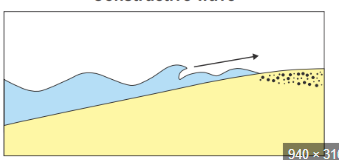
Name 5 features of constructive waves
Wave crests are far apart
Gentle sloping wave front
Breaking wave spills forward
Strong swash pushes pebbles and sand up the beach
Gentle beach
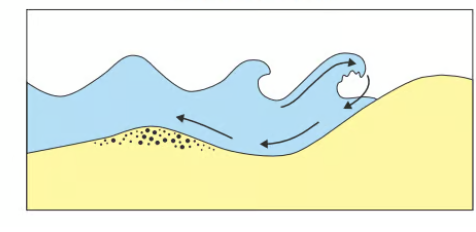
Name 5 features of destructive waves
Waves close together
Steep wave front
Breaking waves plunges downwards
Steep beach
Strong backwash pulls sand and sediment back into the sea
Deposition
When material transported by the sea is dropped due to the water losing energy
Wave Break
When a wave hits the beach and friction slows the base of the wave causing the crest (top) to break over
Erosion
The wearing away and removal of material by a moving force
Geology
The study of the Earth and how it works
Igneous Rock
Formed from molten rock often linked to volcanoes
Sedimentary Rock
Formed from sediments that have settled at the bottom of a lake, sea or ocean, and have been compressed over millions of years
Metamorphic Rock
Rocks thatW have been subjected to tremendous heat and/or pressure, causing them to change into another type of rock
Weathering
The weakening or decay of rocks in their original place, mostly caused by weather factors such as rainfall and temperature changes
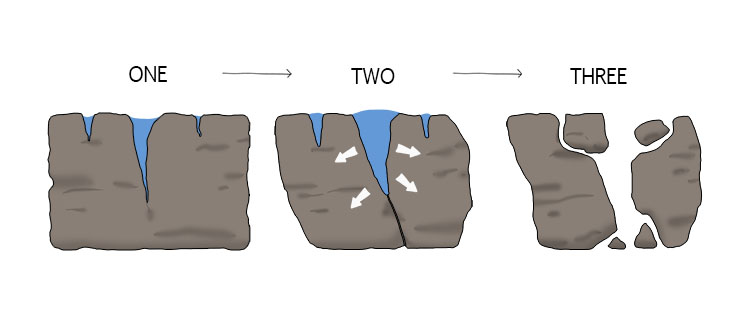
Describe the process of freeze thaw weathering at stage 1?
Day: water collects in cracks in rocks
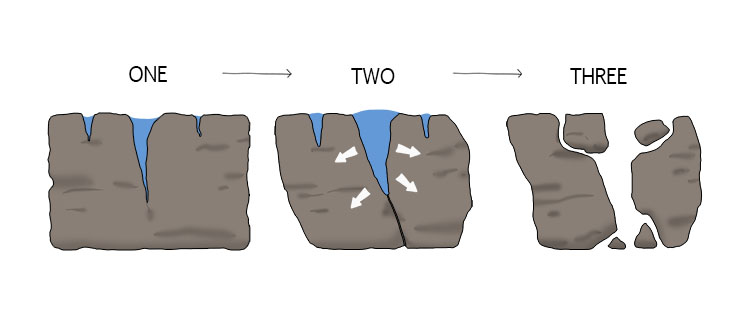
Describe the process of freeze thaw weathering at stage 2?
Night: water freezes to form ice. Expansion causes stresses and cracks are enlarged
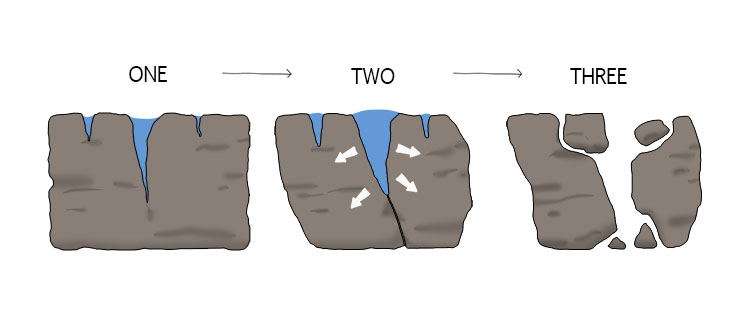
Describe the process of freeze thaw weathering at stage 3?
Day/Night: repeated freezing and thawing. Rock fragments break off and collects as scree at the foot of the rockface
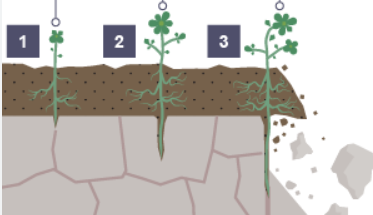
Describe the process of biological weathering at stage 1?
Roots enter small cracks in the rock
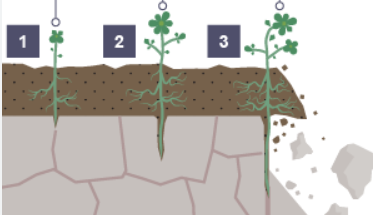
Describe the process of biological weathering at stage 2?
As roots grow the crack gets larger
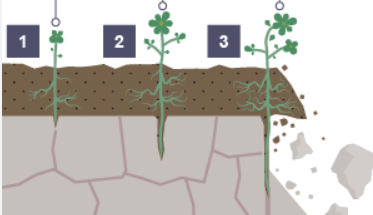
Describe the process of biological weathering at stage 3?
Rock breaks away, the same process can happen with animals burrowing
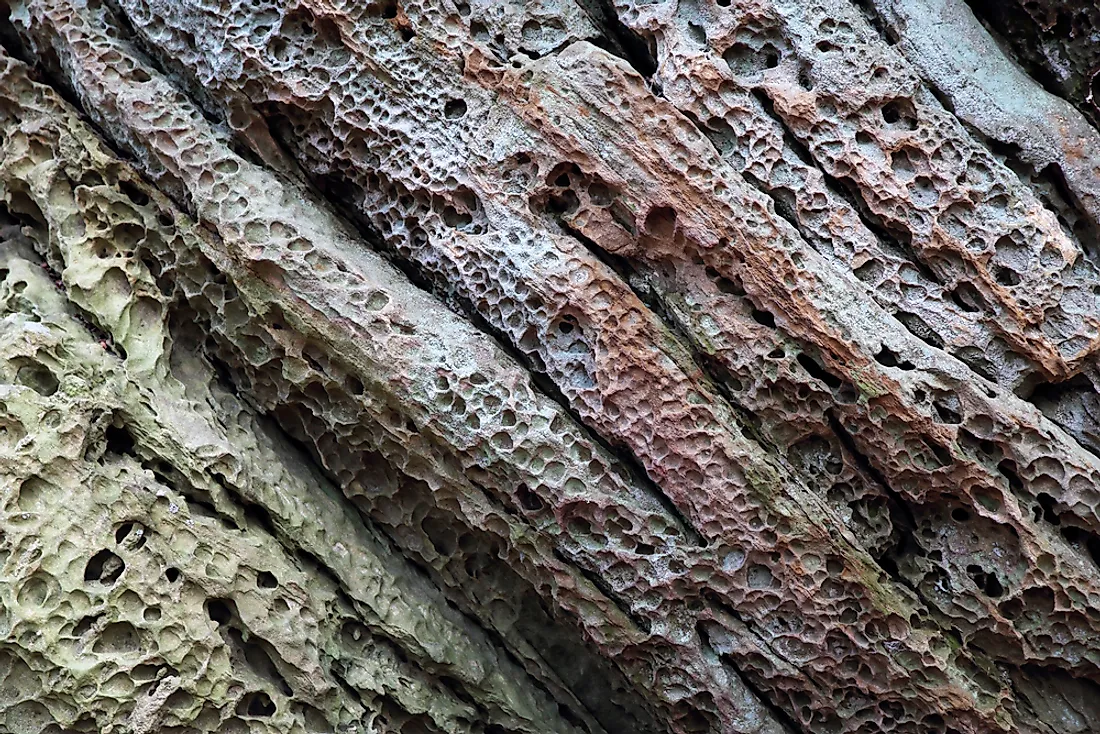
Describe chemical weathering
Caused by chemical change. Rain water which is slightly acidic, which dissolves certain types of rocks and minerals
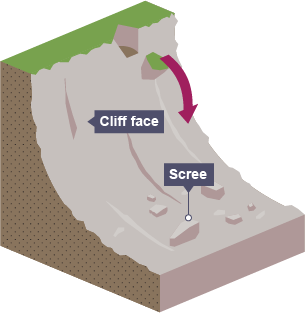
Rock fall
Fragments of rock break away from the cliff face, often due to freeze thaw weathering
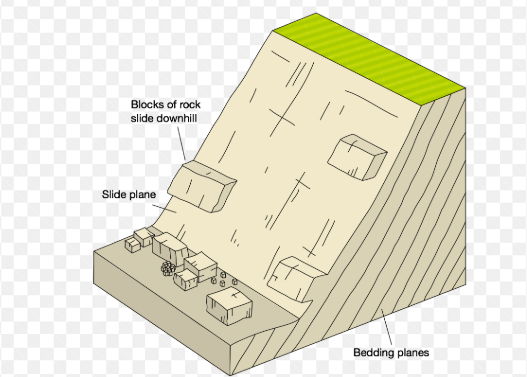
Landslide
Sliding of blocks of rock moving rapidly downslope, usually saturated with water
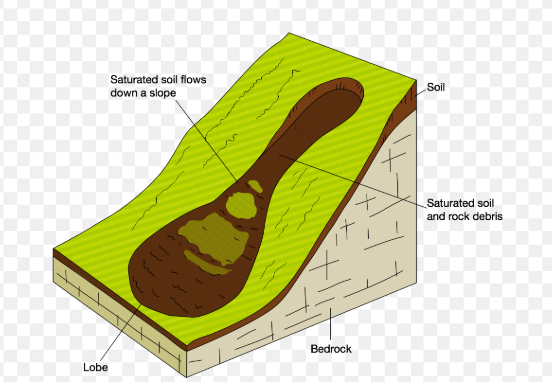
Mud Slide
Saturated soil and weak rock flow down a slope
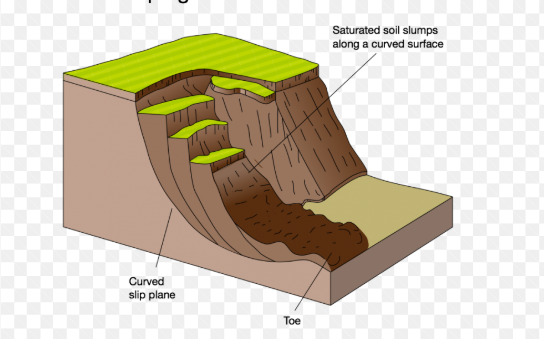
Rotational Slip
Slumping of loose material, often along a curved surface saturated by water
Mass Movement
The downhill movement of sediment because of gravity
Discordant Coastline
Where rocks are perpendicular to the edge of the coastline
Concordant Coastline
Where the same rock runs along the length of the coast
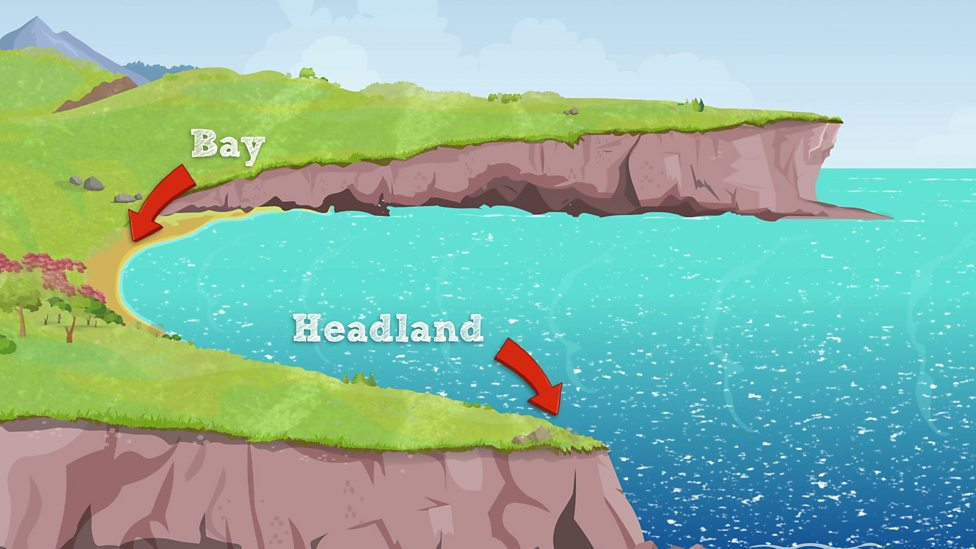
Describe the formation of headlands and bays
Headlands and bays are formed when there is a difference in the rocks along the coast. The softer rock will erode quicker than the harder rock leaving bays in the rock. The harder rocks erodes slower, leaving headlands.
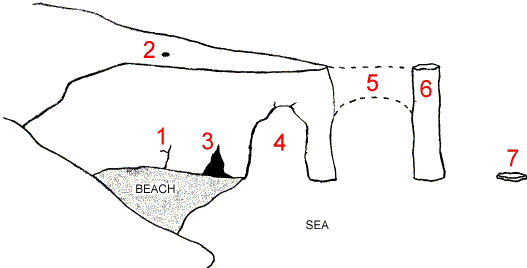
Describe the formation of arches, stacks and stumps at stage 1?
Joint or fault in the resistant rock
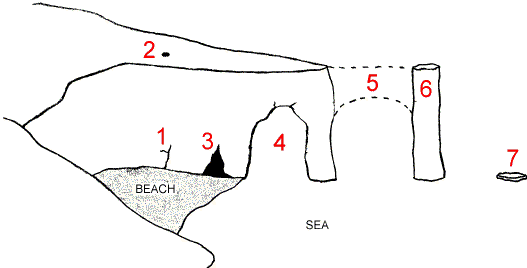
Describe the formation of arches, stacks and stumps at stage 3?
Cave - abrasion and the hydraulic action of the waves widens the weaknesses in the cliff to form a cave
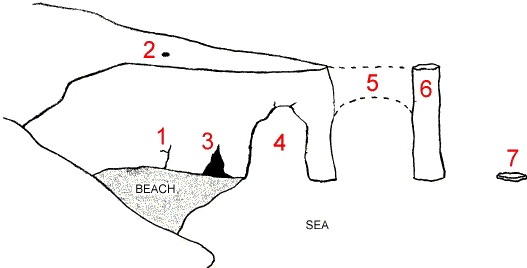
Describe the formation of arches, stacks and stumps at stage 4?
Arch - waves cut through the headland to form an arch which is continually being widened at its base by the force of the waves surrounding it
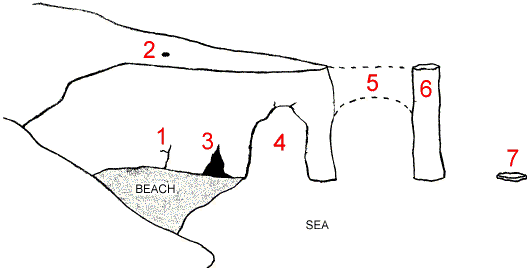
Describe the formation of arches, stacks and stumps at stage 5?
Roof of the arch becomes to heavy to support and collapses
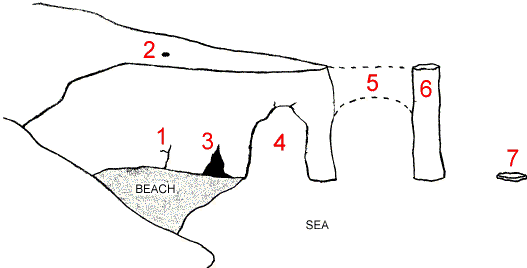
Describe the formation of arches, stacks and stumps at stage 6?
Stack - an isolated portion of the cliff
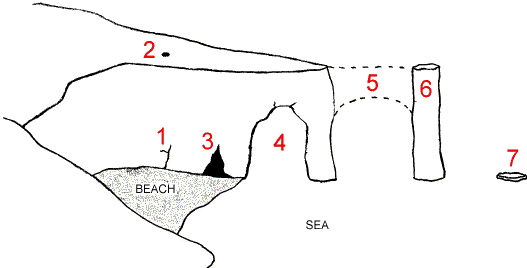
Describe the formation of arches, stacks and stumps at stage 7?
Stump - The stack is undercut and collapses leaving a stump
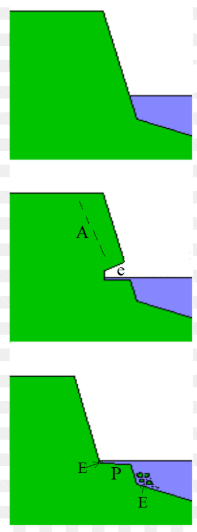
Describe the formation of a wave cut platform
Wave cut platforms are created when waves crash against the bottom of a cliff. The top off the clip then sticks out over the sea. The bit of rock that sticks will eventually weaken and collapse into the sea. The piece of rock will be dragged out by the backwash and will be deposited extending the platform
Hydraulic action
The sheer force of the waves as they smash against the cliff. Air becomes trapped in the cracks in the rock and causes the rock to break apart
Abrasion
This is when pebbles grind along a rock platform much like sandpaper. Over time the rock becomes smooth
Attrition
This is when rocks that the sea is carrying knock against eachother. They break apart to become smaller and more rounded
Solution (erosion)
This is when the sea water dissolves certain types of rocks
Solution (Transportation)
When minerals in rocks are dissolved in the sea and then carried in solution. The load is not visible
Suspension
Small particles such as silts and clays are suspended in the flow of the water
Saltation
Where small pieces of shingle or large sand grains are bounced along the sea bed
Traction
Where pebbles and larger material are rolled along the sea bed
Sandy beaches
Occur in sheltered bays, the swash is stronger than the backwash so sediment is deposited and constantly moving up the beach
Pebble Beaches
Are a result of strong backwash, pebbles do not move far up the beach, making the profile steep
Sand Dunes
Large heaps of sand at the back of broad sandy beaches
What do sand dunes need to form (5 things)
Large flat beach
Large supply of sand
A large tidal range, so the sand can dry
Onshore wind to move the sand to the back of the beach
An obstacle such as driftwood for the dune to form against
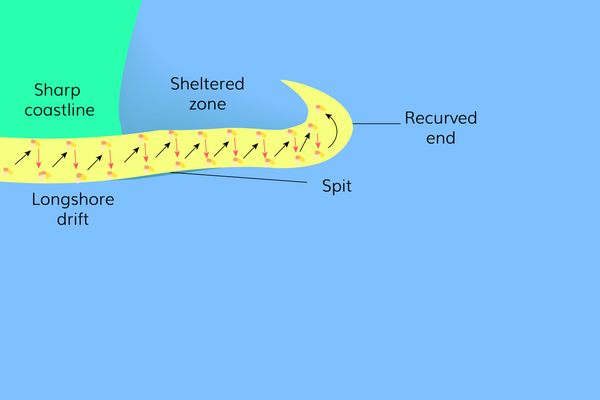
Spit
An extended stretch of beach material that sticks out to sea and is joined to the mainland at on end
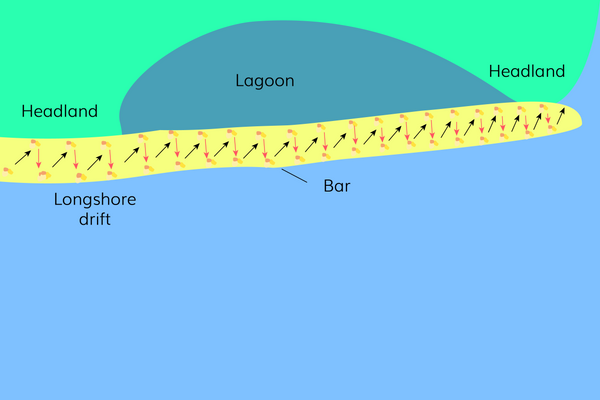
Bar and lagoon
Linear ridges of sand/shingle extending across a bay and are connected to land on both sides. Lagoons are formed behind a bar
Describe the formation of a spit, bar and lagoon, step 1?
Sediment is carried by longshore drift
Describe the formation of a spit, bar and lagoon, step 2?
When there is a change in the shape of the coastline, deposition occurs. A long thin ridge of material is deposited. This is the spit
Describe the formation of a spit, bar and lagoon, step 3?
A hooked end can form if there is a change in wind direction
Describe the formation of a spit, bar and lagoon, step 4?
Waves cannot get past a spit, therefore the water behind a spit is very sheltered. Silts are deposited here to form salt marshes or mud flats
Describe the formation of a spit, bar and lagoon, step 5?
Sometimes a spit can grow across a bay, joining two headlands together. This landform is known as a bar and a lagoon is formed behind
What are beaches formed by?
Constructive waves
How is a sand beach created?
By low energy waves and are flat and wide - sand particles are small so the weak backwash can move them back down the beach, creating a long, gentle slope
How is a shingle beach created?
By high energy waves and are steep and narrow - sand particles are washed away but larger shingle left behind. The shingle particles build up to create a steep slope
How is a sand dune created? Step One?
Sand dunes are formed when sand deposited by longshore drift is moved up the beach by the wind
How is a sand dune created? Step Two?
Obstacles (eg driftwood) cause wind speed to decrease so sand is deposited, forming small embryo dunes
How is a sand dune created? Step Three?
Embryo dunes are colonised by plants. The roots of the vegetation stabilises the sand, encouraging more sand to accumulate there. This forms foredunes, and eventually mature dunes. New embryo dunes form in front of stabilised dunes
How is a sand dune created? Step Four?
Dune slacks (small pools) can form in hollows between dunes
Can caves and arches be identified on a map?
No
How can we identify a stack on a map?
Look like little blobs in the sea
How can we identify a cliff on a map?
Shown as little black lines
How can we identify a wave cut platform on a map?
Shown as bumpy edges along the coast
How can we identify sand beaches on a map?
Shown as pale yellow
How can we identify a shingle beach on a map?
Shown as pale yellow or white with speckles
How can we identify a spit on a map?
Shown by a beach that carries out to sea, but is still attached at one end