The solar system
 Call Kai
 Learn
Learn Practice Test
 Spaced Repetition
 Match
Match Flashcards
 Knowt Play
1/18

There's no tags or description
Looks like no tags are added yet.
Name | Mastery | Learn | Test | Matching | Spaced | Call with Kai |
|---|
No analytics yet
Send a link to your students to track their progress
19 Terms
Where is our solar system found?
milky way
What are the eight natural satellites called planets that orbit the sun (from closest to furthest)?
mercury
venus
earth
mars
jupiter
saturn
uranus
neptune
What also orbits the sun?
dwarf planets like pluto
What are natural satellites that orbit some planets?
moons
what is an example of a man made satellite?
the international space station
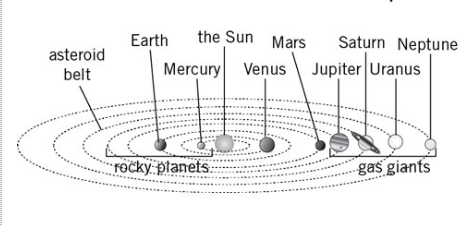
What are the terrestrial (rocky) planets?
mercury
venus
earth
mars
What are the jovian (gas) planets?
jupiter
saturn
uranus
neptune
What separates the terrestrial and jovian planets?
the asteroid belt
What belt is beyond the jovian planets?
Ruiper belt
How is a star formed?
disc of dust and gas rotates
cloud of dust and gas is drawn inward by gravity
the temperature in the centre becomes hotter
a protostar is formed
fusion takes place
the star begins to shine
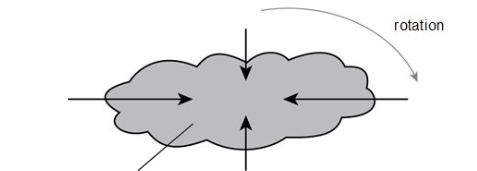
Stage 1 of birth of a star
clouds of dust, rock and gas exist in a planetary nebula
gas is drawn inwards by gravity and clumps begin to form
the collapsing cloud begins to rotate and flatten into a disc of gas and dust
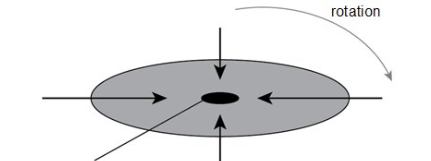
Stage 2 of birth of a star
the disk rotates faster and faster pulling more material inwards
the particles collide more often the temperature increases in the centre
a hot dense core called a protostar is created
Stage 3 of birth of a star
when the protostar becomes hot enough hydrogen atoms begin to fuse producing helium
energy is released
the star begins to shine
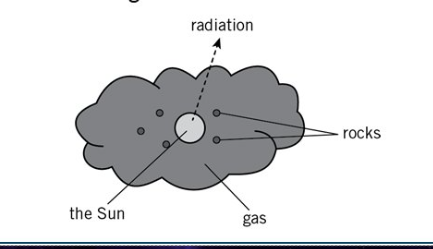
Stage 4 (Sun & solar system) star formation
in the formation of the solar system the sun is the star at the centre
the heat from the sun evaporates any ice in the cloud
it pushes away the gas leaving clumps of rock orbiting close to the sun
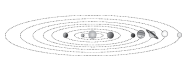
Stage 5 (Sun & solar system) star formation
the clumps are not hot enough to become protostars
but go on to form planets or if smaller asteroids orbiting the star
our sun has 4 inner rocky planets and four outer gas giants orbiting it
with an asteroid belt between mars and jupiter

Stage 6 (Sun) star formation
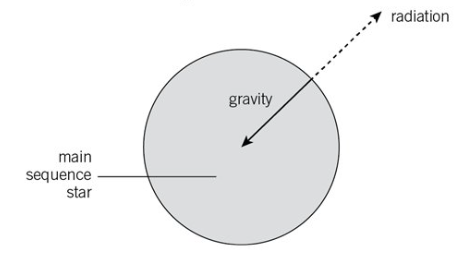
eventually radiation pressure pushing outwards from fusion reaction in thestar or in our sun is equal to gravity pulling inwards
the forces are balanced and the star is stable it will remain the same size
it is a main sequence star
At what stage is our sun in at the moment?
main sequence star
What forces are acting on the sun when its a main sequence star? (2)
gravity and radiation are equal
radiation inwards and gravity outwards
How are planets formed? (2)
rocks, clumps left behind from star formation
→ fusion