OVS SCH4U1 Chapter 21 (21.4)
 Call Kai
 Learn
Learn Practice Test
 Spaced Repetition
 Match
Match Flashcards
 Knowt Play
1/9

Earn XP
Name | Mastery | Learn | Test | Matching | Spaced | Call with Kai |
|---|
No analytics yet
Send a link to your students to track their progress
10 Terms
Define a reversible reaction
a chemical reaction that occurs both forewards (reactant —> product) and reverse (product —→ reactant) simultaneously
when do reactions go to completion? (Non-reversible reactions)
the product of the reaction is released as soon as it is formed, the reverse reaction can never be reached
What are the three types of non-reversible reaction products?
formation of a (insoluble) precipitate
AgNO3(aq) + NaCl(aq) → NaNO3(aq) + AgCl(s)
no double arrow
formation of a gas
Mg(s) + 2HCl(aq) → MgCl2(aq) + H2(g)
open system
formation of a molecular compound (water)
HCl(aq) + NaOH(aq) → NaCl(aq) + H2O(l)
dissociation constant
However if we consider the net ionic equation Ag+ + Cl− → AgCl, then the reverse reaction would be AgCl → Ag+ + Cl−.
The Keq for the reverse reaction is 1.8 × 10⁻¹⁰. For all practical purposes, the reaction goes to completion.
Silver nitrate also forms a precipitate with NaI. What would this precipitate be?
Would the reaction between HBr and KOH also be considered irreversible?
Define Chemical equilibrium
state of a system where the rate of the foreward reaction = rate of the reverse reaction
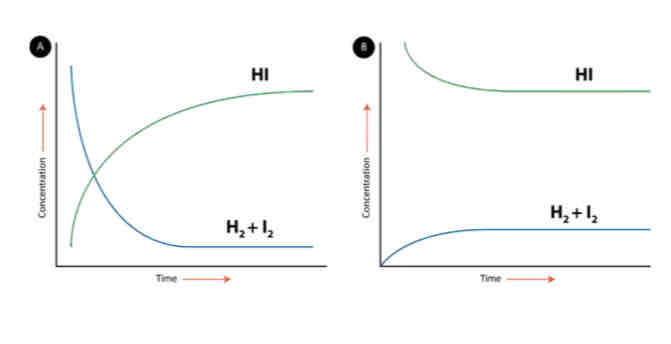
equilibrium between reactants and products
what are the five conditions of a system at equilibrium are:
system must be closed
no new material in, no removal of material
kept constant
system must remain at the same temperature and pressure
equilibrium is a dynamic process
forward and reverse are taking place
The rates of the forward and reverse reaction must be equal
reactants =/= products
once equilibrium is attained, the amount of product and reactant will be constant
phase equilibrium vs solution equilibrium
phase equilibrium
a substance is in equilibrium between two states
solution equilibrium
a solid substance isn in a saturated solution
rate of dissolution = recrystallization