Media Management
 Call Kai
 Learn
Learn Practice Test
 Spaced Repetition
 Match
Match Flashcards
 Knowt Play
1/69

There's no tags or description
Looks like no tags are added yet.
Name | Mastery | Learn | Test | Matching | Spaced | Call with Kai |
|---|
No analytics yet
Send a link to your students to track their progress
70 Terms
Gross Domestic product (GDP)
Measures the total monetary value of all finished goods and services produced within a country during a specific period. Indicator of a nation’s health + GDP per capita.
Inflation
Rate at which the prices for goods and services rises, which erodes purchasing power ver time. [Central banks target around a 2% annual inflation]
Interest rate
“Cost of money”, the percentage under charges for borrowing assets. Primary tool to control inflation and stimulate economic activity.
Recession
Significant decline in economic activity that spreads across the economy and lasts more than a few months.
Signs of recession
Declining GDP for two consecutive quarters.
Increase of unemployment
Decrease in consumer spending and bussiness investments.
Decline in industrial production.
What are fiscal and monetary policies
Two complementary approaches governments and central banks use to influence economic conditions.
Fiscal policy
Government decisiones regarding taxation and public spending. Managed by elected governments and financial ministries
Monetary policy
Central bank decisions about interest rates and money supply. Controlled by Central Banks.
Taxes
Mandatory contributions to keep the game running.
Key types: Income tax, sales tax, capital gains ad social and security medicare.
Supply and demand
They determine prices in free market. There are three key market scenarios.
1. High demand low supply: premium pricing, scarcity
Low demand high supply: Discounting
Equilibtrium
Assets
Anything of value that you own that can be converted into cash.
Net worth
True measure of financial wealth, most accurate indicator of financial position (assets - liabilities)
Liabilities
Money that you owe, your financial obligations.
Revenue
Total income generated by the sale of goods/services before any expense is deducted.
Expenses
All costs of doing business.
Profit
Amount remaining after all expenses have been paid. Net income is the true measure of profitability.
Cash flow
The net amount and cash equivalents being transfered into and out of your household or business. + cash flow = more money coming in / - cash flow = spending exceeds income.
Liquidity
How easily an asset can be converted into cash without significantly affecting its market price. High liquidity (cash, savings), Moderate liquidity ( stocks, bonds) Illiquid (real state and collectables)
Shareholders vs stakeholders
Shareholders see it from an ownership perspective, while stakeholders are a broader community.
ROI (Essential metrics)
Measures campaign effectiviness by comparing gains to costs.
Market share (Essential metrics)
Percentage of total market sales captured by a company (indicates competitive position snd growth trajectory)
Fiscal year and Q4 behaviour (Essential metrics)
Companies act urgently in Quarter 4 to reach annual targets.
Compound interest
(Interest on interest) It is the interest calculated on both the initial principal and the accumulates interest from previous periods. Exponential growth mechanism.
Stocks
Securities representing proportionate ownership in a corporation
Bonds
Loans made by investors to borrowers, who pays regular interests.
Funds
A pre packed collection of stocks and bonds
What is the golden rule?
The biggest risk isn’t losing your money on the market, is losing your future to inflation by never investing at all.
What is diversification
Practice of spreading investments across different asset types to limit exposure to any single investment.
What are the business objectives
A) Fulfilling consumer needs, with products that address specific wants
B) Generating profit through the sale of its products or services so the business can keep evolving.
Business as a coordinated effort
Organizations of people, resources… + Commercial activities + Marketing (which encompasses all aspects, from understanding the consumer to promoting the product)
Nature of audiovisual market
The audiovisual industry operates on a dynamic market influenced by various external factors (political, legal, social…) → Satisfy inmaterial needs → Influence on citizens
Characteristics of the entertainment industry
A) Celebrity dependance B) Rapid growth and decline C) Creative intuition D) Intellectual property portection
Profit motive of audiovisual industry
Profit is essential to improve products, rewarding shareholders and creating jobs. But ethical considerations must be present. Balance economic and social and personal benefits for the employee.
Dual clientele in Audiovisual industryt
A) Audience (final consumers of the content, though they don’t directly finance it) B) Advertisers (primary source of financing)
Here we have a management challenge: Balancing the needs of both client types.
UNderstanding consumer behaviour
When? do consumers have time for content consumption.
Where? do they engage with content
How? Which devices they use to content access
Dual nature of audiovisual content
Inmaterial good (idea that gives form)
Material distribution (physical or digital medium through which content is distributed)
Creative to commercial (transforming one idea into succesfull commercial products)
Current trends in audiovisual sector
Formation of large multimedia groups through integration
Increased competition
International expansion of companies
Audience demands that require greater innovation
Technological dependence
Production (creation) Distribution (delivery) Consumptions (tech enabled viewing experiences). Technological innovations are influencing media industry.
Challenges in decision making
A) Technological unpredictability B) Legal insecurity ( uncertain regulatory environment) C) Economic uncertainty
Why a definition is more than just a label
Regulation and law (taxes, protections…)
Professional standards
Social responsability
Old approach to defining a media company was based on its control of the value chain. If you handled key steps, you were a media company.
IN the digital age, new players emerged that did not create content but rather controlled its flow.
They perform media-like functions
Shape public opinion
But they don’t fit the classic definition.
5 Flaws that make the old definition obsolete
Excludes non-profits and public service media (like BBC)
Ignores B2B (what about the players who trade content behind the scenes)
Can’t hold convergence: It can’t classify new hybrid models.
Vague on content: don’t distinguish between professional or user-generated content.
Undefined core skills
The new approach defines a company by its engagement in three core activities
Content sourcing (creation, acquisition or purchasing)
Content aggregation (selections, editing; curatorial function)
Content dissemination (distribution adn delivery of aggregated content)
New map for the media Landscape
Media Companies in a narrow sense: focus on journalistic and economic objectives.
Media Companies in a broader sense: based on three core activities
Not media Companies: Companies that provide the tools but don’t handle the content.
What are the problems that the new model solves?
Problem 1: Should X company pay advertising taxes?
Problem 2: Is Y company responisble for hate speech on its platform?
What are social statues
Essential legal documents that define a company’s structure and rules.
Importance of social statues
Legal clarity: they define a company’s operations.
Ensure stability: protect companies from hostile takeovers.
Safeguard independence: help separate the business from journalistic integrity.
Key elements of social statues
Company identity and purpose
Governance structure
Financial and legal regulations
Editorial independence
Company identity and purpose
Registered name
Business activities
Legal headquarters
Governance and decision making
Board of directors (roles within the company)
Executive roles (responsibilities of the CEO and other executives)
Shareholder rights (rules for shareholder participation and voting)
Financial and legal regulations
Capital structure (how shares and ownership is distributed)
Profit distribution
Compliance (adherence to law and regulation)
Editorial independence and ethics
Journalistic integrity
Ethical standard
Preventing influence
Corporate Governance structure
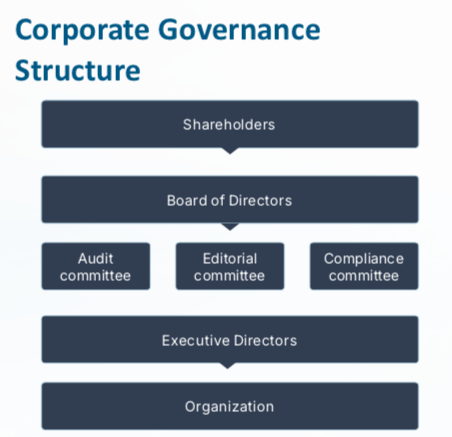
Shareholder influence
Their influence varies depending on their involvement:
→ Executive shareholders: active in daily operations
→ Financial Partners: contribute capital only
Private vs Public entities
Private companies are managed by private initiatives, while state owned enterprises (SOE) are managed by government apointees.
Evolution of media ownership
From family-run, to professional management and now public listing (where external shareholders join)
Shareholder functions
Elect directors / Asses financial health / Vote on decisions
Shareholder rights
Profit participation, preferential suscription rights. They can vote an access company information.
What are the Annual General Meetings? (AGM)
Their purpose is to discuss company performance
Published in official bulletins
Frequency
Roles within the Boards of DIrectors
President → Vice → Secretary → CEO
(but specific duties vary depending on company’s size)
What are the functions of a Board of director?
1. Strategic direction and vision
Executive oversight
Budget approval
ethical standars
Editorial board
· Content strategy
· Reviews topics
· Ethical guidelines
Compliance and Ethics Comittees
Compliance with regulations
Investigation of ethical concerns
Reporting + corrective actions
What are autitors?
They provide independent oversight of financial statements, this ensures confidence for shareholders and stakeholders.
Importance of capital in a newspaper
Fundamental asses that allows firms to operate, develops and grow.
The sources can be self-generated though profits or obtained from external sources like investors.
Forms of ownership
Private, public, non-profit, employee, state owned