7.4 Externalities & Social Costs/Benefits
 Call Kai
 Learn
Learn Practice Test
 Spaced Repetition
 Match
Match Flashcards
 Knowt Play
1/56

There's no tags or description
Looks like no tags are added yet.
Name | Mastery | Learn | Test | Matching | Spaced | Call with Kai |
|---|
No analytics yet
Send a link to your students to track their progress
57 Terms
What is an Externality and what do they cause
Where the actions of a producer or consumer give rise to side effects on others not directly involved in the action (third parties)
They cause a cost or benefit affecting a third party that is not reflected in market prices.
What is the third party
Those not directly involved in the decision making but affected by the decision.
How do externalities cause market failure
Externalities cause market failure because the market price does not reflect the true social costs or benefits of production or consumption, leading to over- or under-allocation of resources.
Negative Externality + examples of when they are created
Occurs when an economic activity creates external costs to third parties
Can be created during production e.g. pollution from factories or created during consumption e.g. health costs from smoking.
Positive Externality + examples of when they are created
Occurs when an economic activity creates external benefits to third parties.
Can be created during production, such as research and development or created during consumption, such as education or vaccination.
What does it mean if a cost/benefit is private
They are experienced by the people who are directly involved in the decision to take a particular action.
What is a Private Cost (PC)+ examples
The cost of an economic activity paid directly by the producer or consumer involved.
Those costs that are incurred by a consumer or by the firm that produces a good or service.
Examples:
• Wage costs
• Raw materials
• Electricity bills
Marginal Private Cost (MPC)
The additional cost incurred by producers or consumers from producing or consuming one more unit.
What is Private Benefit (PB) + Examples
The benefit received directly by consumers or producers from an economic activity.
Those benefits that are received by a third party not involved in the action.
Examples:
• Enjoyment from consumption
• Profit to firms
Marginal Private Benefit (MPB)
The additional benefit received by consumers or producers from consuming or producing one more unit.
What is an External Cost (EC) + Examples
A cost imposed on third parties who are not directly involved in the economic activity.
Those costs incurred and paid for by a third party not involved in the action.
Examples:
• Pollution
• Noise
• Health damage
Marginal External Cost (MEC)
The additional cost imposed on third parties by the production or consumption of one more unit.
What is External Benefit (EB) + Examples
A benefit received by third parties not directly involved in the economic activity.
Examples:
• Herd immunity from vaccination
• Cleaner environment from green energy
Marginal External Benefit (MEB)
The additional benefit received by third parties from the consumption or production of one more unit.
In the case of an airport expansion, what are the private costs/benefits and the external costs and benefits
Private cost - development costs paid by owners of airport, costs of users of the airport e.g. airlines & passengers
Private benefit - revenue received by airport owners or the advantages users of the airport gain from this expansion
External cost - Additional noise pollution experienced by those living on the flight path of the airport which may cause them to soundproof their home or even move
External benefit - If some flights transfer to the expanded airport from elsewhere, there will be less noise pollution for those who live on the flight path of the other airport.
Social Cost (SC)
The total cost to society of an economic activity, equal to private cost plus external cost.
Formula for Social Cost
SC = PC + EC
Marginal Social Cost (MSC)
The total additional cost to society of producing or consuming one more unit of a good.
Formula for Marginal Social Cost
MSC = MPC + MEC
Social Benefit (SB)
The total benefit to society from an economic activity, equal to private benefit plus external benefit.
Formula for Social Benefit
SB = PB + EB
Marginal Social Benefit (MSB)
The total additional benefit to society from consuming or producing one more unit of a good.
Formula for Marginal Social Benefit
MSB = MPB + MEB
What is the Market Outcome with Negative Externalities vs Positive Externalities
Negative - The market produces more than the socially optimal level of output. (MSC > MPC)
Positive - The market produces less than the socially optimal level of output. (MSB > MPB)
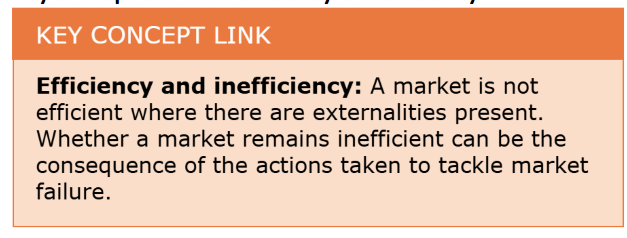
Key concept link with efficiency & inefficiency of markets with externalities
What is the Socially Optimal Output
The level of output where marginal social cost equals marginal social benefit.
What is Deadweight Welfare Loss
A loss of economic welfare caused by producing or consuming at an inefficient level of output due to inefficient allocation of resources.
What two things can the positive/negative externalities come from + which line on graphs do they each affect
Production and consumption
Production externalities affect cost curves
Consumption externalities affect benefit curves
What are negative externalities of production
Occur when third parties are harmed by the production of a good or service.
Two examples of negative production externality
Most cases of environmental pollution e.g. when a firm illegally disposes of toxic waste - those living near the factory may suffer ill health + wider issue of global warming yet there is no cost to the polluting firm.
Growing problem of plastic waste e.g. one issue is how to dispose of unusable plastic as limits on ways plastic can be recycled - much of the waste plastic finds its way to rivers and oceans, causing problems for marine creatures + the food chain with problems when fish is consumed.
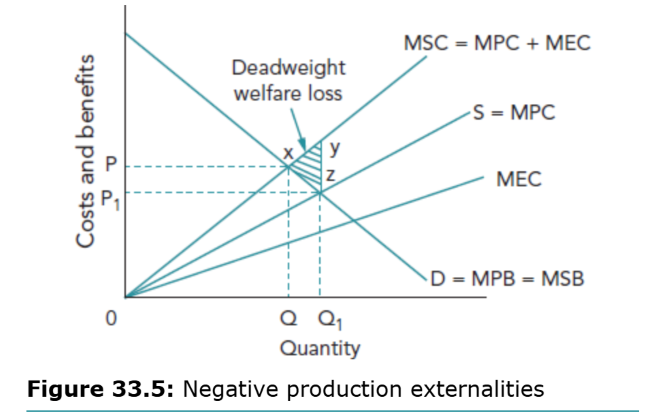
Graph showing negative production externalities + explanation
Production creates external costs (MEC), so MSC > MPC.
Firms produce where MPC = MPB, causing overproduction (Q₁ > Q).
The socially optimal output is where MSB = MSC.
Overproduction leads to deadweight welfare loss (triangle) due to pollution/negative spillovers.
What are positive externalities of production
Benefits to third parties created by producers of goods and services.
Two examples of positive production externality
Medical research e.g. a new medicine or vaccine developed to combat a serious disease - recipients of treatments obviously benefit but also wider benefits to herd immunity and reduced incident of the disease + greater output and productivity of a healthy work force.
New trees planted to replace those that have been destroyed for plantation - people who plant the trees will eventually be able to sell them but wider community will benefit through a reduction of CO2 in the atmosphere.
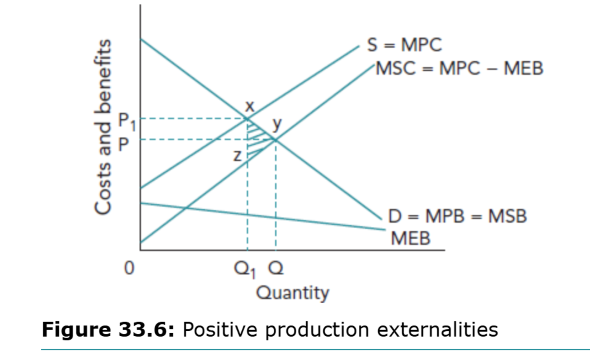
Graph showing positive production externalities + explanation
• Production creates external benefits (MEB), so MSC < MPC.
• Market output is where MPC = MPB, causing underproduction (Q₁ < Q).
• The socially optimal output is where MSB = MSC.
• Underproduction results in deadweight welfare loss from missed social benefits.
What are negative externalities of consumption
A harm to a third party not involved in the consumption of a product created by consumers who use the product.
Example of negative consumption externality
Passive smoking (which now does have regulations in some countries) - causes non-smokers discomfort and, if long term, respiratory problems + the cost of treating smokers in public health care is paid by non-smokers as well.
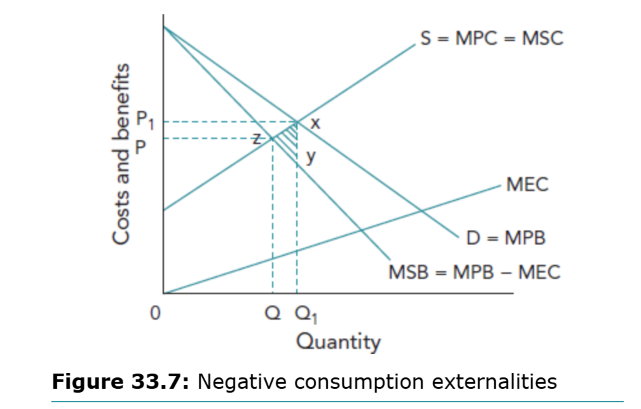
Graph showing negative consumption externalities + example
• Consumption creates external costs (MEC), so MSB < MPB.
• Consumers act where MPB = MPC, causing overconsumption (Q₁ > Q).
• The socially optimal output is where MSB = MSC.
• Overconsumption causes deadweight welfare loss (e.g. passive smoking).
What are positive externalities of consumption
The spillover effects of consumption of a good or service on others not consuming the good
(Key argument for the provision of merit goods by the government)
Two examples of positive consumption externality
Education - students who complete high school clearly benefit over those who don’t through greater employment opportunities and higher pay - the benefits extend to their families and to their future economic prospects
Health care (particularly if free) - benefits will be felt not only by those who receive treatment but also their families(more likely to be able to provide) and the economy (a healthy population = higher standards of living & economic growth)
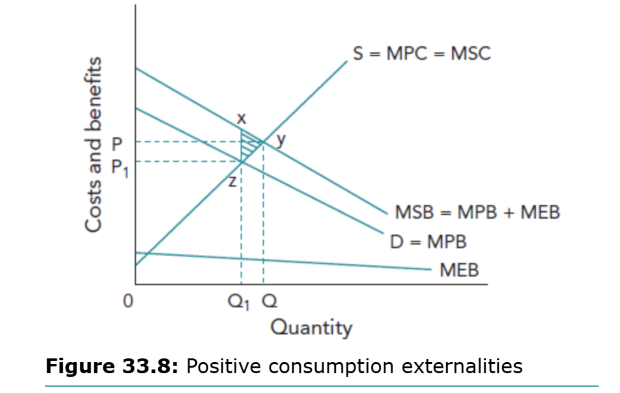
Graph showing positive consumption externalities + explanation
• Consumption creates external benefits (MEB), so MSB > MPB.
• Market outcome where MPB = MPC leads to underconsumption (Q₁ < Q).
• The socially optimal output is where MSB = MSC.
• Underconsumption causes deadweight welfare loss (e.g. education, healthcare).
What is the Welfare Loss from Negative Externalities
The loss arising from overproduction where MSC exceeds MPC.
• Market equilibrium occurs at MPB = MPC
• Social optimum occurs at MSB = MSC
• Market output is too high
📌 The welfare loss is the triangle between MSC and MPC.
What is the Welfare Loss from Positive Externalities
The loss arising from underproduction where MSB exceeds MPB.
• Market equilibrium ignores external benefits
• Market output is too low
• Social optimum is where MSB = MSC
📌 Welfare loss is the triangle between MSB and MPB.
What is Asymmetric Information + examples
Occurs when one party in a transaction has more information than the other (usually the seller)
E.g. Doctors vs patients, Insurers vs customers
What are the two types of asymmetric information
Adverse selection (hidden characteristics)
Moral hazard (hidden actions)
What is adverse selection + example
When sellers have information that buyers do not have on product quality or vice versa
E.g. in the used car market when sellers know more than buyers, causing good-quality cars to be withdrawn and leaving mainly low-quality cars.
What is a Moral Hazard + examples
When individuals take greater risks because they do not bear the full cost of their actions.
E.g. Overconsumption of healthcare services due to insurance coverage, risky driving with insurance
What is Cost–Benefit Analysis (CBA)
A method of evaluating decisions by comparing total social costs and total social benefits.
Decision Rule in Cost–Benefit Analysis e.g. in environmental policy - How to decide if a project should be approved or not.
A project should proceed if social benefits exceed social costs but reject if vice versa (social costs exceed social benefits)
When is Cost–Benefit Analysis used
Used by governments to evaluate infrastructure, environmental, and public sector projects.
How is the cost-benefit approach different from private sector methods (two ways)
Seeks to include all costa and benefits not just the private ones
Often has to provide a shadow price for costs and benefits where no market price is available
What is a shadow price
One that is applied where there is no established market price available
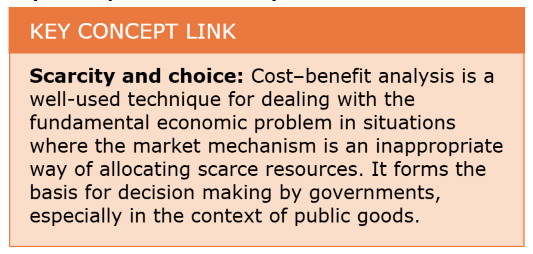
Key concept link of scarcity and choice with cost-benefit analysis
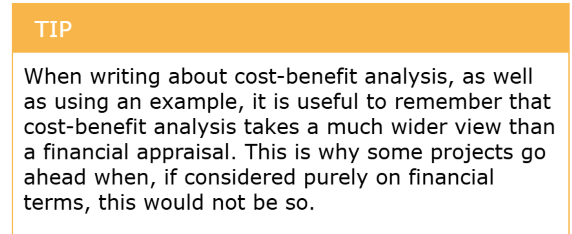
Why is cost-benefit analysis sometimes better than financial appraisal
Because it takes a wider view
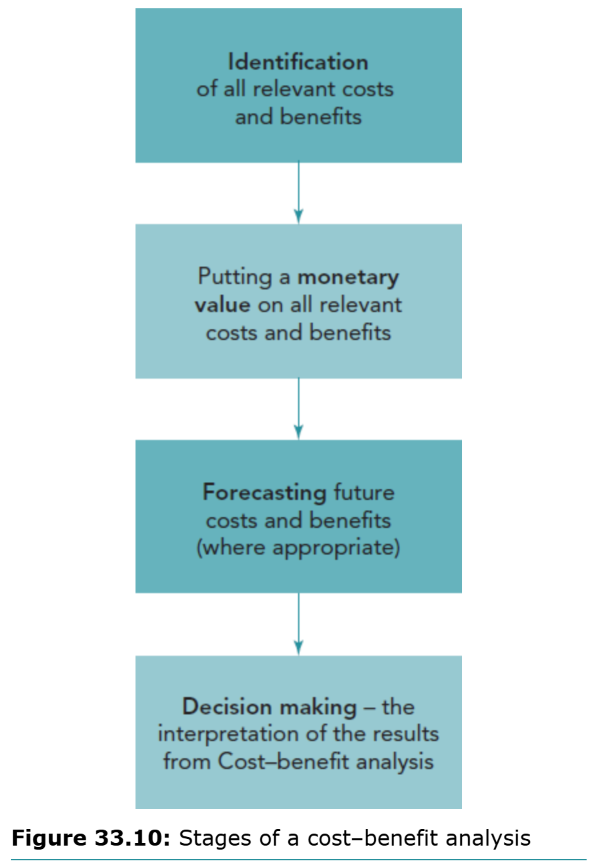
What are the stages of cost benefit analysis (4)
Identification
Valuation
Forecasting
Decision- making
Link Between Externalities and Market Failure
Externalities cause divergence between private and social costs or benefits, leading to market failure.
Overall Evaluation of Externality Theory
Externality theory explains market failure well but measuring social costs and benefits is difficult in practice.
How to apply externalities in exams (step-by-step method - 6):
Identify type of externality
2. Explain private vs social costs/benefits
3. Use correct curves (MSC, MPC, MSB, MPB)
4. Explain welfare loss
5. Apply to real-world example
6. Evaluate (measurement difficulty, time lags, govt failure)