Unit 1- radiation biology
 Call Kai
 Learn
Learn Practice Test
 Spaced Repetition
 Match
Match Flashcards
 Knowt Play
1/159

There's no tags or description
Looks like no tags are added yet.
Name | Mastery | Learn | Test | Matching | Spaced | Call with Kai |
|---|
No analytics yet
Send a link to your students to track their progress
160 Terms
atom is ionized=
biological effects begin here
ionization
photon hits an electron, electron is loose
Radiation interacts at the ___ level
atomic
Atoms combine to form ___
molecules (which make the cells & organs of the body)
X-ray energy deposited in the atom & ionization can affect…
the bonds holding atoms together (causing the molecule to break apart)
radiation is more likely to… (in medicine)
kill a cell, rather than cause cancer
When do early effects of radiation occur?
minutes, hours, days, or weeks after exposure
Examples of early tissue interactions
nausea/ fatigue
erythema
hair loss (epilation)
blood disorders
Why do early effect of radiation occur
typically from high doses given acutely
Acute radiation syndrome
radiation sickness
Whole body exposure examples: early effects of radiation
hemopoietic
GI
CNS
Local tissue damage examples: early effects of radiation
skin, gonads
**most common in radiation therapy
when do late tissue interactions typically occur?
months or years after exposure
examples of late tissue interactions
cataracts
fibrosis
organ atrophy
reduction in fertility/ sterility
cancers
local tissue damage (skin, cataracts)
why do late effects of radiation occur?
lower doses that are given over long periods of time, but can also occur from higher acute exposure
fetal effects on radiation
embryo/fetus exposed in utero to low or high levels of radiation
examples of fetal effects of radiation
prenatal death
neonatal death
congenital malformation
childhood malignancy
diminished growth & development
What unit is used to measure the amount of radiation exiting the tube? (OUtput)
cOUlomb
__ can be described as the amount of radiation produced in air when ionizing radiation is present
air kerma
EXCAGES
exposure- coulomb
absorbed dose/ air kerma- gray
equivalent/ effective dose- sievert
Coulomb/kg
exposure to ionizing radiation in air; electrical charge
measures OUTPUT of machines
only applies to x-rays & gamma rays
Air kerma (gy)- acronym
Kinetic energy released in matter
Air kerma metric unit
joules/kg
1gy= 1j/kg
___ is preferred over coulomb/kg
air kerma
Air kerma (gy)
Kinetic energy transferred from photons to electrons during ionization/ excitation
expresses how energy transfers from beam to air
if air kerma is shown ‘per minute’ it is showing air kerma from__
fluoro
Absorbed dose in air=
to be delivered to patient (air kerma)
DAP meter (dose area product)
measures amt of energy delivered to pt by x-ray beam
total sum of air kerma over exposed area of patient’s surface
where is DAP meter located?
beyond collimator (between collimator & patient)
DAP equation
absorbed dose x collimated area
(most accurate measurement for pt dose)
Measurement for DAP
mgy-cm²
absorbed dose is measured in
gray
Absorbed dose
ionizing radiation that passes through the patient or stays there (absorbed)
some gets absorbed due to density (bone) & higher atomic number
what is responsible for biologic damage to the tissue that is exposed?
absorbed dose
what unit is used to measure the biologic effects of radiation (effective/ equivalent dose)
sievert
What is the radiation weighting factor?
takes into account the radiation type & energy range that may cause biologic damage
equivalent dose
Average dose in a tissue or organ in the human body and its associated radiation weighting factor
compares biologic damage to different types of radiation
equivalent dose equation
•EqD = D x WR
D= absorbed dose
WR= weight factor
1 mGy= __mSv
1
what is the quantity of radiation received by radiation workers? (badge reports)
equivalent dose
The concept of tissue weighting factor is used to do what?
Takes into account the radiosensitivity of the organ or tissue irradiated
effective dose
sum of the type of radiation used(WR) and the tissue irradiated (WT)
effective dose equation
•EfD = Dose x WR x WT
what is the best measure to overall risk of exposure to humans from ionizing radiation
effective dose
radiation weighting factors: x-rays, gamma rays, alpha particles
x-rays= 1
gamma rays=1
alpha particles= 20
radiation in tissue
absorbed dose (D)- patient
gray
joules/kg
effects in tissue (biologically)
equivalent dose (EqD) (radiation quality/harm)
Sv
D x Wr
effective dose (EfD) (patient overall risk)
Sv
D x Wr x Wt
Conversion help:
1 Gy= 1 Sv
1000 mGy= 1 Gy
example for conversions
1000 mGy = 1 Gy
Divide mGy by 1000 or move decimal to left 3
Example: 150mGy = 0.15
1 Gy = 1000 mGy
Multiply Gy by 1000 or move decimal to right 3
Example: 0.5Gy = 500mGy
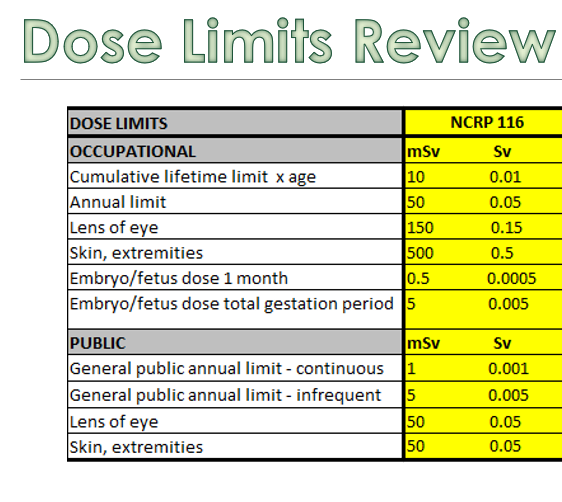
slide 29
know how to convert, & the yellow highlighted box
from report 116
Cumulative occupational dose limit
10 x age
10 mSv or .01 Sv
Annual occupational dose limit
50 msv or .05 Sv
Lens of eye occupational dose limit
150 msv or .15 Sv
skin/ extremities occupational dose limit
500 mSv or 0.5 Sv
embryo/fetus dose limit- 1 month
0.5 mSv or .0005 Sv
embryo/fetus dose limit entire gestation period
5 mSv or .005 Sv
General public annual dose limit- continuous
1 mSv or .001 Sv
general public annual limit- infrequent
5 mSv or .005 Sv
lens of eye dose limit- for public
50 mSv or .05 Sv
skin, extremities dose limit for public
50 mSv or .05 Sv
what is within the nucleus
protons & neutrons
what is outside of the nucleus
electrons
closer an e-shell is to the nucleus, the ___ the binding energy
higher
max # of electrons in a shell increases with..
the distance of the shell from the nucleus
outer shell can have a max # of ___ electrons
8
electron shell equation
2n²
shell orders
K, L, M, N, O, P
K= highest binding energy (requires most to get rid of)
P= lowest binding energy
in a neutral/ balanced atom, the total # of electrons in shells is equal to what
#of protons in the nucleus
the larger the atom, the more __ needed to ionize
energy
compton interaction ionizes an ___ electron
outer shell
photoelectric interaction ionizes an ___ electron
inner shell
how much keV to ionize the inner shell of tungsten?
70 keV or higher
what is the first step in how x-rays create images or damage cells
ion pairs
steps of ionization- ion pair
atom is neutral
an x-ray photon strikes the atom w/ enough energy to knock an electron out of its orbit
results in ion pair
negative electron (anion)- sometimes called photoelectron
positive ion (cation)- the rest of the atom, which lost a negative electron
what is made of 2 or more atoms bonded together
molecules
molecules are formed by __ and __ bonding
ionic & covalent
valence electrons are what?
electrons in the outmost shell of an atom
atoms tend to gain, lose, or share valence electrons to achieve filled outer shell
ionic binding
attraction between POSITIVELY charged ions & NEGATIVELY charged ions that forms AFTER electrons are TRANSFERRED from 1 atom to another
GIVING AN ELECTRON AWAY
an atom of sodium + an atom of chlorine=
sodium chloride (Na + Cl= NaCl)
example of ionic bond (sodium & chloride)
Sodium has one e- in outermost shell and
chlorine has space for one more e-Sodium is now (+) because it gave an e- and
chlorine is now (-) because it gained an e-
covalent bonding
when two atoms share one or more pairs of electrons so that both atoms can fill their outer (valence) shells.
SHARING OF ELECTRONS
example of covalent bonding with oxygen & hdyrogen
•Oxygen has 6 electrons in outermost shell and hydrogen has 1 and there are 2 hydrogen atoms
• So in water, two hydrogen atoms each share an electron with the oxygen to form a molecule
mass number (A number) is
#of protons AND # of neutrons in a nucleus
Atomic number (Z number) is
#of protons in a nucleus (determines element we are looking at)
isotopes
• Atoms with the same number of protons and electrons, but a different number of neutrons
(which does NOT change the element just the mass#)
barium atomic (Z) number is__ and mass number is ___
56 (protons) & 138 MASS
Barium atomic mass is
138
coherent (classical) scattering
•X-ray interacts with an atom and excites it
change in direction WITHOUT energy loss
seen with low energy (less than 10 keV)
do nothing for the image at all
isotopes are atoms of an element that differ in:
number of neutrons (mass #)
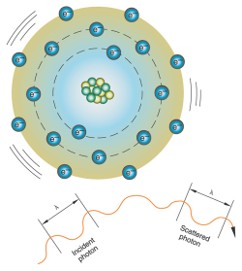
this is an example of?
coherent (classical)
compton scattering
•Ionization of outer shell e-
•Incident photon will scatter in a different direction
**adds unwanted exposure & reduces contrast
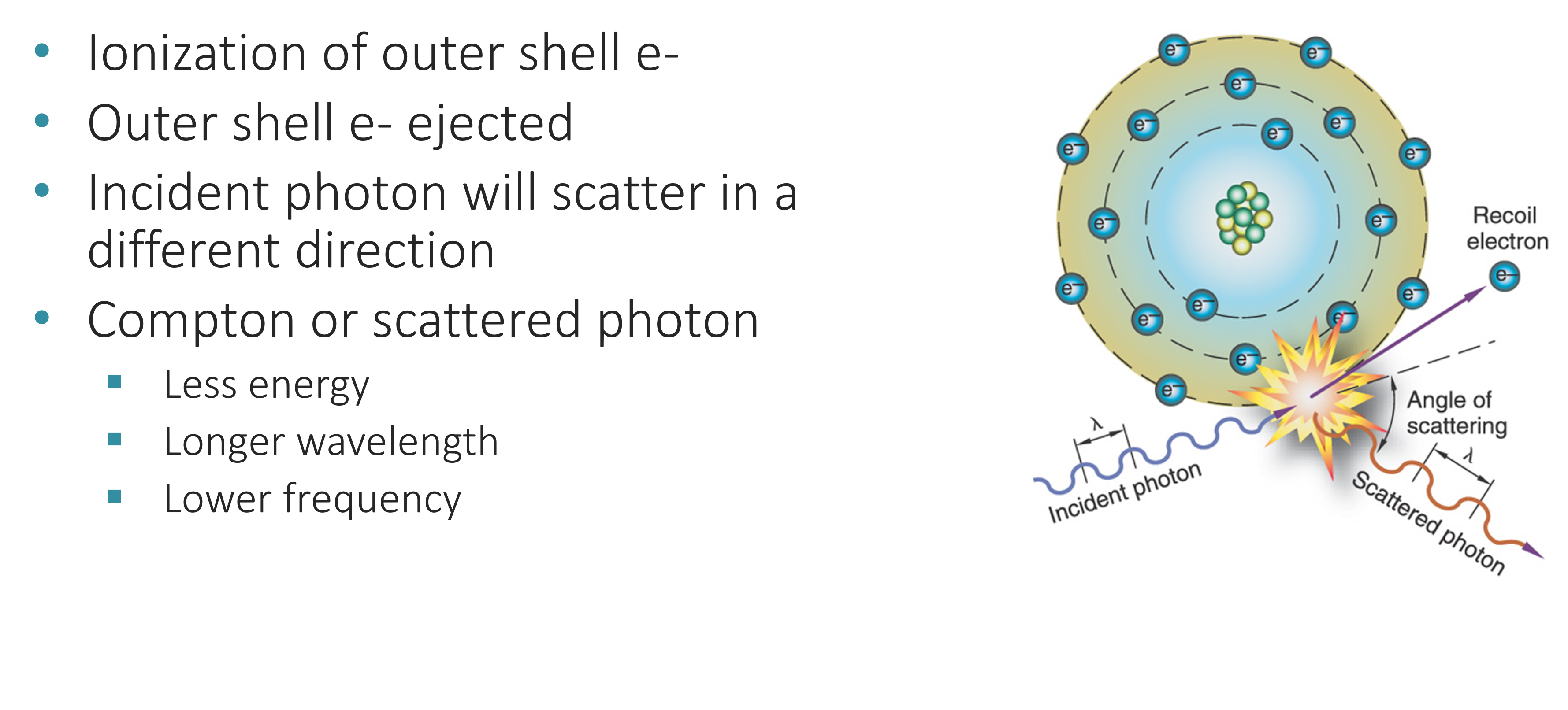
what type of scatter is this?
compton
what scatter attributes most dose to techs
compton
the process of photoelectric absorption is an interaction between
x-ray photon & inner-shell electron
photoelectric absorption
Ionization of inner shell e-
Inner shell e- ejected = X-ray photon absorbed,
becoming ‘photoelectron’Atom is unstable because inner shell e- is missing
bone absorbs this the most!!
Inner shell vacancy filled by an outer shell e-
Characteristic Cascade
what process results in the major part of image production/ contrast?
photoelectric absorption
what happens to the energy of the x-ray photon during pair production?
Energy of the photon is absorbed and transformed into matter composed of two particles:
negatron
positron.
pair production
A very high‑energy X‑ray passes close to the nucleus.
The photon disappears and becomes:
One electron (−) and One positron (+)
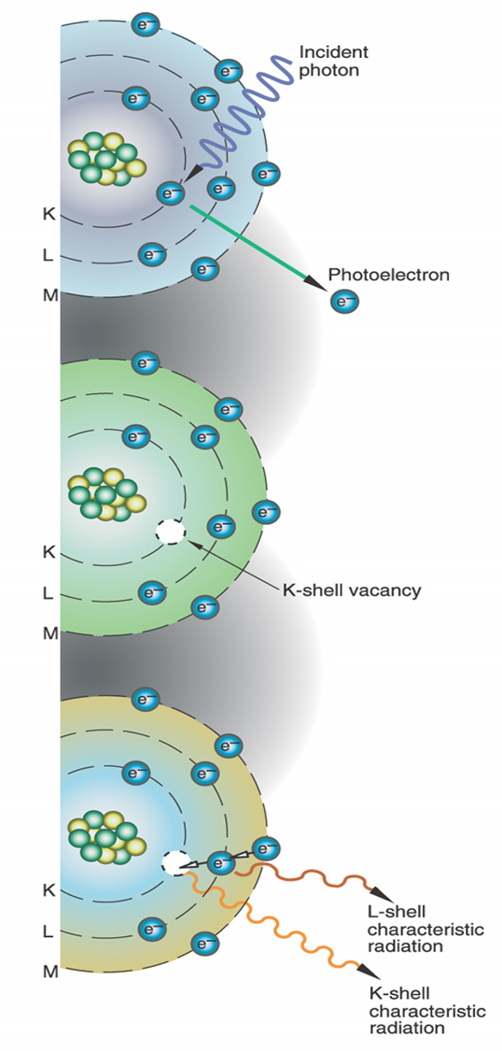
what process is this?
photoelectric absorption
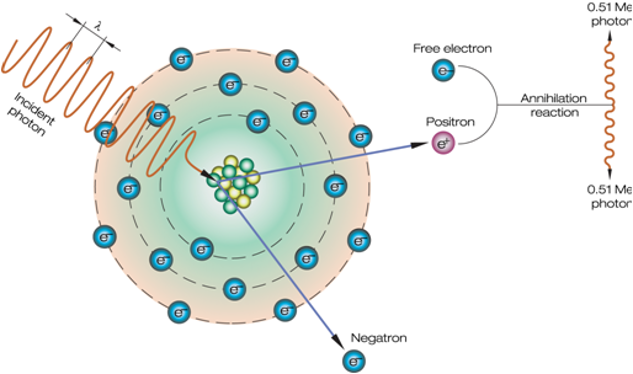
what process is this?
pair production