World History Final Review (PBHS)
 Call Kai
 Learn
Learn Practice Test
 Spaced Repetition
 Match
Match Flashcards
1/52

There's no tags or description
Looks like no tags are added yet.
Name | Mastery | Learn | Test | Matching | Spaced | Call with Kai |
|---|
No analytics yet
Send a link to your students to track their progress
53 Terms
Bill of Rights
first ten amendments to the US Constitution, guaranteeing the rights of all citizens; ratified in 1791
absolutism
system of government in which a ruler holds total power
George Washington
commander in chief of the US continental army during the Revolutionary War; America's first President
Thomas Jefferson
wrote the Declaration of Independence; inspired by John Locke; became America's 3rd President; an Enlightenment thinker
laissez-faire
idea that the government should not interfere with the economy
Declaration of the Rights of Man and Citizen
a charter of basic liberties that was based on the American Constitution; written by the French during the French Revolution
Articles of Confederation
America's first Constitution
Napoleon Bonaparte
military leader who overthrew the Directory and crowned himself Emperor of France after the French Revolution; was in power from ~1799-1815
guillotine
used by revolutionaries in France to execute opponents
Bastille
attack on the prison and munitions store house which began the French Revolution in 1789
socialism
system in which the government owns and controls the means of production
Congress of Vienna
meeting in 1814 to figure out how to rebuild Europe after the Napoleonic Wars
Archduke Franz Ferdinand
his assassination in June 1914 was the spark which led to World War I
trench warfare
type of warfare where armies dug into trenches, and had to cross 'No Man's Land' in order to attack each other and gain ground; heavy casualties; slowed progress on the Western Front
Allied Powers of WWI
France, Great Britain, Russia, Italy, and later United States
Central Powers of WWI (aka Triple Alliance)
Germany, Austria-Hungary, Bulgaria, and Ottoman Empire
mobilization
assembling troops and supplies for war
War Guilt Clause
declared Germany and Austria were completely responsible for starting World War I
capitalism
economic policy with freedom and choice, along with profits and investment
Hiroshima
first atomic weapon was used on this city
Axis Powers in WWII
Germany, Japan, Italy
Allies of WWII
Great Britain, Soviet Union, and United States
blitzkrieg
'lightning war' using bombers and fast tanks to defeat the enemy quickly; used by Nazis
appeasement
policy which sought peace and stability by satisfying demands of an aggressor
isolationism
policy which US followed which advocated for staying out of European wars
Nazi-Soviet Nonaggression Pact
gave Hitler the freedom to attack Poland, splitting the country with the Soviets at the beginning of World War II
D-Day
allied invasion of Normandy, France
Christopher Columbus
discovered West Indies on his 1492 voyage
Maximilien Robespierre
a major leader of the French Revolution, he was eventually executed at the end of it
Karl Marx
the writer of the Communist Manifesto who is seen as the main creator of Communism
4 M.A.I.N. causes of WWI
imperialism, nationalism, alliances, militarism
Schlieffen Plan
This war plan called for Germany to attack and invade France first, then move their troops to fight Russia
Vladimir Lenin
the main Communist leader of the Russian Revolution who started the Soviet Union
Joseph Stalin
Communist dictator of the Soviet Union 1924-1953
Adolf Hitler
Nazi dictator of Germany 1933-1945; responsible for the Holocaust during World War II
Nazi Party
The political party that came to power in Germany before World War II; Adolf Hitler was their dictator; used a swastika as its symbol
Gulag
Soviet prison camps; terrible conditions for prisoners who worked sometimes until death
Holocaust
the systematic murder of Jews and other undesirables by the Nazis during World War II
Korean War
1950-1953; the United States along with United Nations' forces came to the defense of South Korea after it was invaded by the communist North Koreans. Eventually the war ended in a stalemate, dividing Korea in half still to this day. North Korea is still a communist dictatorship
Vietnam War
1965-1973; North Vietnamese communists invaded the US backed South Vietnam; after years of intense jungle and guerrilla warfare eventually the US withdrew its forces and the North Vietnamese communists completely took over South Vietnam by 1975
NATO
North Atlantic Treaty Organization; an alliance made to defend one another if they were attacked by any other country (specifically the Soviet Union); US, England, France, Canada, Western European countries are members
Warsaw Pact
An alliance between the Soviet Union and other Eastern European nations. This was in response to NATO
Communism
a political theory from Karl Marx; advocates elimination of all social classes; calls for all property to be publicly owned and each person works and is paid according to their abilities and needs
Cold War
the power struggle between the communist Soviet Union and the capitalist democracy of the United States from 1945-1991
World War I
(1914 - 1918) European war in which an alliance including Great Britain, France, Russia, Italy, and the United States defeated the alliance of Germany, Austria-Hungary, Turkey, and Bulgaria. Caused by Militarism, Imperialism, Alliances, and Nationalism
Treaty of Versailles
Treaty that ended WWI; It blamed Germany for WWI and handed down harsh punishments like reparations, loss of territory and natural resources, made them shrink their military, etc. It was hated by Nazis like Hitler
Age of Enlightenment
a period of new ideas about government and the rights that people have; main ideas like natural rights, consent of the governed, and social contract were written about during this time
Franklin D Roosevelt
president of the United States from 1933-1945; President during most of WWII and the Great Depression
Winston Churchill
British Prime Minister for most of World War II
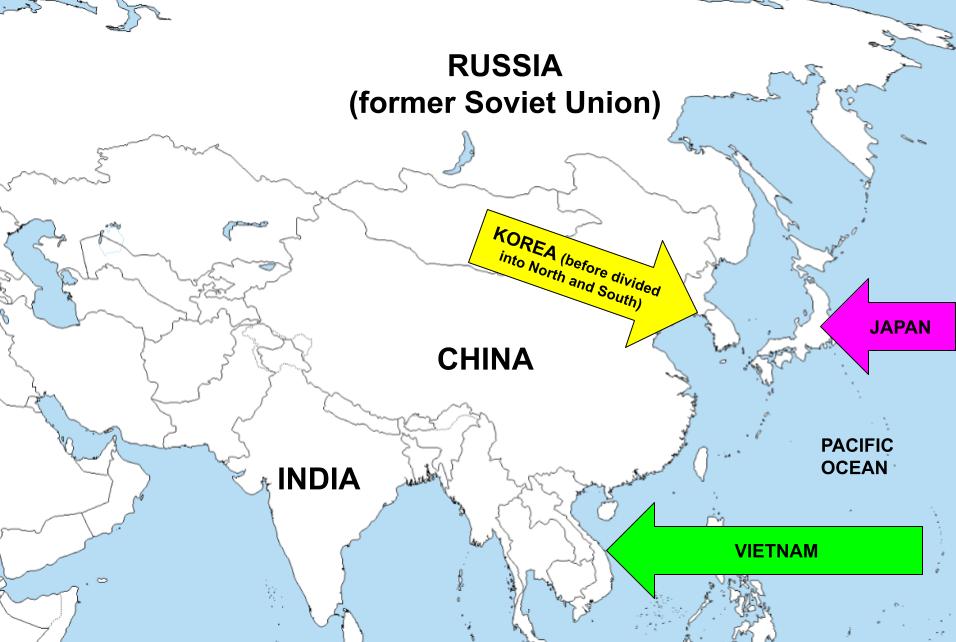
Locations to know in Asia
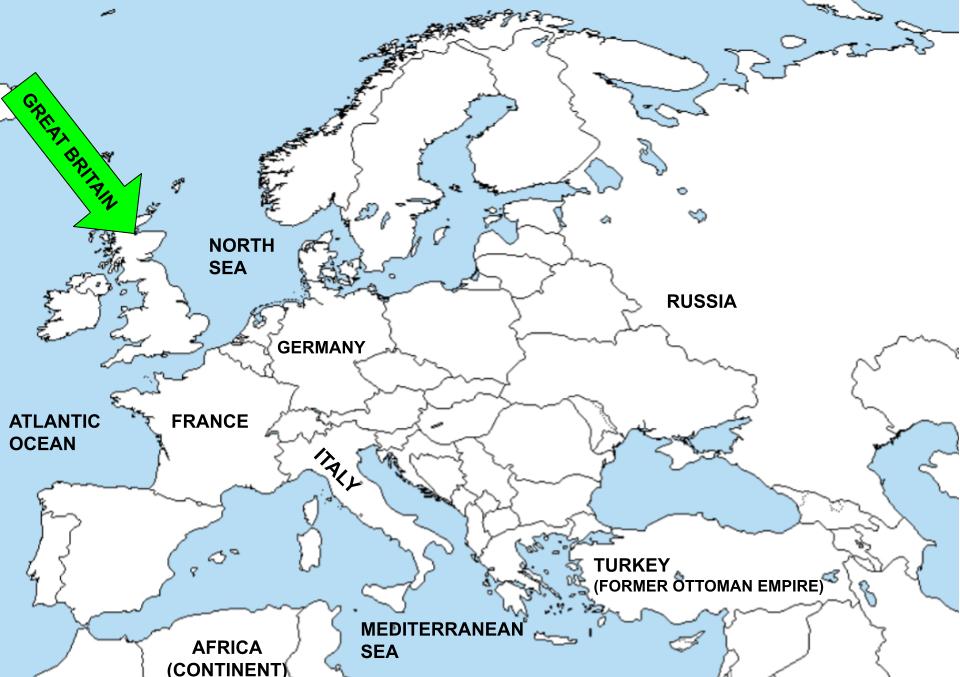
Locations to know in Europe
King Louis XVI and Marie Antoinette
French King and Queen during the French Revolution, known for their extravagant lifestyle. Both executed in 1793 by guillotine.
Taxes and Third Estate, Enlightenment Ideas, American Revolution, and Monarchy
the causes of the French Revolution from 1789-1799