Toxicology - Chemical carcinogenesis
 Call Kai
 Learn
Learn Practice Test
 Spaced Repetition
 Match
Match Flashcards
 Knowt Play
1/18

There's no tags or description
Looks like no tags are added yet.
Name | Mastery | Learn | Test | Matching | Spaced | Call with Kai |
|---|
No analytics yet
Send a link to your students to track their progress
19 Terms
What is cancer?
groups of cells:
uncontrolled growth (a lot of cell divisions)
invasion (intrusion on and destruction of adjacent tissues)
Metastasis (spread to other locations in the body via lymph or blood)
there are benign (friendly) and malignant tumors
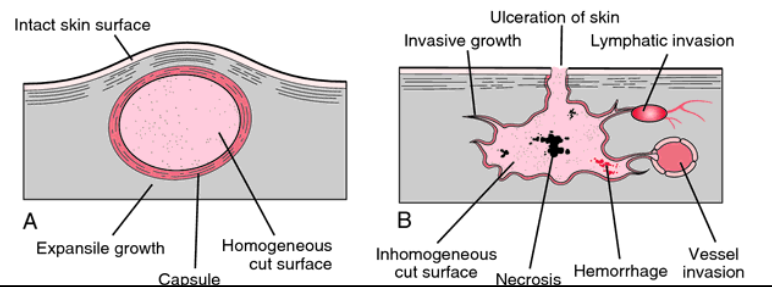
What are characteristics of the two different types of tumors?
Benign:
well differentiated
there is no infiltration (capsule)
it has slow growth
there is no necrosis
Malignant:
is poorly differentiated
there is infiltration
no capsule
fast growth
necrotic tissue
What is the leading cause of death?
cancer —> 8.2 million cases world wide
lung cancer
liver cancer
stomach cancer
colorectal cancer
breast cancer
oesophagus cancer
Different which cancer based on gender
What are the main cancer risk factors?
diet
tobacco
infection
reproductive and sexual behavior
How is cancer induced chemically?
Mutations —> regulations of cell divisions —> cancer
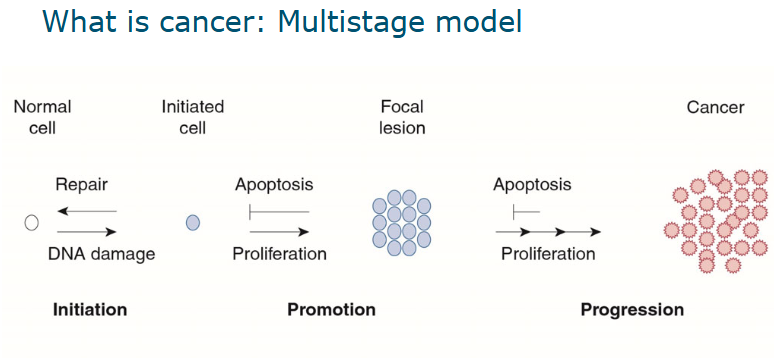
multistep process
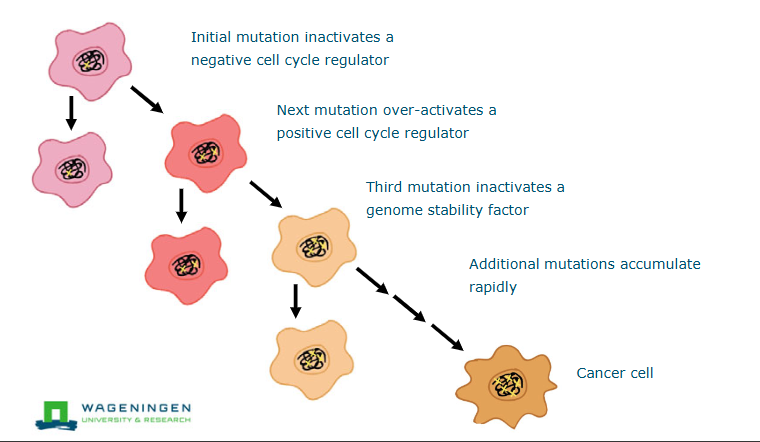
How do you go from a mutation to cancer?
The regulation of the cell cycle:
mutations of two types of cell cycle regulators may promote cancer development
overactivation of positive regulators (oncogenic)
inactivation of negative regulators (inhibition of tumour supressors)
What does oncogenic mean?
overactivation of positive regulator
What are proto-oncogenes?
genes with a normal function in regulating cell division
what are the mutations caused by proto-oncogenes?
“always on” protein
Amplification (more protein)
“combo” unregulated
What do proto-oncogenes turn into?
Oncogenes —> transformed genes causing uncontrolled cell division
How does tumour suppression work?
This is a gene that normally blocks cell cycle progression (in response to DNA damage)
active tumour suppression gene is inactivated
inactive tumour suppressor genes —> no control of cell division of cells (with damage to DNA)
What is cancer?
the loss of control over cell division
changes in genes involved in the cell cycle
no single event is enough to turn a cell into a cancerous cell (multi-step)
Accumulation of damage to a number of genes (multiple hits) across time leads to cancer
What is the difference between genotoxic and non-genotoxic carcinogens?
Genotoxic carcinogens —> every molecule increases cancer risk
Non-genotoxic carcinogens —> a threshold/safe level of exposure can be defined
What is an example of chemical carcinogenesis?
PAHs
Benzo[a]pyrene (cigarette smoke, charbroiled food [is a PAH]) —> need metabolic activation
genotoxic carcinogens
Aflatoxin B1 (mycotoxin on rice, cereals, peanuts) —> need metabolic activation
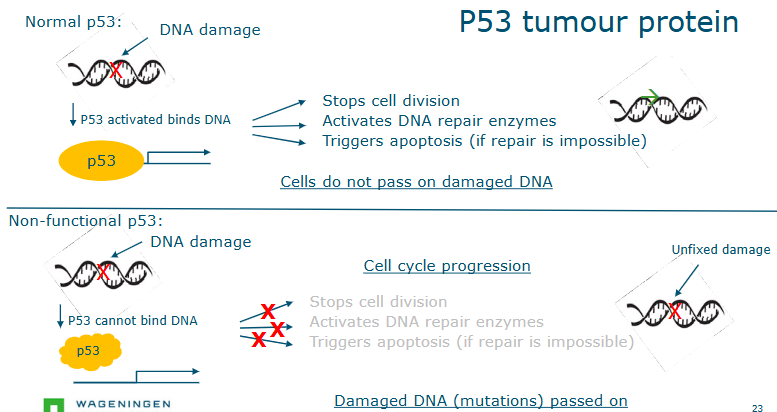
Explain the P53 tumor protein?
normal —> can bind to damaged DNA
stops cell division
non functional —> cannot bind to damaged DNA
cell cycle progresses
What are non-genotoxic chemicals?
They:
have no direct binding of chemical to DNA
no direct damage
no interaction of chemical or metabolite with DNA
Are chemicals that:
cause cell death and aberrant repair (usually at high
concentrations only)
Affect metabolism of chemicals (P450 enzymes)
Affect cell growth (up)
● Induce DNA synthesis (up) -> gene expression (up)
● Affect hormonal system
● Induce production of reactive oxygen species
What is an example of a indirect genotoxic chemical?
Reactive oxygen species (ROS) —> effects: gene transcription and cell proliferation
Dioxins (TCDD) —> activate aryl hydrocarbon receptors
Asbestos fibers —> frustrated phagocytosis: activates macrophages —> inflammation & ROS production —> followed by fibrosis (increased collagen deposition) —> asbestosis (lung fibrosis) —> lung cancer —> malignant mesothelioma
How are carcinogens classified?
G1 —> carcinogenic
G2 —> probably carcinogenic
G 2B —> possibly carcinogenic (no longer needs to be forbidden)
G3 —> cannot be classified (lack of data)
G4 —> proven to be non-carcinogenic
What are limitations of carcinogenic studies?
high doses needed to find effects
difficult to extrapolate to low doses (real-life exposure)
considered unethical
predictive
rats or mice arent humans