Diagnostic Audiology
 Call Kai
 Learn
Learn Practice Test
 Spaced Repetition
 Match
Match Flashcards
 Knowt Play
1/87

There's no tags or description
Looks like no tags are added yet.
Name | Mastery | Learn | Test | Matching | Spaced | Call with Kai |
|---|
No analytics yet
Send a link to your students to track their progress
88 Terms
What is hyperkeratosis?
Eczema
What is otitis externa?
An inflammation or infection of the external ear canal.
It can be caused by bacteria of fungus, and is often caused by water remaining in the ear canal after swimming
“Swimmer’s ear”
What is acute otitis media?
More of a short term otitis media that can be treated with antibiotics
What is serous otitis media?
Otitis media with effusion. It involves fluid behind the ear drum and can occur without infection
What is chronic suppurative otitis media?
This is when fluid is trapped behind the eardrum for more than 3 months. It occurs with perforation of TM and an active bacterial infection
What is exostoses?
A bony growth in the ear canal that is often seen in swimmers.
What is a cholesteatoma?
A skin cyst caused by a long standing retraction pocket of the tympanic membrane into the middle ear
Parts of the ear drum
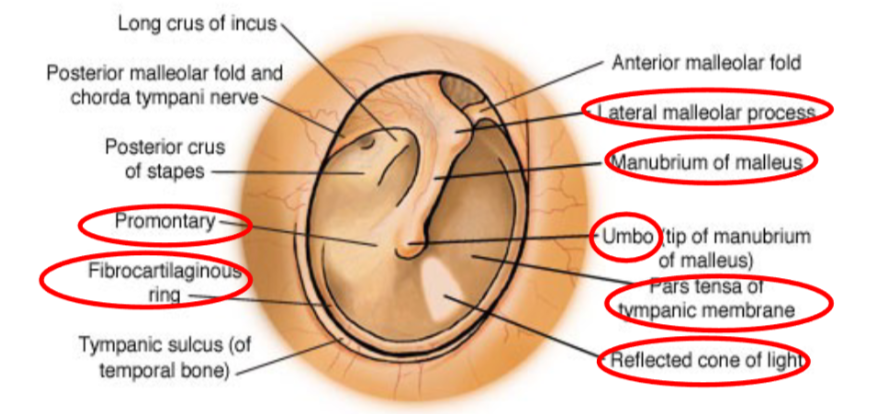
What is the Rinne test?
With a 512 Hz tuning fork, press the fork against the mastoid bone and then hold it a cm away from the ear. Then you say, which is louder, behind the ear or in front?
What is a Rinne positive test?
This is when air conduction is louder. It means that it is normal or SNHL
What is the Weber test?
When you strike a 512 Hz tuning fork and place it on the forehead and see which ear it lateralizes to
What is a positive Weber test?
A positive means the sound lateralized to one ear. The sound lateralizes to the bad ear because the blockage hides ambient room noise, making the bone-conducted sound louder.
A patient reports to you that they are having difficulty hearing from their left ear. Upon completing the Weber fork test, the patient reports that the tone is heard in the left ear. This is indicative of what?
Unilateral conductive hearing loss
What is a myringotomy?
A surgical procedure that involves making a small cut in the eardrum to drain fluid from the middle ear
What is impedance?
How much sound was not allowed in / how much sound was reflected back
Measured in ohms
What is admittance?
This is how much sound was admitted into the middle ear
Measured in mmho
In tympanometry, do we measure impedance or admittance?
Admittance
In terms of admittance, what do we call the mass/spring component?
susceptance
T/f. When mass and stiffness are equal, you are at the resonance frequency of the middle ear.
What values of reactance indicate stiffness domination, mass domination, or equal?
Negative = stiffness dominative
Zero = equal
Positive = mass dominative
What are the two components of admittance?
Compliance susceptance = increases with low frequency
Mass susceptance = increases with high frequency
Stiffness susceptance would increase with _______ Hz.
Low Hz
What will adding mass to the system cause?
A mass tilt
What is a mass tilt?
A high frequency sloping hearing loss
Will the resonant frequency for adding mass to the system be low or high?
Low resonant frequency
Due to the mass pathology effect on high frequencies, what probe tone should we use to study mass characteristics of the ME and diseases that increase the system mass?
What will adding stiffness to the system cause?
A stiffness tilt
What is a stiffness tilt?
An upward or low frequency sloping hearing loss
Will the resonant frequency for adding stiffness to the system be low or high?
High
Since stiffness pathologies affect low Hz, what probe tone should we use?
A probe tone of greater than or equal to 226 Hz.
Which muscle does the active dilation of the eustachian tube?
Tensor veli palatini
Politzer, Toynbee, Valsalva
Politzer=rubber bulb
Toynbee=swallowing
Valsalva=blowing
What is a normal Vec of an adult female?
0.8 - 1.9 cc
What is the normal Vec of an adult male?
1.0 - 2.2
What is the abbreviation of static admittance of static compliance?
Ytm
What is normal admittance for an adult?
>=0.3 mmho
Is tympanometry a measure of compliance?
No, it’s a measure of admittance
What is a type D tympanogram?
A double peak
What is tympanometric width?
It is the width of the tympanogram at half the height from the tympanic peak to tail
What is a normal TW for an adult?
50-110
What is a tympanometric gradient?
It is the steepness of the slope of the tympanogram near the peak
What is a normal tympanometric gradient?
>0.2
How much elevated will the acoustic reflex threshold be in a unilateral conductive hearing loss?
It will be elevated by the amount of the air bone gap
What are 2 possible causes of unilateral CHL with paradoxical acoustic reflex?
Ossicular Discontinuity
Localized cholesteatoma
What degree of SNHL would create a normal acoustic reflex threshold?
Less than 50 to 55 dB
What degree of SNHL would create an elevated acoustic reflex threshold, but a low sensation level?
SNHL thresholds between 50 and 80 dB HL
What degree of SNHL would create an absent acoustic reflex threshold?
greater than or equal to 80 dB
Although a retrocochlear pathology resembles a cochlear pathology in acoustic reflex, there are 3 distinct differences:
Elevated AR >100 dB HL, but with high sensational levels from the ear with cochlear loss
Absent AR regardless of degree of SNHL
Positive reflex decay
What is positive reflex decay?
It is when the response falls to less than or equal to 50% of it’s initial magnitude during the 10 second stimulus
What is the test of choice for tone decay?
Olsen and Noffsinger’s
A tone decay of about 20-25 dB in the higher frequencies in a duration on 1 minute likely indicates what type of pathology?
Cochlear
How much tone decay indicates a cochlear vs retrocochlear pathology?
Normal/Conductive = 0 dB
Cochlear = 5-25 dB decay
Retrocochlear = >30 dB decay
When is no tone decay present?
When the tone is heard for a full 1 minute
A marked or rapid decay, which is evident at all frequencies, is typically indicative of what type of pathology?
Retrocochlear
What acoustic reflex pattern will ANSD show?
Absent or elevated (high SLs) at all frequencies tested
Acoustic reflexes are usually absent/elevated at high sensation levels regardless of the degree of hearing loss in what pathology?
8th nerve tumor
What is the difference between a lower motor neuron lesion and an upper motor neuron lesion?
Lower motor neuron lesion = entirety of one half of the face affected
Upper motor neuron lesion = bottom part of one half of the face affected
List 2 tests for recruitment
Loudness balance - ABLB, AMLB
Short Increment Sensitivity Index (SISI)
What does ABLB stand for?
Alternate Binaural Loudness Balance Test
Used for asymmetrical hearing loss
What are 2 types of graphs we use for ABLB?
Laddergram
Steinberg-Gardner
How do we perform the ABLB test?
Signals are rapidly alternated between ears at the same frequency at a fixed 20 dB step size in the reference ear
The listener judges both signals to be of equal loudness at each presentation level
Intensity is held constant in the reference ear that has normal hearing
What is complete recruitment?
Equal loudness at equal HTL or intensities +- 10 dB
What does recruitment vs decruitment show?
Recruitment = cochelar loss
Decruitment = retrocochlear loss
How does recruitment work?
Since some hair cells have died and each cochlear band no longer has a full complement of hair cells, the brain recruits some hair cells from adjacent cochlear bands - these hair cells have a double duty:
They are still members of their original cochlear band and
They are members or one or more additional cochlear bands
Any hair cell may be recruited into several different cochlear bands
Why are sounds louder in recruitment?
Because many cochlear bands are stimulated at the same time
Why is hearing fuzzy in recruitment?
Because usually we hear just one frequency for a given sound, but in SNHL, the brain receives many signals of different Hz at the same time, making patients be unable to distinguish similar sounding words
What are 2 principles we need to think about why recruitment happens?
Place principle
Summation principle
What does SISI stand for?
Short Increment Sensitivity Index
How do you perform the SISI test?
Present a tone at 20 dB SL and present brief 1 dB increments and have pt tell when they hear a change in loudness
What is Difference Limen for Intensity?
The smallest change (1dB) in the intensity of a pure tone that can just be detected
Detected by SISI test
What does a high vs low score on the SISI test indicate?
High score = cochlear lesion
Low score = neural, CHL, or normal hearing
What should you do if you suspect a cochlear loss?
Perform
SISI at 2 and 4 kHz
AR decay measures at 500 and 1000 Hz
What is the Masking Level Difference Test?
A test that compares the listener’s threshold for a variety of masking conditions
AKA “release from masking”
What is the main thing happening in MLD?
When the stimuli are out of phase at the two ears = Binaural advantage = release from masking
What does PI-PB function stand for?
Performance Intensity when Phonetically Balanced word lists are used
What is PBmax?
The maximum score on the PI-PB function
What is a plateau?
When the PI function evens out when the intensity of presentation is raised above the PBmax level
Basically, the score does not improve or decline if intensity is raised
What is an abnormal PI-PB function score?
When a reduction of speech recognition scores occurs above where PBmax is obtained
What is the difference between cochlear and retrocochlear roll over in the PI-PB function?
Cochlear will have some rollover, retrocochlear will have severe rollover
What is organic hearing loss?
A real hearing loss thar results from anatomical or physiological abnormality
What is a non-organic hearing loss?
A hearing loss that is unrelated to physical or organic impairment in the auditory system, or an exagerrated/fake hearing loss
What is a loss with no apparent disorder called?
A functional hearing loss
What are 2 other names for psychogenic deafness?
Conversion disorder
Hysterical deafness
Do patients genuinely believe they have hearing loss when they have a psychogenic deafness?
Yes!
What is the difference between a factitious disorder and malingering?
A factitious disorder is made up to gain sympathy or special attention while malingering is done in order to have external gain
What is the Delayed Auditory Feedback test?
When people hear what they are saying simultaneously as they are talking, it makes them stutter
We ask a patient to tap a pattern over and over on a button while we send that tapping 200 ms delayed at a level lower than admitted threshold back to person
Can also do the same thing with reading
What is the swinging story test?
A story that is played in the pt’s ears in which some parts are presented to the better ear, the poorer ear, or to both ears. We present the test slightly above the pt’s threshold in the better ear and 10 dB below the threshold in the poor ear. Then you ask the pt to repeat the story
What is the Pulse-Count Method?
You present a number of pure-tone pulses rapidly. Intensity of tones may be varied. Ask patient to count and recall the number of pulses heard.