psychopathology test two study guide
0.0(0)
Studied by 0 people Call Kai
 Learn
 Practice Test
 Spaced Repetition
 Match
 Flashcards
 Knowt Play
Card Sorting
1/74

Earn XP
Description and Tags
75 Terms
1
New cards
Describe the difference between fear and anxiety. How do the symptoms of a panic attack differ from simple fear?
Anxiety is a general feeling of apprehension about possible future danger. Fear is an alarm reaction that occurs in response to immediate danger. An anxiety attack is a fear response that occurs in the absence of any external danger. The symptoms of a panic attack are nearly identical to those experienced during a state of fear except that panic attacks are often accompanied by a subjective sense of impending doom, including fears of dying, going crazy, or losing control.
2
New cards
Describe the four major subtypes of phobias (in the table, ignore “other”) and give examples of phobias falling into each of the categories.
Animal: Snakes, spiders, dogs, insects, birds
Natural Environment: Storms, heights, water
Blood/Injection/Injury: Seeing blood or an injury, receiving an injection, seeing a person in a wheelchair
Situational: Public transportation, tunnels, bridges, elevators, flying, driving, enclosed spaces
Natural Environment: Storms, heights, water
Blood/Injection/Injury: Seeing blood or an injury, receiving an injection, seeing a person in a wheelchair
Situational: Public transportation, tunnels, bridges, elevators, flying, driving, enclosed spaces
3
New cards
How is a blood-injection-injury phobia distinct from other types of phobias?
Rather than showing the simple increase in heart rate and blood pressure seen when most people with phobias encounter their phobic object, these people show an initial acceleration, followed by a dramatic drop in both heart rate and blood pressure. This is very frequently accompanied by nausea, dizziness, or fainting, which does not occur with other specific phobias.
Experience at least as much (if not more) disgust as fear.
Interestingly, people with this phobia demonstrate this unique physiological response pattern only in the presence of blood and injury stimuli; they exhibit the more typical physiological response pattern characteristic of the fight-or-flight response to their other feared objects. From an evolutionary and functional standpoint, this unique physiological response pattern may have evolved for a specific purpose: By fainting, the person being attacked might inhibit further attack, and if an attack did occur, the drop in blood pressure would minimize blood loss. This type of phobia appears to be highly heritable.
4
New cards
Explain how research has linked the concept of evolutionary preparedness to phobias.
This prepared learning occurs because, over the course of evolution, those primates and humans who rapidly acquired fears of certain objects or situations that posed real threats to our early ancestors may have enjoyed a selective advantage (meaning, they survived more often than those who had no fear of such things). Thus, “prepared” fears are not inborn or innate but rather are easily acquired or especially resistant to extinction.
In one important series of experiments using human subjects, Öhman and his colleagues found that fear is conditioned more effectively to fear-relevant stimuli (slides of snakes and spiders) than to fear-irrelevant stimuli (slides of flowers and mushrooms). Moreover, once the individuals acquired the conditioned responses to fear-relevant stimuli, these responses (including activation of the relevant brain area, the amygdala) could be elicited even when the fear-relevant stimuli (but not the fear-irrelevant stimuli) were presented subliminally. This subliminal activation of responses to phobic stimuli may help to account for certain aspects of the irrationality of phobias. That is, people with phobias may not be able to control their fear because the fear may arise from cognitive structures that are not under conscious control.
Another series of experiments showed that lab-reared monkeys in a vicarious conditioning paradigm can easily acquire fears of fear-relevant stimuli such as toy snakes and toy crocodiles but not of fear-irrelevant stimuli such as flowers and a toy rabbit. Thus, both monkeys and humans seem selectively to associate certain fear-relevant stimuli with threat or danger. Importantly, these lab-reared monkeys had no prior exposure to any of the stimuli involved (e.g., snakes or flowers), supporting the evolutionarily based preparedness hypothesis even more strongly than the human experiments. For example, human subjects (unlike the lab-reared monkeys) might show superior conditioning to snakes or spiders because of preexisting negative associations to snakes or spiders rather than because of evolutionary factors.
5
New cards
Describe the characteristics of social phobia/social anxiety disorder.
Social anxiety disorder (or social phobia) is characterized by disabling fears of one or more specific social situations. In these situations, a person fears that she or he may be exposed to the scrutiny and potential negative evaluation of others or that she or he may act in an embarrassing or humiliating manner.
Marked fear or anxiety about one or more social situations in which the individual is exposed to possible scrutiny by others. In children, the anxiety must occur in peer settings and not just during interactions with adults.
The individual fears that he or she will act in a way or show anxiety symptoms that will be negatively evaluated (i.e., will be humiliating or embarrassing; will lead to rejection or offend others).
The social situations almost always provoke fear or anxiety. In children, the fear or anxiety may be expressed by crying, tantrums, freezing, clinging, shrinking, or failing to speak in social situations.
The social situations are avoided or endured with intense fear or anxiety.
The fear or anxiety is out of proportion to the actual threat posed by the social situation and to the sociocultural context.
The fear, anxiety, or avoidance is persistent, typically lasting for 6 months or more.
The fear, anxiety, or avoidance causes clinically significant distress or impairment in social, occupational, or other important areas of functioning.
The fear, anxiety, or avoidance is not attributable to the physiological effects of a substance (e.g., a drug of abuse, a medication) or another medical condition.
The fear, anxiety, or avoidance is not better explained by the symptoms of another mental disorder, such as panic disorder, body dysmorphic disorder, or autism spectrum disorder.
If another medical condition (e.g., Parkinson’s disease, obesity, disfigurement from burns or injury) is present, the fear, anxiety, or avoidance is clearly unrelated or is excessive.
6
New cards
How could evolutionary theory explain the origin of social phobia?
It has been proposed that social fears and phobia evolved as a by-product of dominance hierarchies that are a common social arrangement among animals such as primates. Dominance hierarchies are established through aggressive encounters between members of a social group, and a defeated individual typically displays fear and submissive behavior but only rarely attempts to escape the situation completely. Thus, these investigators argued, it is not surprising that people with social anxiety endure being in their feared situations rather than running away and escaping them, as people with animal phobias often do.
If social anxiety evolved as a by-product of dominance hierarchies, it is not surprising that humans have an evolutionarily based predisposition to acquire fears of social stimuli that signal dominance and aggression from other humans. These social stimuli include facial expressions of anger or contempt, which on average all humans seem to process more quickly and readily than happy or neutral facial expressions. In a series of experiments that paralleled ones for specific phobias, Öhman and colleagues demonstrated that subjects develop stronger conditioned responses when slides of angry faces are paired with mild electric shocks than when happy or neutral faces are paired with the same shocks. Indeed, even very brief subliminal (not consciously perceived) presentations of the angry face that had been paired with shock were sufficient to activate the conditioned responses, probably because even these subliminal angry faces activate the amygdala—the central structure involved in fear learning. Relatedly, people who have social anxiety show greater activation of the amygdala (and other brain areas involved in emotion processing) in response to negative facial expressions (such as angry faces) than do normal controls. Such results may help explain the seemingly irrational quality of social anxiety, in that the angry faces are processed very quickly and an emotional reaction can be activated without a person’s awareness of any threat. The hyperactivity to negative facial expressions is paralleled by heightened neural responses to criticism.
If social anxiety evolved as a by-product of dominance hierarchies, it is not surprising that humans have an evolutionarily based predisposition to acquire fears of social stimuli that signal dominance and aggression from other humans. These social stimuli include facial expressions of anger or contempt, which on average all humans seem to process more quickly and readily than happy or neutral facial expressions. In a series of experiments that paralleled ones for specific phobias, Öhman and colleagues demonstrated that subjects develop stronger conditioned responses when slides of angry faces are paired with mild electric shocks than when happy or neutral faces are paired with the same shocks. Indeed, even very brief subliminal (not consciously perceived) presentations of the angry face that had been paired with shock were sufficient to activate the conditioned responses, probably because even these subliminal angry faces activate the amygdala—the central structure involved in fear learning. Relatedly, people who have social anxiety show greater activation of the amygdala (and other brain areas involved in emotion processing) in response to negative facial expressions (such as angry faces) than do normal controls. Such results may help explain the seemingly irrational quality of social anxiety, in that the angry faces are processed very quickly and an emotional reaction can be activated without a person’s awareness of any threat. The hyperactivity to negative facial expressions is paralleled by heightened neural responses to criticism.
7
New cards
What is behavioral inhibition?
The most important temperamental variable in infants, which shares characteristics with both neuroticism and introversion. Behaviorally inhibited infants who are easily distressed by unfamiliar stimuli and who are shy and avoidant are more likely to become fearful during childhood and, by adolescence, to show an increased risk of developing social anxiety.
8
New cards
How is the amygdala involved in panic disorder?
The panic attacks themselves in panic disorder arise from activity in the amygdala, either by cortical inputs (e.g., evaluating a stimulus as highly threatening) or by activity coming from more downstream areas like the locus coeruleus.
9
New cards
Distinguish between interoceptive and exteroceptive conditioning.
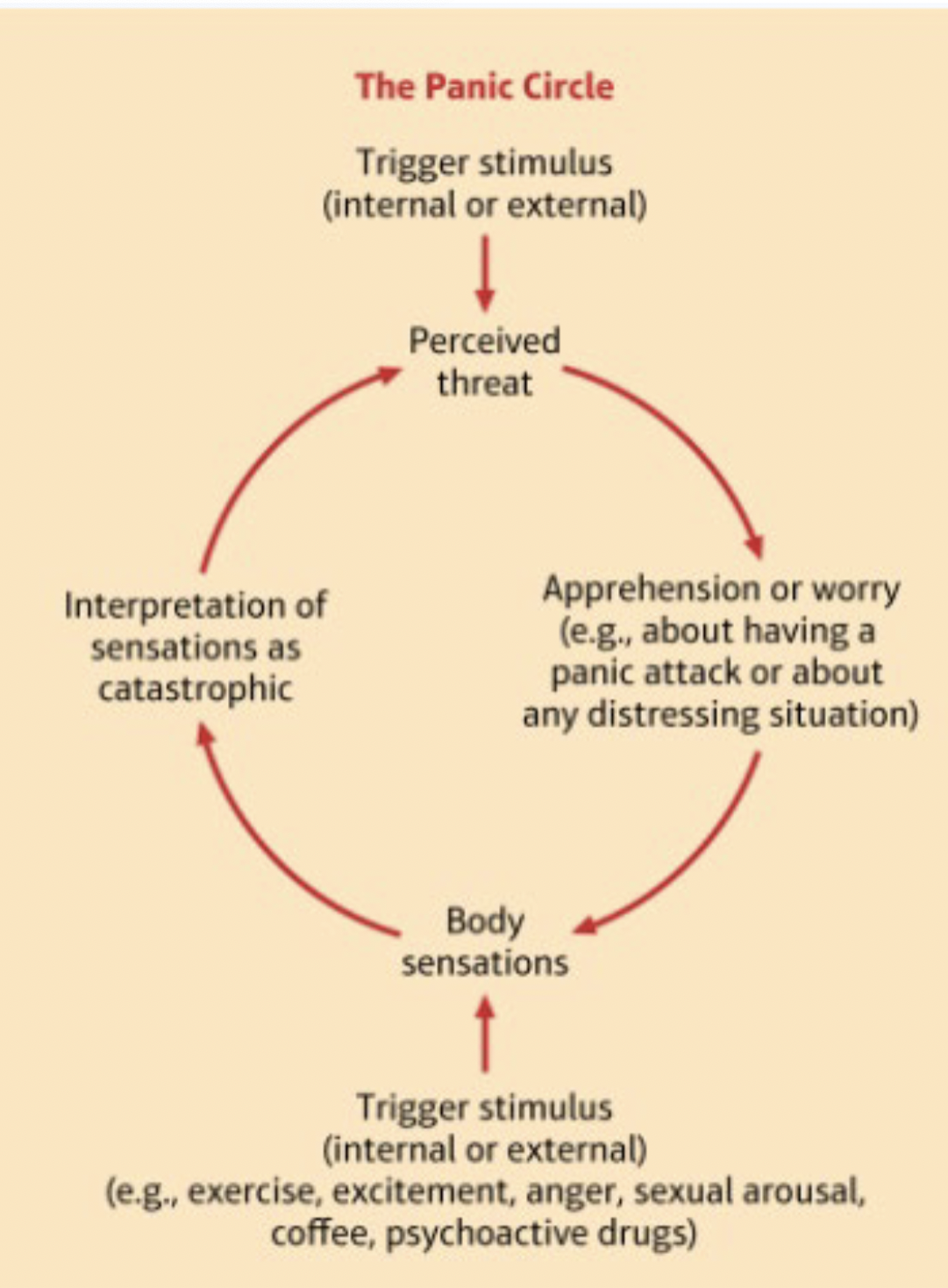
A comprehensive learning theory of panic disorder developed during the past few decades suggests that initial panic attacks become associated with initially neutral internal (interoceptive) and external (exteroceptive) cues through an interoceptive conditioning (or exteroceptive conditioning) process, which leads anxiety to become conditioned to these CSs (conditioned stimuli), and the more intense the panic attack, the more robust the conditioning that will occur. This conditioning of anxiety to the internal or external cues associated with panic thus sets the stage for the development of two of the three components of panic disorder: anticipatory anxiety and, sometimes, agoraphobic fears. Specifically, when people experience their initial panic attacks (which are terrifying emotional events replete with strong internal bodily sensations), interoceptive and exteroceptive conditioning can occur to different kinds of cues, ranging from heart palpitations and dizziness to shopping malls. Because anxiety becomes conditioned to these CSs, anxious apprehension about having another attack, particularly in certain contexts, may develop, as may agoraphobic avoidance of contexts in which panic attacks might occur in a subset of individuals.
10
New cards
Explain how the experience of nocturnal panic challenges a purely cognitive view of this disorder.
Nocturnal panic refers to waking from sleep in a state of panic. People with both daytime and nocturnal panic tend to have more severe anxiety and more frequent and severe panic attacks. Although one might think that such panic attacks occur in response to nightmares, considerable research shows that this is not the case. Sleep has five stages that occur in a fairly invariant sequence multiple times throughout the night: one stage called REM sleep (rapid eye movement sleep) during which vivid dreaming occurs, and four stages of non-REM sleep (Stages 1–4) when vivid dreams do not occur. If nocturnal panic attacks occurred in response to dreams, we would expect them to occur during REM sleep (when nightmares usually occur), but in fact they occur during Stage 2 and early Stage 3 sleep, usually a few hours after falling asleep. It is important to note that nocturnal panic attacks are different from “sleep terrors” or “night terrors,” which usually occur during Stage 4 sleep. Night terrors are usually experienced by children, who often scream and then fear that someone or something is chasing them around the room; however, they do not wake up. Nocturnal panic attacks also differ from isolated sleep paralysis, which can sometimes occur during the transition from sleep to waking. Sleep paralysis involves awareness of one’s surroundings accompanied by a stark sense of terror (resembling that during a panic attack) and an inability to move, which seems to occur because the individuals are waking from REM (dream) sleep, when muscle activity below the neck is suppressed.
11
New cards
What are “safety behaviors” and how can they function to maintain the panic cycle?
One would think, from the cognitive perspective, that this catastrophic thought would have been proved wrong so many times that it would finally go away. However, evidence suggests that such disconfirmation does not occur because people with panic disorder frequently engage in safety behaviors (such as breathing slowly or carrying a bottle with anxiolytic medication) before or during an attack. They then mistakenly tend to attribute the lack of catastrophe to their having engaged in this safety behavior rather than to the idea that panic attacks actually do not lead to heart attacks. Similarly, people who think they may faint will tend to lean against solid objects. Research suggests that it is important during treatment to identify these safety behaviors so that the person can learn to give them up and finally see that the feared catastrophe still does not occur.
12
New cards
Explain Captain Stevens’ concern “that many of these men and women are being pulled into a treatment and disability regime that will mire them in a self-fulfilling vision of a brain rewired, a psyche permanently haunted.”
“Clinicians aren’t separating the few who really have PTSD from those who are experiencing things like depression or anxiety or social and reintegration problems, or who are just taking some time getting over it,”
Being constantly told that they are suffering from PTSD will make them believe it
Being constantly told that they are suffering from PTSD will make them believe it
13
New cards
What does it mean to argue that PTSD as a construct might be “overextended?”
The diagnostic criteria for PTSD, they assert, represent a faulty, outdated construct that has been badly overextended so that it routinely mistakes depression, anxiety, or even normal adjustment for a unique and particularly stubborn ailment.
14
New cards
Why does the author argue that PTSD is “almost unique” among psychiatric diagnoses?
The link to a traumatic event, which makes PTSD almost unique among complex psychiatric diagnoses in being defined by an external cause.
15
New cards
Explain the findings of Bodkin’s study.
Alexander Bodkin screened 90 clinically depressed patients separately for PTSD symptoms and for trauma, then compared the results. First, he and a colleague used a standardized PTSD screening interview to assess PTSD symptoms. Then two other PTSD diagnosticians, ignorant of the symptom reports, used a standard interview to see which patients had ever experienced trauma fitting DSM-IV criteria. If PTSD arose from trauma, the patients with PTSD symptoms should have histories of trauma, and those with trauma should show more PTSD. It was not so. While the symptom screens rated 70 of the 90 patients PTSD-positive, the trauma screens found only 54 who had suffered trauma; the diagnosed PTSD “cases” outnumbered those who had experienced traumatic events. Things got worse when Bodkin compared the diagnoses one-on-one. If PTSD required trauma, then the 54 trauma-exposed patients should account for most of the 70 PTSD-positive patients. But the PTSD-symptomatic patients –were equally distributed among the trauma-positive and the trauma-negative groups. The PTSD rate had zero relation to the trauma rate. It was, Bodkin observed, “a scientifically unacceptable situation.”
16
New cards
In what ways might the VA system encourage “chronic disability?”
PTSD is by far the easiest mental health diagnosis to have declared “service-connected,” a designation that often means the difference between little or no care and broad, lasting health coverage. Service connection also makes a vet eligible for monthly disability payments of up to $4,000. That link may explain why most veterans getting PTSD treatment from the VA report worsening symptoms until they are designated 100 percent disabled — at which point their use of VA mental health services drops by 82 percent. It may also help to explain why, although the risk of PTSD from a traumatic event drops as time passes, the number of Vietnam veterans applying for PTSD disability almost doubled between 1999 and 2004, driving total PTSD disability payments to more than $4 billion annually. Perhaps most disastrously, these payments continue only if you’re sick. Unlike a vet who has lost a leg, a vet with PTSD loses disability benefits as soon as he recovers or starts working.
17
New cards
How might the DSM criteria for PTSD (as they are currently written) fall short when it comes to recognizing race-based trauma?
It does not adequately account for the cumulation of smaller traumatic events and how that can turn into PTSD (since race-based trauma is usually a bunch of smaller things building up.)
18
New cards
The author argues that psychological responses to racism can be similar to psychological responses to sexual assault or domestic violence. Explain her argument.
Both events are an assault on the personhood and integrity of the victim. Similar to rape victims, race-based trauma victims may respond with disbelief, shock, or dissociation, which can prevent them from responding to the incident in a healthy manner. The victim may then feel shame and self-blame because they were unable to respond or defend themselves, which may lead to low self-concept and self-destructive behaviors. In the same study, a parallel was drawn between race-based trauma victims and victims of domestic violence. Both survivors are made to feel shame over allowing themselves to be victimized. For instance, someone who may have experienced a racist incident may be told that if they are polite, work hard, and/or dress in a certain way, they will not encounter racism. When these rules are followed yet racism persists, powerlessness, hypervigilance, and other symptoms may increase.
19
New cards
Why might defining trauma as a “discrete event” be inadequate for those who experience racism?
This is limiting given that many minorities experience cumulative experiences of racism as traumatic, with perhaps a minor event acting as “the last straw” in triggering trauma reactions
20
New cards
What advice does the author have for clinicians?
Mental health professionals must be willing and able to assess race-based trauma in their minority patients. Clinicians assessing ethnoracial minorities are encouraged to directly inquire about the patient’s experiences of racism when determining trauma history. Thus it is important that all clinicians are well-trained in the delivery of culturally competent care to enable them to properly serve diverse patients.
21
New cards
What is “prolonged exposure” therapy?
The patient is asked to vividly recount the traumatic event over and over until there is a decrease in his or her emotional responses. This procedure also involves repeated or extended exposure, either in vivo or in the imagination, to feared (but objectively harmless) stimuli that the patient is avoiding because of trauma-related fear. PTSD treatment.
22
New cards
What is the focus of cognitive therapy for PTSD?
Based on a cognitive model of the disorder. More specifically, it is thought that PTSD becomes persistent when people who have experienced trauma make excessively negative and idiosyncratic appraisals of what has happened to them in a way that creates a sense of a serious, current threat.
Cognitive therapy for PTSD is designed to modify excessively negative appraisals of the trauma or its consequences, decrease the threat that patients experience when they have memories of the traumatic event, and remove problematic cognitive and behavioral strategies.
Cognitive therapy for PTSD is designed to modify excessively negative appraisals of the trauma or its consequences, decrease the threat that patients experience when they have memories of the traumatic event, and remove problematic cognitive and behavioral strategies.
23
New cards
Describe the criteria for binge eating disorder.
Recurrent episodes of binge eating. An episode of binge eating is characterized by both of the following:
-Eating, in a discrete period of time (e.g., within any 2-hour period), an amount of food that is definitely larger than what most people would eat in a similar period of time under similar circumstances.
-A sense of lack of control over eating during the episode (e.g., a feeling that one cannot stop eating or control what or how much one is eating).
The binge-eating episodes are associated with three (or more) of the following:
-Eating much more rapidly than normal.
-Eating until feeling uncomfortably full.
-Eating large amounts of food when not feeling physically hungry.
-Eating alone because of feeling embarrassed by how much one is eating.
-Feeling disgusted with oneself, depressed, or very guilty afterward.
Marked distress regarding binge eating is present.
The binge eating occurs, on average, at least once a week for 3 months.
The binge eating is not associated with the recurrent use of inappropriate compensatory behavior as in bulimia nervosa and does not occur exclusively during the course of bulimia nervosa or anorexia nervosa.
24
New cards
Describe the issue of “diagnostic crossover.” What types of crossover are more/less common with respect to EDs?
It is quite common for someone who is diagnosed with one form of eating disorder to be later diagnosed with another eating disorder. This may reflect the fact that current diagnostic systems are not doing a good job of categorizing these disorders and that dimensionally-based approaches might be more appropriate.
Bidirectional transitions between the two subtypes of anorexia nervosa (restricting and binge-eating/purging) were especially common.
Shifts from anorexia nervosa to bulimia nervosa also occurred in about a third of patients. The transition to bulimia nervosa seems to occur after an earlier transition to the binge-eating/purging subtype of anorexia nervosa.
25
New cards
How does ethnic identity affect rates of eating disorders?
Being Caucasian, however, does appear to be associated with subclinical problems that may place individuals at higher risk for developing eating disorders. Examples of such problems include body dissatisfaction, dietary restraint, and a drive for thinness.
Although Asian women exhibit levels of pathological eating similar to those of white women, it has long been held that African Americans are less susceptible to subclinical types of eating problems and body image concerns than Caucasians are. Fewer black than white women also had bulimia nervosa
However, as minorities become more and more integrated and internalize white, middle-class societal values about the desirability of thinness, we should expect to see increases in the rates of eating disorders in minorities.
A select number of the clinical features of diagnosed forms of eating disorders may also vary according to culture. For instance, about 58 percent of patients with anorexia nervosa in Hong Kong are not excessively concerned about fatness, rather stomach bloating. Patients with anorexia nervosa who were living in Britain but who had South Asian ethnic origins also were less likely than patients with English ethnic origins to show evidence of fatphobia. Young women in Ghana who had anorexia nervosa were also not especially concerned about their weight or shape. Rather, they emphasized religious ideas of self-control and denial of hunger as the motivation for their self-starvation. In a final example, Japanese women with eating disorders reported significantly lower levels of perfectionism and less of a drive for thinness than did American women with eating disorders.
In contrast, bulimia nervosa does seem to be a culture-bound syndrome. More specifically, it seems to occur in people who have had some exposure to Western ideals about thinness, who have access to large amounts of food, and who, because of modern plumbing, can purge in private.
26
New cards
Describe the basic findings of the “Fiji study.”
Anne Becker and her colleagues (2002). When Becker first began conducting research in Fiji in the 1990s, she was struck by the considerable percentage of Fijians (especially women) who were overweight with respect to their Western counterparts. From a cultural perspective, however, this made sense. Within Fijian culture, being fat was associated with qualities that were highly valued such as being strong, able to work, and kind and generous. Being thin, in contrast, was regarded negatively because it was thought to reflect being sickly, incompetent, or having somehow received poor treatment. Culturally, fatness was preferred over thinness, and dieting was viewed as offensive. What was also striking was the total absence of any condition that could be considered an eating disorder. After television came to Fiji, however, the cultural climate changed. Not only were Fijians able to see programs such as Beverly Hills 90210 and Melrose Place that were popular at that time, but many young women also began to express concerns about their weight and dislike of their bodies. For the first time, women in Fiji started to diet in earnest. The young Fijian women studied by Becker also made comments that suggested that their body dissatisfaction and wish to lose weight were motivated by a desire to emulate the actors they had seen on television. Although Becker did not collect information about eating disorders themselves (she measured attitudes toward eating), this “natural experiment” provides us with some anecdotal information as to the way in which Western values about thinness may begin to insert themselves into foreign cultural environments. Indeed, a subsequent research study involving participants in 26 countries has now confirmed that the more women are exposed to Western media (via TV, movies, magazines, or music), the more dissatisfied they are with their bodies.
27
New cards
What is a neurodevelopmental disorder?
A group of conditions characterized by an early onset and persistent course that are believed to be the result of disruptions to normal brain development. Heterogeneous, but overlap and share common risk factors.
28
New cards
What are the earliest signs that an infant might develop autism?
Problems with social communication, a significant decline in their focus on the eyes of others from 2 to 6 months of age and this decline continues until 24 months—at which point it is approximately half the level of focus as that seen in typically developing children, increase in their focus on inanimate objects, which is double the level of typically developing children by 24 months.
29
New cards
What concerns does the author have about the use of stimulant drugs in children? Do these drugs work?
Attention-deficit drugs increase concentration in the short term, but when given to children over long periods of time, they neither improve school achievement nor reduce behavior problems. The drugs can also have serious side effects, including stunting growth. They do not get to the root of the issue; they are looking for an easy solution to the problem and ignoring how experience can lead to attention issues. Too focused on inherent biology.
30
New cards
What is the diabetes metaphor for ADHD? Is there evidence to support it?
Back in the 1960s I, like most psychologists, believed that children with difficulty concentrating were suffering from a brain problem of genetic or otherwise inborn origin. Just as Type I diabetics need insulin to correct problems with their inborn biochemistry, these children were believed to require attention-deficit drugs to correct theirs. It turns out, however, that there is little to no evidence to support this theory.
31
New cards
Is there evidence for a paradoxical effect of stimulant drugs? Explain.
However, there really was no paradox. Versions of these drugs had been given to World War II radar operators to help them stay awake and focus on boring, repetitive tasks. And when we reviewed the literature on attention-deficit drugs again in 1990 we found that all children, whether they had attention problems or not, responded to stimulant drugs the same way. Moreover, while the drugs helped children settle down in class, they actually increased activity in the playground. Stimulants generally have the same effects for all children and adults. They enhance the ability to concentrate, especially on tasks that are not inherently interesting or when one is fatigued or bored, but they don’t improve broader learning abilities. Paradox: why would a stimulant calm kids down?
32
New cards
How do the long-term effects of these medications differ from the short-term effects?
The effects of stimulants on children with attention problems fade after prolonged use. They apparently develop a tolerance to the drug, and thus its efficacy disappears. Many parents who take their children off the drugs find that behavior worsens, which most likely confirms their belief that the drugs work. But the behavior worsens because the children’s bodies have become adapted to the drug. To date, no study has found any long-term benefit of attention-deficit medication on academic performance, peer relationships or behavior problems.
33
New cards
What types of factors are proposed by the author as contributing to attention difficulties in children?
Among them are family stresses like domestic violence, lack of social support from friends or relatives, chaotic living situations, including frequent moves, and, especially, patterns of parental intrusiveness that involve stimulation for which the baby is not prepared. For example, a 6-month-old baby is playing, and the parent picks it up quickly from behind and plunges it in the bath. Or a 3-year-old is becoming frustrated in solving a problem, and a parent taunts or ridicules. Such practices excessively stimulate and also compromise the child’s developing capacity for self-regulation.
34
New cards
Explain the author’s general concerns and the evidence he presents for these concerns.
We are overprescribing amphetamines just like we did in the 1950s and 1960s and this is leading to increased addiction and reliance rates. Additionally, the things that we believe drugs are helping with aren’t actually being treated.
35
New cards
Is there evidence that stimulant use in children with ADHD reduces the risk of later substance abuse? Explain.
The problem with this reassuring message is that it was based on flimsy evidence. Experts had relied on studies of children treated with stimulants by their personal physicians, compared with children who had ADHD but did not receive stimulants. These community studies were fraught with confounding variables and were only suggestive. Three months ago, the only randomized trial to study future substance abuse by ADHD kids refuted the notion that stimulants, when taken in childhood, have a protective effect. Investigators found strong evidence that ADHD itself in fact predisposes children to later substance abuse -- but no evidence that stimulant medication reduces this rate any better than treating ADHD with behavioral approaches. Further evidence that stimulants do not protect children from addiction was provided in a comprehensive review published last month in JAMA Psychiatry.
36
New cards
Describe the evidence of the effectiveness of exercise in treating depression.
Exercise has acute and long-term effects on mood, 30-45 minutes is the ideal time. Sometimes 20 works. Exercise may protect against future episodes of depression. Comparable to other treatments, like medication, in effectiveness Also improves “quality of life” and cognitive performance with really no side effects. Pushes back against some of the cognitive declines that come with depression. Might stimulate the growth of neurons.
37
New cards
In general terms, explain the types of evidence that link inflammation to depression.
Depression is more common in people with medical conditions linked with inflammatory activity
Inflammation stimulates HPA axis, can cause a pro-inflammatroy feedback loops
Hypothalamus regulates the endocrine system
Pituitary Gland
Adrenal Glands release cortisol
Some studies find higher levels of proinflammatory markers in those with depression
But results are mixed in terms of causal direction
Inflammatory challenges can increase depression symptoms
38
New cards
Explain why researchers believe the hippocampus plays a role in depression.
The hippocampus has a smaller volume among people with depression
Lower metabolic activity among people with depression
Reductions in hippocampus volume may precede depression
Stress is related to depression, stress causes chronically elevated cortisol (which can also cause heart disease), and chronically elevated cortisol can shrink the hippocampus
Lower metabolic activity among people with depression
Reductions in hippocampus volume may precede depression
Stress is related to depression, stress causes chronically elevated cortisol (which can also cause heart disease), and chronically elevated cortisol can shrink the hippocampus
39
New cards
Why is ECT a controversial treatment for depression? Is it effective?
Unilaterally, on one side of the brain, passes an electrical current through the brain and causes a seizure (the body does not convulse) 8-12 sessions
Still considered controversial, there are protests but some people say that it saved their lives
Controversy comes with history, it used to be used to punish patients
Usually only offered to people who have extreme suicidal depression that is treatment-resistance
Works in about half of those patients
We don’t know why it works
Can cause short-term amnesia surrounding the sessions
Target left prefrontal cortex
40
New cards
What is rTMS?
Repetitive Transcranial Magnetic Stimulation
Passing a magnet over your head causes a massive stimulation of neurons, they’re firing everywhere
Same areas as ECT
Does not seem to cause amnesia, sometimes the skin in the area hurts a bit
Insurance companies don’t really cover rTMS
Right now it is restricted to clinical trials and the wealthy
Passing a magnet over your head causes a massive stimulation of neurons, they’re firing everywhere
Same areas as ECT
Does not seem to cause amnesia, sometimes the skin in the area hurts a bit
Insurance companies don’t really cover rTMS
Right now it is restricted to clinical trials and the wealthy
41
New cards
Why is lithium a “mixed bag” when it comes to the treatment of bipolar disorder?
Incredibly toxic, have to be very careful with dosing and you have to get regular blood tests
Narrow window of therapeutic effectiveness; you have to get the levels just right
The side effects of taking too much are horrible
Lithium primarily helps with mania (mood stabilizer) reigns in the manic episodes
Does not help with depression that much
Long term retreatment with lithium shows the symptoms being entirely under control for 30%
Can lose effectiveness over time
50% of people see waning effectiveness after 3 years of treatment
Helps with suicidality
Because of this it is sometimes prescribed for unipolar depression
Since it doesn’t help with depression episodes it is sometimes prescribed with an antidepressant
This can be bad, can cause rapid cycling between depression and mania
42
New cards
What do behaviorists posit as the causes of depression?
People with depression experience a reduction of positive reinforcers and feedback loop
Because of social withdrawing
Uncontrollable negative events and learned helplessness
You don’t care why this is occurring, just making undesired symptoms less common and increasing desired symptoms
Because of social withdrawing
Uncontrollable negative events and learned helplessness
You don’t care why this is occurring, just making undesired symptoms less common and increasing desired symptoms
43
New cards
What is behavioral activation therapy? How might it be implemented?
Increase opportunities for positive reinforcers
When do you feel better, when do you feel worse, how can we get you more positive reinforcers, let’s put you in more of those situations
When do you feel better, when do you feel worse, how can we get you more positive reinforcers, let’s put you in more of those situations
44
New cards
Describe Beck’s cognitive theory of depression, including the negative cognitive triad and the errors in thinking discussed in your book/in class.
Beck’s Negative Cognitive Triad
Negative views about yourself, the world, the future
Automaticity, quick, automatic thoughts, very hard to control because they are so quick/automatic
Errors in thinking
-People who are depressed are not evaluating the evidence well
-Dichotomous or all-or-none reasoning
-Selective abstraction, which involves a tendency to focus on one negative detail of a situation while ignoring other elements of the situation.
Arbitrary inference, which involves jumping to a conclusion based on minimal or no evidence
-Overgeneralization
My friends is mad at me so everybody hates me
-Personalization
Every bad thing is about me/my fault
Beck hypothesized that the cognitive symptoms of depression often precede and cause the affective or mood symptoms rather than vice versa. For example, if you think that you are a failure or that you are ugly, it would not be surprising for those thoughts to lead to a depressed mood. Beck’s theor is a diathesis–stress theory in which negative cognitions are central.
45
New cards
What is the modern definition of neuroticism?
Tendency to experience frequent and intense negative emotions in response to stress
46
New cards
What are the key cognitive correlates of neuroticism?
Perception that world is dangerous/threatening
Belief that one is unable to cope
Heightened focus on criticism
Perceptions of lack of control
Belief that one is unable to cope
Heightened focus on criticism
Perceptions of lack of control
47
New cards
Consider that argument that the current DSM overemphasizes categories that are minor variations of a broader underlying syndrome of neuroticism. Describe the evidence for this claim.
Evidence (referencing anxiety and unipolar depression)
High rates of comorbidity (both concurrently and over time)
Broad treatment response
Both drugs and psychotherapy
Shared neurobiological mechanisms
Hyper-excitiably of limbic (amygdala) structures
Limited inhibitory control by cortical structures
High rates of comorbidity (both concurrently and over time)
Broad treatment response
Both drugs and psychotherapy
Shared neurobiological mechanisms
Hyper-excitiably of limbic (amygdala) structures
Limited inhibitory control by cortical structures
48
New cards
Explain how positive affect and negative affect are related to anxiety and depression.
Positive emotionality (a facet of extraversion)
Depression: high negative affect and low positive affect
Anxiety: high negative affect and hyperarousal
People with low positive affect are less responsive to drugs and CBT, and it is closely linked with suicidally and impairment.
Depression: high negative affect and low positive affect
Anxiety: high negative affect and hyperarousal
People with low positive affect are less responsive to drugs and CBT, and it is closely linked with suicidally and impairment.
49
New cards
Is neuroticism “treatable” (i.e., is it something that can be changed)? Explain.
Neuroticism: change is slow over time, biggest change in behavioral manifestation of traits
Easiest of Big 5 to change
Higher it is, harder to change
SSRIs seem to dampen neuroticism
Drugs acting on dopamine and norepinephrine may increase extraversion/positive affectivity
Exercise: increases E/PA and associated with neurogenesis
Easiest of Big 5 to change
Higher it is, harder to change
SSRIs seem to dampen neuroticism
Drugs acting on dopamine and norepinephrine may increase extraversion/positive affectivity
Exercise: increases E/PA and associated with neurogenesis
50
New cards
What are the major diagnostic criteria for panic disorder?
Recurrent (unexpected) attacks
Super high physiological arousal, fight or flight instincts
Followed by (one month of) one or more of the following:
Worry about future attacks
Maladaptive changes in behavior as a result
Super high physiological arousal, fight or flight instincts
Followed by (one month of) one or more of the following:
Worry about future attacks
Maladaptive changes in behavior as a result
51
New cards
What are the major diagnostic criteria for agoraphobia?
Marked fear/anxiety about two or more (six mos or more)
Public transport
Open spaces
Enclosed spaces
Lines/crowds
Outside of home alone
Fearing because escape might be difficult or help not available in event of panic or other “embarrassing” symptoms
Public transport
Open spaces
Enclosed spaces
Lines/crowds
Outside of home alone
Fearing because escape might be difficult or help not available in event of panic or other “embarrassing” symptoms
52
New cards
Describe anxiety sensitivity and interoceptive awareness and how these two factors play a role in panic disorder.
High anxiety sensitivity
-Sense that you believe that physical symptoms have horrible consequences
Interoceptive awareness
-Awareness of body’s internal state
-Sense that you believe that physical symptoms have horrible consequences
Interoceptive awareness
-Awareness of body’s internal state
53
New cards
Explain how CBT could be used to treat panic disorder. What steps would be involved?
Relaxation training
Identifying cognitions
And challenging them
(Maybe) induce panic in therapy
Relaxation and reinterpretation
Exposure
If someone is worried about panic attacks in specific locations you could take a field trip to that place
Internal or External
Arousal or place
Identifying cognitions
And challenging them
(Maybe) induce panic in therapy
Relaxation and reinterpretation
Exposure
If someone is worried about panic attacks in specific locations you could take a field trip to that place
Internal or External
Arousal or place
54
New cards
Describe the diagnostic criteria for GAD.
Anxious almost all the time, in almost all situations
More days than not for at least six months
A number of events/activities
Free-floating
More days than not for at least six months
A number of events/activities
Free-floating
55
New cards
What are the characteristic cognitions of those with GAD?
Cognitions focused on threat
Threat is used broadly, does not have to be physical
Believe worry is effective and productive
Assumption leads to hyper-vigilance
Threat is used broadly, does not have to be physical
Believe worry is effective and productive
Assumption leads to hyper-vigilance
56
New cards
Describe the type of traumatic experience necessary for the diagnosis of PTSD.
Exposure to actual or threatened death/serious injury or sexual violence
Directly (self) or witnessing (in person)
Learning of such events with respect to close family member/friend (events must be violent/accidental)
Experiencing exposure (repeated or extreme) to aversive details of traumatic events
-Media does not count
-Stuff like first responders, finding a body
Directly (self) or witnessing (in person)
Learning of such events with respect to close family member/friend (events must be violent/accidental)
Experiencing exposure (repeated or extreme) to aversive details of traumatic events
-Media does not count
-Stuff like first responders, finding a body
57
New cards
What are the primary diagnostic criteria for PTSD?
One or more intrusion symptoms
-Recurrent, involuntary, and intrusive distressing memories
-Recurrent distressing dreams related to trauma
-Dissociative reactions (flashbacks)
-Intense distress when exposed to related cues
-Marked physiological reactions to cues
Persistent avoidance of stimuli associated with trauma (internal or external)
Negative alternations in cognitions and mood associated with trauma
Alterations in arousal and reactivity
-Strong startle responses
58
New cards
What findings have led researchers to be concerned that PTSD may often be an inappropriate diagnosis? Or that the “net” cast by PTSD might be too broad?
Cause and effect isn’t that clear:
Isn’t always clear that symptoms are caused by trauma
PTSD symptom cluster is often present after events that don’t meet the DSM’s definition of trauma
All PTSD symptoms can occur in the absence of any trauma
In some studies, symptoms don’t predict trauma
May be over-diagnosing anxiety, depression, normal adjustment to difficult or traumatic events
What kind of narrative are we reinforcing?
59
New cards
What types of trauma do the PTSD criteria fail to capture? Explain.
“Racism is not typically considered traumatic by mental health care providers”
In treatment, experiences are often minimized or questioned
Does not account for cumulative trauma (like race-based trauma) or the drama that the loss of a job or divorce could cause
In treatment, experiences are often minimized or questioned
Does not account for cumulative trauma (like race-based trauma) or the drama that the loss of a job or divorce could cause
60
New cards
Describe obsessions and compulsions.
Obsessions
Recurrent thoughts/images/ideas/impulses
Intrusive, persistent, cause distress
Compulsions
Repetitive behaviors or mental acts
Feel necessary to reduce distress or prevent the bad thing from happening
Recurrent thoughts/images/ideas/impulses
Intrusive, persistent, cause distress
Compulsions
Repetitive behaviors or mental acts
Feel necessary to reduce distress or prevent the bad thing from happening
61
New cards
Why isn’t OCD considered a psychotic disorder?
It is not considered psychotic because most people with OCD recognize that their beliefs are untrue/impossible
They still believe it, but they recognize it as irrational
There are some people with OCD who don’t have insight into their irrationality
This is tagged as “with poor insight”
They still believe it, but they recognize it as irrational
There are some people with OCD who don’t have insight into their irrationality
This is tagged as “with poor insight”
62
New cards
Why was OCD taken out of the anxiety disorders section of the DSM?
Does not behave like an anxiety disorder
Does not respond to benzodiazepines
Doesn’t follow the same gender trends as anxiety disorders
Does not respond to benzodiazepines
Doesn’t follow the same gender trends as anxiety disorders
63
New cards
How can CBT be used to treat OCD?
CBT (exposure and response prevention)
Exposure to obsession
Disallow compulsion
Exposure to obsession
Disallow compulsion
64
New cards
Describe the pattern of gender difference in terms of diagnosed eating disorders.
Differential pressures
There is pressure on women to be skinny, and pressure on men to be noticeably muscular
Anorexia and Bulimia are far more common in women than men
Binge-Eating Disorder is almost evenly split between men and women, but women have it a bit more
Gender-noconforming people and sexual minorities have an elevated risk for all eating disorders
65
New cards
What changes were made to the criteria for AN and BN in the DSM 5?
Lowered thresholds for both Anorexia Nervosa and Bulimia Nervosa
Amenorrhea (loss of menstrual cycle) used to be a requirement, but they got rid of that
So many problems with that, garbage criteria with no backing
Weight
Got rid of concrete number for weight, made it more flexible
Frequency requirement for binging/purging
Amenorrhea (loss of menstrual cycle) used to be a requirement, but they got rid of that
So many problems with that, garbage criteria with no backing
Weight
Got rid of concrete number for weight, made it more flexible
Frequency requirement for binging/purging
66
New cards
What are the major criteria for a diagnosis of AN?
Refusal to maintain minimal body weight, restriction of energy intake relative to requirements; significantly low weight
Intense fear of gaining weight or becoming fat despite being underweight; or persistent behavior that interferes with weight gain, even though at a significant low weight
Distortion in body weight/shape perception, undue influence of body weight and shape on self-evaluation, denial of seriousness of current low body weight.
67
New cards
Describe the two types of anorexia.
Restricting
Starving yourself, not consuming enough
Binge/Purge
If you’re significantly underweight and binging and purging it is considered anorexia rather than bulimia
Starving yourself, not consuming enough
Binge/Purge
If you’re significantly underweight and binging and purging it is considered anorexia rather than bulimia
68
New cards
What are the major criteria for BN?
Recurrent episodes of binge eating
Eating more food than what would be consumed by other people in a similar setting
Feel a lack of control; want to stop, but can’t stop eating
Recurrent inappropriate behaviors to prevent weight gain (from binges)
Purging, excessive exercise, abusing laxatives
At least one time a week for at least three months
Self-evaluation unduly influences by weight/shape
Purging and non-purging types
69
New cards
How is a “binge” different from simple over-eating?
Eating more food than what would be consumed by other people in a similar setting
Feel a lack of control; want to stop, but can’t stop eating; shame
Feel a lack of control; want to stop, but can’t stop eating; shame
70
New cards
Is there evidence that eating disorders are culture-bound syndromes? Explain. Include cross-cultural data discussed in class.
Key Cultural Elements: idealization of thinness and fear of weight gain
Anorexia
Increase in prevalence throughout 20th century (concurrent with thinning of ideal body type)
Past 20 years, recent increases in prevalence in young women
Study in Curacao
Island nation; majority black
Researchers assessed anorexia and bulimia on this island
Found no cases of either disorder among the black population, found some in biracial, found mostly in white population
Entire island has exposure to western media
Traditional values of the island did not favor dieting
64% of people who had an ED had been abroad recently
There is a long history of Anorexia, you don’t need western culture to see it
Anorexia is culturally influenced but not culturally-bound
Bulimia
More variable
No cases in absence of exposure to Western influences
Requires access to a lot of food, so occurs mostly in wealthy nations
71
New cards
Why is anorexia often so challenging to treat?
Egocintonic; you don’t want to stop
This makes it hard to treat
Difficulties
Timing
Long time to get treatment
Hard to engage
Against their will
Control issues
No medication
Comorbidity
This makes it hard to treat
Difficulties
Timing
Long time to get treatment
Hard to engage
Against their will
Control issues
No medication
Comorbidity
72
New cards
What is the primary focus of treatment for people with bulimia?
CBT and Interpersonal have strong support
Look at what triggers the binge, it’s usually distress, and them find a better way of coping
Treatments target that distress
CBT to help with all-or-nothing thinking
SSRIs show some success in managing stress that triggers binges
Even just 8-10 sessions of CBT show good outcomes
Binge-Eating Disorder has similar treatments
73
New cards
How might the DSM criteria for PTSD (as they are currently written) fall short when it comes to recognizing race-based trauma?
It does not adequately account for cumulative trauma, which is what race-based trauma tends to be
74
New cards
With what did the DSM authors replace the term “neurosis” (or “neurotic”)? Why?
The DSM replaced neurosis with anxiety/depression disorders because they wanted to break it up into smaller categories to increase validity.
75
New cards
Describe the components of the integrated model of panic disorder (see image in ppt or book) we discussed and how they work together.