Gen Bio, stuff from exam 3
 Call Kai
 Learn
Learn Practice Test
 Spaced Repetition
 Match
Match Flashcards
 Knowt Play
1/29

There's no tags or description
Looks like no tags are added yet.
Name | Mastery | Learn | Test | Matching | Spaced | Call with Kai |
|---|
No analytics yet
Send a link to your students to track their progress
30 Terms
Muscle hierarchy
Muscle → made of long cylindrical cells (muscle fibers), full of filaments (myofibrils), made of repeating units called sarcomeres, made of thick and thin filaments, Thin made of actin, thick made of mysoin
Cardiac cells
Striated, all fire togther, can generate implulse on their own, they are branched cells.
Smooth muscle
Wall of digestive tract, bladder, uterus blood vessels, Not attached to bone, not striated, no T tubules, no well-developed SR
Less efficient, slower contractions and relaxation
3 types of skeleton
Hydrostatic skeleton: fluid-filled cavity, Closed, fluid under pressure: Cnidarians, nematodes, annelids
Exoskeleton External, non-living – does not grow: Arthropods,chitin, protection and movement, Mollusks – CaCO3 – just protection
Endo skeleton: echinoderms and chordantes , can be cartilage (flexible skeletal tissue,chondrocytes,) or bone (Rigid skeletal tissue, dynamic clacium carbonate, calcium phosphate)
4 stages of food processing
Ingestion - food into cavity
digestion - macromolecules to monomers
absorption - cells take up monomers
elimination - undigested, pass out of system
Components of human digestion
Alimentary canal - complete digestive tract
Acessory glands - secrete digestive juices (pancreas, gallbladder, liver salivary glands)
Peristalsis - contractive waves in smooth muscles, moves food
Sphincters, circular muscular valves, keeping things contained in proper compartments
Food processing Pre ingestion
Triggered by NS, stimulates salivary glands
Food processing prior to stomach
Mechanical - teeth
Chemical - amylase
Mucus - proctective barrier, lubricant, helps create bolus
Tounge - moves food, creates bolus
Swallowing and anatomy involved
Food in mouth moves to pharynx(contains openings of trachea and espohagus), epiglotis covers trachea so food moves through esphogeal sphincter into esphogus
Esphogus - muscular tube connecting pharynx to stomach, bolus moves to stomach via peristalsis
Cardiac Sphincter - opens when bolus moves to stomach from esphogus, closes when food has entered
Food processing in stomach
Elastic can hold ~2 liters, stomach lining replaced every 3 days
has pits with gastric glands.
specific cells in stomach
Mucus cells - secrete mucus - protection + lubricant
Chief cells - secrete pepsinogen
peritial cells - H+ cells pushed against gradient into stomach, Cl- cells taken from blood, put into the stomach creating HCl
function of Hcl in stomach
PH of stomach, antimicrobrial
HCl, changes pepsinogen’s shape, taking of its “safety cap” turning it into pepsin. Once pepsin is produced, pepsin molecules can make pepsinogen into pepsin by themselves without hcl and begin turning proteins into peptides.
Pepsin is an endopiptidase, if a protein were a pearl necklace, endopiptidase cuts the necklace anywhere, allowing for large proteins to be cut into smaller ones very quickly
Stomach processing results in _____, wich enters _____
Chyme - partially digested carbs, small polypeptides, undigested material
enters small intenstine via pyloric sphincter
Food processing in small intestine
Duodenum: first part, where most chemical digestion occurs
Jejunum: middle part between duodenum and ileum
Ilium: lower portion
Carb digestion
Polysaccharides, disaccharides to monosaccharides
Oral cavity – salivary amylase
SI – pancreatic amylase, disaccharidases
Protein digestion
Polypeptides to amino acids
Stomach – pepsin
SI – pancreatic trypsin, chymotrypsin, dipeptidases, carboxypeptidases, aminopeptidases
Nucleic Acids
DNA, RNA to nitrogenous bases, sugars, phosphates
SI – pancreatic nucleases, nucleotidases, nucleosidases, phosphatases
Lipids
bile salts from the liver emulsify large fat masses into tiny droplets to increase surface area. Second, pancreatic lipases chemically hydrolyze these droplets into absorbable glycerol, fatty acids, and monoglycerides.
Absorption in small intestine
absorption via villi and microvilli in small intestine, most villi contain capillaries
What enters the large intestine
Some undigested protein, fats, carbs remain
Indigestible material – cellulose, dead cells
Function of LI
Entry regulated by ileocecal valve,
mostly water recovery, explusion of waste via anus, not involved in metabolism
Functions of Liver
SI absorbs nutrients wich enters blood through capillaries wich all meet at the hepatic portal vein.
hepatic portal vein → nutrient rich blood to liver who Detoxifies, produces proteins and and removes excess glucose then sends blood to heart to circulate throughout body.
Respiration, broad conceptual.
Gas exchange with enviornment
small aquatic organisms do not require specalized respiratory structures because their SA:V ratio is fine.
Larger aquatic and terrestrial organisms require moist specialized structures to facilitate gas exchange
Necessary characteristics of specialized respiratory structures
Thin walls, must reach blood in time
Large surface area - SA:V ratio
Moist - allow for diffusion, o2 must be dissolved to pass through membrane
Many blood vessels - whisk away oxygenated blood, maintain gradient
CC respiratory structures
Body surfaces - simple, small, must be moist even if terrestrial and insefficent
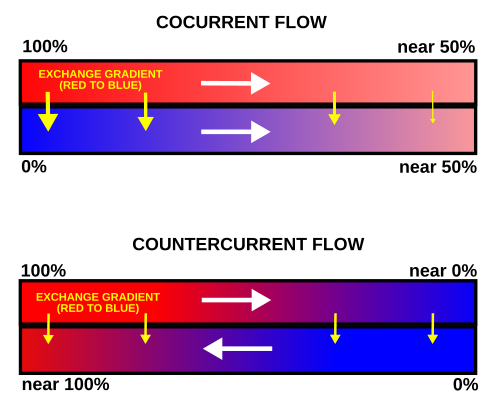
Gills - gas exchange in water, countercurrent exchange, maximises o2 diffusion
Tracheal System - system of air filled tubes (ducts), no circulatory system required
Lungs: Specialized structures for respiration in terrestrial vertebrates
regulation of breathing
Higher metabolic rate = more co2 in blood = lower ph of blood, triggers body to blow off co2 (panting)
increased metabolic activity → increase CO2. some CO2 dissolves in blood to beomce bicarb ions, some becomes to hemoglobin and some binds to plasma in its original gaseous form, this is the co2 that passes through the BBB and enters CSF where, as a result of fewer buffer proteins and a presence of water, it dissolves, releasing h+ ions. These H+ ions are detected immediately by chemoreceptors in the medulla (CSF coats medulla) and medulla triggers respiration to increase to blow off co2 and reduce aciditiy.
osmoregulation
osmoconfomer - Body fluids at equilibrium with surrounding seawater – isosmotic
osmoregulator - Control internal osmolarity independent of external environment
Can live in inhospitable or variable environments
Terrestrial vertebrates - must be osmoregulators.
Nitrogenous waste
Proteins + nucleic acids broken down for energy → nitrogenous waste
Deamination, removal of amino group generates ammonic (toxic)
Types of nitrogenous waste
Ammonia – highly soluble, low E required, but toxic
Urea – low toxicity, but higher E requirement and requires water to excrete
Uric acid – very high E requirement but insoluble and low toxicity