Ch. 3 AP Microeconomics (Interdependence and Gains from Trade)
0.0(0)
Studied by 3 people Call Kai
 Learn
Learn Practice Test
 Spaced Repetition
 Match
Match Flashcards
 Knowt Play
Card Sorting
1/13

Earn XP
Description and Tags
Last updated 6:59 PM on 9/16/22
Name | Mastery | Learn | Test | Matching | Spaced | Call with Kai |
|---|
No analytics yet
Send a link to your students to track their progress
14 Terms
1
New cards
WTO
The World Trade Organization - an international body that enforces agreements that reduce barriers to international trade; successor to the GATT, FOUNDED 1995.
2
New cards
Comparative Advantage
The ability of an individual, firm, or country to produce a good or service at a lower OPPORTUNITY COST(not inputs like absolute advantage) than other producers. Is way there is gains from trade. Reflects the relative opportunity cost.

3
New cards
International Trade
________________ __________ WILL make a country as a whole better off, but it can make some people or groups(special interests) worse off, which is why some people do not support it.
4
New cards
Interdependence
The mutual dependence of countries on goods, resources, and knowledge from other parts of the world, the current trend is points to an increasing amount of this through trade.

5
New cards
Absolute advantage
The ability of an individual, firm, or country to produce more of a good or service than competitors using the same amount of resources(inputs).

6
New cards
Consumption
If countries or individuals choose not to trade, then the production possibilities frontier becomes a _____________ possibilities frontier.
7
New cards
Specialization
When people, businesses, regions, and/or nations concentrate on goods and services that they can produce better than anyone else

8
New cards
Inverse
It is impossible for a person or country to have a comparative advantage in two goods when compared on the PPF, because the opportunity cost of one good will be the ______ of the other goods opportunity cost.
9
New cards
Trade
Benefits everyone in society because it allows people to specialize in activities in which they have a comparative advantage. However for both parties to benefit, the price at which they trade MUST lie between the two opportunity costs.

10
New cards
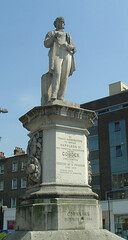
David Ricardo
English economist who argued that the laws of supply and demand should operate in a free market (1772-1823), and thoroughly developed comparative advantage in his book "Principles of Political Economy and Taxation".
11
New cards
Corn Laws
Passed in 1815 in England by gentry/squires who controlled parliament. Raised the tariffs on imported grain (which flooded market after Napoleonic Wars) in order to protect their own interests. Provoked demonstrations, riots and even an attack on the Prince Regent. The government responded by suspending habeas corpus, dealing harshly with suspects and employing spies to infiltrate mob. Repealed in 1846,Economist David Ricardo voted against this in principle.
12
New cards
Imports
Goods and services that are produced abroad and sold domestically

13
New cards
Exports
Goods produced domestically and sold abroad

14
New cards
NAFTA
A trade agreement between Canada, the United States and Mexico that encourages free trade between these North American countries.