Genetics Suicide Note
 Call Kai
 Learn
Learn Practice Test
 Spaced Repetition
 Match
Match Flashcards
 Knowt Play
1/143

There's no tags or description
Looks like no tags are added yet.
Name | Mastery | Learn | Test | Matching | Spaced | Call with Kai |
|---|
No analytics yet
Send a link to your students to track their progress
144 Terms
What binds to modified histones to stimulate or inhibit transcription?
Readers
E. coli lac operon control by lacI is
Negative Inducible
Proteins that affect the structure of DNA bound to histones without altering histone chemical structure are called:
Chromatin Remodeling Complexes
Which of the following processes is also known as RNA silencing or posttranscriptional gene silencing?
RNA Interference

Where would the lac repressor be bound in a (nonmutant) E. coli cell that is growing in low glucose and high
lactose? (I = lac repressor gene; Z, Y, A = lac operon structural genes; P = lac promoter; O = lac operator)
The Repressor would not be bound
The disorder xeroderma pigmentosum is associated with a defect in what type of DNA repair system?
Nucleotide-Excision Repair
Which of the following base changes in DNA is an example of a transition?
A to G
What type of genes are not regulated?
Constitutive Genes
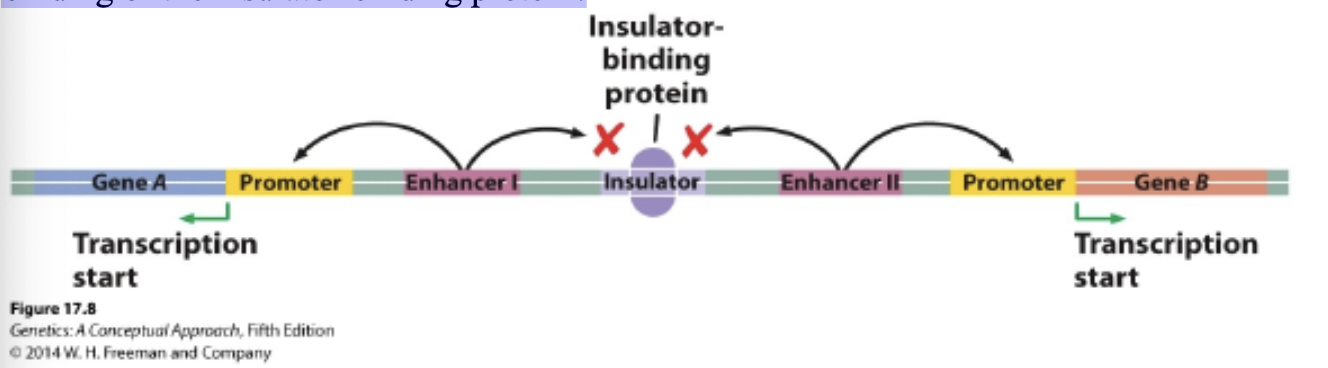
Given the following figure, what would be the effect of a mutation that occurred in the insulator that prevented the
binding of the insulator-binding protein?
Both enhancer 1 and enhancer 2 would be able to stimulate the transcription of Genes A and B
What turns on the transcription of a negative inducible operator?
An inducer
A mutant E. coli strain is found that synthesizes β-galactosidase in the absence of glucose whether or not lactose is
present. What two mutations might lead to this outcome?
Lac I- mutation or Lac Oc mutation
A Eukaryotic DNA Sequence that activates transcription at distant promoters is called a(n)
Enhancer
Which of the following types of Eukaryotic gene regulation take place at the level of DNA
Alternation of Chromatin Structure
Nonhomologous end joining repairs
Double-Strand breaks without using a homologous template
DNA-binding Proteins influence the ability of what to initiate what?
RNA Polymerase
Which of the following statements about somatic mutations is FALSE?
They may be inherited in the offspring of mutated individuals.
Which of the following statements about response elements is INCORRECT
A single eukaryotic gene is regulated by only one unique response element.
A boundary element is also known as a(n)
insulator
Which of the following statements about chromosome 9 open reading frame 72 (C9orf72) and its association with
amyotrophic lateral sclerosis (ALS) is FALSE?
Proteins translated from mRNAs with expanded GGGGCC repeats are primarily toxic to muscle cells.
What is responsible for induction of the lac operon?
allolactose
A mutation that changes a GC base pair to AT is a(n):
transition
Which of the following mutagens is MOST likely to cause a frameshift mutation?
intercalating agent
A _____ mutation changes a codon that specifies an amino acid into one that terminates translation.
nonsense
A scientist created transgenic C. elegans worms that expressed a gene that made the worms glow green under
fluorescent light. Then she injected double-stranded RNA complementary to this gene. Which of the following results
was MOST likely to be seen?
The worms were not able to glow green under fluorescent light.
A lac operon of genotype lacI+ lacP+ lacO+ lacZ+ lacY– will produce β-galactosidase but not permease when:
lactose is present.
Which of the following statements about chromatin-remodeling complexes is INCORRECT?
They can alter the chemical structure of histones.
Alternative splicing is known to be important in the regulation of the:
sexual development in Drosophila melanogaster
The _____ is a type of regulator protein that binds to a region of DNA in the promoter of a gene called the
operator and prevents transcription from taking place.
repressor
A lac operon of genotype lacI– lacP+ lacO+ lacZ+ lacY+ will produce β-galactosidase and permease when:
lactose is present or not
A mutant E. coli strain, grown under conditions that normally induce the lac operon, does not produce ß-
galactosidase. What is a possible genotype of the cells?
lacI+ lacP– lacO+ lacZ+ lacY+ lacA+
When siRNAs are present, the rate of mRNA degradation _____ and the rate of protein production _____.
increases; decreases
Suppose a scientist discovered a mutant strain of C. elegans worms that had lost the ability to regulate gene
expression via RNA interference mechanisms. Which of the following might she predict is a possible source of this
defect?
There is a mutation in the gene that encodes the Dicer enzyme that makes it nonfunctional.
The radiation levels caused by the atomic bomb explosions in Japan led to an increase in incidents of which
disease?
leukemia
Insulators can block the effects of enhancers only when they lie:
between an enhancer and a promoter
In a cell, which molecules are translated into proteins as initiation factors increase?
mRNAs
Which of the following enzymes represents a writer of histone modification?
Methyltransferases
During initiation of translation in bacteria
specific rRNA base pairs with a sequence in mRNA to position a ribosome at the start codon
Which enzyme is capable of degrading RNA in the 5′ → 3′ direction?
exonuclease
A ________is a complex structure consisting of several rRNA molecules and many proteins.
ribosome
When codons that code for the same amino acid differ in their _____, a single tRNA might bind both of them
through wobble base pairing
3’ base
suppose that some cells are grown in culture in the presence of radioactive nucleotides for many generations so that
both strands of every DNA molecule include radioactive nucleotides. The cells are then harvested and placed in new
medium with nucleotides that are not radioactive so that newly synthesized DNA will not be radioactive. What
proportion of DNA molecules will contain radioactivity after two rounds of replication?
1/2
What is the Shine–Dalgarno sequence?
a consensus sequence that is complementary to a sequence of nucleotides at the 3′ end of 16S rRNA
What term best describes codons that specify the same amino acid?
synonymous
Below is a list of steps in the processing of ribosomal RNAs. Please select the choice that lists the steps in the
CORRECT sequential order.
1. Methyl groups added to specific bases and the 2′-carbon atom of some ribose sugars
2. Transcription of the rRNA precursors from DNA
3. Cleavage of precursor rRNA
4. Individual rRNA molecules ready for ribosome assembly
5. Trimming of precursor rRNA
2,1,3,5,4
Which of the following nitrogenous bases is frequently modified enzymatically to become a rare type of
nitrogenous base in tRNA?
uracil
what would be a likely result of expressing telomerase in somatic cells?
cancer
_____ are tandemly repeated DNA sequences located at the ends of eukaryotic chromosomes.
Telomeres
What protein is key to the specificity between an amino acid and its tRNA?
aminoacyl-tRNA synthetase
Below is a list of steps of intron removal and splicing during pre-mRNA processing. Please select the choice that
lists the steps in the CORRECT sequential order.
1. Attachment of snRNP U1 to the 5′ splice site
2. Transcription of the DNA template into the pre-mRNA molecule
3. Release of lariat structure
4. Splicing together of exons
5. Transesterification reaction at the branch point adenine
2,1,5,3,4
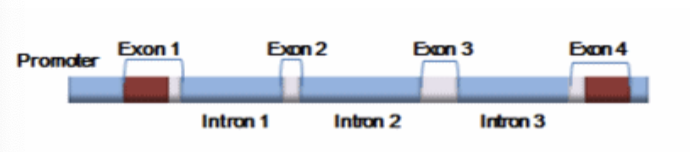
Given the figure below, within which of the following would the 5' untranslated region be located? The sequences
in red and light gray are included in the mature mRNA. The sequences in light gray make up the protein-coding
sequence of the gene.
exon 1
How many common amino acids are found in proteins?
20
DNA polymerases require all of the following for DNA replication EXCEPT
3′ to 5′ polymerase activity.
The _________ promoter is upstream of the core promoter.
regulatory
An in vitro transcription system that contains a bacterial gene does not initiate transcription. What is one possible
problem?
here is a mutation at –10, where a promoter consensus sequence is located.
What may be the consequence of a mutation in the gene that encodes eukaryotic Rat1 exonuclease for eukaryotic
transcription mediated by RNA polymerase II?
he transcription may not be properly terminated, and RNA polymerase II may not be released.
Which of the following is observed in prokaryotes but not in eukaryotes?
The 5' end of a prokaryotic mRNA can be translated while the 3' end is still being transcribed.

The diagram shown below is one half of a replication bubble. As the DNA template strands unwind toward the
right, new strands of DNA get synthesized. Which of the following represents a lagging strand?
B
Which of the following elements would NOT be found in an mRNA molecule?
promoter
Which one of the following statements is NOT true for all E. coli DNA polymerases?
They possess 5′ → 3′ exonuclease activity.
if the sequence of an RNA molecule is 5'–GGCAUCGACG–3', what is the sequence of the nontemplate strand of
DNA?
5'–GGCATCGACG–3'
Suppose a mutation occurred that prevented a eukaryotic pre-mRNA from receiving a 5' cap. What would be an
expected result?
Translation would not occur as the ribosome would not be able to bind to the mRNA.
Translating an mRNA requires two other types of RNA:
tRNA and rRNA.
Which of the following small RNA types is unique to prokaryotes?
crRNA
What kind of RNA molecule can be found in eukaryotes but not in bacteria?
pre-mRNA

Which process is illustrated in the diagram below?
transcription
Which of the following statements is FALSE regarding TFIID?
It is a transcriptional activator protein
Ribozymes are RNA molecules that
catalyze chemical reactions
Which of the following RNA molecules is required for the process of translation?
tRNA
If ribonucleotides were depleted from a cell during S phase, how would DNA synthesis be affected? (Ignore
energetic considerations.)
Replication would cease because ribonucleotides are required to initiate DNA synthesis.
___________ regulate transcription and can interact with the basal transcription apparatus at the core promoter.
Enhancers
In prokaryotic translation, what protein binds to the small subunit, preventing the large subunit from binding?
IF-3
Wild-type Arabidopsis has five chromosomes (2n = 10). Trisomic plants are designated as "Tr" followed by the
trisomic chromosome number—that is, Tr1 is trisomic for chromosome 1. Assuming that trisomy is fully viable and
that all possible pairing configurations (including nonpairing) are possible at meiosis, what proportion of the progeny
from the cross Tr1;Tr2 × Tr1;Tr2 will have a wild-type chromosomal complement?
1/81
While doing research on deep-sea vents, you discover a very simple new life form. After some initial analysis, you
find that this life form contains small fragments of DNA, small complementary RNA fragments, and proteins.
Fortuitously, you collected two strains, one that is purple and one that is yellow. You wish to discover which of those
three molecules could be the genetic material. The classic experiment of which of the following scientists would be
the MOST appropriate to mimic?
Avery, MacLeod, and McCarty
DNA strands grow in the 5′ to 3′ direction. This means that the _____ of an incoming nucleotide attaches to the
_____ of the growing strand.
5′ phosphate; 3′ hydroxyl
Which statement does NOT describe a difference between DNA and proteins?
DNA is located in the nucleus, whereas proteins are only located in the cytoplasm of cells
Which scenario generates nonviable products during meiosis?
ingle crossover in the inverted region in a cell heterozygous for a paracentric inversion
une has two brothers with Becker muscular dystrophy (BMD), an X-linked recessive condition that allows
affected males to survive into adulthood. Her parents are phenotypically normal. She marries Sheldon, who also has
BMD. June and Sheldon have a daughter. What is the probability that this daughter will have BMD?
1/4
Which term refers to mating between closely related people?
consanguinity
Which DNA modification is the addition of a –CH3 group?
methylation
Which of the following would NOT necessarily be true for a DNA molecule?
A + T = G + C
How does histone acetylation affect chromatin?
t loosens the chromatin and allows increased transcription.
Which statement is INCORRECT concerning an X-linked recessive trait in humans?
An affected woman almost always has an affected mother.
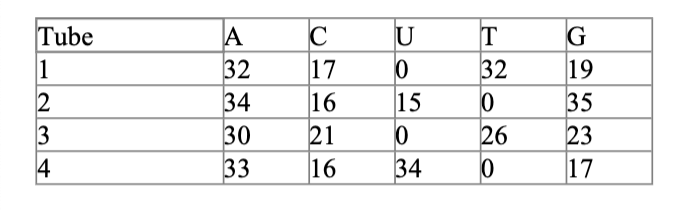
ou are a research assistant in a lab that studies nucleic acids. Your advisor gave you four tubes for analysis. Each
of these tubes differs in its contents by the source of its nucleic acids: mouse cytoplasm (single-stranded RNA), yeast
nuclei (double-stranded DNA), rotavirus (double-stranded RNA), and parvovirus (single-stranded DNA). The
approximate nucleotide base composition of each sample is given in the table below.
Tubes 1 and 3
Which of these sequences could form a hairpin?
5′-GGGGTTTTCCCC-3′
Enzyme X is an RNase, a molecule that breaks down RNA molecules. Enzyme Y is a DNase, an enzyme that
breaks down DNA molecules. Which of the choices describes a likely similarity between enzyme X and enzyme Y?
Both enzymes break phosphodiester bonds.
Most strains of cultivated bananas were created by crossing plants within and between two diploid species: Musa
acuminata (genome = AA) and Musa balbisiana (genome = BB). Some bananas have genome AAB, which is an
example of which kind of polyploidy?
allotriploid
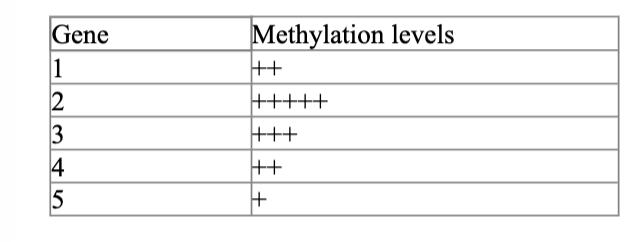
You are a researcher studying the genetic basis of colon cancer. You have been working with a colon cancer cell
line to determine the expression levels of different genes that might contribute to cancer formation. You obtain the
DNA methylation status of five genes of interest (the data are shown in the table below). The plus (+) sign indicates
the level of DNA methylation; more plus signs correlate with increased methylation levels.
gene 2
Why do telomeres in somatic cells shorten each time the cell divides?
DNA polymerases cannot replicate the ends of chromosomes.
Pedigrees showing the hypothetical human trait have the following characteristics:
- Only males are affected.
- Affected fathers always pass the trait to sons.
What is the MOST likely mode of inheritance for this disorder?
y-linked
Two chromosomes have the following segments, where · represents the centromere:
K L M · N O P Q R
S T U V · W X Y Z
What type of chromosome mutation would result in the following chromosomes?
K L M · N O P Q R
S T X Y U V · W X Y Z
displaced duplication
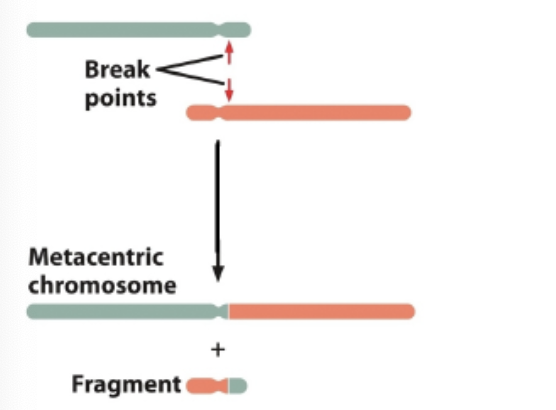
Which of the following is represented in the figure?
reciprocal translocation
Which of the following is attached to the 2′ carbon of a ribose sugar in an RNA molecule?
a hydroxyl group
Species I has 2n=18 and species II has 2n=22. How many chromosomes will be found in an autotetraploid of
species II?
44
Which of the following descriptions is NOT true of heterochromatin?
It makes up most chromosomal material and is where most transcription occurs.
What statement best describes supercoiling?
Supercoiling occurs when the DNA helix is subjected to strain.
How did Alfred Hershey and Martha Chase contribute to our understanding of DNA?
They found that the phosphorus-containing components are the genetic material of phages.
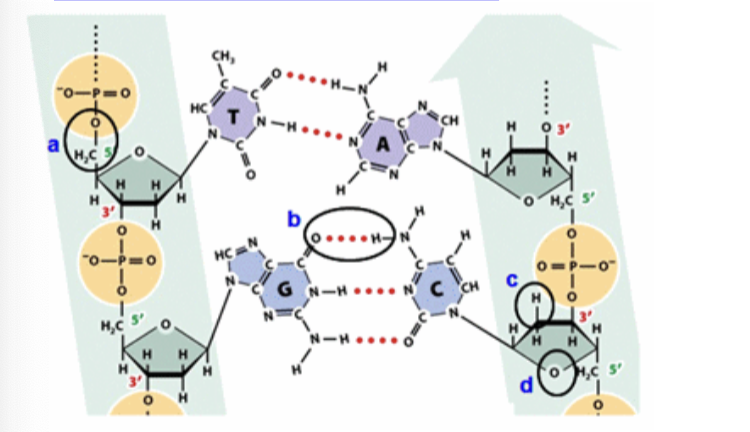
Which circle shows a noncovalent bond?
Circle B
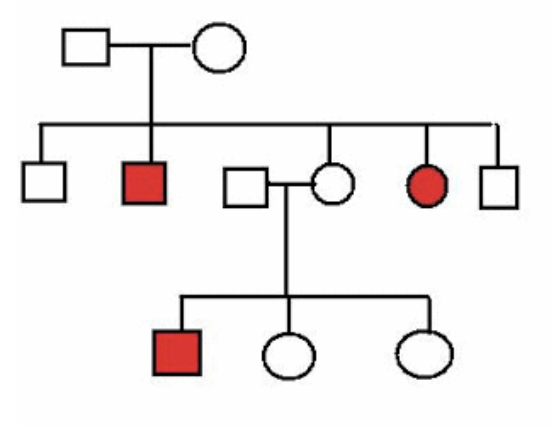
What is the MOST likely mode of inheritance for the trait segregating in the pedigree below?
Autosomal Recessive
How did Fred Griffith contribute to our understanding of DNA?
He discovered the "transforming principle" that could genetically alter bacteria.
The bonds that connect nucleotides in a single strand are called _____ bonds.
phosphodiester