Fire Exam 2
 Call Kai
 Learn
Learn Practice Test
 Spaced Repetition
 Match
Match Flashcards
 Knowt Play
1/252

There's no tags or description
Looks like no tags are added yet.
Name | Mastery | Learn | Test | Matching | Spaced | Call with Kai |
|---|
No analytics yet
Send a link to your students to track their progress
253 Terms
What are the 3 components of the fire triangle?
Heat
Fuel
Oxygen
What is fire?
Rapid exothermic combustion between a fuel and an oxidant that releases energy + byproducts
What is the current composition of Earths atmosphere?
78% Nitrogen
21% Oxygen
1% Other gasses
Historically, fires ignited due to ______ ______, primarily ______ and ___________ _________
Abiotic Factors
Lightning
Spontaneous Combustion
Initial heat to start a fire is _____
Ignition
What is actually burning in a fire?
Flammable gases
Sustaining fire is dependent on what 3 factors?
Weather
Topography
Fuel
Landscape fire patterns are determined by what 3 factors?
Climate
Ignitions
Vegetation
What does a blue flame indicate?
Complete combustion
What does a yellow flame indicate?
Incomplete combustion
What are the 5 phases of combustion?
Preignition
Ignition
Flaming Combustion
Glowing Combustion
Extinction
What is preignition?
Fuels must be a certain temperature to ignite, this varies by fuel types
What are the 3 phases of preignition?
Dehydration
Volatilization
Pyrolysis
What is Dehydration? (in regards to preignition)
Fuels must be dry enough to ignite
What is volatilization?
Conversion of waxes/oils to vapor
What is pyrolysis?
Thermal degradation to volatile gases, semi-volatile tar, and solid char
What does white smoke indicate?
Water Vapor
Green fuels
What does black smoke indicate?
Volatile fire
Heavy fuels not fully consumed
Sometimes manmade materials
What does gray smoke indicate?
Fire winding down
Smoldering
What is required for ignition?
Initial heat
T/F: a spreading fire is a series of smaller ignitions
True (technically)
What does ignition temp vary by?
Fuel moisture
Fuel Type
Relative concentration of fuel and oxygen
What are the primary volatile compounds in wildland fires?
Terpenoids
What highly influences time to ignition?
Fuel moisture
What is flaming combustion?
The active flaming stage, where oils are volatized & burned
What is an example of a green fuel that can significantly contribute to flaming combustion?
Gallberry
Palmetto
Wax Myrtle
What is glowing combustion?
After volatile oils are consumed, solids begin to burn
What are the 2 primary soilids in wildland fuels?
Cellulose & lignin
What is the complete combustion formula for cellulose?
6CO2 + 6H2O + ignition heat → C6H12O6 + 6O2 + Heat
T/F: Fire often results in complete combustion
False (INcomplete combustion)
Why does fire often results in incomplete combustion?
Lignin & cellulose are not glucose
Secondary compounds do not have same ignition temp
What are some additional byproducts that are created by incomplete combustion?
Unburned hydrocarbons
Carbon monoxide
Particulates
Mineral (or ash) content
What emissions from prescribed fire are particularly dangerous to human health?
Carbon Monoxide (CO)
PM < 2.5
Where on the fire line poses the most risk for carbon monoxide poisoning? (According to Dr. Lane)
Idling on the UTV
What is smoldering?
A type of combustion that occurs at low temperatures, often with wet or subterranean fuels or following a surface fire
What is extinction? (In regards to fire, not the ESA)
The termination of combustion
What are several factors that extinction relies upon?
Fuel limitations
Insufficient Oxygen
Insufficient heat to sustain process
What is a head fire?
Fire burning with the wind
Why are head fires so volatile? (HINT: what are they doing to unburned fuels?)
Preheating
What is a backing fire?
Fire burning against the wind?
How do underground fires start?
Either through soils (peat) or with tree stumps
What can you do to extinguish underground fires?
Nothing
What is Heat? (not the 1995 Robert DeNiro movie)
Energy movement as a result of temperature differences
How is heat generated
By chemical processes
What are the 3 ways heat can be transferred?
Conduction
Convection
Radiation
What is conduction?
Movement from one part of fuel to another
What is convection?
Transfer of heat by movement of a gas or liquid
What is radiation?
Heat movement through waves traveling at the speed of light
What does heated air do?
Rises
T/F Conduction is important for upward movement of heat
False (downward movement)
T/F: Cellulose is a very poor conductor of heat
True
What commonly dehydrates and preheats fuels?
Radiation (usually from the sun)
What is residence time?
How long flaming front stays in one place
What are the four primary characteristics that describe fuels?
Fuel Type
Fuel Arrangement
Fuel Size & Moisture
Fuel Load & Duff Conditions
What is fuel type?
Refers to the different sizes of live or dead vegetation arranged on the ground
What are the 2 broad fuel types?
Light & Heavy
What are light fuels? (Fine Fuels)
Any fuel with a diameter </= 1”
T/F: Fine Fuels have a high surface area to volume ratio
True
A high surface area to volume ratio means that fine fuels have/are: (I hope i worded this good enough)
Quicker drying
Quicker dehydration during preignition
Lower ignition temperature
Easily extinguished after rapidly spreading fires with little residual smoke
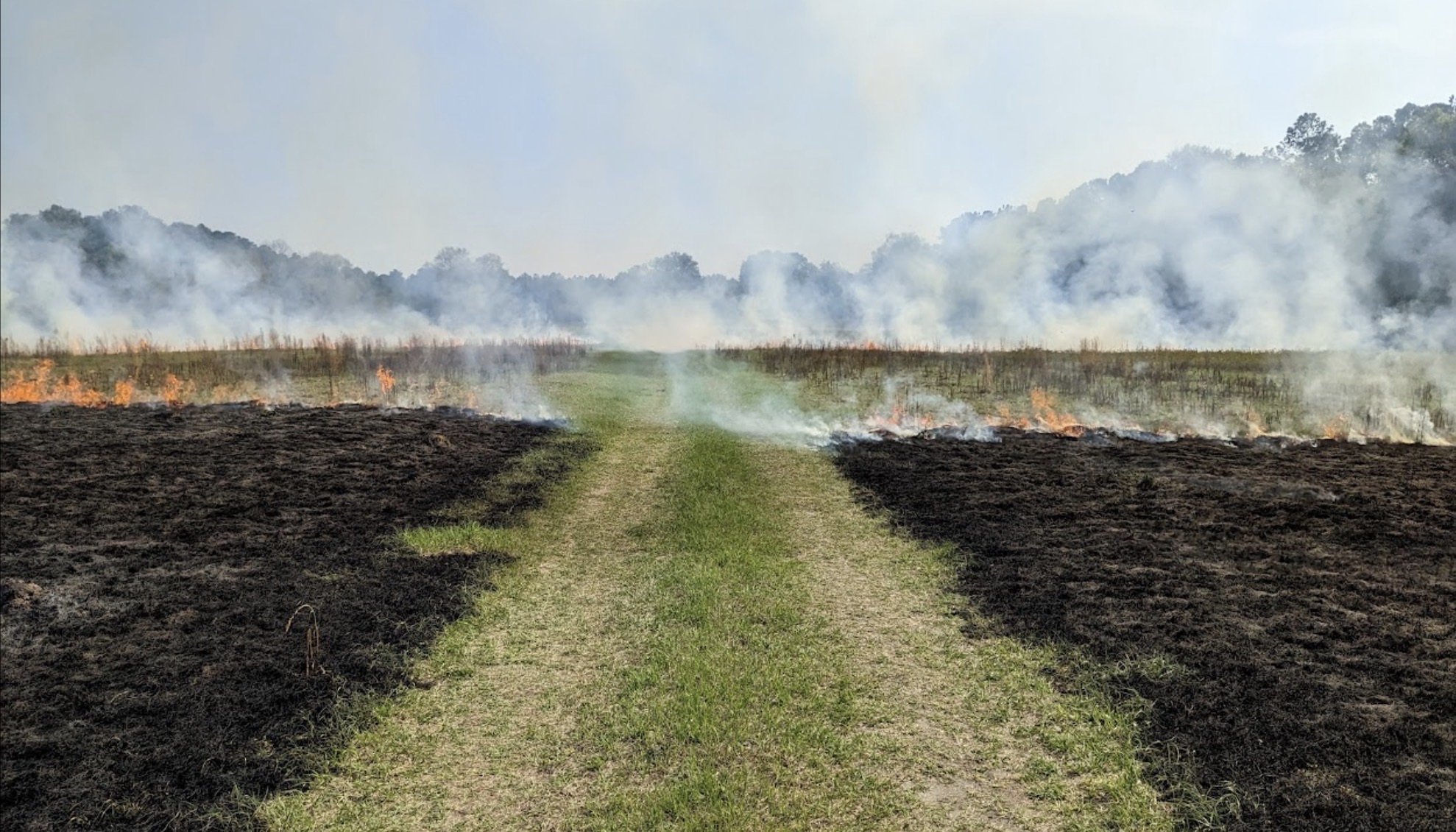
Whats a factor that matters with light fuels? (HINT: see picture)
Compaction
What are heavy fuels?
Fuels >/= 1” Diameter
What is an issue that is caused by heavy fuels?
Smoldering
T/F: Cool season burns produce more smoke than warm season burns
False (flipped)
What does KBDI stand for?
Keetch-Byram Drought Index
Dead fuel moisture is assessed using ______
Timelag
How big is a 1 Hour fuel?
< 0.25” in diameter
How big is a 10 Hour fuel?
0.25-1” in diameter
How big is a 100-hour fuel?
1-3” in diameter
How big is a 1000 hour fuel?
3->8” in diameter
What has a huge effect on 1 hour fuel moisture?
Relative Humidity
If your RH is < _____ avoid burning
30%
RH is naturally at lowest between what hours?
1-3 pm
What is percent fuel moisture?
How much moisture fuels can hold
What is the recommended fuel moisture to avoid burning 100/1000 hr fuels?
17%
What is moisture of extinction?
Fuel moisture content at which a fire will not spread, spreads only sporadically, and in a non predictable manner
What is fuel arrangement?
How the fuels are arranged horizontally & vertically
2 main categories of horizontal fuel
Patchy
Continuous
What the minimum size for a fire break?
No smaller than 1 ½ x flame length; 3 ft min
What are the 4 main categories of vertical fuels?
Ground fuels
Surface fuels
Ladder fuels
Aerial or canopy fuels
What are ground fuels?
Below surface litter, includes duff, peat, roots, etc.
What are surface fuels?
All combustibles on or near the surface
What are Ladder fuels?
Create a continuity between surface and canopy, allowing fire to carry into tree crown relatively easily
What are Aerial or Canopy fuels?
Tree canopy, including branches, twigs, needles, etc.
What is fuel loading?
The quantity of fuels in an area, represented most commonly by tons/acre
What does Rough mean?
Years since last burn
You receive a call from John Landowner asking you to burn his stand. He says that it has a 5 year rough, what does that mean?
5 years since last burn
What 2 ways is fuel loading measured?
Direct measurement via sampling
Estimation via photo comparisons
Fuel loading & continuity can be directly measured using the _________ ________ method
Planar intercept
What is a major challenge you will encounter in roughs >5 years?
Duff
What is duff? (We didn’t go over the definition in class, but still good to know)
Decaying forest floor litter
Major challenges duff presents
Smoldering/smoke issues
Tree death if feeder roots get burned
What might a burn be considered if substantial duff is present?
Restoration or first entry
To avoid burning duff, 3 steps should be followed prior to a burn
Know the last day of rain
Know current drought conditions
Know current moisture level of duff in stand
T/F: after a hurricane, the KBDI will be around 800
False (800 is death valley dry)
What do restoration burns aim to remove?
½ - 1” of duff
_____ is the key factor for determining what will burn
Moisture
2 major drivers in wind
Temperature gradients between equator & poles
Earth’s spin
What is the Coriolis effect?
Wind travels east/west on the equator because it has to travel farther than the poles
T/F: North America is affected by Westerlies
True
Southeast weather is affected by the _____
ENSO = El Niño-Southern Oscillation Cycle