Physics unit 2 Waves and Electricity definitions
 Call Kai
 Learn
Learn Practice Test
 Spaced Repetition
 Match
Match Flashcards
 Knowt Play
1/69

Earn XP
Description and Tags
Name | Mastery | Learn | Test | Matching | Spaced | Call with Kai | Chat |
|---|
No analytics yet
Send a link to your students to track their progress
70 Terms
Ampere
the unit of measurement of electric current one amphere(1A) is the movement of one coulomb(1C) oc change per seconds(1s)
Amplitude
The magnitude of the maxiumum displacement reached by an oscillation in the wave
Antinodes
Regions on a stationary wave where the amplitude of the oscillation is at its maximum
Charge
A fundmental property of some particles ot is the ccause of the elctromagnetc force and it is a basic aspect of decribing electrical effects
coherence
Waves which must have the same frequency and a constant phase relationship. (Coherent waves are needed to form a sta le standing wave)
Compression
an area in a longitudinal wave in which the particle oscillations put them closer to eachother than their equilibrium state
conduction band
A range of energy amounts that electrons in a solid material can have which delocalses them to move freel through the solid
constructive interference
The superposition effect of two waves that are in phase producing a larger amplitude resultant wave
Coulomb C
The unit of measurement for charge one coulomb is the quantity of charge that passes a point in a conductor per second when one ampere of current is flowing in the conductor
Charge of an electron
-1.6×10⁻¹⁹C
Critical angle
The larges angle of incidence that a ray in a more optically dense medium can have and still emerge into less dense medium. Beyond this angle the ay will be totally inernally reflected
Current
The rate of flow of charge
Destructie interference
The superposition effect of two waves that are out of phase producing a smaller amplitude
Diffrction
When a wave passes close by an object or through a gap the wave energy spreads out
Displacement
The position of a particular point on a wave at a particular instant in time measure form the mean(equilibrium) position
Drift velocity
the slow overall movement of the charges in a current
Electric current rule
The sum of current entering a junction is wqual to 0
EMF
A voltage wit the energy coming into the circuit
Electronvolt (Ev)
1Ev=1.6×10⁻¹⁹J
Excitation
An energy stat for a system that is higher energy than the ground state.
Frequency
The number of complete wave cycles per second
Ground state
The lowest energy level for a system
Interference
The superposition outcome of a combination of waves. Interference only occurs when the waves are coherent
Ionisation Energy
The minimum energy required by an electron in an atom’s ground state in order to remove the electron completely from the atom
Line spectrum
A series of individual lines of colour showing the frequency present in a light source
Longitudinal wave
A wave in which the oscillations occur parallel to the direction of movement of the wave energy
Maxiumum
In a diffraction or interference patter: The bright spots
Minimum
In a diffraction or interference patter: The dark spots
Monochromatic
Containing or using one colour/light of a single wavelength/frequency
Nodes
Regions on a staionary wave where the amplitude of oscillation is 0
Ohm’s Law
The current through a component is directly proportional to the voltage across it, providing the temperature and resistance remain the same.
Time Period
The time taken for one complete oscillation at one point on the wave
Phase
The stage a given point on a wave is through a complete cycle, measured in radians
Photoelectrons
Electrons released from a metal surface as a result of its exposure to electromagnetic radiation
Photons
Packets of electromagnetic radiation energy
Photon energy
E=hf
Phlank’s Constant
6.63 × 10⁻³⁴
Polarisation
The 0orientation of the plane of oscillation of a transverse wave. If the wave is polarised, all its oscillations occur in one single plane
Potential difference
The voltage of a component that is using electrical energy in a circuit and transfer this energy to other stores
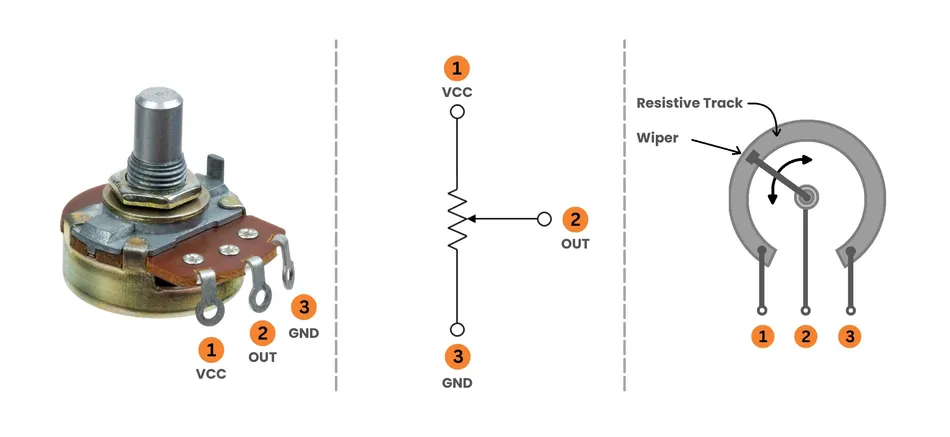
Potential divider
A circuit designed to provide specific voltage value by splitting an emf across two resistor
Potentiometer
A version of the potential divider in which a single resistance wire is used in two parts to form the two resistances. A sliding connection on the wire can be adjusted to alter the comparative resistances and thus alter the output pd from the potentiometer
Progressive wave
A means for transferring energy via oscillation
Rarefaction
an area in a longitudinal wave in which the particle oscillations put them further apart from each other than their equilibrium state
Refraction
A cange in wave speed and direction when the wave moves from one medium to another
Refractive index
n=c/v
Resistanc
The opposition to the flow of electrical current
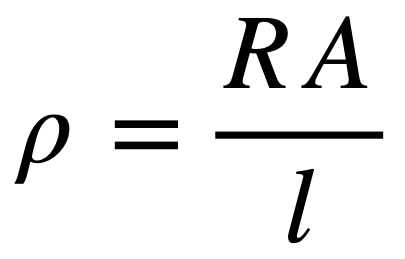
Resistivity(ρ)
RA/l
Semiconductors
Materials with lover resistivity than insulator but higher than conductors. Thy usually have small number of delocalised electrons that are free to conduct
Snell’s law
n1sin(θ)1=n2sin(θ)2
Sonometer
An apparatus for experimenting with the frequency relationships of a string under tension usually consisting of a horizontal wooden sounding box and a metal wire stretched along the top of the box
Stationary/Standing wave
A wave which has oscillations in a fixed space with regions of significant oscillation and regions with zero oscillation, which remain in the same location at all times(nodes and anitnodes)
Stopping voltage
The minimum voltage needed to reduce the photoelectric current to 0 when illuminated with a particular frequency of ligh
superconductivity
The electrical property of a material having 0 resistivity
Superposition
when more than one wave is in the same location the overall effect is the vector sum of their individual displacements at each point where they meet
Threshold frenquency
The minimum frequency of electromagnetic radiation that can cause the emission of photoelectron from a metal
TIR
Waves reflect back into the same medium at a boundary between two media. This requires to conditions to be met:
the rays is attempting o emerge from the more dense medium
i>c
Transport equation
I=nAvq
I is current
n is number density
A is cross sectional area of the conductor
v is the drift velocity
q is the charge of all the carriers combined
Transverse Wave
A wave in which the oscillations occur perpendicular to the direction of movement of tthe wave energy
Twin-beam oscillscope
An oscilloscope with two inputs. It displays each as a li9ne on the screen and both are shown at the same time to compare inputs
Valence Band
A range of energy amounts that electrons in a solid material can have which keeps them close to one particular atom
Voltage
A measure of the amount of energy a component transfers per unit of charge passing though it
Voltage circuit rule
the sum of emfs equals to the sums of pds
Wave
a means for transferring energy via oscillations
Wave equation
v=fλ
Wave speed
The rate of movement of the wave
Wavefronts
Lines connection points on the wave that are at exactly the same phase position
Wavelength
The distance between a point on a wave and the same point on the next cycle of the wave
Wave=particle duality
The principle that the behaviour of electromagnetic radiation can be described in terms of both waves and photons
Work function
The minimum energy need by an election at the surrface of a metal to be emitted from it