PSY252 - Sensation/Perception Study Guide
 Call Kai
 Learn
Learn Practice Test
 Spaced Repetition
 Match
Match Flashcards
 Knowt Play
1/43

There's no tags or description
Looks like no tags are added yet.
Name | Mastery | Learn | Test | Matching | Spaced | Call with Kai |
|---|
No analytics yet
Send a link to your students to track their progress
44 Terms
Absorption of energy by sensory organs and the conversion of energy into an electrical signal used by the nervous system
Sensation
Translating sensory input into something meaningful
Perception
Hearing a loud crashing noise from the sky, interpreting that as thunder.
Example of sensation & perception
Receptors convert physical signals into neural responses (electrical signals)
Conversion transduction
Perception is a mirror that reflects the world perfectly
False (actually an interpretation of info in the world)
Wavelengths posses color themselves
False
Distance over which an electromagnetic wave repeats peaks
Wavelength
When we look at the world, we are demonstrating controlled hallucinating
True
Perceptions are heavily influenced by expectations from prior experiences and stored knowledge
True
A physicist who proposed the mind could be studied by examining the relationship between physical stimulation and a person’s experience.
Gustav Fechner
Study of quantitative relationship between physical stimuli and the sensations they produce
Psychophysics
Smallest intensity that can be detected
Absolute threshold
Why do identification tasks measure reaction time, instead of accuracy?
Accuracy has a ceiling effect (100% correct) so not effective
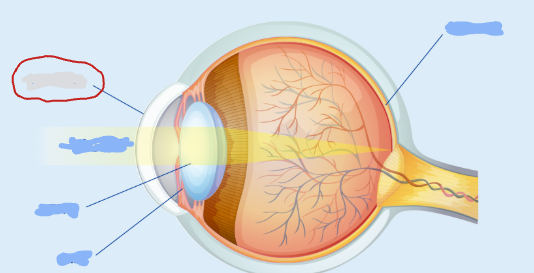
Cornea (rigid layer refracts light also filters against bacteria/injury)
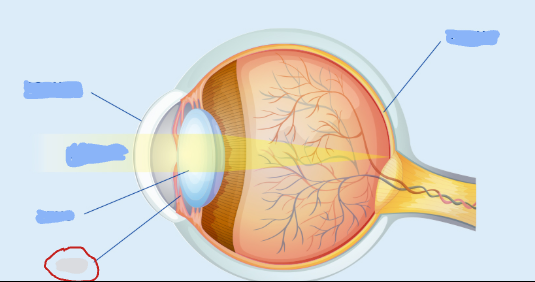
Iris (regulates amount of light that enters by adjusting the pupil
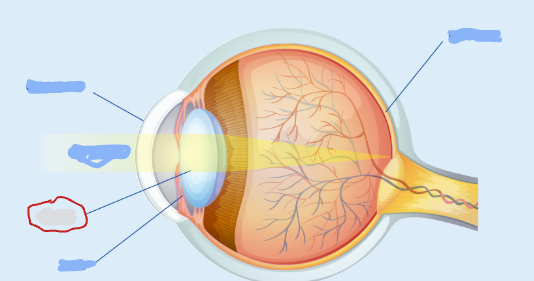
Lens (adjusts focus by changing curvature)
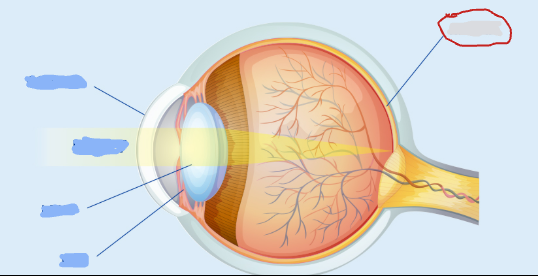
Retina (in back of the eye, visualreceptors: cones for detail/color, rods for low light)
Close objects are seen clearly, further objects are seen blurry
Nearsightedness
Distant objects seen clearly, close objects seen blurry
Farsightedness
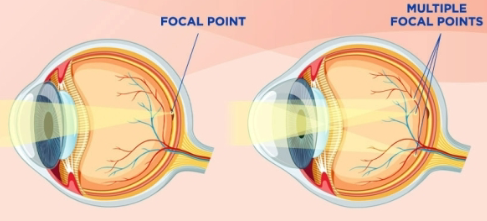
Cornea or lens has an uneven curvature and uneven light curvature
Astigmatism
Hole in retina where axons leave, blood vessels enter
Optic disc (blind spot)
Characteristics of rods
100 million
100x more sensitive
Improves sight in low lighting
Peripheral
Characteristics of cones
6 million
Color/ detail
Center of retina
Neurons that process visual information and transmit to the brain via optic nerve
Ganglion cells
Pattern of light that produces a neutral response in a cell
Receptive field
ganglion cells respond more when light falls in the center, and less in the surround
center surround arrangement
X-shaped structure where optic nerves cross for depth perception and peripherals
Optic chasm
Signals from right visual field go to the left hemisphere
Contralateral organization
Hubel and Wiesel (1962)
Discovered neurons in the PVC have specialized receptive fields and when stimulated, changes a neuron’s firing rate
Kanwisher (1997)
Used FMRI to examine brain activity in faces vs. objects (more activity for faces)
Also lines and edges at specific orientations
Suggests humans see 3D objects by breaking them down into basic shapes called “geons”
Recognition-by-components theory
mental predisposition to perceive stimuli in a certain way based on expectations, experiences, culture, etc.
Perceptual set (top-down processing)
Tendency to have the same perception even when features are changing
Perceptual constancy
Bottom-up processing
Slower analysis of details (more cognition)
6 gestalt principles
Proximity (objects close perceived as together)
Similarity
Closure (brain fills in missing info for incomplete objects)
Simplicity (prefer simplest form)
Good continuation (preference for flowing lines)
Common fate (synchronization)
Morton & Johnson (1991)
Discovered newborns preferred formed faces over disfigured ones or blank faces
Phenomenon where distinct stimuli is instantly detected among various subtle stimuli
Pop-out effect (for upright faces)
Tendency to perceive faces as wholes rather than separate parts
Holistic processing
Arrangement/distance of facial features
Configural information
Localized facial features appear normal when inverted, but appear off when face is turned upright
Thatcher effect
Individuals have difficulty recognizing faces of familiar people
Prosopagnosia