L1 - Introduction
 Call Kai
 Learn
Learn Practice Test
 Spaced Repetition
 Match
Match Flashcards
 Knowt Play
1/36

Earn XP
Description and Tags
Lecture + Textbook Chapter(s) 2 & 4
Name | Mastery | Learn | Test | Matching | Spaced | Call with Kai |
|---|
No analytics yet
Send a link to your students to track their progress
37 Terms
Neuropsychology
A branch of psychology that studies the relationship between the brain’s physical structures and processes, and human behavior, emotions, and cognition.
Working Domains of Neuropsychologists
Hospitals (Most Common)
Mental health care (GGZ) (Most Common)
Rehabilitation centres
Forensic institutions
Residential or nursing homes
Specialized institutions (e.g., centers for epilepsy or visual impairments)
Other
Subtraction Method
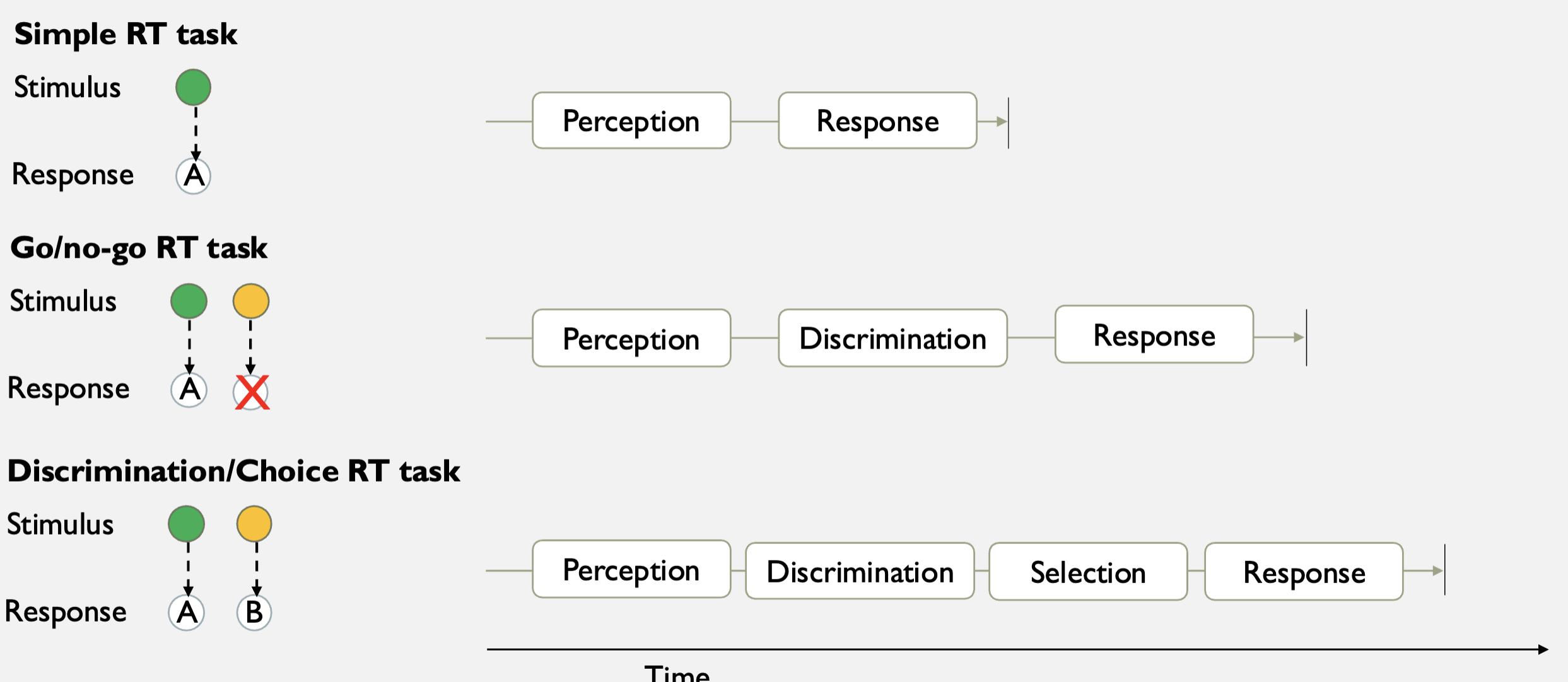
Use of mental chronometry. Basically, they measure the reaction time to a response. Then they measure the reaction time to a response with something like discrimination and/or selection. They then subtract the normal reaction time to a response from the discrimination and/or selection to measure the cognitive process speed of discrimination and/or selection.
Mental Chronometry
The scientific study of reaction time (RT) to infer the speed, duration, and nature of cognitive processes, including perception, memory, and decision-making. Involves the reaction time paradigm and pure insertions.
Reaction Time Paradigm
The use of reaction times to evaluate cognitive processes.
Pure insertions
A single cognitive process can be inserted into a task without affecting the duration of other processes.
Subtraction Method Criticisms (2!)
Fallacies of pure insertion: attention, memory, etc. (Solution → Include multiple tasks).
Limited ecological validity: gap between everyday life and in a lab (Solution → VR/AR, Add Questionnaires + Observations)
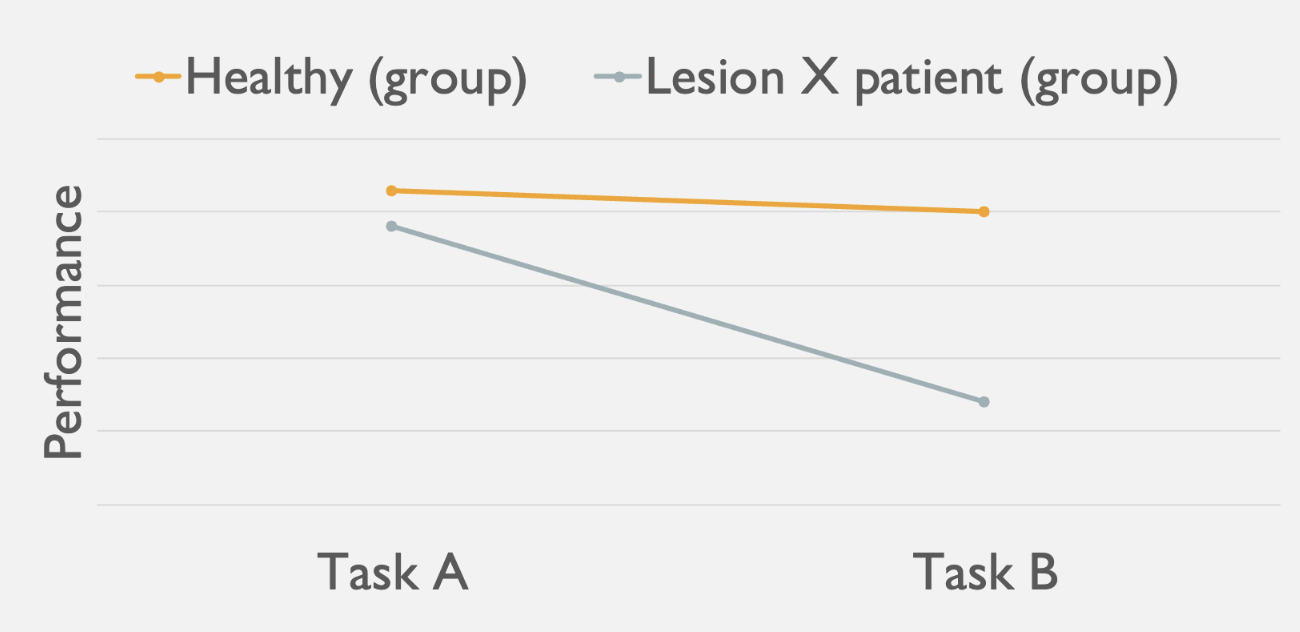
Single Dissociation
Double Dissociation
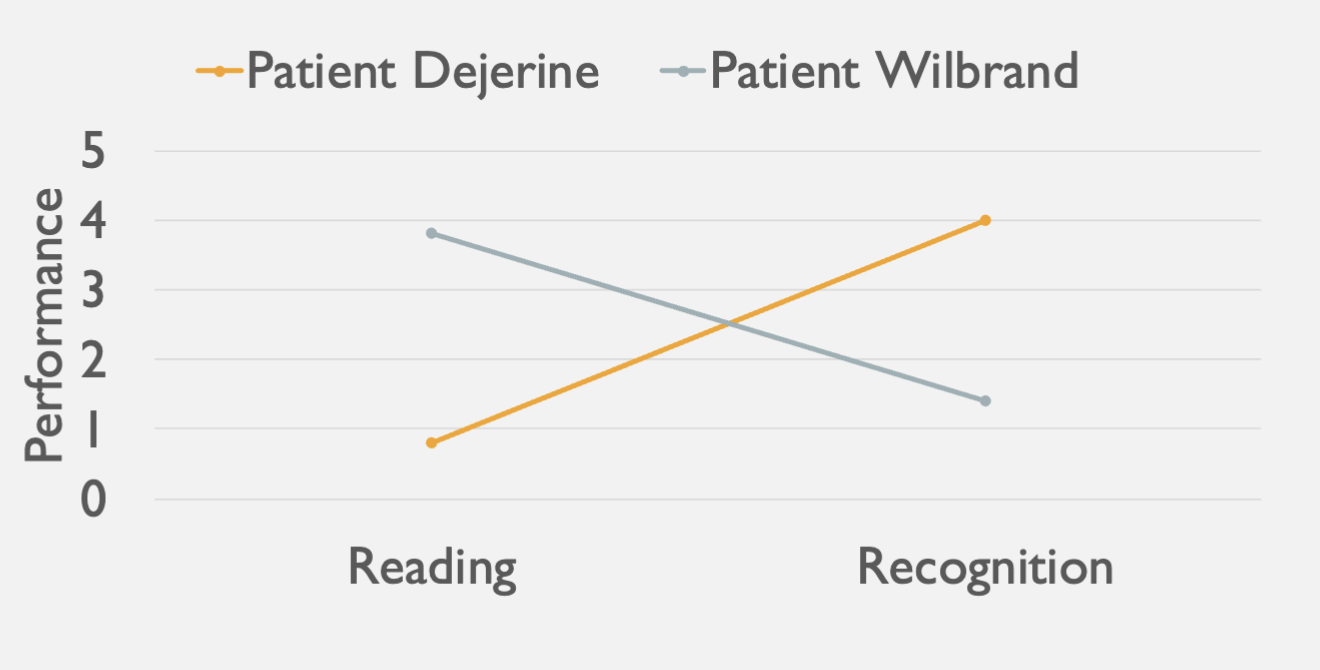
Demonstrates that two (more or less) independent cognitive processes rely on different brain regions or mechanisms (= parallel organization).
However: Even a single, unified neural network can sometimes behave like it has separate systems. So, if two patients show a double dissociation that doesn't automatically mean their brains have two separate, independent modules. A single system can still produce that pattern.
Normal Range of Performance is What?
It falls between - and + 2 Standard Deviation (SD)
Interpretation of Dissociation
Scores on one task should significantly fall above or below the average of the normative group (more than -/+ 2SD).
The differences between the performances on task A and B differ significantly from each other.
2 Types of Imaging Techniques
Structural (CT, MRI → DTI, VBM, MRS)
Functional (fMRI, PET, EEG, ERP, MEG)
2 Types of Resolutions
Temporal Resolution → Speed of the recording.
Spatial Resolution → Sharpness of the image.
Computerized Tomography (CT)
Advantages:
High Spatial Resolution
Produces slices of the brain (X-Ray Images).
Cheap and quick.
Low Temporal Resolution.
Disadvantages:
Subtle Abnormalities are.
Harmful to children and unborn babies.
Workings:
Damages processes in the brain produce more water, making the image darker in those areas. Blood and calcium are white in the image.
Radiological Contrast Agent
It is a substance introduced into the body to enhance the visibility of internal structures, tissues, or fluids during imaging tests.
Magnetic Resonance Imaging (MRI)
Advantages:
High Spatial Resolution
MRI distinguishes between gray and white matter (CT does not).
Disadvantages:
High Cost
Time Consuming
Claustrophobia
Workings:
Basically, water molecules are in the brain: the magnet aligns the water molecules then disrupts them and measures the energy released when they realign to create the image.
Functional Magnetic Resonance Imaging (fMRI)
Advantages & Disadvantages of fMRI are basically the same as MRIs..
Workings:
Super large magnet goes around you and measures Blood-Oxygenated Level Dependent (BOLD) → measures ratio between blood-poor and blood-rich hemoglobin.
Increased activity in brain areas = higher levels of blood!
Electroencephalography (EEG)
Advantages:
Very safe!
High temporal resolution.
Cheap & quick!
Disadvantages:
Only measures top level activity, not deeper.
Workings
Measures electrical activity produced by the brain cells.
Positron Emission Tomography (PET)
Advantages:
Good for medicine.
Disadvantages:
High cost
Radiation
Workings
Measures electrical activity produced by the brain cells.
EEG Brain Waves (DTABG)
Delta → Deep Sleep
Theta → Drowsiness, Light Sleep
Alpha → Relaxed, Calm
Beta → Alert, Focused
Gamma → High-Level Attention
Empirical Cycle Steps (OIDTE)
Observation → Induction → Deduction → Testing → Evaluation
Ratio Score
A score which indicates how the more complex condition relates to the simple condition.
Practice Effects
The occurrence of improvement in performance with repetition of tasks.
Types of Research
Observational/Descriptive, Correlational, (Quasi-) Experimental.
Meta-Analysis, Literature & Systematic Review
Literature Review → research question is answered by summarising previous find-
ings.
Systematic Review → Criteria are defined in advance about which studies
will be included in the review and all research articles that meet these criteria
are included.
Meta-Analysis → Data from previous studies are combined and dedicated analysis
software can be used to statistically test whether the various findings correspond
with or contradict each other.
Intention-To-Treat Analysis
Analysing the groups as they were assigned at the start.
Cross-Over Design
A crossover design is a type of RCT.
In crossover designs, participants receive not one but several interventions, and the effect of the interventions is compared within participants.
The AB/BA design is the simplest example of a cross-over design
Multiple-Baseline Design
Multiple-baseline design is taking several baseline measurements to determine what the baseline is and/or how recovery is progressing.
Longitudinal
A cohort study is a longitudinal study in which a specific group of people ( cohort) is followed for a longer period of time, often several years.
Cross-Sectional Design
Measurements are made at one point in time. This allows, for example, a look at the prevalence of a particular disease.
It also allows the study of people of different ages or people who are at different times in the disease progression, without any test-retest effects. However, cross-sectional research is correlational….
Case Studies
In case studies, one person (single-case-study) or several people (case-series) are thoroughly studied.
The purpose of a case study is not to obtain results that are directly generalisable, but to collect data about unique individuals or groups.
Heterogeneity & Homogeneity
Heterogeneity → When something has a variety.
Sometimes you need a sample that has many varied features in order to generalise - this also depends on the research question.
Sometimes you may want homogeneity → when something is not varied.
Open Science & Errors
All about transparent and accessible research!
The aim of open science is to improve the quality of scientific research, for example by evaluating the reproducibility and replicability of findings.
Open science also involves reporting null findings.
Preregistration.
Type 1 Error → False Positive
Type 2 Error → False Negative
PICO Method
People, Intervention, Control, Outcome.
Two types of neuropsychological research
Fundamental neuropsychological research
Clinically oriented neuropsychological research
Fundamental Research
Focuses on understanding the cognitive disorders/processes and related brain structures.
Clinically Oriented Research
Focuses on improving the assessment and treatment of brain disorders.