All Topics Design
 Call Kai
 Learn
Learn Practice Test
 Spaced Repetition
 Match
Match Flashcards
 Knowt Play
1/338

There's no tags or description
Looks like no tags are added yet.
Name | Mastery | Learn | Test | Matching | Spaced | Call with Kai |
|---|
No analytics yet
Send a link to your students to track their progress
339 Terms
Conflict and compromise
The development of new products often require a multidisciplinary team including designers, engineers, and manufacturers. These different actors often have different priorities when developing a product and this can often lead to conflict. In order to achieve the goals of creating the new product, the different team members must often compromise.
Culture
In the context of classic design, culture plays an important part. They often reflect cultural influences and mark transition points within a particular culture. The culture of concern may be national, religious or a sub-culture, such as a particular youth culture or movement.
Design classic
A product that serves as a standard of its time, that has been manufactured industrially and has timeless appeal.
Dominant design
The design contains those implicit features of a product that are recognized as essential by a majority of manufacturers and purchasers.
Form
Also considered as the three-dimensional space that a product takes up, in the context of classic design, form relates to the shape of a product and the aesthetic qualities that the shape gives.
Function
Products can be considered classic designs based on how well they fulfil the task that they have been designed for.
Image
Within the context of classic design, image relates to the instantly recognizable aesthetics of a particular product. For example, the shape of a Coca-Cola bottle, or the shape of a Volkswagen Beetle motor car.
Obsolescence
This is the stage in a product life cycle where the product is no longer needed even though it functions as well as it did when first manufactured. Classic designs tend to transcend obsolescence and become desired objects long after they have ceased to be manufactured.
Omnipresence
In the context of classic design, a product that is omnipresent has existed and been in circulation for a long time.
Retro-styling
A design that uses the form and decoration from a particular period of time and/or style.
Status
Products considered as classic designs often increase in value and can project a certain status as they become more desirable. The ownership of a classic design can increase the perceived status of an individual.
Ubiquitous
In the context of classic design, a product that is ubiquitous is one that can be found almost everywhere. For example, a mobile phone.
Classic design
A classic design is an industrially manufactured object with timeless appeal. It serves as a standard of its time and remains relevant to future generations and has an lasting impact on society.
Iconic
The longevity of classic designs suggest quality and the continued demand for such products is not dependent on heavy marketing.
21st century
The design is often widely imitated, usually with cheaper versions. This way it reinforces the status of the original design and its 'pioneering' concept.
Design classics are usually innovative in the use of materials and technology with beautiful designs.
Change from classic designs:
Once mass production techniques became more established designers embraced the opportunities as a way of providing people with well-designed products at a affordable price. No longer was classic design preferred by the society.
Image
Image is the general impression that a person, organization or products presents to the public.
- Aesthetically pleasing objects appear to the user to be more effective, by virtue of their sensual appeal.
- Making you emotionally attached can create a feeling that the objects functional affectively.
Status & Culture
Classic designs are often recognised across culture and hold iconic status. Like movie stars, designed objects carry a similar visual power.
we are drawn to them for their beauty and distinct features.
Obsolescence
No longer produced or date, because the product is out of data.
When this happens, the resale value of existing products increase drastically as the number of product available lessens over time.
Some products are considered classic design...
...based on the quality of execution, enduring qualities and restraint.
Iconic Status depends on...
- dominant position in the market
- aesthetic qualities
- its desirability
Planned obsolescence:
This is when product is deliberately designed to have a specific product cycle.
These products is designed to convince the customers that the product is a quality product, even though it needs replacement.
Obsolescence can be determined by fashion, technology, materials and construction techniques.
Mass Production
Mass production involves the bulk manufacturing of products that have little or no customisation. The set of cost for mass production are high because it involved extensive mechanisation and automation.
Why is mass production strategy used?
It is used to produce higher number of units, but supply these to the market at a lower cost than the competitors. Therefore, the consumer is able to access product of equivalent quality at a lower price.
Omnipresence
When an object becomes part of our everyday lives, we become familiar with and comfortable with it's presence and style. We start to attach emotions, feelings and experiences to the product.
The demand for the product continues to grow even when better products are in the market.
Dominant design
Dominant design is the emergence of a product that possesses a particular feature that seem to be essential.
When classic design is dominant in the market-place it can be difficult to change; emotional issues can also impact decision making.
Students need to consider classic designs that have become dominant in the market place and the difficulties for designers to change them.
Form follows function
Form follows function means that the results of design should drive directly from its purpose.
This manifests ideas such as machine aesthetics and the architectural movement of international style. These ideas reduce ornamentation of the design.
Retro styling
Imitative of a style, fashion or design from the recent past.
Retro styling builds on classic design, capturing the form and function but can often use of new technologies.
ex: mini cooper and VW Beetle are good examples of retro styling products.
Designers need to be respectful to the original design. New technologies and manufacturing methods make retro styling possible.
Conflict and compromise
The balance between form and function is often a difficult part for designers. If the product is purely functional, it may lack in appeal to consumers.
The human psyche appreciates beauty and this is embedded in its form.
Practical function
The practical function of a object or space is determined by rational and well-reasoned approach to its design.
Decision by the designer and the user is determined by the objects usability and reliability.
Psychological function
The psychological function of a object or space in determined by the emotional response.
Decision by the designer and the user will evoke personal identity, the narrative of 'me' and relate to the desirability of the object and space.
Practical function meets psychological function
rational meets emotional
When practical function forms the designers primary goal that interaction with the object can become intuitive.
Ex: aesthetically pleasing objects appear to the user to be more effective
Intuitive design features:
- affordance
- expectation
- efficacy
- responsiveness
- explorability
- emotional security
Adjustability
The ability of a product to be changed in size, commonly used to increase the range of percentiles that a product is appropriate for.
Alertness
The level of vigilance, readiness or caution of an individual.
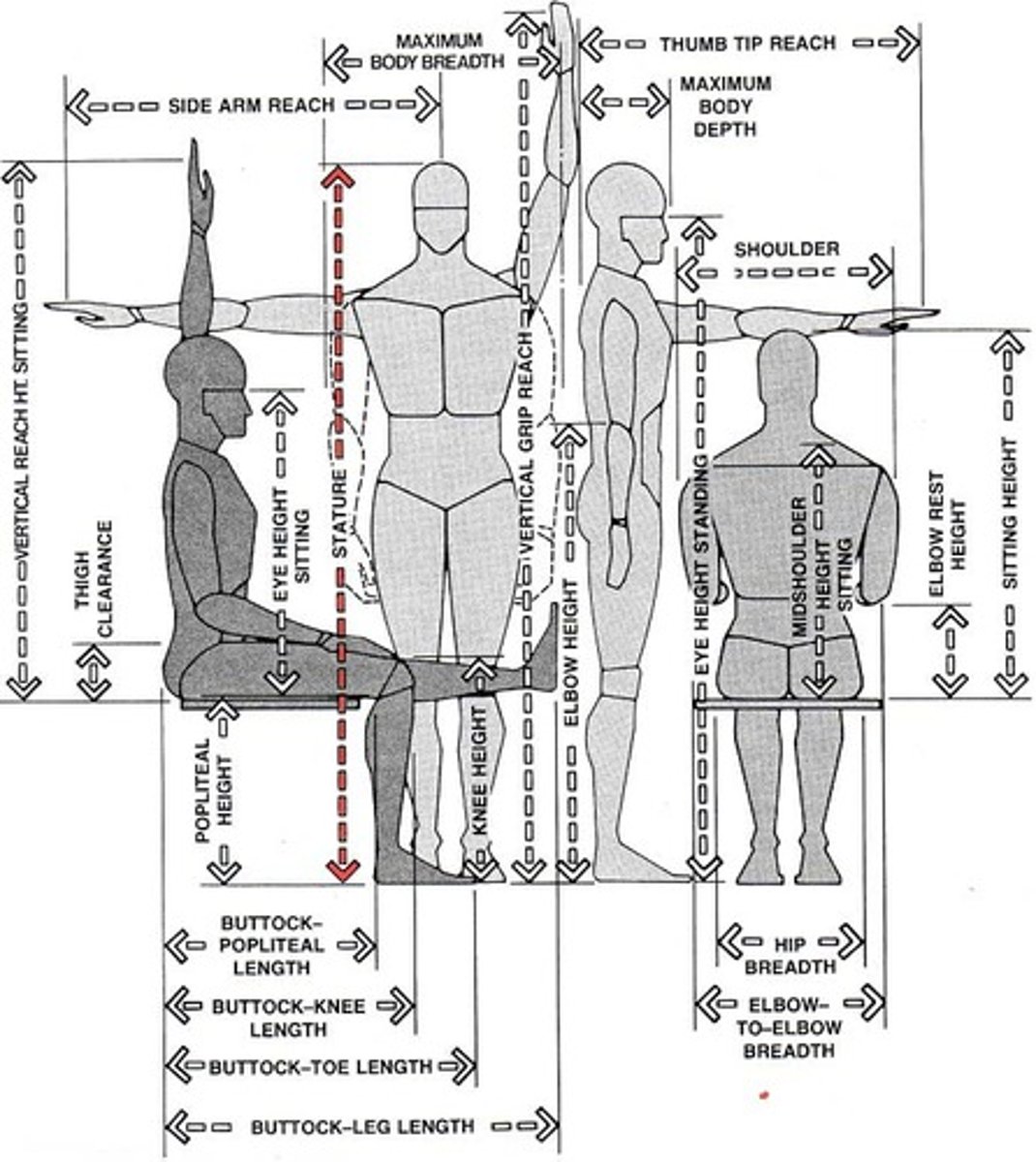
Anthropometrics
The aspect of ergonomics that deals with body measurements, particularly those of size, strength and physical capacity.
Biomechanics
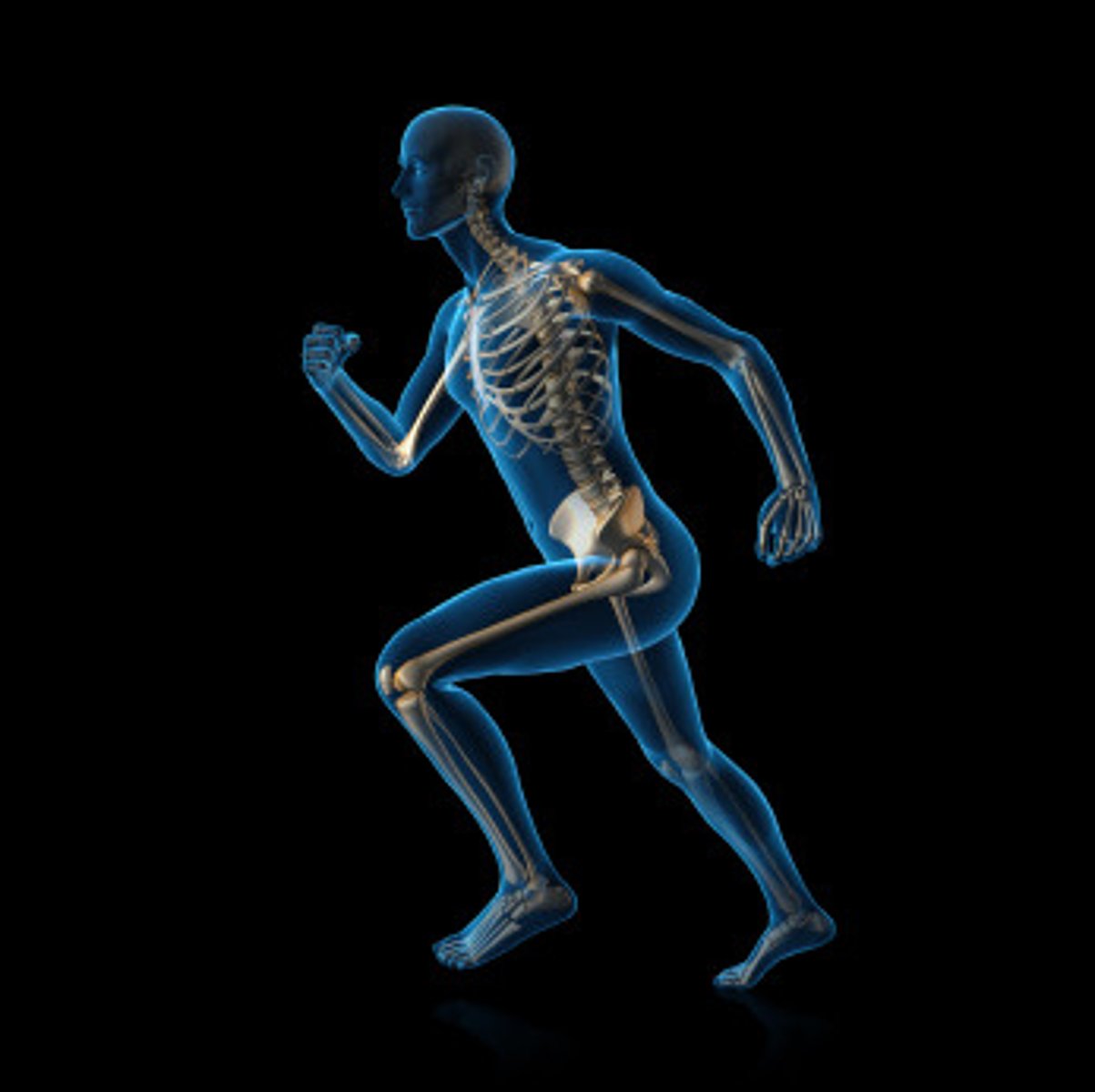
The research and analysis of the mechanics of living organisms. Biomechanics in Human factors includes the research and analysis of the mechanics (operation of our muscles, joints, tendons, etc.) of our human body. It also includes Force (impact on user's joints), Repetition, Duration and Posture.
Clearance
The physical space between two objects.
Cognitive ergonomics
How mental processes, (memory, reasoning, motor response and perception), affect the interactions between users and other components of a system.
Comfort
A person's sense of physical or psychological ease.
Dynamic data
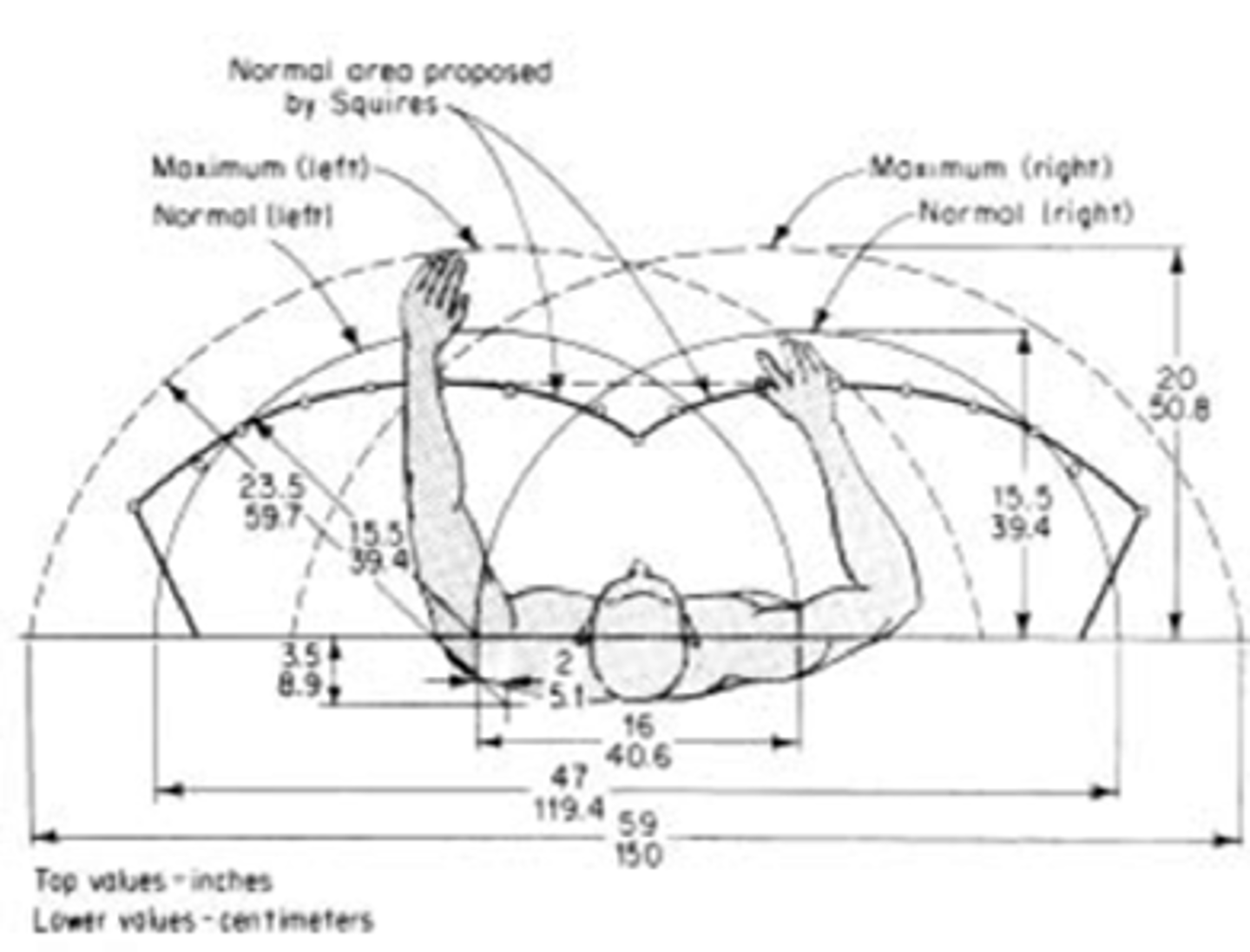
Human body measurements taken when the subject is in motion related to range and reach of various body movements. E.g. crawling height, overhead reach and the range of upper body movements.
Environmental factors
A set of psychological factors that can affect the performance of an individual that come from the environment that the individual is situated.
Ergonomics
The application of scientific information concerning the relationship between human beings and the design of products, systems and environments.
Fatigue
A person's sense of physical or psychological tiredness.
Functional data
Functional data includes dynamic data measurements while performing a required task e.g. reaching abilities, maneuvering and aspects of space and equipment use.
Human error
Mistakes made by users, some of which can result in catastrophic consequences for people, property and the environment, as they are considered key contributors to major accidents.
Human factors
A scientific discipline concerned with understanding how humans interact with elements of a system. It can also be considered the practice of designing products, systems or processes to take account of the interaction between them and their users. It is also known as comfort design, functional design and user-friendly systems.
Human information processing system
An automatic system that a person uses to interpret information and react. It is normally comprised of inputs, processes (which can be sensory, central and motor), and outputs.
Interval data
Interval data are based on numeric scales in which we know the order and the exact difference between the values. Organised into even divisions or intervals, and intervals are of equal size.
Nominal data scale
Nominal means 'by name' and used in classification or division of objects into discrete groups. Each of which is identified with a name e.g. category of cars, and the scale does not provide any measurement within or between categories.
Ordinal data
A statistical data type that exists on an arbitrary numerical scale where the exact numerical value has no significance other than to rank a set of data points. Deals with the order or position of items such as words, letters, symbols or numbers arranged in a hierarchical order. Quantitative assessment cannot be made.
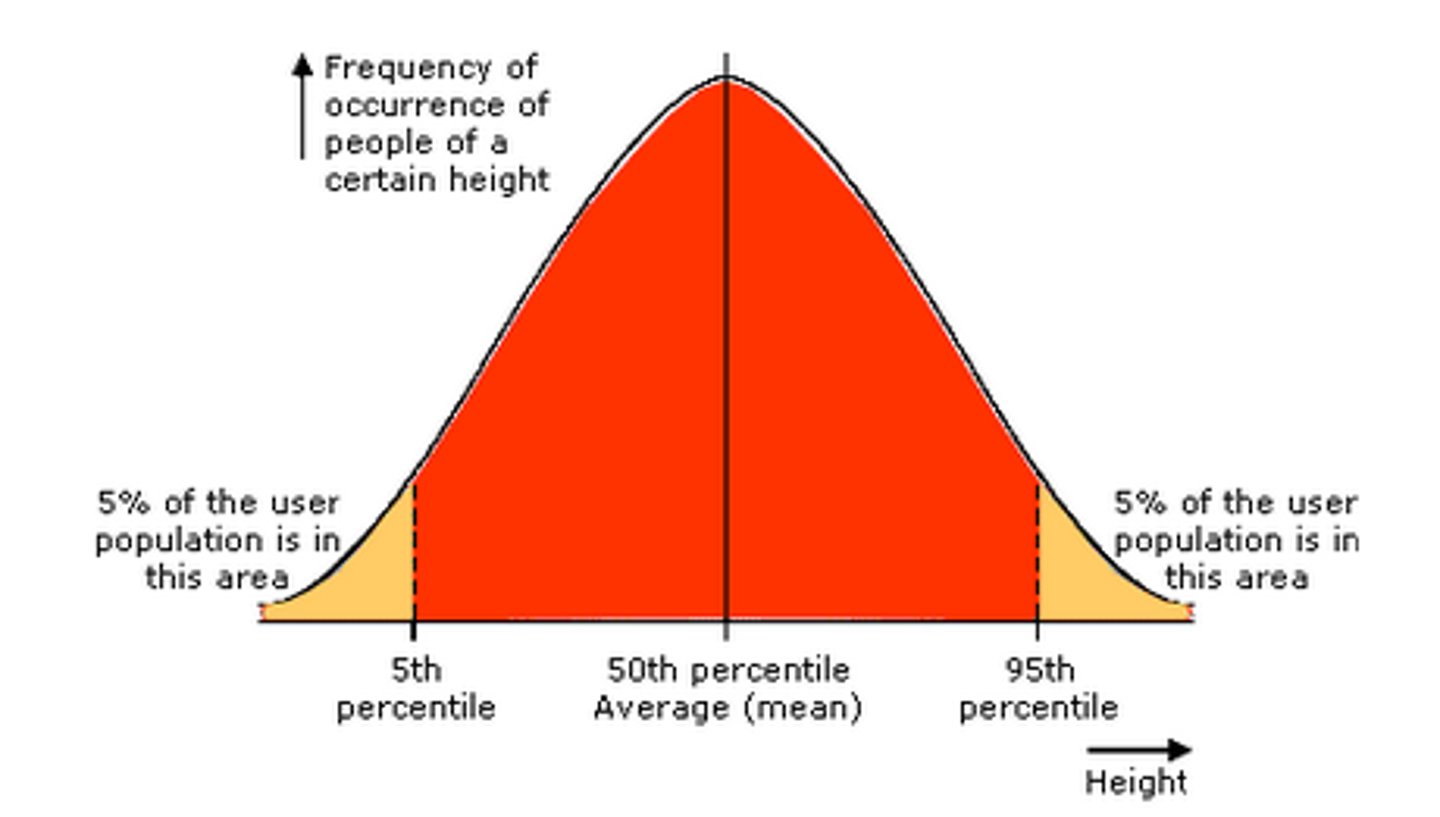
Percentile range
That proportion of a population with a dimension at or less than a given value. For a given demographic (gender, race, age), the 50th percentile is the average.
Perception
The way in which something is regarded, understood or interpreted.
Physiological factor data
Human factor data related to physical characteristics used to optimise the user's safety, health, comfort and performance
Primary data
Data collected by a user for a specific purpose.
Psychological factor data
Human factor data related to psychological interpretations caused by light, smell, sound, taste, temperature and texture.
Qualitative data
Typically descriptive data used to find out in depth the way people think or feel - their perception. Useful for research at the individual or small (focus) group level.
Quantitative data
Data that can be measured and recorded using numbers. Examples include height, shoe size, and fingernail length.
Range of sizes
A selection of sizes a product is made in that caters for the majority of a market.
Ratio data scale
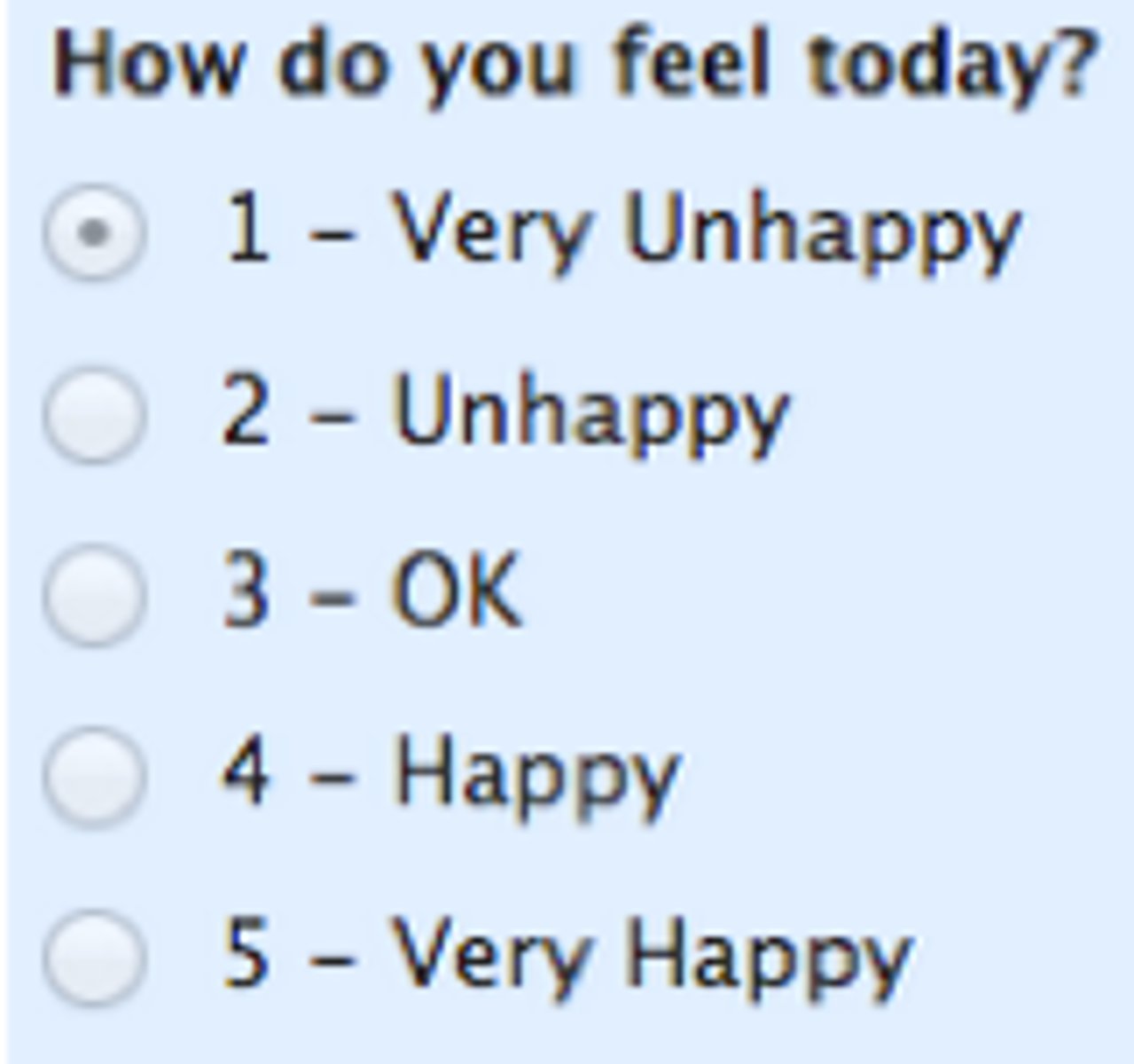
A ratio scale allows you to compare differences between numbers. For example, use a rating scale of 1-10 to evaluate user responses.
Reach
A range that a person can stretch to touch or grasp an object from a specified position.

Secondary data
Data collected by someone other than the user.
Static data
Human body measurements when the subject is still.
Structural data
Refers to measurements taken while the subject is in a fixed or standard position, e.g. height, arm length.
Workplace environmental factors
These factors can be considered to maximise performance of a user in a role and reduce the risk of accidents. They can be categorised as: • Management (policies, safety education) • Physical environment (noise, temperature, pollutants, trip hazards, signage) • Equipment design (controls, visibility, hazards, warnings, safety guards) • The nature of the job (repetitiveness, mental or physical workload, force, pressure) • Social or psychological environment (Social group, morale) • The worker (personal ability, alertness, age, fatigue)
Type of workplace environmental factor- Management
Workplace environmental factor includes policies, safety and education
Type of workplace environmental factors -Physical environment
Workplace environmental factor includes noise, temperature, pollutants, trip hazards and signage
Type of workplace environmental factors- Equipment design
Workplace environmental factor includes controls, visibility, hazards, warnings and safety guards
Type of workplace environmental factors- The nature of the job
Workplace environmental factor includes repetitiveness, mental or physical workload, force and pressure.
Type of workplace environmental factors - Social or psychological environment
Workplace environmental factor includes social groups and morale.
Type of workplace environmental factors- The worker
Workplace environmental factor includes personal ability, alertness, age and fatigue.
Conceptual modelling
- Originates in the mind
- Primary purpose is to outline the principles and basic functions of a design or system
Conceptual modelling: Nature of Design
Assist their understanding by simulating the subject matter they represent.
Designers should consider:
- systems
- services
- products
in relation to what they..
- should do
- how they should behave
- what they should look like
- whether they will be understandable by the users in the manner intended
Conceptual Modelling: Characteristics
What happens at the start of the design process
Reflects all of the major design elements but is as simplified as possible
It is a broad expression of concepts/ideas that are not limited by a narrow focus
Can take different forms; sketching, physical, diagrammatic
Good way of testing key parts of a specification through design
Can highlight previously unseen or unconsidered problems
Conceptual modelling: Advantages
User trials - users can interact and give feedback on a concept
This often reveals differences between the intent and the actual way users will understand and use a design
Speed up the development cycle of a product
The feedback from testing the design against key criteria allow a design to evolve quicker
Testing of production methods prior to manufacture
It may become obvious that a process or technique is too complicated or costly
Reduce development costs by avoiding mistakes
The further along the development process a mistake is discovered, the higher the cost
Functionality is tested when using physical conceptual models
Model can be tested against key specification criteria
Testing of mechanisms - proof of concept
Conceptual modelling: Disadvantages
Performance - models may not perform in the same way as a production version would
This difference may lead to false impressions of a product when users are testing and giving feedback
Functionality - due to the basic nature of a conceptual model, it may not produce the same user-experience
It may be difficult to simulate the experience of a complex idea with a simple model
Graphical modelling
Used to communicate design ideas
Graphical modelling: Nature of Design
- Simplify the data
- Present it in a way that the understanding of what is being presented aids further development or discussion.
Designers utilise graphical modelling as a tool to explore creative solutions and refine ideas from the technically impossible to the technically possible, widening the constraints of what is feasible.
2D and 3D graphical models + advantages
Simple, freehand sketches that communicate an idea are the essential starting point of a designer.
They:
- are quick to generate
- require very few tools (cheap)
- can be changed and modified rapidly
- offer an effective way of communicating
Important things to remember when using 2D and 3D graphical modelling
- You don't necessarily need to draw all the parts of an idea
- Key features should be labelled
- Arrows can help communicate parts that move
- Aligned 2D views can show how features relate
Perspective drawing
This creates the illusion of an object's size getting smaller the further away from the viewing point, just how objects get smaller the further they are into the distance.
Can take a long time to set up, only done toward the end of concept modelling when large changes are unlikely to occur, avoiding a costly waste of time.
Characteristics of perspective drawing:
- creates an impressive presentation view of a design
- can accentuate key features
- more time intensive to produce than freehand sketching
- many sides hidden from view
- often used to present a final design before it is developed for production
Types of perspective drawing:
1. one-point perspective
2. two-point perspective
3. three-point perspective
Orthographic Projection
- A precise and formal drawing technique
- 2D views that are aligned with one another to present different parts of a design
- Drawings are usually to a scale factor appropriate to fit on a common page size
- More commonly generated automatically from CAD models
- Dimensions often added to indicate sizes
- Orthographic projection used mainly as precursor to manufacturing
Orthographic Projection: Section views
Shows the internal profile of a shape when cut across the middle
Orthographic Projection: Detail views
Allows a portion of a view to be enlarged, highlighting information that would be difficult to communicate.
Orthographic projection is traditionally unshaded, but can be shown in a variety of formats:
- Visible edges only
- Visible and invisible edges
- Shaded with visible lines
- Shaded with hidden lines
Orthographic Projection: Assembly Drawings
Show the various component parts assembled in place with one another, to communicate the finalised design as a whole.
Orthographic Projection: Exploded Assembly Drawings
Show how the parts fit together with one another.
Parts are usually moved away from one another in a direction parallel to their point of insertion or mounting.
Physical modelling
The creation of a smaller or larger tangible version of an object that can be physically interacted with.
Physical modelling: Modelling materials
A range of different modelling materials can be implemented for different purposes relating to their properties like workability, physical and aesthetic qualities. Some of these include:
- cardboard
- clay
- silicone
- balsa wood
- polyurethane foam
Physical modelling: Scale models
Would be used when making a full size model would be inappropriate or time consuming.
Architects often use scale models to show how buildings or developments might look.
Physical modelling: Aesthetic models
Used to assess how the look of a product will be received.
Links to form, colour, texture and emotional responses.
Can be both digital or physical.
Physical modelling: Instrumented models
Where usually a prototype is linked with various sensors and a computer.
Data is collected during the prototype's use, and that data can be utilised to inform the subsequent design changes moving forward.
Examples:
- crash testing of the chassis of a car
- effect of wind aerodynamics on a plane
- testing of the feedback from prosthetic limbs
The advantage of a physical model vs digital model
Physical model:
- ability to interact directly with it
Digital model:
- the speed at which it can be changed and adapted
Mockups vs prototypes
A mockup:
usually, a full-size 3D model, that replicates the aesthetics and ergonomics of the intended design, but not the functionality.
Many mockups would be used to inform the development of the product.
A prototype:
a full-size 3D model that replicates both the aesthetics and functionality of a design. It is often one of the last steps before manufacturing takes place, but usually created by specialists using non-commercial manufacturing techniques.
Computer Aided Design: Essential Idea
Is the generation, creation, development and analysis of a design or system using computer software
Computer Aided Design: Nature of Design
As technologies improve and the software becomes more powerful, so do the opportunities for designers to create new and exciting products, services and systems.
Greater freedom in customisation and personalisation of products has a significant impact on the end user. The ability to virtually prototype, visualise and share designs enhances the whole design cycle from data analysis through to final designs
Computer Aided Design: Advantages
- Data can be stored in a variety of formats
- Changes can be made very quickly
- Digital models can be zoomed, rescaled and cropped for detail
- Data can be instantly shared across the globe for immediate production
- Parts can be manufactured directly from drawings or models
Computer Aided Design: Disadvantages
- Initial setup cost can be high
- Training required can be extensive compared to sketching
- Electricity is a requirement for use
- Digital work can be corrupted or stolen
- Compatibility issues between software and hardware
- Skills require upgrading as software updates