FSHN 3600 - Exam 2
 Call Kai
 Learn
Learn Practice Test
 Spaced Repetition
 Match
Match Flashcards
 Knowt Play
1/79

Earn XP
Description and Tags
Proteins, Metabolic Integration, & Exercise
Name | Mastery | Learn | Test | Matching | Spaced | Call with Kai |
|---|
No analytics yet
Send a link to your students to track their progress
80 Terms
Primary protein structure
AAs linked together in a specific sequence based on genetic code.
____ protein structure forms a peptide backbone.
Primary
Secondary protein structure
H bonding occurring in peptide backbone of AAs in a protein.
Hydrogen bond
electrostatic attraction between polar groups.
Hydrogen bonding can occur between ___ & ___ groups of peptide backbone forming alpha-helix and beta-pleated sheets.
amine, carboxyl
Secondary protein structures are ___ & ___.
protective, rigid
Tertiary protein structure
3D confirmation, contains disulfide bridges.
Disulfide bridges must be broken by ___. ___ is responsible for breaking these bridges.
reduction, HCl
___ transporters have primary, secondary, & tertiary protein structures working in unison in the ___ regions.
GLUT, transmembrane
_____ structures can occur between an acidic AA & a basic AA.
Tertiary
Tertiary Protein Structure
____ (nonpolar) AA in protein core to avoid an ___ environment.
Hydrophobic, aqueous
Tertiary Protein Structure
___ (polar) AA on surface.
Hydrophilic
How are AAs linked together?
dehydration synthesis (condensation)
Peptide bond
Between 1 AA and 1 hydroxyl group of a carboxyl end of another AA.
How is protein broken down?
Using HCl and proteases.
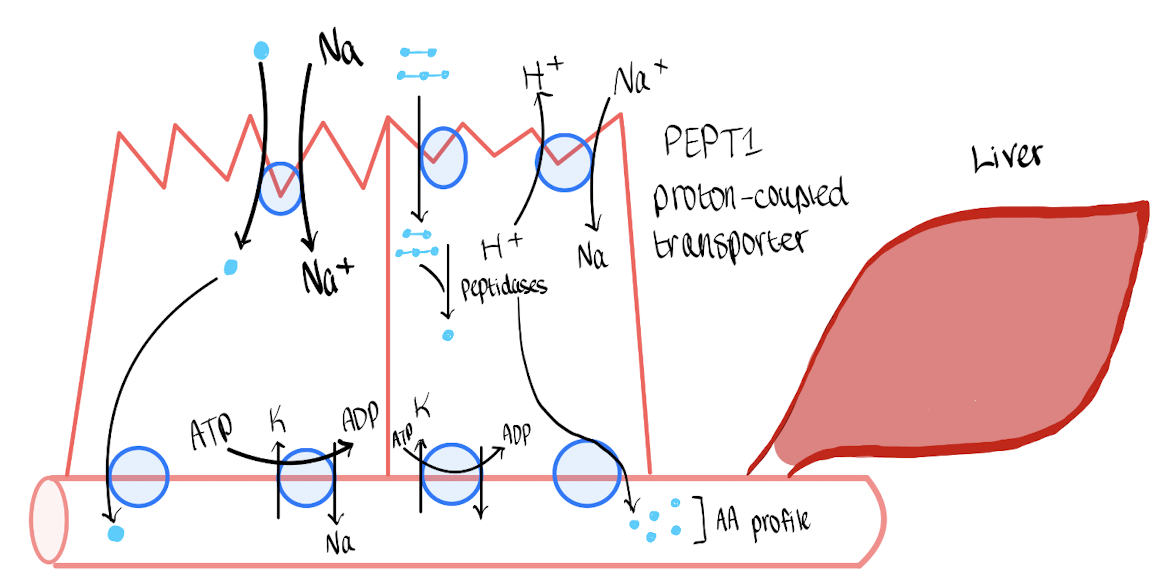
Free AAs use ___ transport and are ___ dependent
active, Na
The liver makes __ -- ____ AAs.
non-essential
Essential/indispensable AA
The body cannot make it.
Non-essential/dispensable AA
The body can make it.
Conditionally essential AA
AAs that are normally non-essential, but must be consumed at specific times.
(e.g. illness or stress)
Carnitine is involved with __ transport into the mitochondria membrane for __-oxidation
FA, beta
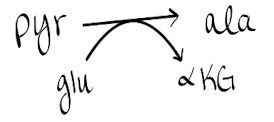
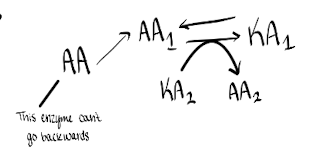
Transamination
transferring an AA group
NEAA synthesis used ___ in the ___ state.
transamination, fed
Gluconeogenesis uses ___ in the ___ state and is ___.
transamination, fasted, hepatic
Deamination
Losing a N group
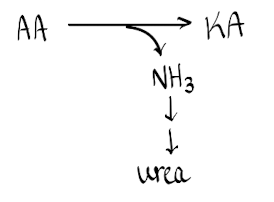
An example of deamination:
hepatic urea-genesis
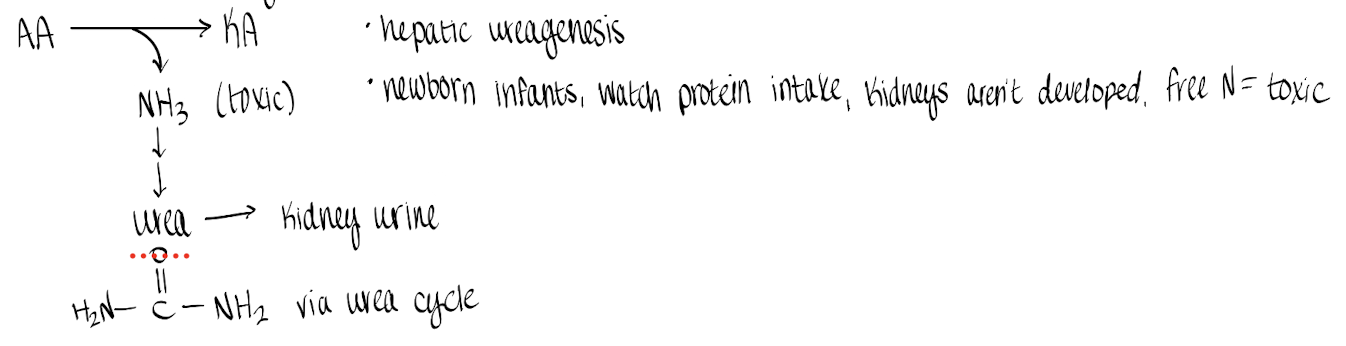
Free ___ is toxic.
nitrogen
N-containing Compounds:
Carnitine
Creatine phosphate
Glutathione (GSH)
Purines/Pyrimidines
Niacin
N-containing non-proteins
Carnitine is made from ___.
lysine
N-containing non-proteins
Carnitine attaches to ___ at the cytosol to carry into the ___ for ___-oxidation.
FAs, mitochondria, beta
N-containing non-proteins
Creatine phosphate is a quick ___ source to form ___.
energy, ATP
Creatine is made exclusively in the ___.
liver
Purines and pyrimidines make up ___ and ___ bases.
DNA, RNA
Glutathione (GSH) is an ____.
antioxidant
Purines/pyrimidines are involved in ___.
DNA
Neurotransmitter Synthesis
Dopamine is made from ____.
tyrosine
Neurotransmitter Synthesis
Serotonin is made from ___.
tryptophan
Neurotransmitter Synthesis
Vitamins can make ___ from tryptophan.
niacin
Branched Chain AAs (BCAA) that flow through the liver
Valine
Leucine
Isoleucine
Branched Chain Keto Acid (BCKA) in the muscle
___ triggers ___ growth.
Leucine, muscle
Increased AA in the blood = an uptake in:
___ ___
___- ___ ___
___ (primarily in the liver)
protein synthesis
N-containing compounds
NEAAs
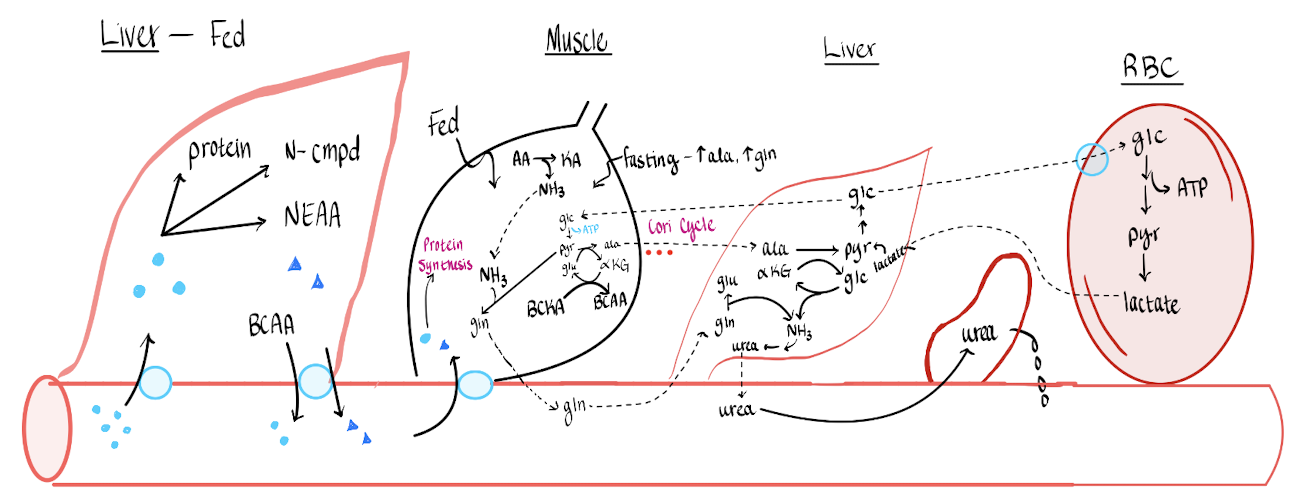
___ stimulates and/or induces enzymes involved in ___ degradation and ___.
Glucagon, protein, urea-genesis
____ is a transporter of N to the liver.
Glutamine
T/F
Essential AAs must become non-essential AAs before it can enter the TCA cycle.
True
How is one supposed to get all AAs needed from the diet?
Eating foods composed of complimentary proteins.
e.g., Beans — limiting AA is methionine, but have plenty of lysine.
What is the purpose of the alanine-glucose cycle?
To shuttle pyruvate to the liver in order for gluconeogenesis to occur in fasting conditions.
Protein Regulation & Turnover
Insulin is an ____ hormone, it promotes ____ ____.
anabolic, protein synthesis
Protein Regulation & Turnover
Glucagon is a ____ hormone, it promotes ____ ____.
catabolic, protein degradation
Neurotransmitter Synthesis
AAs are precursors for the formation of neurotransmitters. Which neurotransmitters correspond to the AA below…
Tyrosine
(listed AA) —→ 5OH-tyrosine —→ DOPA —→ Dopamine —→ norepinephrine —→ epinephrine
Neurotransmitter Synthesis
AAs are precursors for the formation of neurotransmitters. Which neurotransmitters correspond to the AA below…
Tryptophan
(listed AA) —→ serotonin —→ melatonin
Neurotransmitter Synthesis
AAs are precursors for the formation of neurotransmitters. Which neurotransmitters correspond to the AA below…
Glutamate
(listed AA) —→ gamma-aminobutyric acid (GABA)
Inborn Errors of Metabolism
What are two examples of inborn errors of metabolism related to AA metabolism?
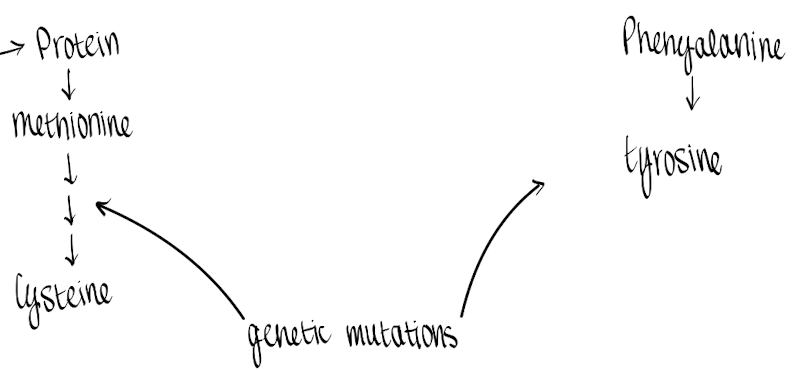
Homocysteinemia & phenylketonuria (PKU)
Inborn Errors of Metabolism
The problem with homocysteinemia:
The enzyme responsible for converting homocysteine (from methionine) to cystathionine and then to cysteine, further into glutothionine is not present because of a genetic defect.
Inborn Errors of Metabolism
Due to the problem of homocysteinemia, toxic levels of homocysteine build up in the blood leading to _____. This is a risk factor for ___ ___ and other issues.
hyperhomocysteinemia, cardiovascular disease
Inborn Errors of Metabolism
What is the dietary recommendation for homocysteinemia?
Limit intake of methionine in the diet.
Inborn Errors of Metabolism
What is the problem with phenylketonuria (PKU)?
The conversion of phenylalanine to tyrosine. The enzyme that carries out this reaction is phenylalanine hydroxylase. Patients with PKU lack this enzyme.
Inborn Errors of Metabolism
Due to the problem with PKU, high concentrations of _____ build up in the blood. If high concentrations persist, they can be converted into phenylpyruvic acid which in high concentrations, lead to ___ ___ and other issues.
phenylalanine, mental retardation
Inborn Errors of Metabolism
What is the dietary recommendation for PKU?
Severely limit the intake of phenylalanine AA in the diet.
(T/F) 1% of the population has polymorphisms.
T
____ occurs in the liver.
Ketogenesis
What processes take place in the fasted state?
Protein degradation
Gluconeogenesis
Urea genesis
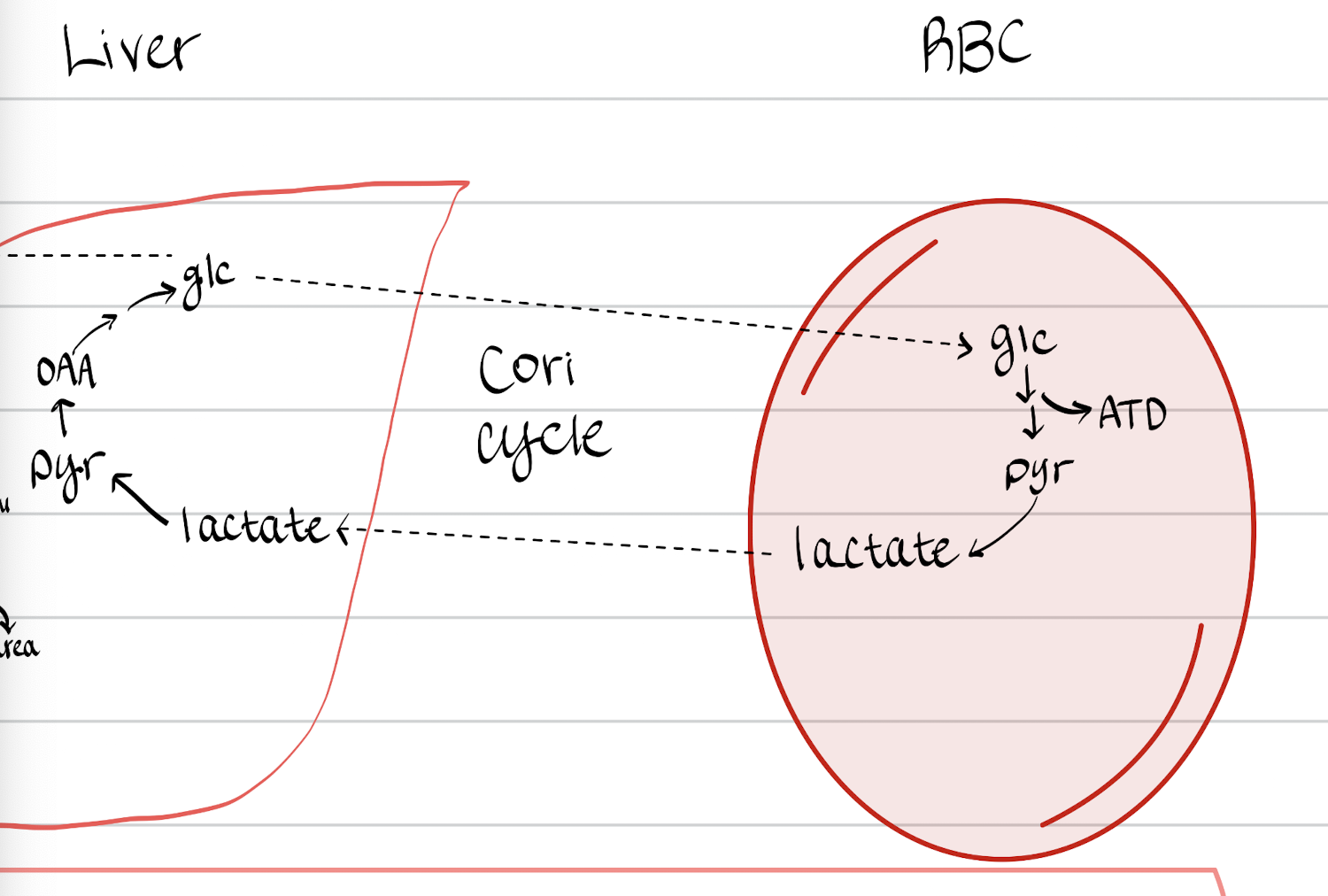
What is the Cori cycle?
Converts lactate produced during anaerobic exercise in muscles into glucose in the liver.
When there is an increase in AA in the blood there is an uptake in:
Protein synthesis
N-containing compounds
NEAAs
___ is needed for the TCA cycle to function.
Pyruvate
Type 1 muscle fiber
Slow twitch, increased mito density
Type __ muscle fibers are utilized in long term exercise.
1
Type 2 muscle fibers
fast twitch
Type 2a muscle fiber
intermediate mito density, aerobic & anaerobic
Type 2b muscle fibers
low mito density, aerobic
Creatine phosphate is a substrate for a ___ ___ source.
burst energy
____ stimulates and/or induces enzymes involved in ____ degradation and ____ ____.
Glucagon, protein, urea genesis
(REVIEW)
Induction
turns on gene for increased abasolute abundance of a protein
(REVIEW)
PTM
Activation or inactivation of protein function or tagging for degradation.
(REVIEW)
Allosteric Regulation
Ability to stimulate or inhibit enzymes.
(REVIEW)
Feedback Inhibition
Reduces enzyme activity when enough product is made.
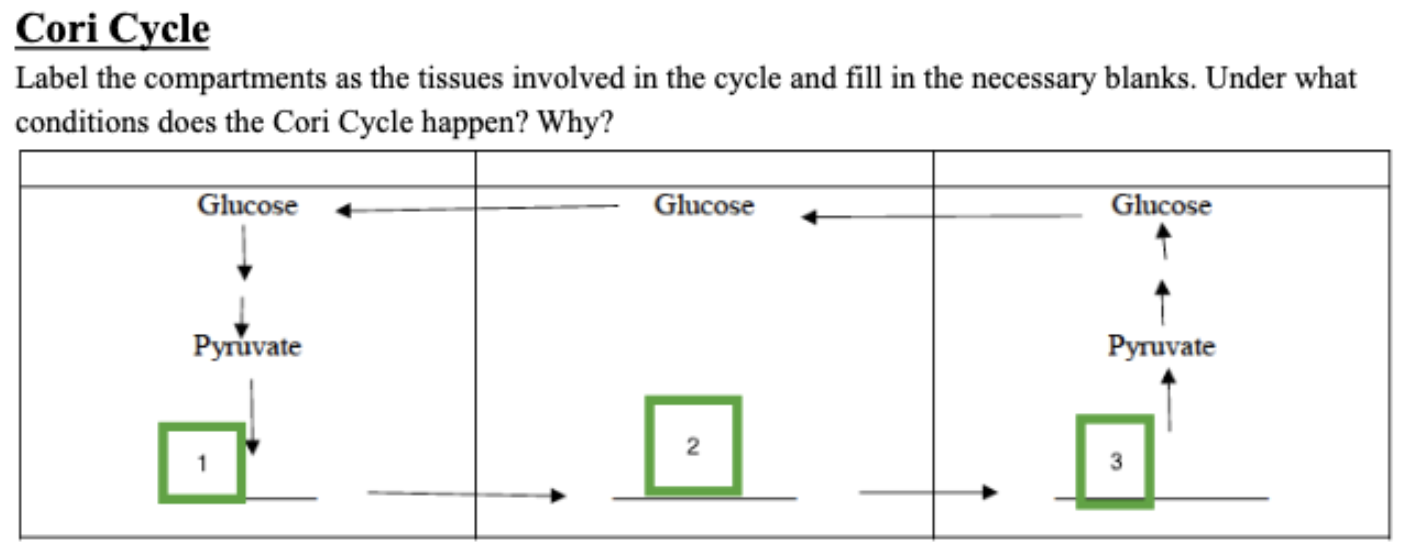
Label 1-3
1-3: Lactate
The Cori cycle occurs during ___ conditions (induced by ___) in order to mobilize lactate from muscle into the liver, and make ___ to raise blood glucose levels and use them for ___ in other tissues.
fasting, glucagon, glucose, energy
We have an AA pool which comes from the ___ and ___ ___.
diet, protein breakdown
If the AA pool is low one ___ will predominate to promote ___ ___.
enzyme, protein degradation
If the AA pool is full another ___ will predominate to promote ___ ___.
enzyme, protein synthesis