PPT 12 Money and Monetary Policy – Introduction to Macroeconomics
 Call Kai
 Learn
Learn Practice Test
 Spaced Repetition
 Match
Match Flashcards
 Knowt Play
1/20

Earn XP
Description and Tags
Flashcards covering key concepts from the lecture on Money and Monetary Policy.
Name | Mastery | Learn | Test | Matching | Spaced | Call with Kai |
|---|
No analytics yet
Send a link to your students to track their progress
21 Terms
Fiat Money
Legal tender that serves four fundamental functions: medium of exchange, unit of account, store of value, and standard of deferred payment.
Monetary Aggregates
Classifications of money supply, starting from the narrowest 'monetary base' to 'broad money'.
Expansionary Monetary Policy
policy aimed at increasing the money supply to combat recession and stimulate economic growth.
Effective in Closing the output gap
Effective when sticky price, unemployment and liquidity trap
Restrictive Monetary Policy
A policy aimed at decreasing the money supply to control inflation and stabilize an overheating economy.
Shift AD and bring it back to Full-employment
Excess reserves
Funds bank can lend out after keeping the required reserves
Fractional reserve banking
The process through which a bank is required to keep a fraction of a deposit in their liquidity, thus regulating the banking system
M1
currency in circulation
Overnight deposits
Money that can be spend immediately = narrow money
Very liquid money
cash & circulation (M1+)
Chequable deposits (M1+)
Personal deposits (M1+)
Non chequable deposits (M1++)
M2
Less liquid money that are almost money, but take time to convert into cash = broad money
Fix term deposit ( < 2 years )
Deposits with notice ( < 3 months)
Mutual fonds (M2+)
Saving Bonds (M2+)
M3
Less liquid money that are almost money, but take time to convert into cash = broad money
Money market funds
Repurchase agreements
Debt instruments ( < 2 years )
Why tracking monetary aggregate of money supply?
Decides monetary policy
Monitor economic activity
Understand inflation pressures
Medium of exchange
Facilitate exchange between sellers and buyers as intermediaries to avoid exchange limitations
Example: dollar, coins, checks
Unit of account
unit of measurement, used for pricing and keeping
records of assets such as debt, property or financial instruments.
Store of value
to transfer purchasing power from the present to the
future (savings)
Standard of deferred payments
must be acceptable to make purchases
today that the purchaser will pay in the future (credit).
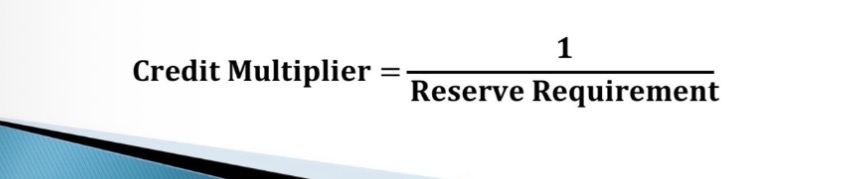
Money multiplier
Shows how much the money supply can increase based on the reserve requirement
Credit multiplier
How banks create money out of thin air:
initial deposit
Loan circulation
The process continue creating new money with each steps
Lower reserve requirements (money multiplier)
Means a higher multiplier, so banks can create more money through lending
Bank run on deposit (banking crises)
Depositors withdrawn their money from bank at the same time because of fear that bank will fail
Banks do not convert cash fast enough
Drain bank reserve = closes or bankrupt banks
Great Depression
Loan Delinquencies
Borrowers fail to make payments on their loans as scheduled
reduced banks abilities to loan
Financial instability
Great Recession
Asset Depreciation
Significant drop in the value of assets held by banks (investments, real estates…)
Loss of capital
Undermine confidence of borrowers on the banking system
Silicon Valley’s Bank