207 Exam flash cards
 Call Kai
 Learn
Learn Practice Test
 Spaced Repetition
 Match
Match Flashcards
 Knowt Play
1/38

There's no tags or description
Looks like no tags are added yet.
Name | Mastery | Learn | Test | Matching | Spaced | Call with Kai |
|---|
No analytics yet
Send a link to your students to track their progress
39 Terms
As the impurity concentration (in solid solution) of a metal is increased, the tensile and yield strengths
Increase
During the recovery of a cold-worked material, which of the following statements are true?
Point defect concentrations are reduced by recombination of vacancies and interstitials.
Some of the strain energy is relieved when dislocations recombine and others arrange into low-energy configurations.
There is some reduction in the number of dislocations when opposite signed dislocations recombine.
The electrical conductivity is recovered to its pre-cold worked state.
During the recrystallization of a cold-worked material, which of the following statement(s) is (are) true?
Grains with high strains are replaced with new, unstrained grains.
The metal becomes as ductile as in its precold-worked state
There is a significant reduction in the number density of dislocations
All of the strain energy induced by cold-working is relieved
How does grain size influence the strength of a polycrystalline material?
Strengthfine-grained > Strengthcoarse-grained
The four strategies for strengthening materials are
Reducing grain size, solid solution strengthening, precipitates, cold work
Increased hindering of dislocation motion makes a metallic material
Harder
Which of the following statements are true about grain growth in alloys?
The rate of grain growth is lower in alloys than in the pure metal (brass vs Cu).
The rate of grain growth is higher at higher temperatures.
How would the plane strain fracture toughness of a metal be expected to change with rising temperature?
Increase
A ductile-to-brittle transition temperature (DBTT), as measured by a Charpy V-notch impact test, is likely to be observed for
Polymers
BCC materials
Which of the following is most likely to have the greatest influence on fatigue life
Surface finish
Fracture toughness of materials is often traded off with which other property? That is, as fracture toughness is engineered to increase in an alloy, which of the following decreases?
Yield strength
Stress corrosion cracking requires
Tensile stress, susceptible alloy and corrosive environment
A peritectic reaction involves which of the following combinations of phase fields?
One liquid and two solid
What is the lever rule when trying to find WT% BETA
WT%B = C0-CA/(CB-CA). It is also just the whole leftside of the lever divided by the whole area.
What is the lever rule when trying to find WT% Alpha.
WT%A = CB-C0/(CB-CA), It is the whole right side divided by the whole area
How to calculate the amount of atoms in a critical nucleous?
Find V* by doing 4/3*pi*r³ and V = a³. Then do V*/V, and this is the number of unit cells. To get the amount of atoms times by 2
Which of the following mechanisms are known to cause brittle failure in normally ductile materials?
ductile-brittle transition, stress corrosion cracking, fatigue.
How do you know if it is a valid slip plane.
For FCC slip plane = (111) For BCC slip plane = (110) the direction dotted with the plane must also be = 0.
At temperatures over about 30% of the absolute melting temperature of a metal, if either stress or temperature is increased, which of the following combinations of effects will result?
The steady-state creep rate increases and the rupture lifetime decreases.
The nucleation rate decreases as the temperature falls below a certain optimal level because the
atomic mobility decreases
for which of the following transformation products does formation not involve atomic diffusion
Martensite
during a typical quench and temper treatment off the fe-c alloys the following occurs
Martensite is formed, followed by the formation of tempered martensite ( ferrite and Cementite).
Rank the microconstituent in order of decreasing strength
martensite, tempered martensite, bainite, fine pearlite, coarse pearlite, spheoidite.
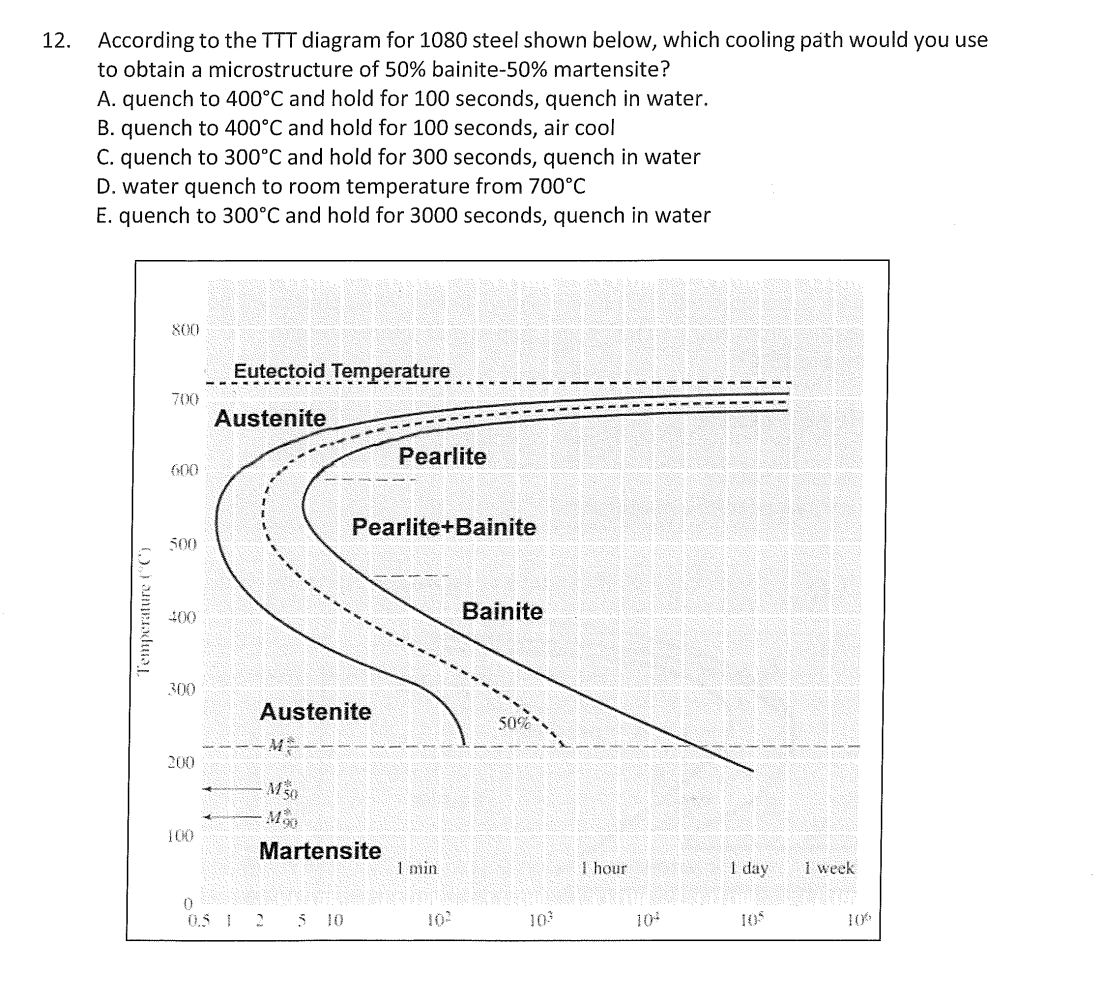
C- Quench to 300 degrees hold for 300 seconds, quench in water. Do this because you end up in the region of bainite and austenite before quenching which turns all the austensite into martensite.
Increasing the resistance to dislocation motion makes a metallic material..
HARDER
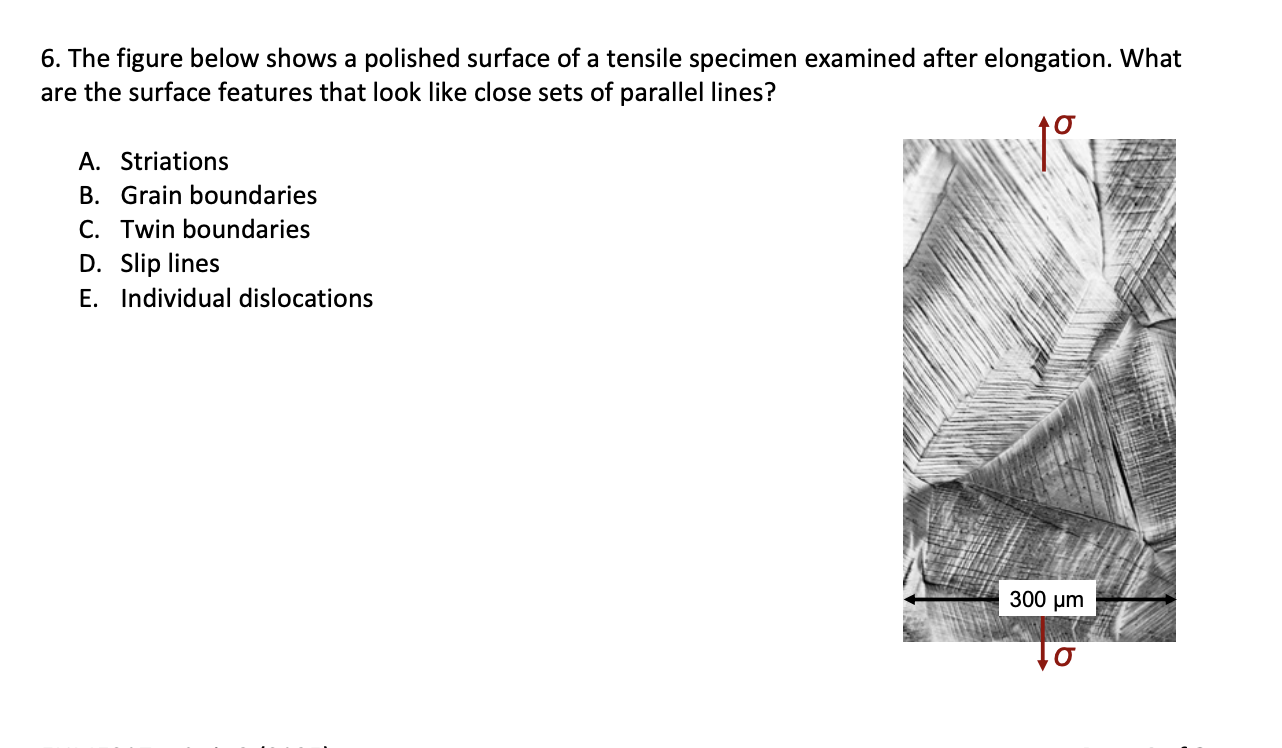
The figure below shows a polished surface of a tensile specimen examined after elongation. What are the surface features that look like close sets of parallel lines?
Slip lines
How does mean stress correlate to fatigue life.
The lower the mean stress the longer the expected fatigue life.
What is the relation ship between Undercooling, Nucleation and Growth rate.
High undercooling = High nucleation and Low grain growth. If Low Undercooling expect the opposite for nucleation and grain growth.
What is Eutectoid phase reaction?
liquid to two solids
What is the eutectoid reaction
solid to two solids
what is the peritectic reaction
liquid + solid to one solid
What us the peritectoid reaction?
two solids to one solid
What is the monotectic reaction
Liquid = Liquid + solid
How do you calculate a for a BCC atom
for BCC a = 4*R/sqrt(3)
How do you calculate a for an FCC crystal
a = 4*R/sqrt(2)
How do you calculate direction?
Final - initial eg x = x2-x1 and y = y2-y1 and if left with 0.5 multiply through to get whole numbers