Microbiology - Chapter 4
 Call Kai
 Learn
Learn Practice Test
 Spaced Repetition
 Match
Match Flashcards
 Knowt Play
1/104

Earn XP
Description and Tags
Name | Mastery | Learn | Test | Matching | Spaced | Call with Kai |
|---|
No analytics yet
Send a link to your students to track their progress
105 Terms
The first ____ cells appeared 2 to 3 billion years ago
Eukaryotic
_______ all evolved from the Last Common Ancestor
Bacteria
Archaea
Eukarya
First primitive eukaryotes were likely ___-celled and ___
Single, Independent
Aggregated
Forming colonies
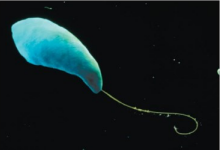
Flagella
Long projections
Few in number
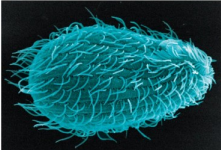
Cilia
Short projections
Numerous
The Glycocalyx is the
Outermost layer that comes into direct contact with the environment
The Glycocalyx is composed of
Polysaccharides
The Glycocalyx appears as
A network of fibers
A slime layer
A capsule
The Glycocalyx contributes to
Protection
Adherence
Signal reception
Most animals lack
Cell walls
___ and ___ do not have cell walls
Protozoa
Helminths
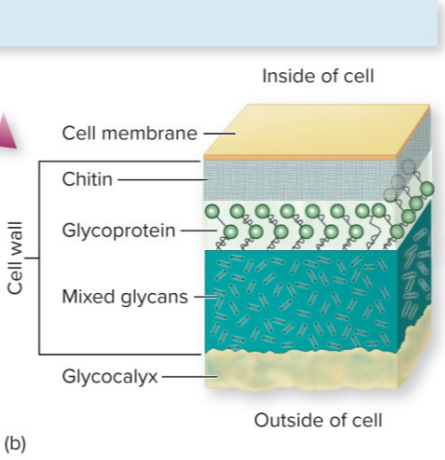
Cell walls of fungi
Rigid and provide structural support and shape
Different in chemical composition from bacterial and archaeal cell walls
Thick inner layer of polysaccharide fibers composed of chitin or cellulose
Thin outer layer of mixed glycans
The Cell Membrane contains
Sterols of various kinds
The Cell Membrane
Typical bilayer of phospholipids in which protein molecules are embedded
Relative rigidity give __ to the membrane
Stability
Important in cells that do not have a cell wall
Sterol
__ of eukaryotes have a similar function as those in bacteria and archaea, serving as selectively permeable barriers
Cytoplasmic membranes
Boundary Structures
Cell Wall
Cell Membrane
Nucleus is the
Most prominent organelle of eukaryotic cells
The nucleus separated from the cell cytoplasm by an external boundary called the __
Nuclear envelope
Internal Structures
Nucleus
Endoplasmic Reticulum
Golgi Apparatus
The nucleus is composed of
Two parallel membranes (lipid-bilayers) separated by a narrow space
The nucleus is perforated (series of holes) with
Small, regularly spaced pores, formed at sites where the membranes unite
The nucleus macromolecules
Migrate through the pores to the cytoplasm and vice versa
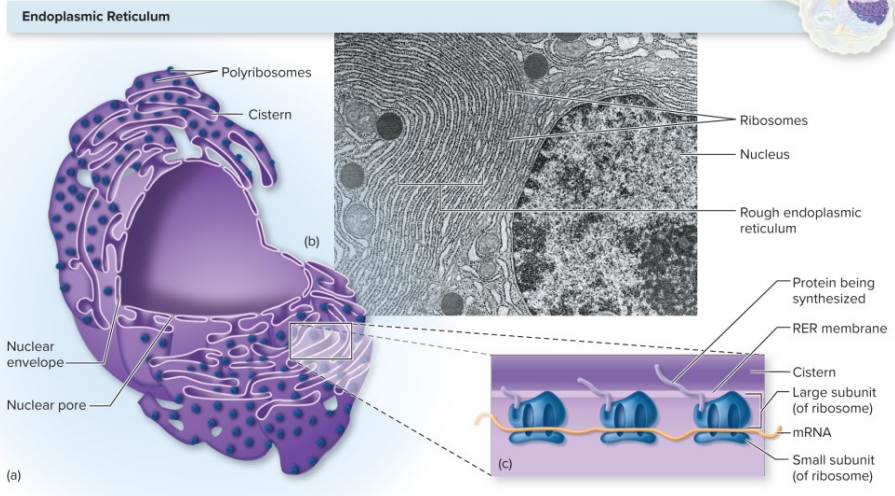
Endoplasmic Reticulum
A series of membrane tunnels used in transport and storage
Rough endoplasmic reticulum (RER):
Allows transport materials from the nucleus to the cytoplasm and to the cell’s exterior
Ribosomes attached to its membrane surface
Smooth endoplasmic reticulum (SER):
Closed tubular network without ribosomes
Functions in nutrient processing and in synthesis and storage of nonprotein macromolecules such as lipids
Golgi Apparatus
The site in the cell in which proteins are modified and then sent to their final destinations
Always closely associated with the endoplasmic reticulum
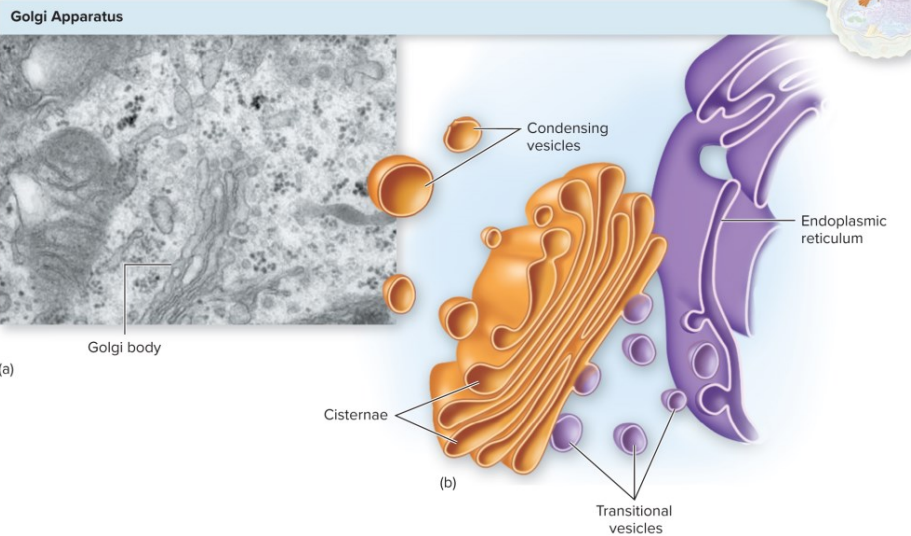
Golgi Apparatus consists of
Several flattened, disc-shaped sacs called cisternae
Transitional vesicles
Are picked up at the face of the Golgi apparatus
Condensing vesicles
Pinch off of the Golgi apparatus and are then conveyed to lysosomes or transported outside the cell
Proteins are
Modified within the cisternae by the addition of polysaccharides and lipids
Nature’s Assembly Line
Nucleus
Endoplasmic reticulum
Golgi apparatus
Nature’s Assembly Line Procedure
A segment of DNA containing the instructions for producing a protein is copied into RNA, and this RNA transcript is passed out through the nuclear pores directly to the ribosomes on the endoplasmic reticulum
Specific proteins on the RER are deposited in the lumen and transported to the Golgi apparatus
Proteins in the Golgi apparatus are chemically modified and packaged into vesicles to be used by the cell
Lysosomes
Bud off the Golgi apparatus as a vesicle
Contain a variety of enzymes involved in the intracellular digestion of food particles and protection against invading microorganisms
Participate in the removal of cell debris in damaged tissue
Vacuoles
Membrane-bound sacs containing fluids or solid particles to be digested, excreted, or stored
Found in phagocytic cells in response to food and other substances that have been engulfed
Contents of a food vacuole are digested through a merger of a vacuole with a lysosome
Mitochondria
Generate energy for the cell
Composed of a smooth, continuous outer membrane with an inner folded membrane
Folds on the inner membrane are called cristae
Cristae
Hold the enzymes and electron carriers of aerobic respiration
Extracts chemical energy contained in nutrient molecules and stores it in the form of high-energy molecules, or ATP
Mitochondria unique organelles
Divide independently of the cell
Contain circular strands of DNA
Have bacteria-sized 70S ribosomes
Cytoplasm
Substance inside the plasma and outside the nucleus
Cytosol
Fluid portion of cytoplasm
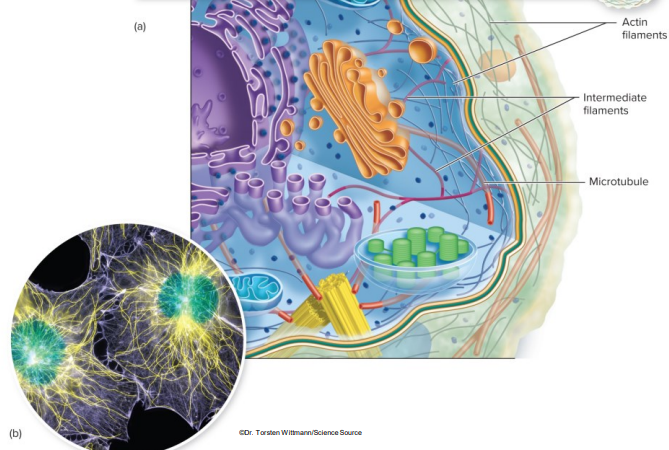
Cytoskeleton are composed of
Microfilaments and intermediate filaments
gives shape and support
Cytoplasmic streaming
Movement of the cytoplasm throughout a cell
Chloroplasts
Found in algae and plant cells
Capable of converting energy from sunlight into chemical energy through photosynthesis
Produce oxygen gas as a by-product of photosynthesis
Resemble mitochondria but are larger, contain special pigments, and are more varied in shape
Ribosomes
Distributed throughout the cell
Scattered freely in the cytoplasm and cytoskeleton
Attached to the rough endoplasmic reticulum
Appear inside mitochondria and chloroplasts
Multiple ribosomes are often found arranged in short chains called
Polyribosomes (polysomes)
Ribosomes structure and size
Large and small subunits of ribonucleoprotein
Eukaryotic ribosome is 80S, a combination of 60S and 40S subunits
Cytoskeleton functions
Anchoring organelles
Moving RNA and vesicles
Permitting shape changes and movement
Three main types of cytoskeletal elements:
Actin filaments: long, thin protein strands
Intermediate filaments: ropelike structures
Microtubules: long, hollow tubes
Yeasts
Round to oval shape
Asexual reproduction, budding
Hyphae
Long, threadlike cells found in the bodies of filamentous fungi
Pseudohypha
Chain of yeast cells
Some fungal cells are considered dimorphic and can take either form, depending on growth conditions
Three types of ways “?” can infect humans
Community
Hospital
Opportunistic
Community-acquired infections
Caused by environmental pathogens.
Hospital-associated infections
Caused by fungal pathogens in clinical settings.
Opportunistic infections
Caused by low-virulence species infecting already-weakened individuals.
Harmless spores can cause ____ infections in AIDS patients.
Opportunistic
Fungal cell walls give off ____ that can trigger allergies.
Chemical substances
A number of species are pathogenic to
Corn
Grain
__% of yearly fruit crop is consumed by fungi.
40
Heterotrophic
Acquire nutrients from a wide variety of organic substrates
Saprobic
These substrates from the remnants of dead plants and animals in soil or aquatic habitats
Parasitic
Grow on the bodies of living animals or plants, although very few require a living host
Fungi ___ the substrate and secrete enzymes that reduces it to small molecules that can be absorbed by the cells.
Penetrate
Fungi are often found in ___ or adverse environments, and those with high salt or sugar content.
Nutritionally poor
Cells of most microscopic fungi grow in
Loose Associations
Colonies
Colonies of yeasts are much like bacteria: they have a
Soft, uniform texture and appearance
Colonies of filamentous fungi are noted for the striking
Cottony, hairy, or velvety texture
Mycelium
The woven, intertwining mass of hyphae that makes up the body or colony of a mold
Septa
The nature of the septa varies from solid partitions with no communication between the compartments to partial walls with small pores that allow the flow of organelles and nutrients between adjacent compartments
Nonseptate hyphae consist of
One long continuous cell
Vegetative hyphae are responsible for the visible ___ that appears on a substrate
Mass of growth
Reproductive, or fertile, hyphae produce
Spores
Spores
Primary reproductive mode of fungi
Can be dispersed through the environment by air, water, and living things
Will germinate upon finding a favorable substrate and produce a new fungus colony in a short time
Asexual Spore Formation
Sporangiospores
Conidiospores or conidia
Sporangiospores
Formed by successive cleavages within a saclike head called a sporangium, which is attached to a stalk, the sporangiophore
Conidiospores or conidia
Free spores not enclosed by a spore-bearing sac
The Protozoa
Name comes from the Greek for “first animals”
Most are harmless, free-living inhabitants of water and soil
Protozoa contains
All of the major eukaryotic organelles
Cytoplasm divided into two parts
Ectoplasm
Endoplasm
Ectoplasm
Clear outer layer involved in locomotion, feeding, and protection
Endoplasm
Granular inner region housing the nucleus, mitochondria, and food and contractile vacuoles
Protozoa Function
Cell membrane regulates food, wastes, and secretions
Cell shape can remain constant (as in most ciliates), or change constantly (as in amoebas)
Size of most protozoans range from 3 to 300 μm:
Protozoa Nutrional and Habitat Range
Heterotrophic, require food in a complex organic form
Free-living species scavenge dead plant or animal debris or graze on bacteria and algae
Some have special feeding structures, such as oral grooves
Some absorb food directly through the cell membrane
Pathogenic species may live on the fluids of their host, such as plasma and digestive juices, or actively feed on tissues
Main limiting factor is availability of moisture
Predominant habitats are fresh and marine water, soil, plants, and animals
Can survive in extremes of temperature and pH
Trophozoite
Motile feeding stage requiring ample food and moisture to stay active
Cyst
Dormant, resting stage when conditions in the environment become unfavorable
Resistant to heat, drying, and chemicals • Can be dispersed by air currents
Important factor in the spread of disease
All protozoa reproduce by
Asexual mitotic cell division
Multiple fission
___ also occurs in most protozoa
Sexual reproduction
Ciliates participate in conjugation in which two cells fuse and exchange micronuclei
This results in new and different genetic combinations that can be advantageous in
Evolution
Helminths
Include tapeworms, flukes, and roundworms
Adult specimens are usually large enough to be seen with the naked eye
Not all flatworms and roundworms are parasites; many live free in soil and water
Disease-causing helminths spend part of their lives in the gastrointestinal tract
Flatworms (phylum Platyhelminthes)
Very thin, often segmented body plan
Divided into cestodes (tapeworms) and trematodes (flukes)
Roundworms (phylum Aschelminthes)
Also called nematodes
Elongated, cylindrical, unsegmented body
In pathogenic helminths, the most developed organ is the
Reproductive tract
Worms have a
A reduction in the digestive, excretory, nervous, and muscular systems
Helminths Life Cycle and Reproduction
Complete life cycle includes the fertilized egg, larval, and adult stages
Adults derive nutrients and reproduce sexually in a host’s body
Nematodes
Sexes are separate and different in appearance
Trematodes
Sexes can be separate or hermaphroditic
Cestodes
Generally hermaphroditic (same sexes)
__ is an intermediate that experiences no parasitic development
Transport host