ACC 211 - Exam 2
 Call Kai
 Learn
Learn Practice Test
 Spaced Repetition
 Match
Match Flashcards
 Knowt Play
1/72

There's no tags or description
Looks like no tags are added yet.
Name | Mastery | Learn | Test | Matching | Spaced | Call with Kai |
|---|
No analytics yet
Send a link to your students to track their progress
73 Terms
Balance Sheet Elements
Assets, liabilities, equity
Assets
Things a business owns or controls
provide value or benefits in the future
Liabilities
amount a business owes
obligation to pay money or provide services
Equity
owner’s share of business
after all debts are paid
Asset Categories (6)
current assets
long-term investments
PPE
Right-of-use assets
intangible assets
other assets
Liabilities & Owner’s Equity Categories (3)
current liabilities
long-term debt
owners equity
Current Assets
Cash or assets converted into cash, sold, or consumed in one year or in the operating cycle
whichever is longer
Cash & cash equivalents
any money available on demand
Cash equivalents - short-term, highly liquid, mature within three months or less
Restrictions or commitments must be disclosed
Basis of Valuation: fair value
Short-term investments (equity securities)
BoV: fair value
changes reported in net income unless:
Accounted for under equity
Can’t determine fair value
Short-term investments (debt securities)
Three classifications:
Held-to-maturity: positive intent and ability to hold to maturity
Trading: Bought and held to sell in the near term to generate income
Available-for-sale: Not classified as either
Receivables
Shown in the balance sheet or notes
Clearly identify:
• Anticipated loss due to uncollectibles
• Amount and nature of nontrade receivables
• Receivables used as collateral
Basis of Valuation: Estimated amount collectable
Inventories
Disclose
Cost flow assumption (e.g., FIFO or LIFO)
Basis of Valuation: Lower-of-cost-or-net realizable value/market
Prepaid expenses
Payment of cash
Cash Payment Before Expense Recorded
Basis of Valuation: cost
PPE is measured based on _____
historical cost
Non-current Assets (long-term investments) (4)
securities
tangible fixed assets
special funds
nonconsolidated subsidiaries or affiliated programs
Long-term investments
• Debt investments —> available-for-sale & fair value
• Held-to-maturity debt investments—> amortized cost
• Equity investments—> fair value or equity method
Noncurrent Assets (PPE)
long-lived assets used in the regular operations of the business
Physical property
depreciates or depletes (land as an exception)
Noncurrent Assets (Intangible Assets)
lack physical structure and are not financial instruments
limited life intangibles amortized
indefinite life-intangibles tested for impairment
Noncurrent Assets (other)
long-term prepaid expenses
• Prepaid pension cost
• Noncurrent receivables
• Assets in special funds
• Deferred income taxes
• Property held for sale
• Restricted cash or securities
Current Liabilities
short term debt a company expects to pay off soon by using current assets
Payables resulting from the acquisition of goods
and services
2. Collections received in advance
3. Other liabilities
Long-term Liabilities
debt a company doesn’t expect to pay off within the normal operating cycle
Long-term Liabilities Types
financing situations: issuance of bonds, long-term lease obligations, and long-term notes payable
Ordinary operations: pension obligations and deferred income tax liabilities.
Occurrence or non-occurrence future events: service or product warranties and other contingencies.
Elements of Owners Equity
capital stock
additional paid in capital
retained earnings
accumulated other comprehensive income
treasury stock
Most common form of the balance sheet
report form
lists the balance sheet sections above one another
Classified report form b/s (assets)
Assets
current assets
Long term investments
Equity Investments
PPE
Total PPE
Intangible Assets
total assets
Classified report form b/s (Liabilities & stockholder equity)
Liabilities & Stockholder’s equity
Current liabilities
Long-term debt
Total liabilities
Stockholders equity
Total stockholders equity
Total libabilities & stockholders equity
Statement of Cash Flows purpose
provide relevant information about the cash receipts and cash payments of an enterprise during a period
Operating activity in the statment of cash flow
cash effects of transitions that determine net income
Investing activity in the statment of cash flow
making and collecting loans and acquiring and disposing of investments and property, plant, and equipment
Financing activity in the statment of cash flow
Involves liability and owner’s equity
Statement of Cash Flows format
cash flows from operating
cash flows from investing
cash flows from financing
net increase (decrease) in cash
cash at beginning of year
cash at end of year
Inflows: Operating
when cash revenue excedes expenses
Inflows: Investing
sale of PPE
Sale of debt or equity securities of other entities
Collection of loans to other entities
Inflows: Financing
issuance of capital stock
issuance of debt (bonds & notes)
Outflows: Operating
when expenses exceed revenues
Outflow: Investing
puchase of PPE
purchase of debt & equity securities of other entities
loans to other entities
Outflow: Financing
payment of dividends
redemption of dividends
reacquisition of captial stock
Significant Noncash Activties
financing and investing activities that don’t affect cash
reported at the bottom of the statement of cash flows or in notes
Types of Ratios
liquidity
activity
profitability
coverage
Liquidity Ratio
Measure of the company’s short term ability to pay its maturing obligations
Activity Ratio
Measures how effectively the company uses its assets
Profitability Ratios
Measures of the degree of success or failure of a given company or division for a given period of time
Coverage Ratios
Measures of the degree of protection for long-term creditors and investors
Current Ratio
current assets / current liabilities
measures short term debt paying ability
Quick (acid-test) ratio
Cash - short-term investments + accounts recievable (net) / current liabilities
measures immediate short-term liquidity
Current cash debt coverage Ratio
Net cash provided by operating activities / average current liabilities
measures a company’s ability to pay off its current liabilities in a given year from its operations
Accounts Receivable turnover Ratio
Net sales / average net accounts receivable
measures liquidity of receivables
Inventory Turnover ratio
Cost of goods sold / average inventory
measures liquidity of inventory
Asset Turnover Ratio
net sales / average total assets
measures how efficiently assets are used to generate sales
Profit margin on sales ratio
net income / net sales
measures net income generated by each dollar of sales
Return on assets ratio
net income / average total sales
measures overall profitability of assets
Return on common stockholder’s equity ratio
Net income - preferred divdends / average common stockholders equity
measures profitability of owners investment
Earnings per share ratio
net income - preferred dividends / weighted average common shares outstanding
measures net income earned on each share of common stock
Price earnings ratio
market price per share / earnings per share
measures the ratio of the market price per share to earnings
Payout Ratio
cash dividends / net income
measures percentage of earnings distributed in the form of per-share cash dividends
Debt to assets ratio
total liabilities / total assets
measures the percentage of total assets provided by creditors
Times interest earned ratio
net income + internet expense + income tax expense / interest expense
measures ability to meet interest payments as they come due
Cash debt coverage ratio
net cash provided by operating activities / average total liabilities
measures a company’s ability to repay its total liabilities in a given year from its operations
Book value per share ratio
common stockholder’s equity / outstanding shares
measures the amount each share would recieve if the company were liquidated at the amounts reported on the balance sheet
Free cash flow ratio
net cash provided by operating expenses - capital expenditure - cash dividends
measures the amount of discretionary cash flow
Future value of a $
value of amount invested at a future date
assuming compound interest
FV = PV (FVFni)
FV= future value
PV = present value
FVFni = future value factor for n periods at i interest
Present value of a $
value now of an amount to be paid or recieved in the future
assuming compound interest
PV = FV (PVFni)
PV = present value
FV = future value
PVFni = present value factor for n periods at i interest
Annuities require…
periodic payments or receipts (called rents) of the same amount
same length interval between such rents
compounding of interest once each interval
Ordinary Annuity
rents occur at the end of each period
no interest during the 1st month
Annuity Due
rents occur at the beginning of each period
Interest will accumulate during 1st period
one more interest period thean ordinary annuity
Future value of an ordinary annuity
R (FVF - OAni)
FVF - OAni = ((1+i)^n -1) / i
R = periodic rent
FVF-OAni = future value factor of an ordinary annuity
i = rate of interest per period
n = number of compounding periods
Future value of an annuity due
multiply future value of ordinary annuity factor by 1 + interest rate
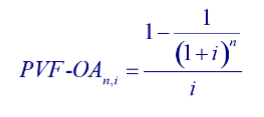
Present Value of ordinary annuity
R= periodic rent
PVF-OAni = present value of an ordinary annuity of 1 for n periods at i interest
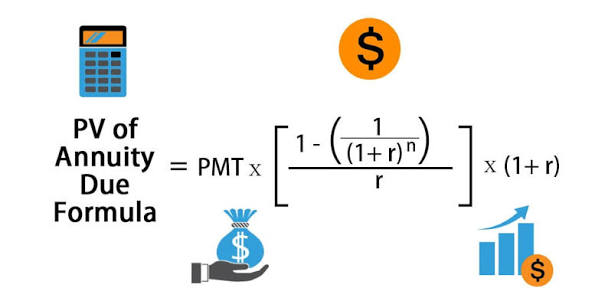
Present Value of Annuity Due
Deferred Annuity
Rents begin after a specified number of periods
Future Value of a Deferred Annuity
Calculation same as future value of an annuity not deferred
Present Value of a Deferred Annuity
Must recognize interest that accrues during deferral period
Valuation of long term bonds
Two Cash Flows:
• Periodic interest payments (annuity)
• Principal paid at maturity (single-sum)