AQA A level Psychology - Social influence
 Call Kai
 Learn
Learn Practice Test
 Spaced Repetition
 Match
Match Flashcards
 Knowt Play
1/78

There's no tags or description
Looks like no tags are added yet.
Name | Mastery | Learn | Test | Matching | Spaced | Call with Kai |
|---|
No analytics yet
Send a link to your students to track their progress
79 Terms
Conformity
A change in a person's behaviour or opinions as a result of real or imagined pressure from a person or group of people
Types of conformity - internalisation
Kelman (1958)
Genuinely accepts group norms
public + private change of opinions/behaviour
Permanent/persist in absence of group members
Attitudes have become part of how individual thinks (internalised)
Types of conformity - identification
Identify with group we value, want to become part of it
Publicly change opinions/behaviour even if privately don't agree with everything
Types of conformity - compliance
'Going along with others' publicly
No change in private opinion
Superficial change - opinions/behaviour stops when group pressure ceases
Explanations for conformity - 1: two process theory
Deutsch & Gerald (1955)
Two main reasons for conformity
2 central human needs: right to be right (ISI) / liked (NSI)
Explanations for conformity - 2: informative social influence (ISI)
Uncertain about what behaviours/beliefs are right or wrong
E.g. do not know answer to question in class, most other students agree, go along (feel they are probably right)
Cognitive process: desire to be right
More likely in new/ambiguous situations (not clear what is right)
Decisions need to be made quickly/group regarded as experts
Explanations for conformity - 3: normative social influence (NSI)
What is 'normal' - typical behaviour for social group
Regulate behaviour of groups/individuals
Emotional process: don't want to look foolish, prefer social approval over rejection
Strangers:don't know norms, look to others for how to behave, concerned about rejection
Friends: concerned about their social approval
More pronounced in stressful situations (greater need for social support)
Explanations for conformity - ISI (research support)
Lucas et al: students give answer to easy/difficult maths questions
More conformity to incorrect answers with difficult problems
Most true for those who rated maths ability as poor
People conform when they do not know the answer, predicted by ISI
Look to other people: assume they must be better than us/are right
Explanations for conformity - NSI (research support)
Asch line study: asked to explain why gave wrong answer
Some said self-conscious giving right answer/afraid of disapproval
Written answers: conformity fell to 12.5%
Supports that they were conforming due to NSI
Explanations for conformity - two process theory (oversimplified)
States behaviour due to either ISI or NSI
Conformity reduced with dissenter in Asch study
Reduced power of NSI (social support) or ISI (alternative source of info)
Isn't always possible to know if ISI or NSI is at work
Questions view of operating independently
Conformity: Asch's research - Asch's research (procedure)
123 American male students
Naive ppts tested individually with group of 6-8 confederates
Had to identify length of standard line (to 3 comparison lines - 2 clearly wrong)
Confederates: correct answer on first few trials
Same wrong answers on 12/18 critical trials
Conformity: Asch's research - Asch's research (findings/conclusions)
Ppts gave wrong answer on 36.8% of critical trials
High level of conformity
75% conformed on at least one trial
25% never conformed
Asch effect: conform even in unambiguous situation
Most said conformed to avoid rejection (NSI) but continued to trust own private opinion (compliance)
Conformity: Asch's research - Asch's research (variations: group size)
Number of confederates
2 confederates: conformity to wrong answer 13.6%
3 confederates: rose to 31.8%
Adding more made little difference
Conformity: Asch's research - Asch's research (variations: unanimity)
Introduced truthful confederate/dissenting but inaccurate
Reduced conformity: 25% wrong answers
Enabled ppt to behave more independently
Suggests influence of majority somewhat depends on unanimity
Conformity: Asch's research - Asch's research (variations: task difficulty)
Making stimulus line/comparison lines more similar in length
Conformity increased: ISI plays greater role when tasks harder
More ambiguous situation - look to others for what is right
Conformity: Asch's research - Asch's research (child of it's time)
Perrin & Spencer: repeated study with UK engineering students
Only one conformed in 396 trials
Felt more confident about measuring lines than original sample so were less conformist
1950s America: especially conformist time, may be less likely to conform today
Asch effect not consistent across situations/time - not fundamental feature of human behaviour
Conformity: Asch's research - Asch's research (artificial task)
Knew they were being studied - may have guessed aim and responded to demand characteristics
Trivial task - no reason not to conform
'Group' did not resemble most groups in everyday life
Does not generalise to everyday life (consequences more important/interact with groups more directly)
Conformity: Asch's research - Asch's research (limited application of findings)
Only men tested - may be subject to beta bias
Neto: women may be more conformist (more concerned about social relationships/being accepted)
American ppts - individualist culture (individual needs over group)
Smith & Bond: suggest higher conformity rates in collectivist cultures (group needs over individual)
Conformity levels sometimes even higher than Asch found
Findings limited to American men - no account for gender/cultural differences
Conformity to social roles - Zimbardo's research (1: procedure)
Stanford prison experiment (1973)
Brutality of prison guards: sadistic personality/created by situation?
24 'emotionally stable' students
Randomly assigned role: prisoner/guard
Arrested/blindfolded/strip-searched e.t.c.
Heavily regulated daily routines/rules enforced by guards
De-individualisation: losing sense of identity
Prisoner's numbers used instead of names, guards in uniform and given complete power
Conformity to social roles - Zimbardo's research (2: findings)
Prisoners rebelled within 2 days, guards retaliated
Guards constantly harassed prisoners/highlighted difference in social roles by enforcing rules
Guards behaviour threatened prisoners psychological/physical health (became anxious/depressed, 3 released early due to signs of psychological disturbance, one went on hunger strike)
More identified with role, more anger/aggression
Some appeared to enjoy power over prisoners
Study stopped after 6 days instead of intended 14
Conformity to social roles - Zimbardo's research (3: conclusions)
Revealed power of situation to influence behaviour
All within prison conformed to social roles
Conformity to social roles - Zimbardo's research (control over variables)
Emotionally stable ppts selected and randomly assigned to roles
Tried to rule out personality differences as explanation of findings
Given roles by chance: behaviour due to pressures of situation, not personalities
Increases internal validity - more confident in drawing conclusions about influence of social roles on behaviour
Conformity to social roles - Zimbardo's research (lack of realism)
Some argued that ppts were play-acting (behaviour reflected stereotypes)
One guard claimed he based his role on a brutal film character
Prisoners rebelled because they thought that was what prisoners did
Zimbardo:
90% conversations about prison life, some expressed views that prison felt real
Seemed real to them, increasing internal validity
Conformity to social roles - Zimbardo's research (role of dispositional influences)
Fromm: exaggerate power of situation and minimise power of dispositional (personality) factors
Only 1/3 guards acted brutally - another third treated them fairly and other third supported prisoners
Conclusions may be overstated
Differences in guards behaviour show they could exercise right and wrong choices (despite situational pressures to conform)
Obedience: Milgram's research (1 - procedure)
Original obedience study (1963)
Why did such a high proportion of Germans support the Holocaust?
40 male ppts recruited through newspaper ad (advertising memory study)
20-50yrs, all kinds of professions, $4.50 for turning up
'Drew lots' for role: ppts always teacher and confederate (Mr Wallace) always learner
3rd confederate (experimenter) in lab coat
Told they could leave study at any time
Learner fitted with electrodes in next room, ppts to give increasing 'shocks' when made mistakes on word pairs task
Unaware shocks were fake/Mr Wallace was an actor
15v (light shock) to 450v (danger - severe shock)
300v: learner pounded on wall and gave no response to next question
after 315v: pounded on wall, gave no further response
Standard instruction if turner to experimenter for guidance: 'absence of response should be treated as a wrong answer'
Unsure about continuing: prods
1. please continue
2. the experiment requires that you continue
3. it is absolutely essential that you continue
4. you have no other choice, you must go on
Obedience: Milgram's research (2 - findings/conclusions)
No participant stopped below 300v
5 (12.5%) stopped at 300v
65% continued to 450v
Observations: signs of extreme tension
Prior: psych students predicted behaviour - no more than 3% would continue to 450v
Unexpected findings
Ppts debriefed + assured behaviour was normal
84% glad they had participated
74% learned something of personal importance
Obedience: Milgram's research (low internal validity)
Ome & Holland: ppts guessed shocks were fake, not testing what he intended
Sheridan & King: ppts gave real shocks to puppy - 54% males / 100% females delivered what they thought was a fatal shock
Obedience in study may be genuine
70% believed shocks were real
Obedience: Milgram's research (good external validity)
Milgram argued lab-based relationship between experimenter/participant reflected wider real-life authority relationships
Hofling et al: levels of obedience in nurses to unjustified demands by doctors over the phone were very high (21/22 obeyed)
Processes of obedience in study can be generalised
Obedience: Milgram's research (supporting replications)
French documentary: contestants in TV gameshow paid to give fake electric shocks to other ppts (actors) when instructed by presenter
80% gave maximum 450v to seemingly unconscious man
Also showed many signs of anxiety
Supports Milgram's conclusions about obedience to authority (not just a one-off)
Obedience: situational variables (1 - proximity)
Original study: teacher/learner in adjoining rooms, could hear but not see
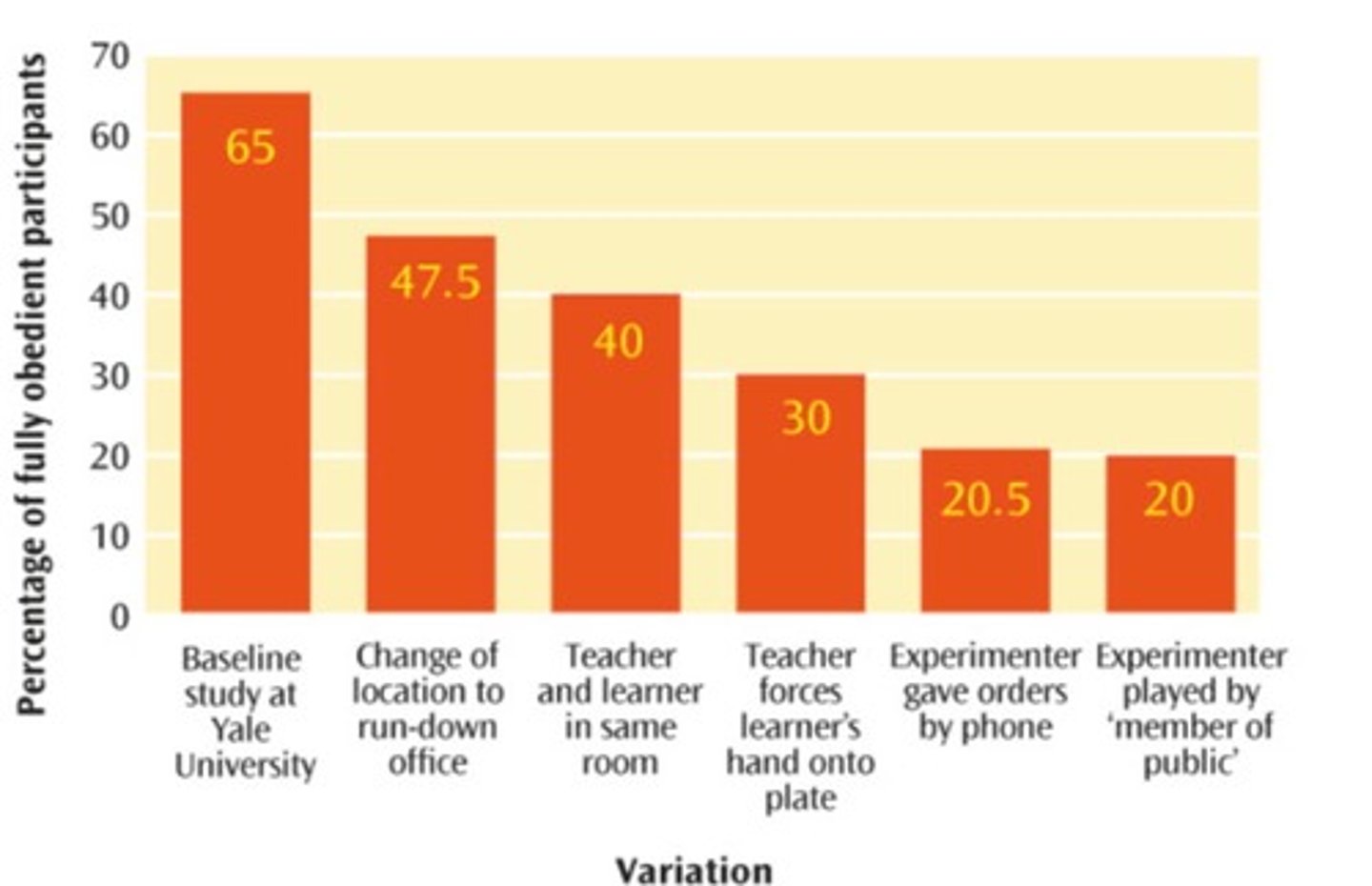
Proximity variation: same room, obedience dropped to 40%
Touch proximity variation: force hand on shock plate, obedience dropped to 30%
'Remote-instruction' proximity variation: instructions over phone, obedience dropped to 20.5% (frequently pretended to give/gave weaker shocks)
Obedience: situational variables (2 - location)
Run-down building rather than Yale university
Obedience fell to 47.5% - experimenter had less authority in this setting
Obedience: situational variables (3 - uniform)
Original: experimenter wore grey lab coat as symbol of authority
Variation: experimenter called away at start by phone call and replaced by 'ordinary member of the public' (everyday clothes)
Obedience dropped to 20% (lowest of all variations)
Uniform = strong visual authority symbol/cue to act in obedient manner
Obedience: situational variables (graph)
Obedience: situational variables (research support)
Bickman: field experiment
Effect of authority on obedience
Confederate dressed in jacket/tie, milkman's outfit, security guard uniform
Asked to provide coin for parking meter/pick up litter etc
2x as likely to obey security guard than jacket/tie
Support Milgram's conclusion: uniform conveys authority/produces obedience
Obedience: situational variables (lack internal validity)
Ome & Holland: ppts in variations even more likely to realise procedure was fake due to extra experimental manipulation
Replaced by member of public: even Milgram recognised so contrived they may have worked it out
Unclear whether results are due to obedience or 'play acting' (ppts saw through deception)
Obedience: situational variables (cross-cultural replications)
Miranda et al: obedience over 90% for Spanish students
Findings not just limited to American males
Smith & Bond: most replications taken place in Western cultures, not that different from USA
Premature to conclude findings apply universally
Obedience: social-psychological factors - agentic state
Occurs when we act on behalf of another person (become an 'agent')
Feel no personal responsibility for actions
Experience high anxiety (moral strain): realise what they're doing is wrong but feel powerless to disobey
Opposite = autonomous state (behave according to own principles/feel responsible for actions)
Agentic shift = shift from autonomy to agent (occurs when perceive someone else as an authority figure due to position in a social hierarchy)
Binding factors = aspects of situation that allow someone to ignore/minimise damaging effect of behaviour
Reduce moral strain
E.g. shifting responsibility to victim/denying damage
Obedience: social-psychological factors - agentic state (research support)
Blass & Schmidt: showed students film of Milgram's study, asked to identify who was responsible for harm to learner
Students blamed experimenter rather than ppt due to legitimate authority (experimenter = top of hierarchy) but also expert authority (scientist)
Students recognised legitimate authority as cause of obedience, supporting explanation
Obedience: social-psychological factors - agentic state (limited approach)
Agentic shift doesn't explain many research findings
Milgram: some ppts did not obey
Humans are social animals in social hierarchies, should all obey
Hoflikng et al: nurses should've shown anxiety as they understood role in destructive process, was not the case
Can only account for some situations
Obedience: social-psychological factors - agentic state (cannot explain behaviour of Nazi's)
Mandel: German Reserve Police Battalion 101
Men obeyed orders to shoot civilians in small Polish town even though not directly ordered to (could be assigned other duties)
Challenges agentic shift: not powerless to obey
Obedience: social-psychological factors - legitimacy of authority
Most societies structured hierarchically
People in certain positions hold authority over the rest of us e.g. police officers, teachers, parents
Legitimate authority: agreed by society
Most accept authority figures should exercise power over others to allow society to function smoothly
Consequences: some people granted power to punish others
Give up independence to people we trust to exercise authority appropriately
Learn to accpet authority during childhood (parents/teachers)
Problems arise when becomes destructive
Charismatic leaders use legitimate authority destructively
Behave in ways that are cruel/dangerous
E.g. Milgram study: prods to order ppts to behave in ways against their conscience
Obedience: social-psychological factors - legitimacy of authority (useful account of cultural differences in obedience)
Countries differ in obedience to authority
Only 16% Australians went to top of voltage scale meanwhile 85% Germans did
Authority more likely to be accepted as legitimate in some cultures
Reflects how societies structured/children raised to respect authority figures
Increase validity of research
Obedience: social-psychological factors - legitimacy of authority (can explain real-life obedience)
Kelman & Hamilton: My Lai massacre (Vietnam War) explained by power hierarchy in US army
Army has authority recognised by government/law
Soldiers assume orders to be legal - even if to kill/rape/destroy villages
LOA gives reasons why destructive obedience is committed
Obedience: dispositional explanations - the authoritarian personality (1 - key study)
Investigated unconscious attitudes towards other racial groups
2000+ middle class white Americans
Developed several scales, including potential for facism scale (F-scale)
E.g. obedience/respect for authority is the most important virtue for children to learn
Authoritarians (scored highly) identified with strong people and were contemptuous of the 'weak'
Conscious of their own/others status
Showed excessive respect/defence to those of higher status
Cognitive style: fixed/distinctive stereotypes of other groups
Obedience: dispositional explanations - the authoritarian personality (2 - characteristics)
Adorno et al: wanted to understand anti-Semitism of the Holocaust
Believed unquestioning obedience is a psychological disorder ((tried to find causes in personality)
Concluded people with authoritarian personalities are especially obedient to authority (exaggerated respect/submissiveness, conventional attitudes towards race + gender)
Believe we need strong/powerful leaders to enforce traditional values
Inflexible outlook
Obedience: dispositional explanations - the authoritarian personality (3 - origin)
Forms in childhood through:
Harsh parenting
Strict discipline
Expectation of absolute loyalty
Impossibly high standards
Severe criticism
Conditional love (parents love depends on child's behaviour)
Creates resentment/hostility
Cannot express feelings directly against parents (fear reprisals)
Displaced onto those seen as 'weaker' (scapegoating)
Explains hatred of people seen as socially inferior (psychodynamic explanation)
Obedience: dispositional explanations - the authoritarian personality (support for link between personality and obedience)
Elms & Milgram: interviewed fully obedient participants - all scored highly on F-scale
Just a correlation between measured variables
Cannot conclude that authoritarian personality causes obedience
Third factor: may both be caused by lower level of education, not directly linked to each other at all
Obedience: dispositional explanations - the authoritarian personality (limited explanation)
Millions of Germans displayed obedient/anti-Semitic behaviour - didn't all have same personality
Unlikely that majority of population had authoritarian personality
Alternative explanation more realistic: social identity theory (SIT) - most Germans identified with the anti-Semitic state + adopted views
Obedience: dispositional explanations - the authoritarian personality (F-scale is politically biased)
Christie & Jahoda: aims to measure tendency towards right wing ideology
But both right and left wing authoritarianism (e.g. Chinese Maoism) require complete obedience to political authority
Not comprehensive dispositional explanation: doesn't explain obedience across whole political spectrum
Resistance to social influence: social support (1 - conformity)
Can help people resist conformity
Pressure to conform reduced with dissenting peers
Asch: dissenter doesn't have to be correct (someone else not following majority frees others to follow own conscience - 'model')
Effect not long lasting: dissenter starts conforming again, so does ppt
Resistance to social influence: social support (2 - obedience)
Pressure to obey reduce if another person seen to disobey
Milgram: obedience dropped from 65% to 10% when ppt joined by disobedient confederate
May not follow their behaviour but disobedience frees ppt to act from their own conscience
Resistance to social influence: social support (research support - conformity)
Allen & Levine (1971): independence increased with one dissenter in Asch type study
Occurred even if dissenter wore thick glasses/said he had problems with vision (couldn't accurately judge lines)
Resistance not motivated by following what someone else says
Enables someone to be free from group pressure
Resistance to social influence: social support (research support - obedience)
Gamson et al: found higher levels of rebellion (independence) than Milgram
Ppts were in groups (produce evidence oil company could use to run smear campaign)
29/33 (88%) rebelled
Peer support linked to greater resistance
Resistance to social influence: locus of control (1 - internals/externals)
Rotter (1966): internal vs external LOC
Internals: events controlled by themselves (e.g. exam performance depends on how hard you work)
Externals: things happen outside of their control (e.g. failed exam = bad teacher/hard questions)
Resistance to social influence: locus of control (2 - continuum)
Isn't simply a matter of being internal or external
Continuum: high internal one end, high external the other, low internal/external in the middle
Resistance to social influence: locus of control (3 - resistance to social influence)
Internal LOCs more likely to resist pressures to conform/obey
Take responsibility for own actions/experiences = more likely to act on own beliefs
High internal LOC: more self confident/achievement orientated/intelligent, less need for social approval (traits lead to greater resistance)
Resistance to social influence: locus of control (research support)
Support link between LOC/obedience
Holland: repeated Milgram study, recorded whether ppts were internals/externals
37% internals did not continue to 450v (showed independence)
23% externals did not
Internals showed greater resistance
Increases validity of LOC as explanation/confidence that it can explain obedience
Resistance to social influence: locus of control (contradictory research)
Not all research supports link between LOC/resistance
Twenge et al: analysed data from American LOC studies over 40 years
People have become more independent and more external
Resistance due to LOC: expect more internal
Challenges link
Results may be due to changing society - things increasingly out of our control
Resistance to social influence: locus of control (limited role)
Role in resisting SI may be exaggerated
Rotter: found LOC only important in new situations
Little influence in familiar situations (previous experiences always more important)
Often overlooked
People who have conformed/obeyed in specific situations in the past are likely to do so again, even with high internal LOC
Only helpful in explaining narrow range of new situations
Minority influence (1 - internalisation)
Minority influences beliefs/behaviour of other people
Distinct from conformity (majority influence)
Most likely to lead to internalisation
3 processes: consistency, commitment, flexibility
Minority influence (2 - consistency)
Increases interest from other people
Synchronic consistency: all saying the same thing
Diachronic consistency: all saying the same thing for some time
Others rethink own vies ('maybe they've got a point if..')
Minority influence (3 - commitment)
Sometimes engage in extreme activities to draw attention to views
Must pose risk to minority - demonstrates commitment to cause
Helps gain more attention (augmentation principle)
Minority influence (3 - flexibility)
Nemeth: consistency can be interpreted negatively
Repetition can be seen as rigid/off-putting to majority (unlikely to result in conversion)
Minority need to be prepared to adapt/accept reasonable counter arguments
Balance consistency/flexibility
Minority influence (4 - snowball effect)
Hear new viewpoint: likely to think about it more
Deeper processing important in conversion to minority viewpoint
Over time: increasing numbers of people switch from majority to minority viewpoint - have been 'converted'
More converted = faster rate of conversion (snowball effect)
Gradually minority becomes majority, social change has occured
Minority influence (5 - key study)
Moscovici et al: blue-green slides
6 ppts viewed 36 blue-green slides (varying intensity)
Stated green or blue
Conditions:
1. 2 confederates consistently said slides were green (2/3 trials) = same wrong answer on 8.42% of trials, 32% wrong answer at least once
2. confederates inconsistent about colour of slides = agreement fell to 1.25%
3. control group (no confederates) = wrong 0.25% of time
Minority influence (research support for consistency)
Moscovici et al: consistent minority opinion had greater effect on other than inconsistent opinion
Wood et al: meta-analysis of almost 100 similar studies, minorities seen as consistent most influential
Confirms consistency is major factor in minority influence
Minority influence (research support for deeper thought)
Change to minority position involves deeper processing of ideas
Martin et al: ppts given message supporting particular viewpoint, attitudes measured
Heard endorsement of view from minority/majority
Heard conflicting view, attitudes measured again
Less willing to change opinions to conflicting view if heard minority group
Suggest minority message had been more deeply processed/more enduring effect
Minority influence (artificial tasks)
E.g. identifying colour of slide far removed from how minorities try to change majority opinions in real life
Jury decision making/political campaigns: outcomes vastly more important
Lack external validity
Limited in what it tells us about minority influence in real life situations
Social influence and social change: lessons from minority influence research (1 - drawing attention)
Civil rights movement
Segregation in 1950s America: schools/restaurants in southern states exclusive to whites
Marches drew attention to situation by providing social proof of problem
Social influence and social change: lessons from minority influence research (2 - consistency)
Many marches/many taking part
Minority of population but displayed consistency of message/intent
Social influence and social change: lessons from minority influence research (3 - deeper processing)
Attention: many who had accepted status quo began thinking about unjustness of it
Social influence and social change: lessons from minority influence research (4 - augmentation principle)
Individuals risked lives
'Freedom riders' - mixed racial groups got on buses to challenge separate seating for black people
Many beaten/suffered mob violence
Social influence and social change: lessons from minority influence research (5 - snowball effect)
Activists (e.g. MLK) gradually got attention of US government
1964: Civil Rights Act passed - prohibiting discrimination
Change from minority to majority support
Social influence and social change: lessons from minority influence research (6 - social cryptomnesia)
Memory that social change happened but not remembering how
Some have no memory of events leading up to change
Social influence and social change: lessons from conformity research
Asch highlighted importance of dissent
One confederate always gave correct answers: broke power power of majority, encouraging others to dissent
Dissent has potential to lead to social change
Environmental/health campaigns exploit conformity processes by appealing to NSI
Provide info about what others are doing (e.g. normative messages on bins, 'bin it - others do')
Social change encouraged by drawing attention to what majority are doing
Social influence and social change: lessons from obedience research
Milgram: importance of disobedient models
Confederate refused to give shocks: obedience in ppts plummeted
Zimbardo: obedience can be used to create social change through process of gradual commitment
Once small instruction is obeyed it becomes more difficult to resist a bigger one
People 'drift' into new kind of behaviour
Social influence and social change (research support for normative influences)
Nolan et al: whether SI processes lead to reduction in energy consumption within a community
Hung messages on front doors of houses
Key message: other residents are trying to reduce energy usage
Significan decreases in energy use compared to control group (message to save energy without reference to otehr people's behaviour)
Conformity can lead to social change through operation of NSI
Social influence and social change (minority influence only indirectly effective)
Social changes happen slowly (e.g. taken decades for attitudes against drink-driving to shift)
Nemeth: effects of minority influence are indirect/delayed
Indirect: majority influenced on matters related to central issue, not issue itself
Delayed: effects not seen for some time
Limited explanation: fragile effects/narrow role in social influence
Social influence and social change (role of deeper processing questioned)
Moscovici's conversion explanation: minority/majority influence involve different cognitive processes
Minority influence causes individuals to think more deeply
Mackie: majority influence may create deeper processing if you do not share their views
Assume others think in same ways as us: when we find majority believes differently - forced to think hard about their arguments
Central element of minority influence challenged/may be incorrect
Doubt on validity of Moscovici's theory