topic 13A lattice energy born-haber cycle chem
 Call Kai
 Learn
Learn Practice Test
 Spaced Repetition
 Match
Match Flashcards
 Knowt Play
1/41

There's no tags or description
Looks like no tags are added yet.
Name | Mastery | Learn | Test | Matching | Spaced | Call with Kai |
|---|
No analytics yet
Send a link to your students to track their progress
42 Terms
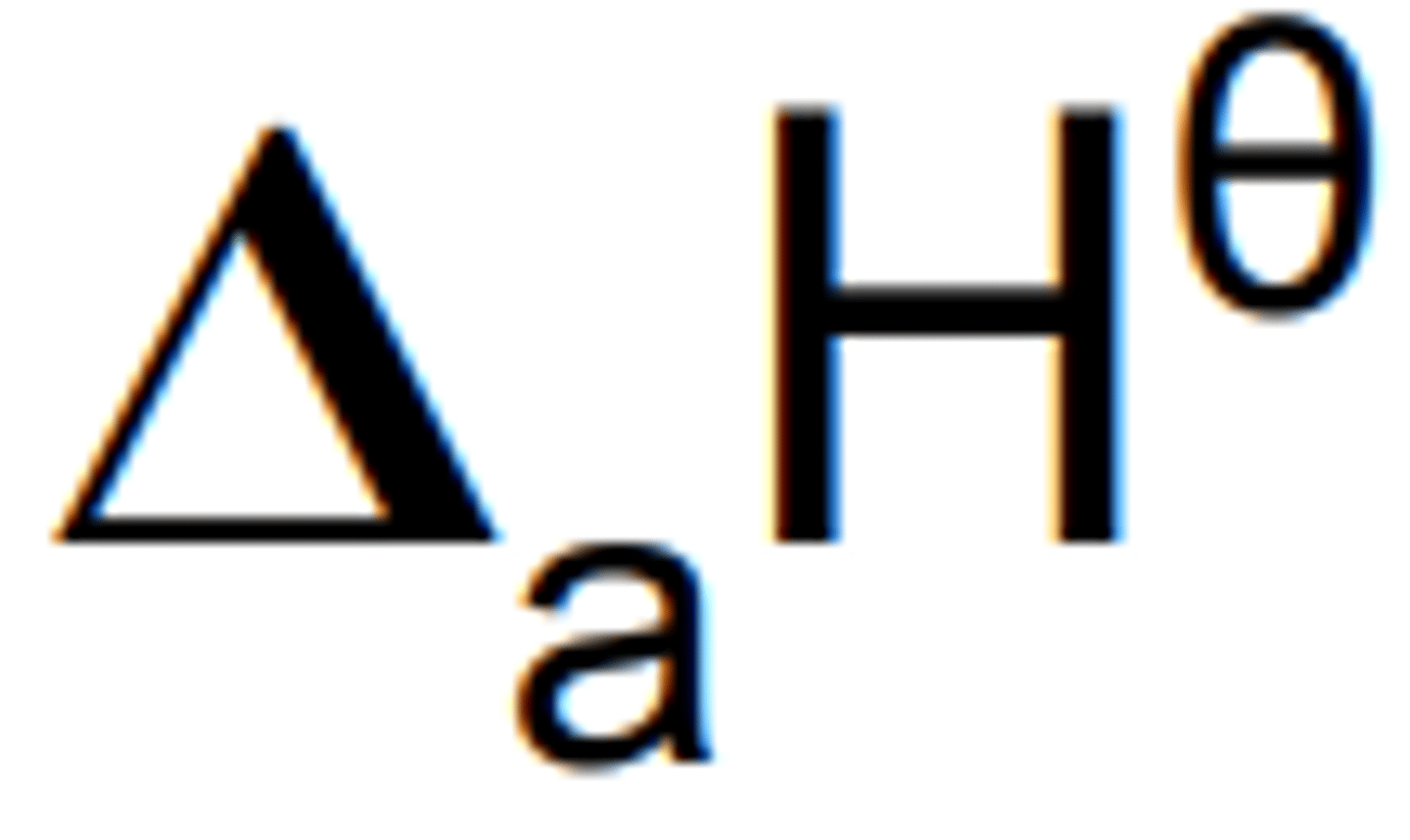
define standard enthalpy change of atomisation
energy change needed to produce 1 mole of gaseous atoms of the element (g)
Which equation does not represent a standard enthalpy change of atomisation?
A Mg(s) → Mg(g)
B Cl2(g) → 2Cl(g)
C ½O2(g) → O(g)
D Hg(l) → Hg(g)
B
2 mol of Cl is formed
draw a Born Haber cycle for NaCl
★ NaCl is made of its constituent elements, Na (s) and 1/2Cl₂ (g)
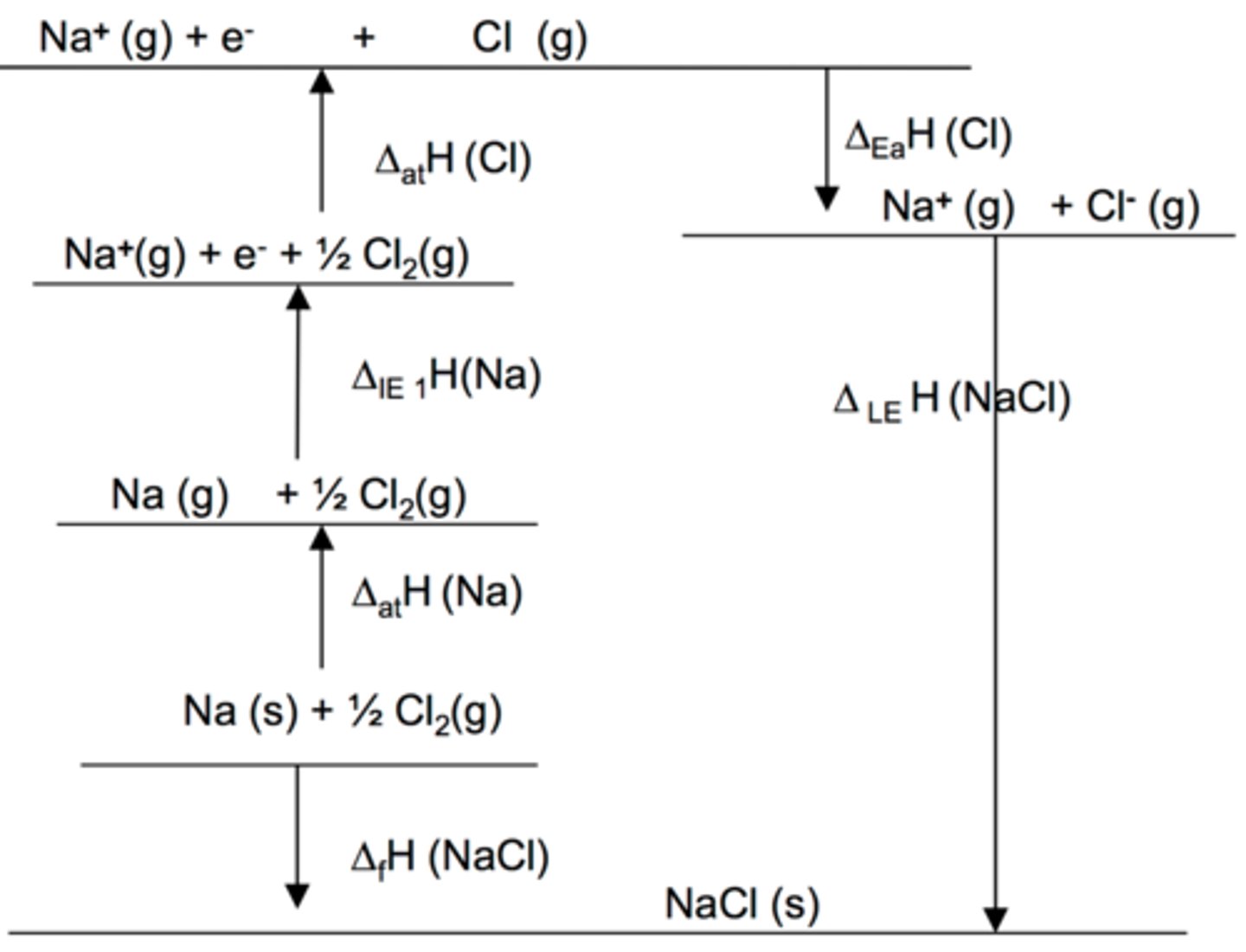
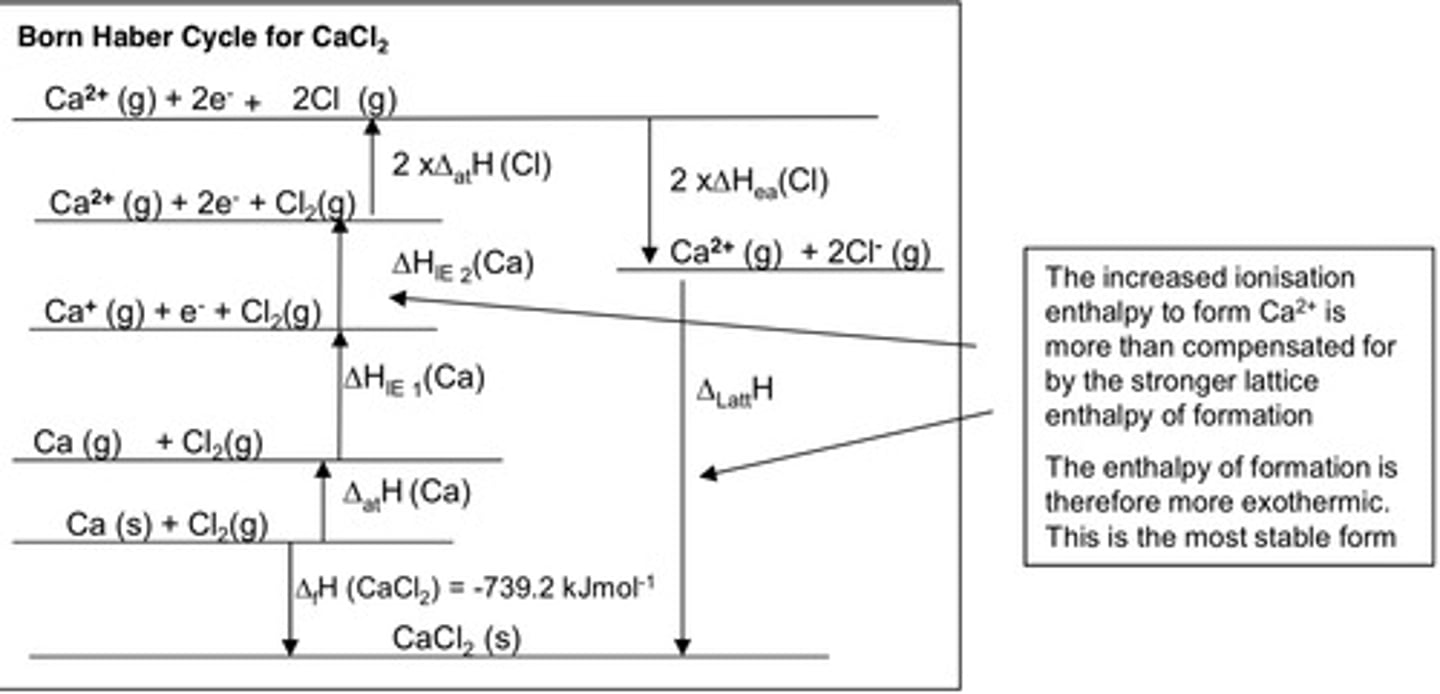
draw the born haber cycle for CaCl₂
★ during the atomisation of Cl₂, Cl₂ (g) is being atomised into 2Cl (g)
★ this means that you must times the ΔHₐₜ of Cl by x2
★ 1st ΔHₑₐ (electron affinity) of Cl should also be x2
write an equation for the first ionisation energy of Na
Na (g) => Na+ (g) + e-
write an equation for the third ionisation energy of Na
Na2+ (g) => Na3+ (g) + e-
is ionisation energy exothermic or endothermic?
endothermic (+) as it requires energy in order to overcome the force of attraction between the outermost electron and nucleus
definition of electron affinity
the energy change that occurs when an electron is acquired by a neutral atom
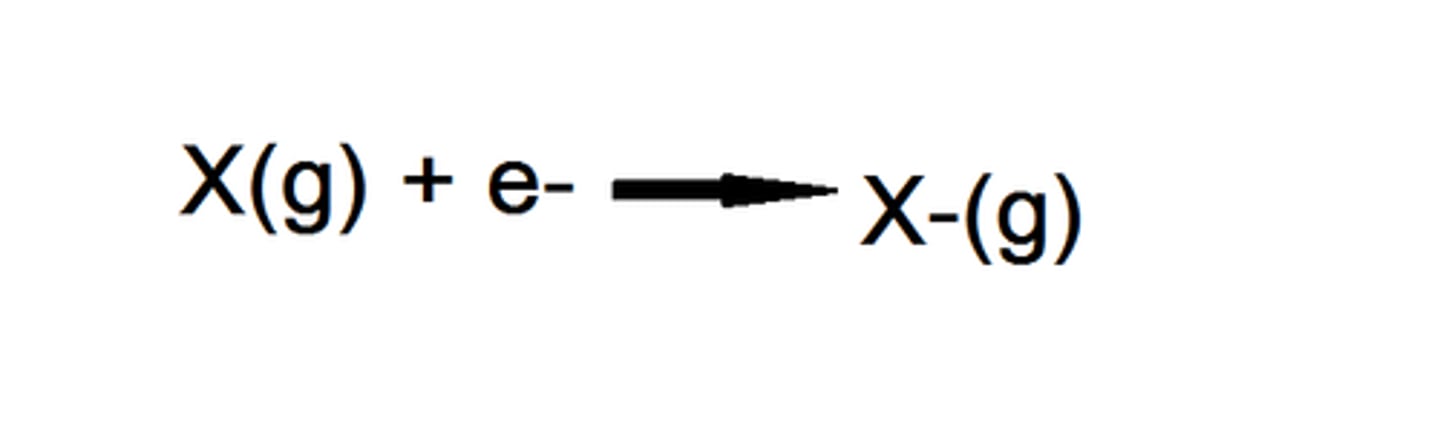
write an equation for the electron affinity of Cl
Cl (g) + e- => Cl- (g)
is first electron affinity endothermic or exothermic?
- exothermic (-)
- attraction between positive nucleus in neutral atom and incoming electron
then, is the second electron affinity endothermic or exothermic?
- endothermic (+)
- due to repulsion between negative ion and incoming electron
- we are adding an electron (-) to something that is already negatively-charged
define the term lattice energy (2)
- the energy change when one mole of an ionic solid is formed from gaseous ions
- ALWAYS EXOTHERMIC (-)
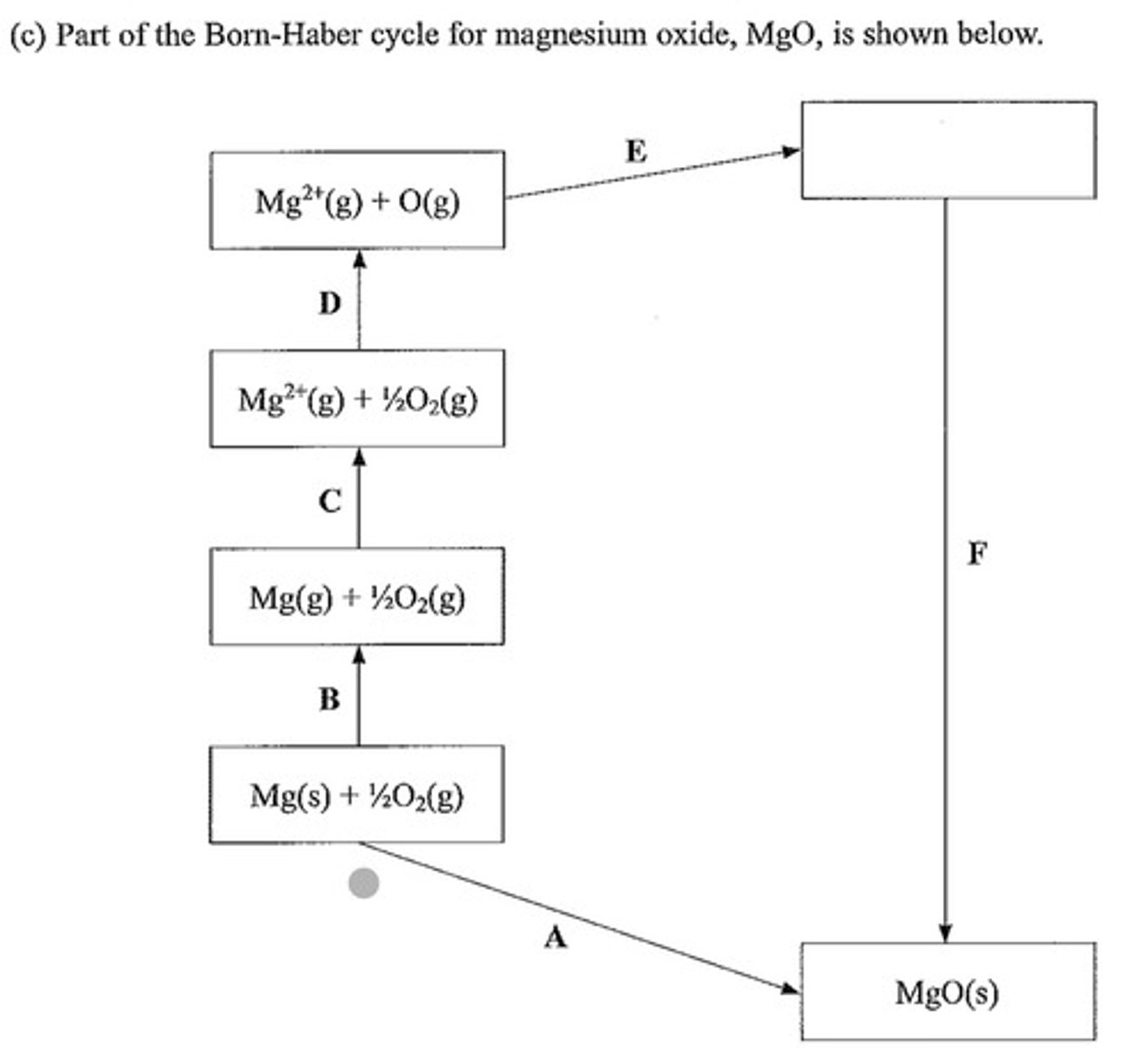
identify the enthalpy changes represented by the letters A and C
A - enthalpy change of formation of MgO
C - sum of first and second ionization energies of Mg
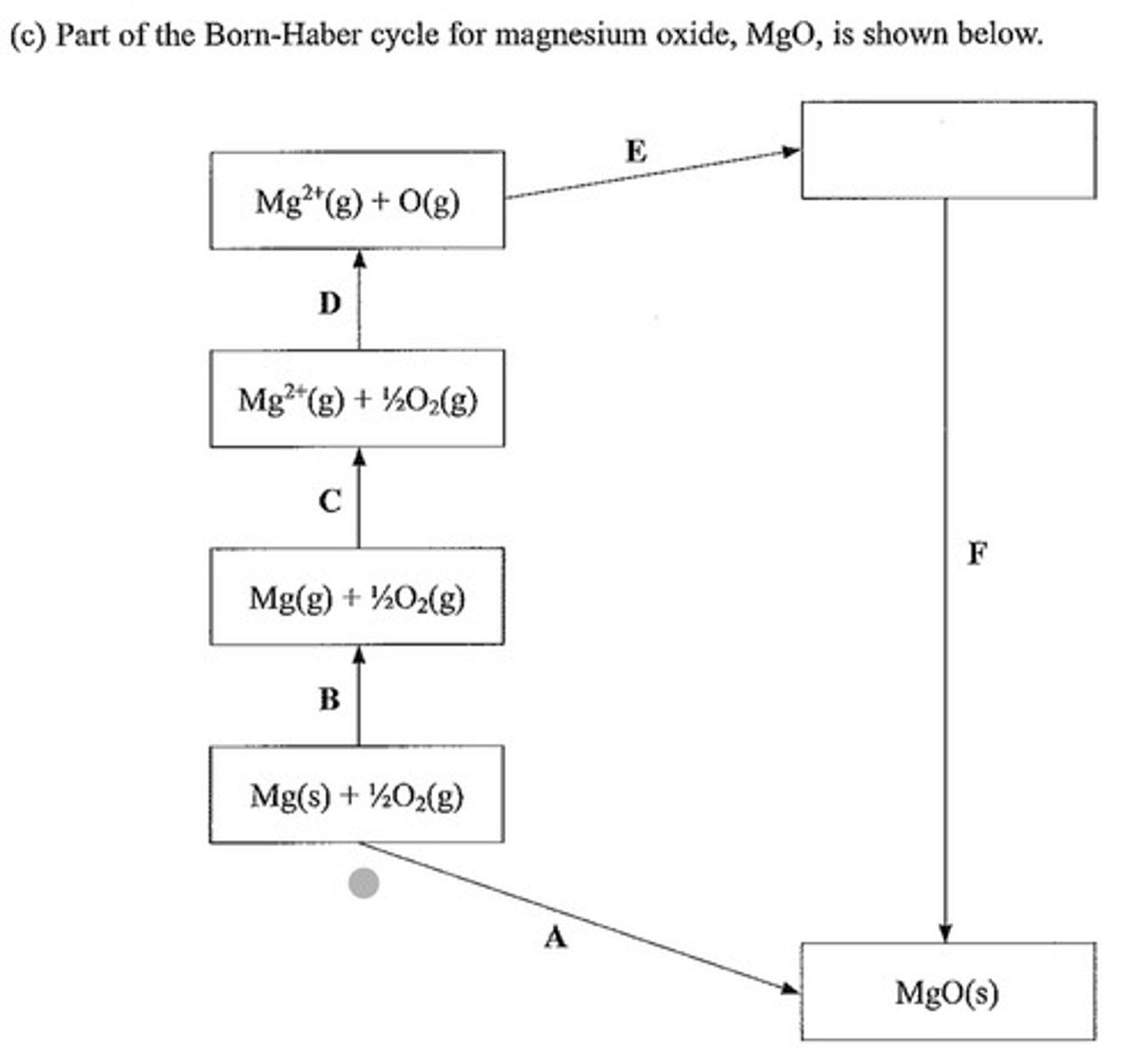
give the expression for the enthalpy change F in terms of other enthalpy changes A to E
F = A - B - C - D - E
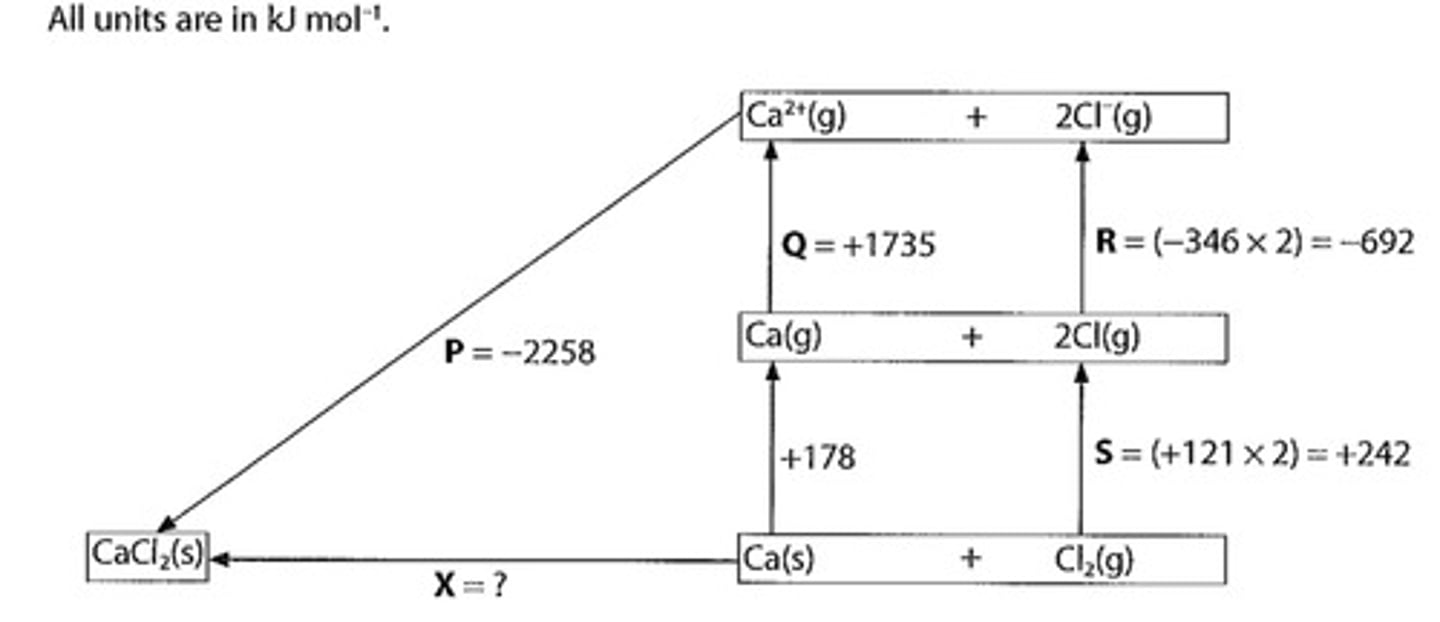
which enthalpy change is correctly labeled on the diagram?
A. enthalpy change for the formation of calcium chloride (P)
B. first ionisation energy of calcium (Q)
C. electron affinity for chlorine (R)
D. twice the enthalpy change of atomization of chlorine (S)
D
describe the forces of attraction in an ionic lattice (1)
forces of attraction between positive and negative ions
suggest 2 forces of repulsion which exist in an ionic lattice (2)
- ions of the same charge repel
- nuclei of the ions repel
suggest how the lattice energy of Mg2+O2- would differ from that of Mg+O-
- Mg2+O2- is more exothermic
state and explain how electron affinity changes as you go down group 7 from chlorine to iodine
- electron affinities become less negative
- as added electron is further from the nucleus
- increases shielding effect from nucleus
predict whether the lattice energy of MgO would be more or less exothermic than the lattice energy of MgS
justify your answer in terms of thee sizes and the shapes of the ions involved
- MgO would be more exothermic
- because S2- is larger than O2-
- while charge is the same on S2- and O2-,
- S2- has a smaller charge density
- O2- forms stronger electrostatic bonds than S2-
explain why is the bond enthalpy of fluorine lower than chlorine
- the size of the fluorine atom is very small, hence the electrons on the fluorine atom repel each other
- this repulsion is larger in fluorine than chlorine
give 2 assumptions used in the model to calculate theoretical lattice energy
- all bonding is ionic
- ions are perfect spheres (no distortion)
- charge is distributed evenly across ions
- ions in contact with one another
explain the difference in the experimental and theoretical value for the lattice energy of AgCl by considering the possible bonding models
- silver ion polarises the electron cloud
- so the bonding exhibit some covalent character
- stronger than ionic alone so experimental value is more exothermic
the lattice enthalpy of a compound, determined by a Born-Haber cycle (experimental lattice energy) generally differs from the theoretical value that can be calculated from the charge numbers and radii of its ions. suggest reason for this.
- experimental lattice energy is always more EXOTHERMIC (more heat given out)
- theoretical assume all the bonds are pure ionic bonding
- however some bonds could be covalent (eg polsarisation)
state what can be deduced by the close similarity of theoretical and experimental lattice energy values for barium iodide
barium iodide is almost 100% ionic
what properties of a cation results in the greatest polarising power?
small radius and high positive charge
eg Al3+
what properties of an anion result in the greatest polarisability (easily polarised)?
large radius (more electrons in shell)
eg I-
are these values lattice enthalpies of dissociation or formation? explain your answer.
LiBr (experimental): -800
NaBr (experimental): -733
AgBr (experimental): -890
LiBr (theoretical): -787
NaBr (theoretical): -732
AgBr (theoretical): -758
- formation
- since the value is negative (exothermic)
based on the given data, which of these compounds have the strongest ionic bonding? explain your answer.
LiBr (experimental): -800
NaBr (experimental): -733
AgBr (experimental): -890
LiBr (theoretical): -787
NaBr (theoretical): -732
AgBr (theoretical): -758
- AgBr
- its experimental value is the most exothermic
- suggesting it has the greatest electrostatic attraction in its lattice
which of these compounds has the most covalent character. explain your answer.
LiBr (experimental): -800
NaBr (experimental): -733
AgBr (experimental): -890
LiBr (theoretical): -787
NaBr (theoretical): -732
AgBr (theoretical): -758
- AgBr
- biggest difference between experimental and theoretical value
- suggest most covalent characteristics
silver bromide is insoluble in water but sodium bromide is soluble. using the data, suggest why this is the case.
LiBr (experimental): -800
NaBr (experimental): -733
AgBr (experimental): -890
LiBr (theoretical): -787
NaBr (theoretical): -732
AgBr (theoretical): -758
- since AgBr has the most covalent character, its distortion of ions will affect its interaction with water
- hence it is insoluble in water
explain why there is a significant difference in theoretical and experimental lattice energy values for magnesium iodide
- the Mg ion is small in ionic radius and highly charged
- iodide ion has a large ionic radius
- so the iodide ion becomes polarised by the Mg ion
- this causes the bonding in MgI to have partially covalent character
when researching bond enthalpy data, a student claimed that it was not necessary to find the value for the C=C bond since they could use the value of a C-C bond and multiply it by 2.
explain why the student is incorrect.
- C=C bond is weaker than 2x Cl-Cl
- as it consists of a pi and sigma bond
define enthalpy change of solution
- when one mole of a solid compound dissolves to form a solution of infinite aqueous dilution (where there is so much water that no further energy change will occur)
- eg NaCl (s) + aq -> Na⁺ (aq) + Cl⁻ (aq) [+3.8 kJmol⁻¹]
- can be exothermic or endothermic
define enthalpy change of hydration
- when one mole of gaseous ions dissolve in water to form an infinitely dilute aqueous solution
- eg Na⁺ (g) -> Na⁺ (aq) [-444 kJmol⁻¹]
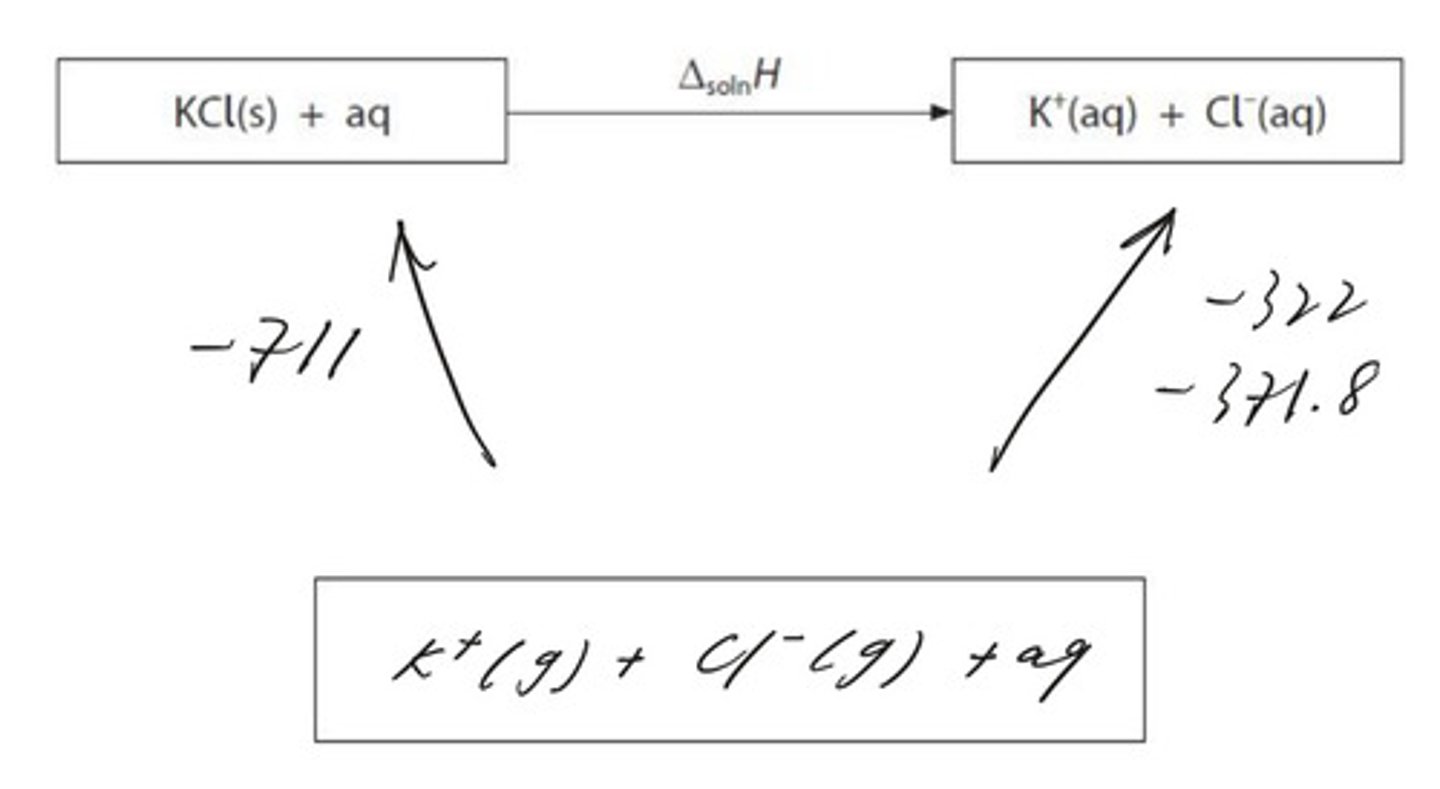
calculate the enthalpy change of solution of KCl by using the data given.
enthalpy change of hydration of K+ = -322
enthalpy change of hydration of Cl- = -371.8
lattice energy of KCl = -711
∆solnH = 711 - 322 - 371.8
∆solnH = +17.2 kJ mol-1
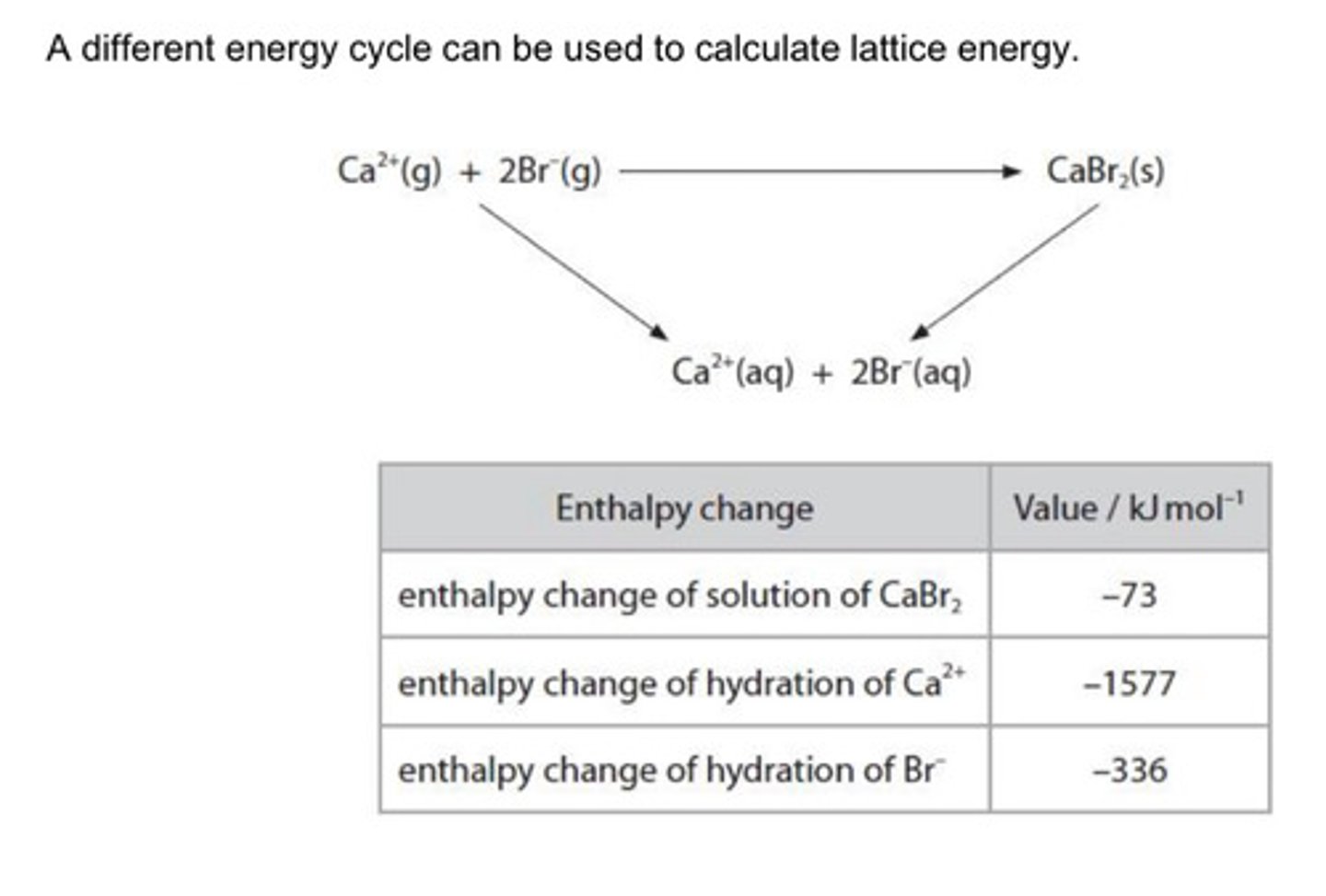
using the data given, calculate the lattice energy of calcium bromide.
enthalpy change of hydration of Ca2+ = -1577
enthalpy change of hydration of Br- = -336
enthalpy change of solution of CaBr2 = -73
-1577 + 2x336 + 73 = 2176
name 2 properties of ions that affect the value of their enthalpy change of hydration
- ionic charge
- ionic radius
describe how ionic size influence enthalpy of hydration value
- as ionic size increase
- enthalpy of hydration becomes less exothermic
describe how ionic charge influence enthalpy of hydration value
- as ionic size increases
- the nuclear charge decrease
- hence enthalpy of hydration become less exothermic
∆solnH of BaF2 = -7 kJ mol-1
∆solnH of BaCl2 = +17 kJ mol-1
use the data given above to explain why BaF2 (s) is less soluble than BaCl2
- in general, the more exothermic, the more thermodynamically feasible it is
- hence BaCl2, due to its endothermic value, is more able to dissolve since its less stable
- in terms of structure, Cl- contains more electrons than F- hence it is more polarisable
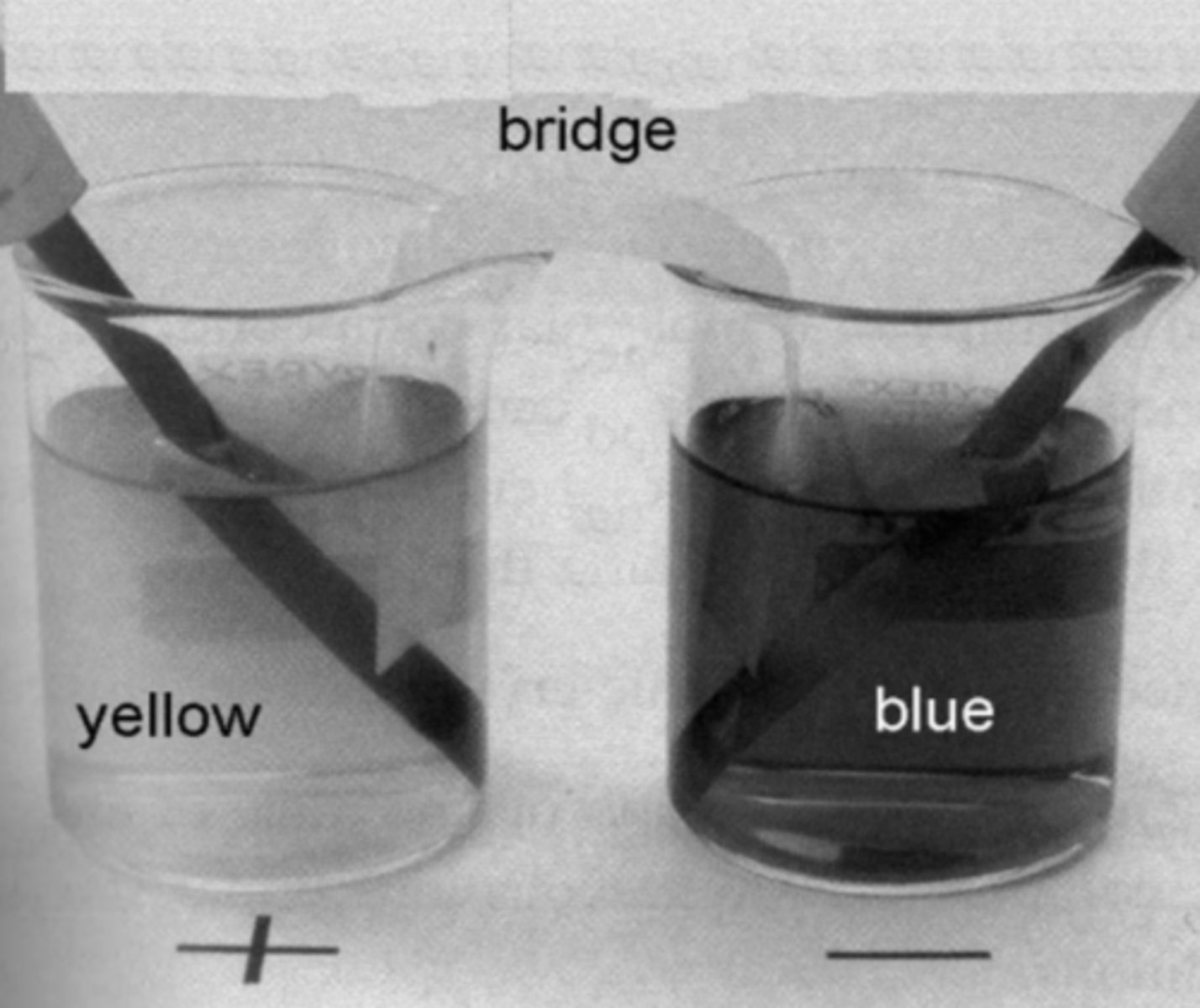
briefly describe an experiment, with a diagram of the apparatus you would use, which shows there are oppositely charged ions in copper(II) chromate(VI), CuCrO4.
describe what you would expect to see.
- the ions migrate
- yellow CrO4²⁻ moves towards the anode (1)
- blue Cu²⁺ moves towards cathode (1)