Ch. 4: Tissue Level of Organization
 Call Kai
 Learn
Learn Practice Test
 Spaced Repetition
 Match
Match Flashcards
 Knowt Play
1/207

Earn XP
Description and Tags
BIOL 2301 - Margarita Bracamonte - HCCS
Name | Mastery | Learn | Test | Matching | Spaced | Call with Kai |
|---|
No analytics yet
Send a link to your students to track their progress
208 Terms
What is a tissue?
A group of 2+ cells working together to perform a specific function.
What is histology?
The study of tissues.
What are the 4 main types of tissues?
Epithelial
Connective
Muscle
Nervous
Where is epithelial tissue found?
Covering the internal and external surfaces of the body.
What are examples of epithelial tissues?
Skin, linings of the digestive, respiratory, and urinary tract organs, etc.
What are the functions of epithelial tissue?
Provide physical protection
Control what enters the body/permeability
Produces and releasses secretions like sweat or oils
What is the overal characteristic of epithelial cells in the tissue?
They are close to each other with no gaping.
What does epithelial polarity refer to?
The differences between the top and the bottom surfaces of the epithelial tissue.
What is the apical surface of epithelial tissue?
It’s exposed surface (the top).
What is the basal surface of epithelial tissue?
It’s base.
What is the exposed layer of epithelial tissue called?
Apical surface.
What is the base layer of epithelial tissue called?
Basal surface.
What occurs at the basal surface of epithelial tissue?
Cell division.
What bonds epitheial tissue to the next structual layer?
The basement membrane or basal lamina.
What is the basement membrane?
A noncellula membrane that attaches the epithelial layer to the surface its attached to.
Is the basement membrane part of the epithelial tissue?
No.
What does avascular mean?
Lacks blood vessels
How are nutrients for epithelial tissues obtained?
Through diffusion from blood vessels in the underlying layer of (usually) connective tissue. or directly from the apical surface.
What is the rate of cell division in epithelial cells like comapred to other cells in the body?
It is the fastest.
CELL JUNCTIONS
What is the classification method of epithelial tissues?
By layer amounts and cell shape.
What are the three epithelial cell shapes?
Squamous
Cubodial
Columnar
What do squamous epithelial cells look like?
Thin and flat.
What is a factor of squamous epithelial cells in terms of function?
Since they are so thin, molecules can pass through it easily for absorption and nutrient release.
What do cubodial epithelial cells look like?
Cube-like.
What do columnar epithelial cells look like?
Tall and slender.
What is a factor of columnar epithelial cells in terms of function?
They are the thickest and least permeable.
What are the two kinds of epithelial layer amounts?
Simple
Stratified
What is a a simple epithelial tissue?
Epithelial tissue with than one layer of cells.
What are the characteristics of simple epithelium?
It is very thin and fragile tissue.
What are the typical functions of stratified epithelium?
Lining the inner body/protected places.
What is a stratified epithelial tissue?
Epithelial tissue with more than one layer of cells.
What are the characteristics of simple epithelium?
It is thick and resists abrasions well.
Where is stratified epithelium typically found due to its structure?
In ‘wear and tear’ locations like the skin, rectum lining, or surface of tounge.
How should epithelial tissues be named?
First by naming the shape then the classification of layer amounts.
Where should one look in order to classify the shape of the epithelial cells?
The cells on the apical surface.
What is pseduostratified epithelium?
Single-layer epithelial tissue that looks like it has more, has columnar cell shapes.
Why does pseudostratified columnar epithelial tissue looks like it has more than one layer?
Not all cells of this layer reach the apical surface, since they are squished, they apear shorter and to create more layers.
Do all pseudostratified columnar epithelial cells touch the basal surface?
Yes.
Do all pseudostratified columnar epithelial cells touch the apical surface?
No.
What can differ from cell to cell in pseudostratified columnar epithelial tissue? What does it lead the observer to believe.
The space between the nucleus and the apical surface, leads to the appearance of many layers.
What is the purpose of cilia on pseudostratified columnar epithelial tissue?
To move mucus towards thr throat for swallowing instead of the mucus and bacteria that could be attached to it to enter the respiratory system.
Is all pseudostratified columnar epithelial ciliated?
No.
Where is non-ciliated pseudostratified columnar epithelial tissue found in?
The male urethra.
What is transitional epithelium?
A tissue that looks like stratified cubodial tissue.
Where is transitional epithelium typically foound?
In the urinary bladder and ureters.
What is the state of transitional tissue in the urinary blanner when it is empty?
The cells on the apical surface appear cubodial and form a dome shape.
What is the state of transitional tissue in the urinary blanner when it is empty?
The cells on the apical surface appear squamous and form a flat shape.
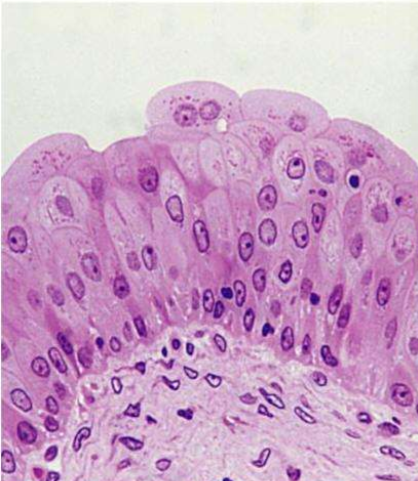
What is this image of?
Resting transitional epithelium tissue.
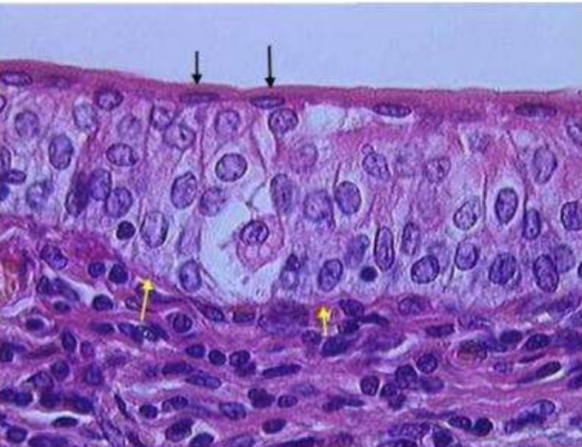
What is this an image of?
Active transitional epithelium tissue.
What are the functions of transitional epithelium?
Streching and recoiling of the urinary bladder and protection from pathogens.
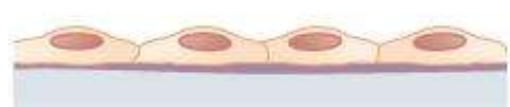
What is this kind of tissue?
Simple squamous epithelial tissue.
Where is simple squamous epithelial tissue found?
Air sacs of the lungs, heart linings, blood vessles, and lymphatic vessels.
What is the function of simple squamous epithelial tissue?
To allow for materials to pass through to lower layers of tissue through diffusion and filtration, as well as secreting lubrication substances for these organs.
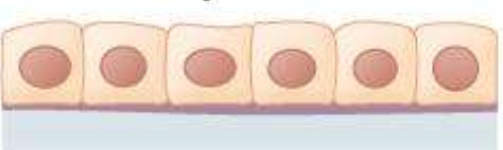
What type of tissue is this?
Simple cuboidal epithelial tissue.
Where is simple cuboidal epithelial tissue found?
In ducts/secretory portions of small glands and in kidney tubules.
What is the function of simple cuboidal epithelial tissue?
Secretion and absorption.
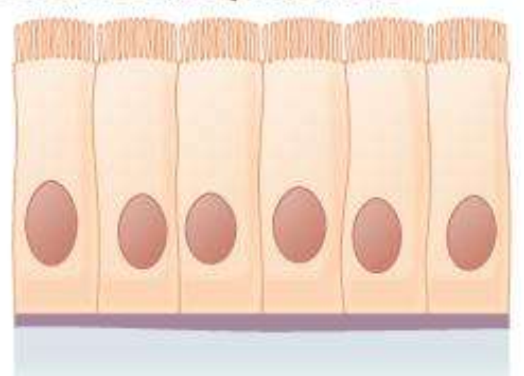
What type of tissue is this?
Simple columnar epithelial tissue.
What are two types of simple columnar epithelial tissue?
Ciliated - has cilia on the apical surface
Non-ciliated - does not have cilia on the apical surface
Where is ciliated simple columnar epithelial tissue found?Where is ciliated simple columnar epithelial tissue found?
In the brochi, uterine tubes, and the uterus.
Where is non-ciliated simple columnar epithelial tissue found?
In the digestive tract and bladder.
What is the function of simple columnar epithelial tissue?
Abroption and secretion of mucous and enzymes.
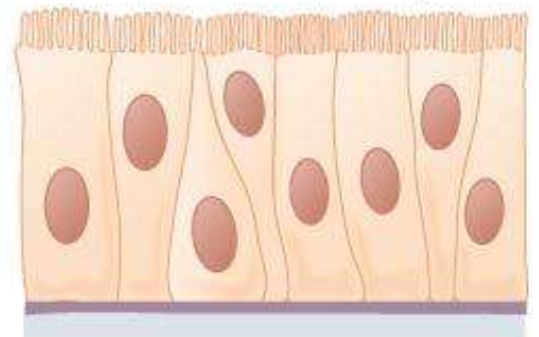
What type of tissue is this?
Psuedostratified columnar epithelial tissue.
What are the two types of psuedostratified columnar epithelial tissue?
Ciliated - has cilia on the apical surface
Non-ciliated - does not have cilia on the apical surface
Where is psuedostratified ciliated columnar epithelial tissue found?
Trachea lining and much of the upper respiratory tract.
Where is psuedostratified non-ciliated columnar epithelial tissue found?
Since it is rare, it is only found in the lining of the male urethra.
What is the function of psuedostratified columnar epithelial tissue?
Secretion and (if ciliated) movement of muscles.
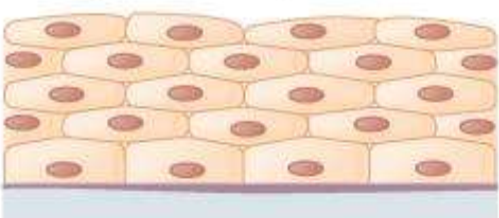
What type of tissue is this?
Stratified squamous epithelial.
Where is stratified squamous epithelial found?
Lining the esophagus, vagina, and mouth.
What is the function of stratified squamous epithelial?
For heavy duty protection agaisnt abrasions.
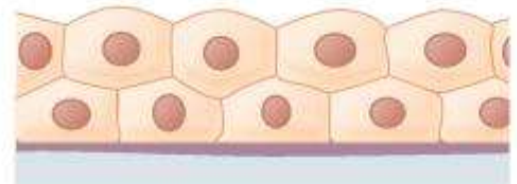
What type of tissue is this?
Stratified cuboidal epithelial.
What are some physical characteristics of stratified cuboidal epithelial tissue differ from transitional epithelial tissue?
The apical surface is flat and it does not form over 3 layers thick.
Where is stratified cuboidal epithelial found?
In sweat, salivary, and mammary glands.
What is the function of stratified cuboidal epithelial tissue?
Protection.
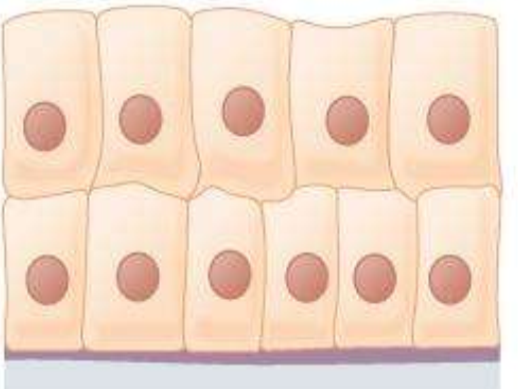
What type of tissue is this?
Stratified columnar epithelial tissue.
Where is stratified columnar epithelial tissue found?
The male urethra and some gland ducts.
What is the function of stratified columnar epithelial tissue?
Secretion and protection.
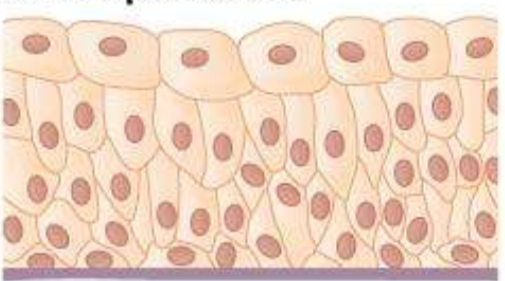
What type of tissue is this?
Transitional epithelial tissue.
Where is transitional epithelial tissue found?
Lining of the bladder, uretha, and ureters.
What is the function of transitional epithelial tissue?
Streching and reverting the urinary organs.
What is the most abundant tissue category in the body?
Connective tissue.
What is connective tissue?
Tissue that supports, protects, and binds together other tissues and organs in the body.
What is the cellularity of conenctive tissue?
Cells are not close together and are surrounded by the extracellular matrix.
What is the extracellular matrix?
A substance that grounds and keeps connective tissue cells in place.
What are the three different kinds of extracellular matricies?
Liquid
Jelly-like
Solid
What is an example of a liquid extracellular matrix?
Plasma in the blood.
What is an example of a jelly-like extracellular matrix?
Cartilage in the ear.
What is an example of a solid extracellular matrix?
Bone in the arms.
What does vascular mean as a characteristic?
Conrains blood vessels.
What can connective tissue be characterized by in terms of blood vessels?
Highly vascularlized.
What are the 6 main functions of connective tissue?
Structural framework of the body
Transportation of fluids/substances
Organ protection
Support, surround, and connect other tissues
Storage of energy
Protection of the body to microogranisms
What are the most common cells in connective tissues?
Fibroblasts.
What does connective tissue make and release?
Fibers.
What are fibers?
Proteins secreted by cells into the extracellular matrix.
What are the three main fibers found in connective tissue?
Collagen
Elastic
Reticualr
What is the most common fiber in connective tissues?
Collagen.
What are collagen fibers like physically?
Long and of a white color.
What are collagen fibers like characteristically?
Mediocrely flexible but extremely strong.
What are two body parts that are abundant in collagen fibers? What are they?
Tendons - connection of skeletal muscles to bones
Ligaments - connections of bones to other bones
What are elastic fibers like physically?
Long and skinny.