2 - measuring eye movements
 Call Kai
 Learn
Learn Practice Test
 Spaced Repetition
 Match
Match Flashcards
 Knowt Play
1/42

There's no tags or description
Looks like no tags are added yet.
Name | Mastery | Learn | Test | Matching | Spaced | Call with Kai |
|---|
No analytics yet
Send a link to your students to track their progress
43 Terms
What are the methods of measuring eye movements?
1. direct viewing
2. videocameras
3. photo-electric viewing
4. EOG/ENG
5. Scleral search coil
Direct viewing of eye movements can detect movements to what degree?
1-2º (2-3 prism diopters) by following limbus or some other landmark
how does direct viewing measure eye movements?
measure movement linearly as the landmark (limbus usually) on eye rotates
What is an advantage to measuring eye movements with videocameras (from direct viewing)?
gives you real time image of eye position which can be analyzed with a computer
How do video cameras measure eye movements?
tracks the center of pupil (first Purkinje image) with a video camera
Videocamera viewing of eye movements can detect movements to what degree?
15 minutes of arc → ~1/4th of a degree
Photoelectric viewing of eye movements can detect movements to what degree?
less than 5 mins of arc → ~1/12th of a degree
How does photoelectric viewing work?
uses a photocell (which detects light level) to measure movement of eye → illuminate subjects eye with infrared illumination and detects amount of reflected light
resistor detects changes of reflected light i.e. sclera (more) vs. iris (less)
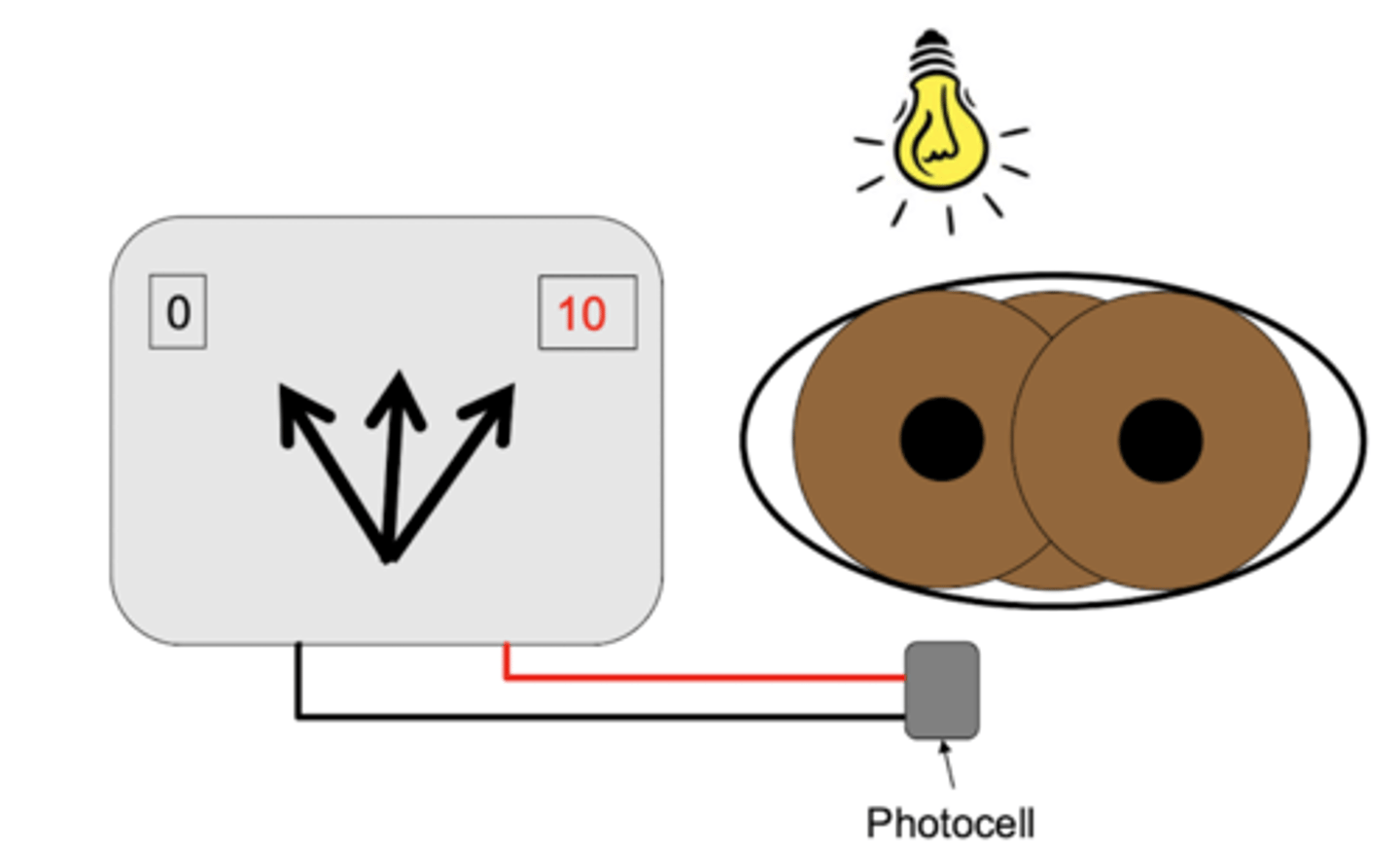
what does photoelectric viewing track?
the limbus
how does the iris and sclera affect light levels in photoelectric viewing?
iris absorbs light → lower light level
sclera reflect light → higher light level
How does ENG/EOG detect eye movements?
uses the cornea's positive charge and the retina's negative charge to detect different electrical potentials as the eye rotates
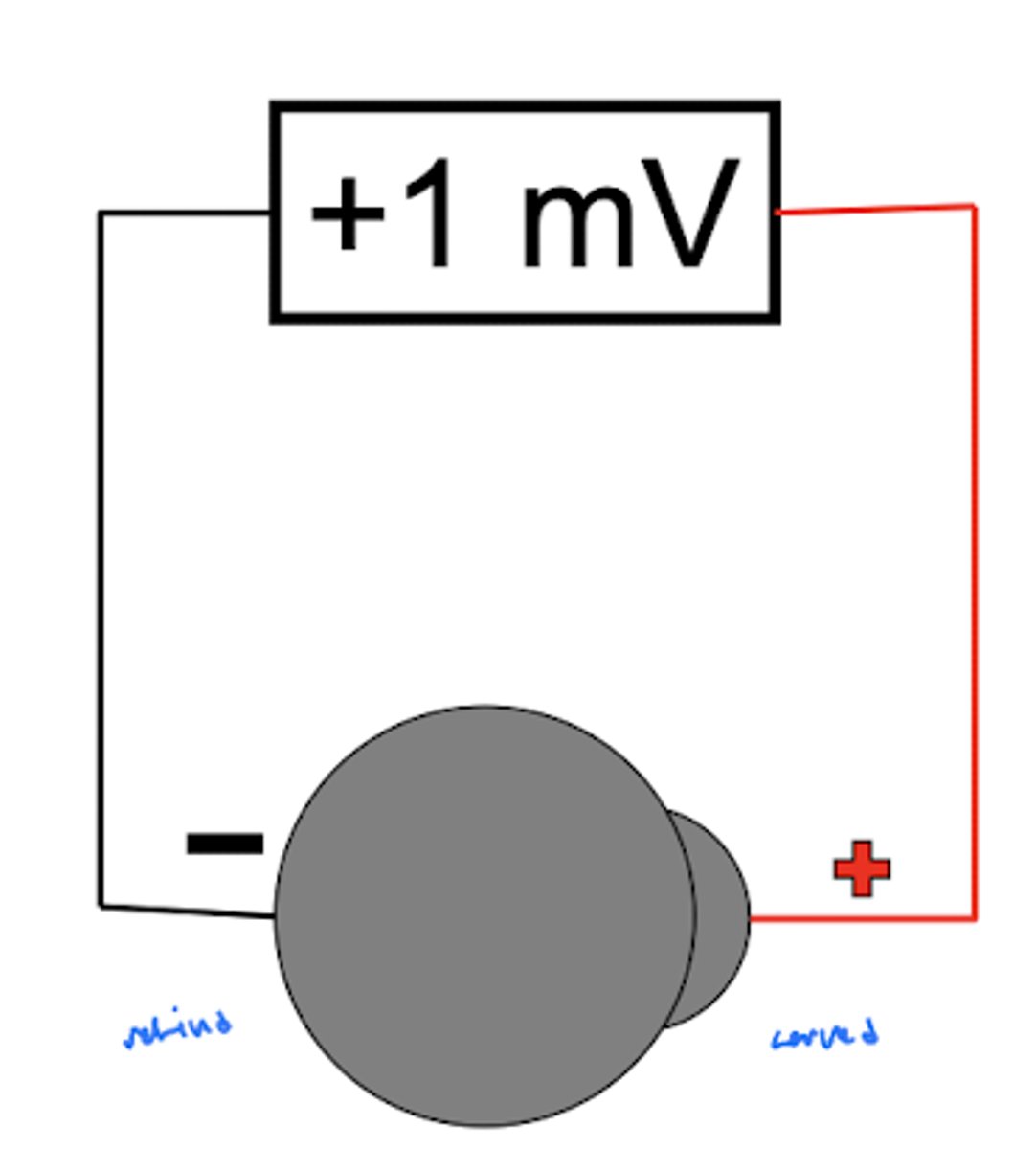
What are the advantages to ENG/EOG?
1. works well in assessing large eye movements (up to ±30°)
2. can measure both horizontal and vertical eye movements
3. works with eyes closed too
What are the problems with ENG/EOG?
1. there is noise → picks up face/blink muscles
2. resolution is typical only to 1º
How does scleral search coil work?
small silicone annulus lens with a wire in it is placed on the eye and patient is put in magnetic field → when the eye moves the coil, a voltage is created that is proportional to the sine of the angle between the plane of the eye coil and direction of the magnetic field
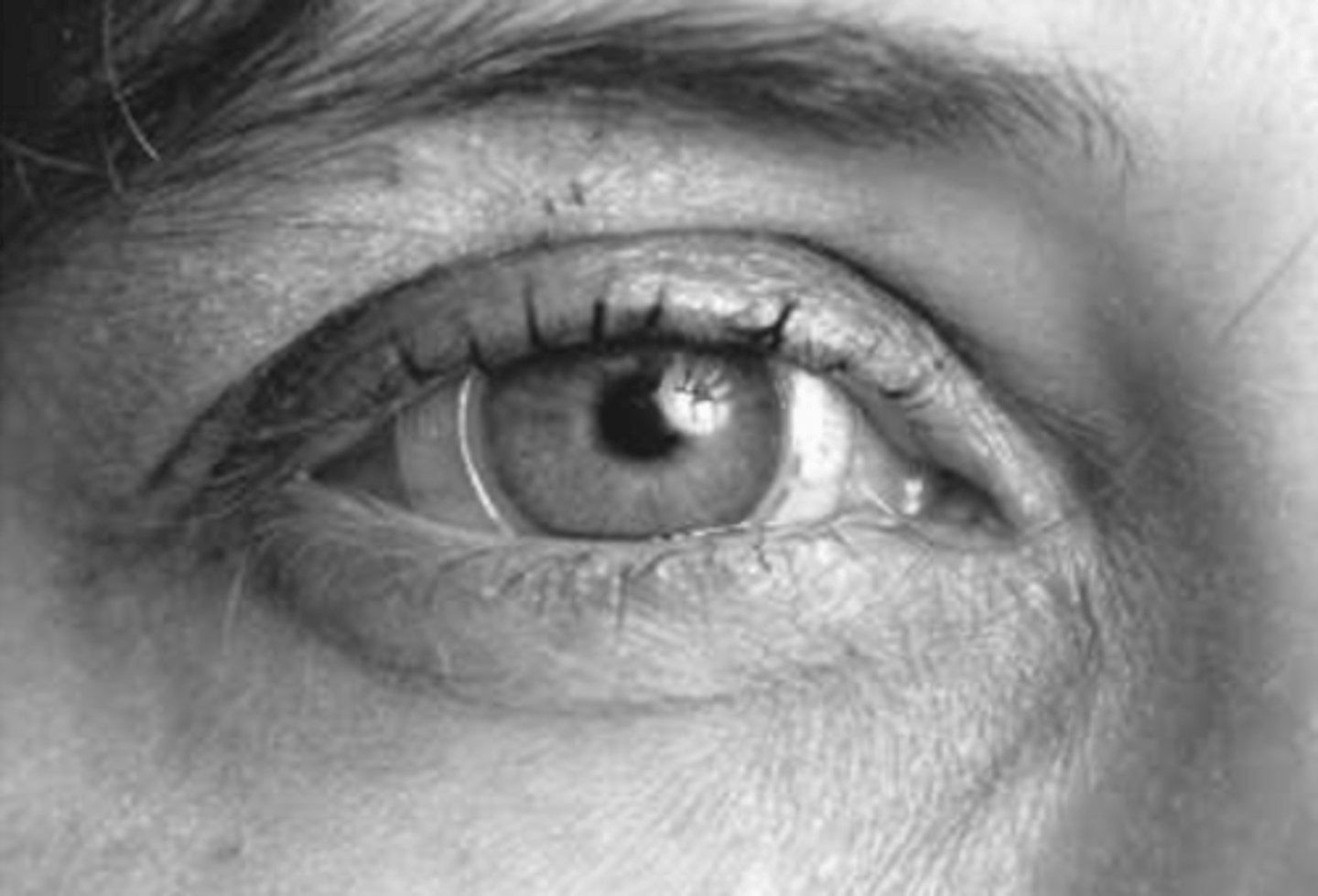
What is the main advantage to the scleral search coil method?
can detect seconds of arc movements → best research method available
What is the main disadvantage to the scleral search coil method?
search coil could slip at large angles of gaze
What type of data do continuous eye movements produce?
they produce an analog signal
analog and continuous are synonyms
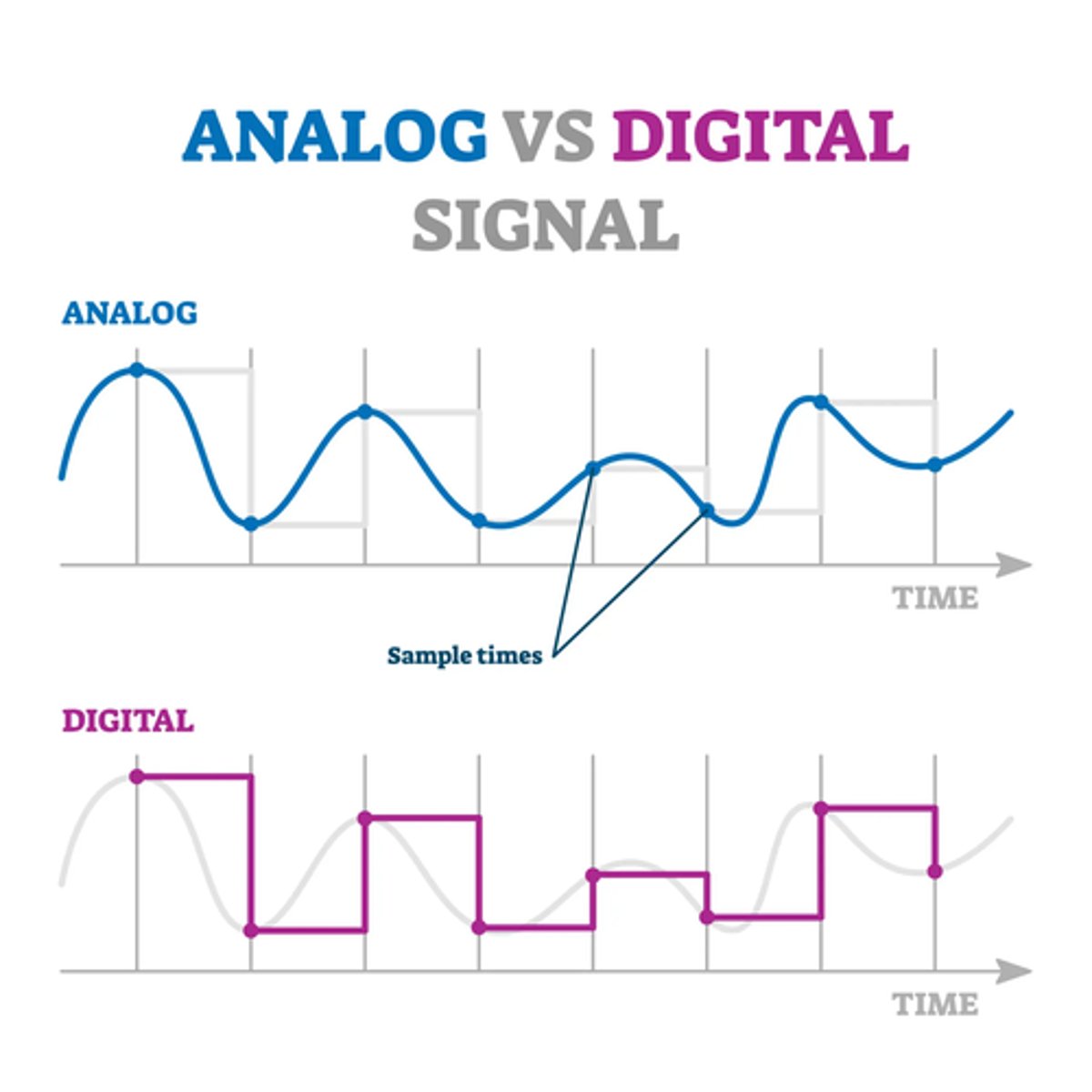
Which eye movement trackers are continuous?
1. limbal trackers (photo-electric)
2. ENG/EOG
3. search coil
What are the disadvantages of video eye trackers?
non-continuous → do not know what eyes are doing between frames
what happens if the eye movement frequency is higher than sampling frequency when using video eye trackers?
can misinterpret data → i.e. aliasing
How is eye movement typically graphically represented?
on a graph with time on x-axis and horizontal or vertical eye position on y-axis
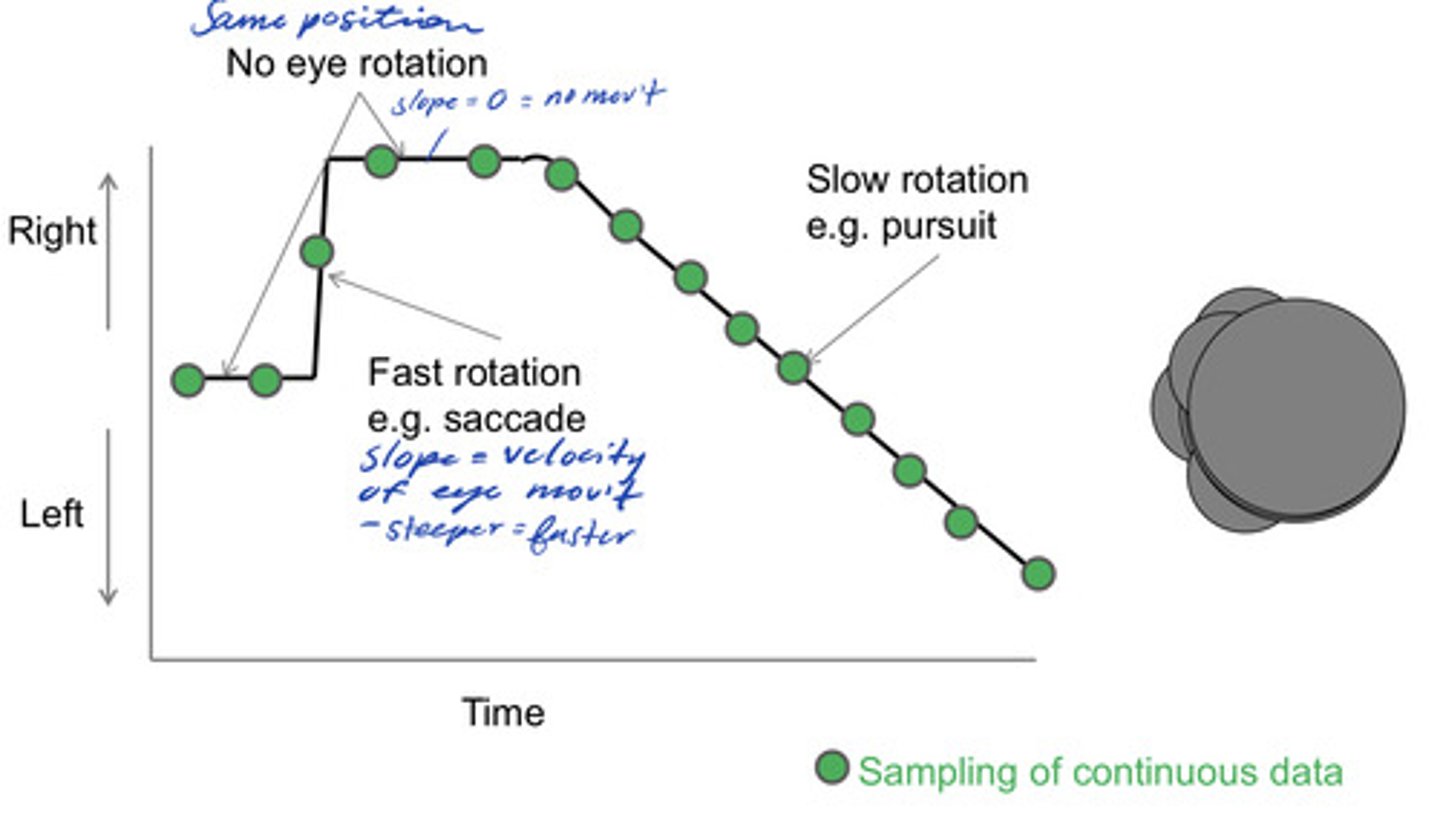
what does the slope look like for fast eye movements? slow eye movements?
fast velocity → steep slope
slow velocity → less steep slope
What did we originally believe about eye movements with reading?
eyes flowed across text taking in information in a continuous stream
What are fixations?
eye stops/pauses of the eye
When do the number of fixations/portion of text increases in reading?
1. increased difficulty of material
2. poor readers
What type of words are more likely to be fixated?
bigger words
What are interfixation/saccade eye movements in reading?
movement of eyes across the page
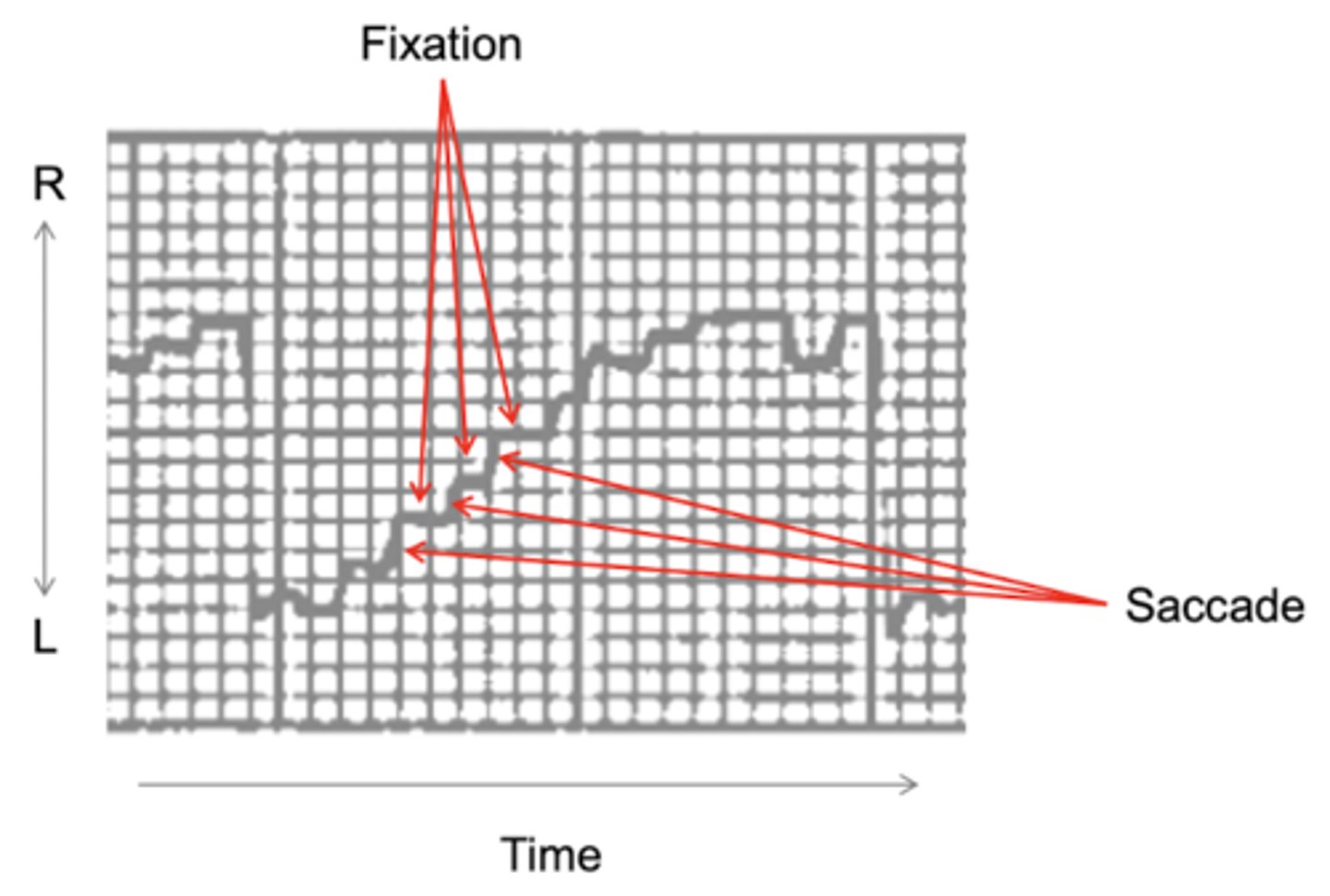
What is the average magnitude of a saccade when reading?
1.5 degrees or ~8 characters
What is a regressive saccade?
saccade directed from right to left (backward) on same line of text
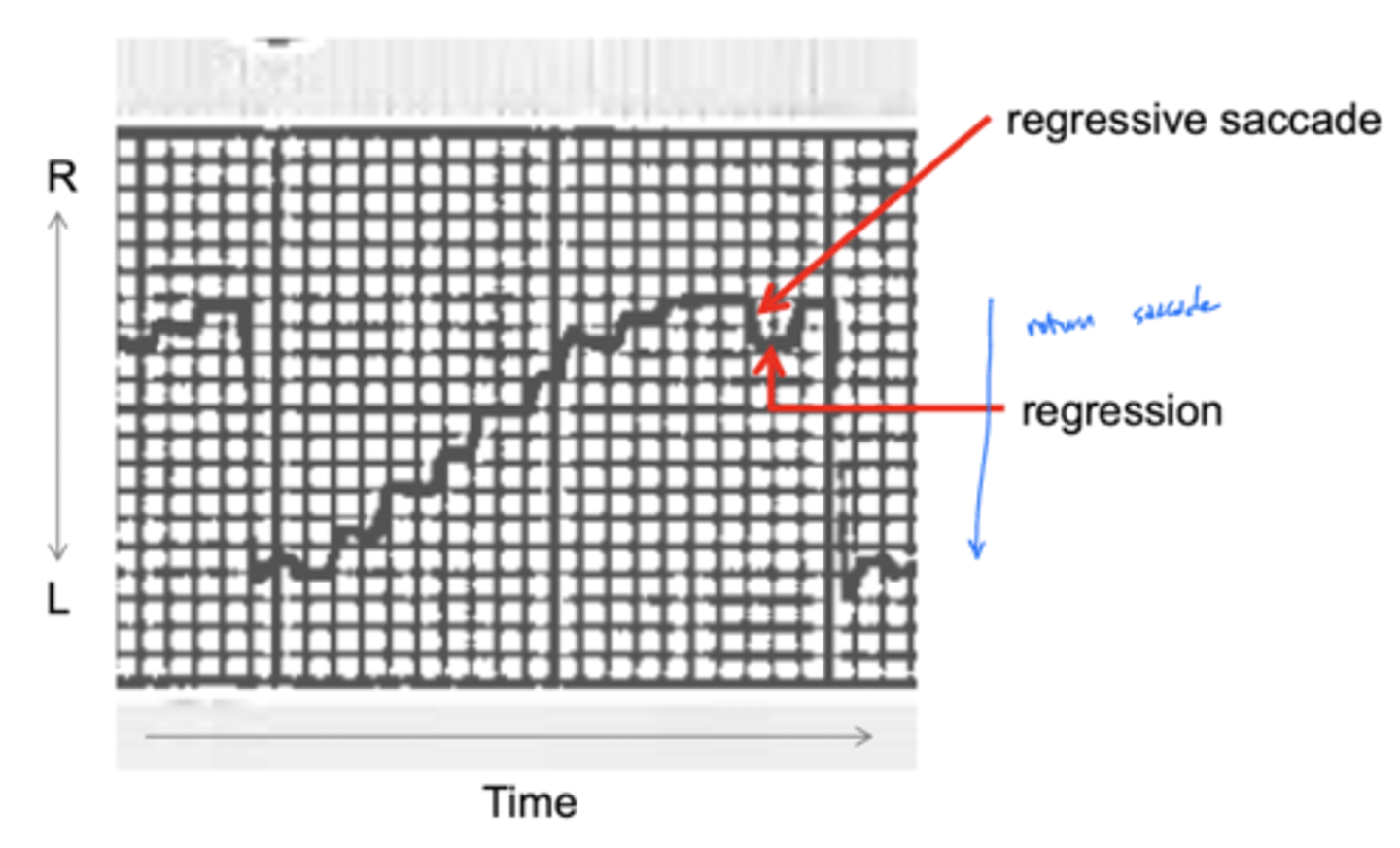
when do regressions occur while reading?
confusing text or unfamiliar words can cause readers to go back when reading
What is a regression?
fixation that occurs after a regressive saccade
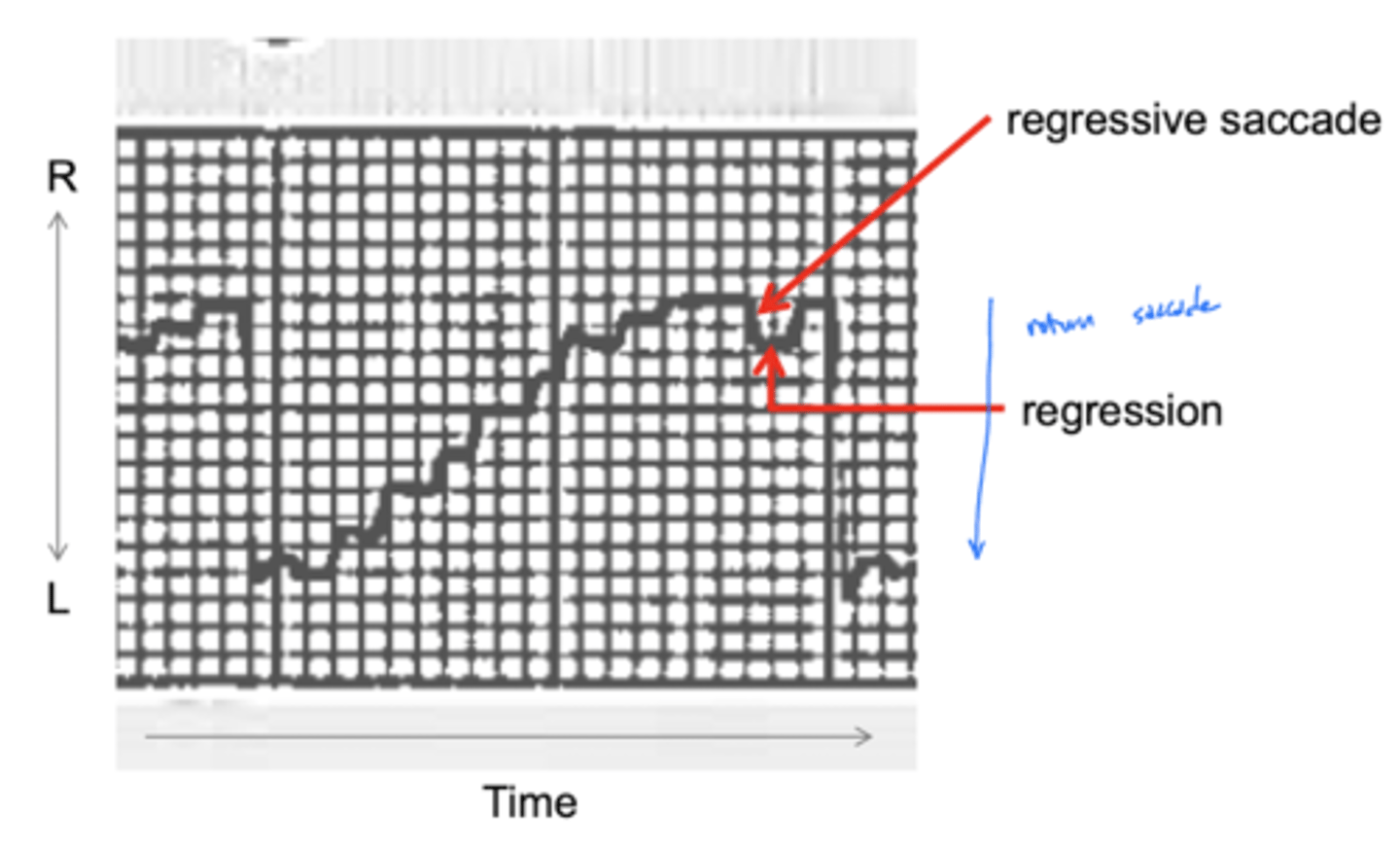
In what patients do we find increased regressive saccades/regressions?
poor readers
About what % of saccades are regressive when reading?
10-15%
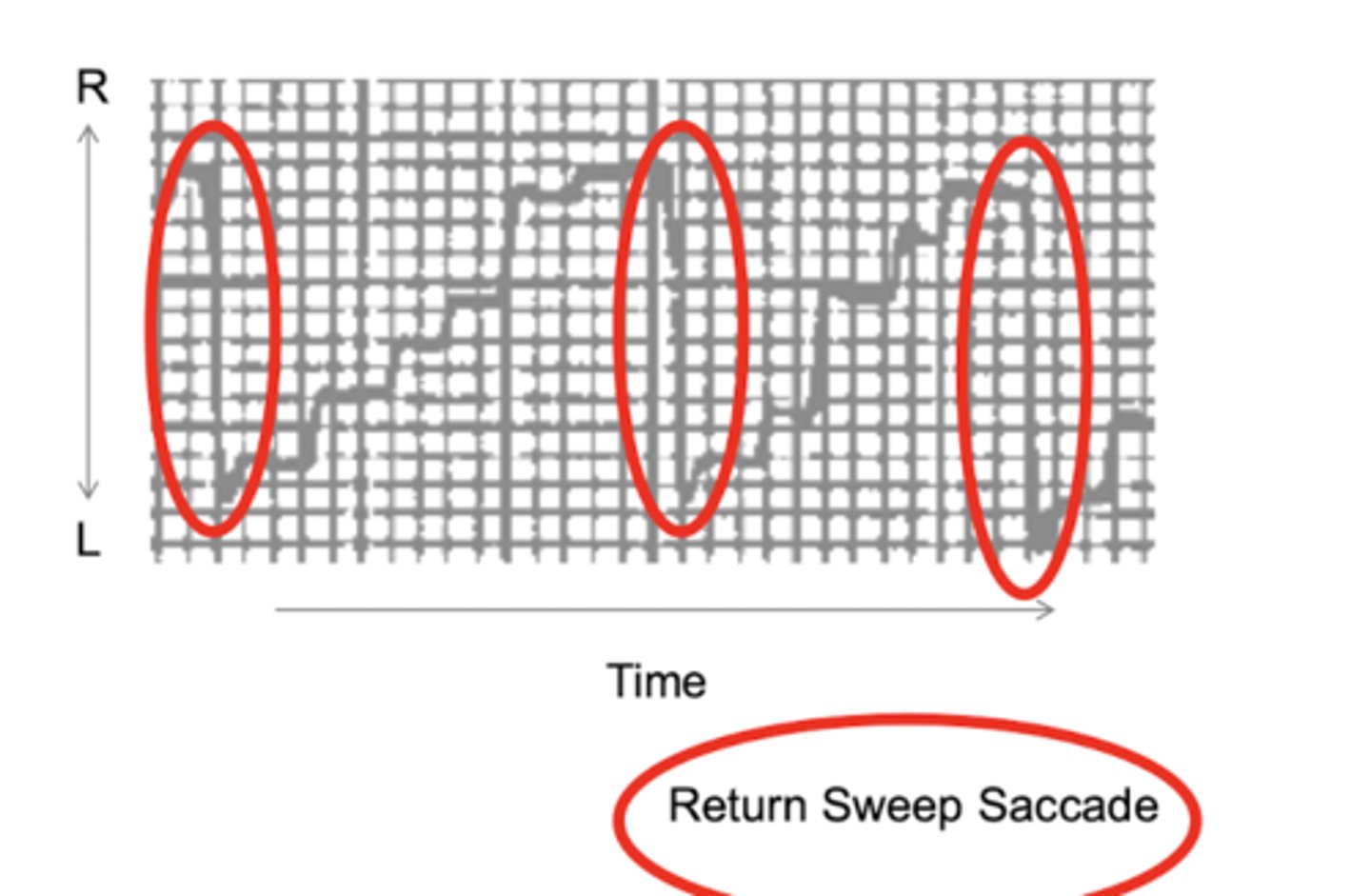
What is a return-sweep saccade?
large right to left saccadic eye movement that shifts eyes from near the end of one line to near the beginning of the next line
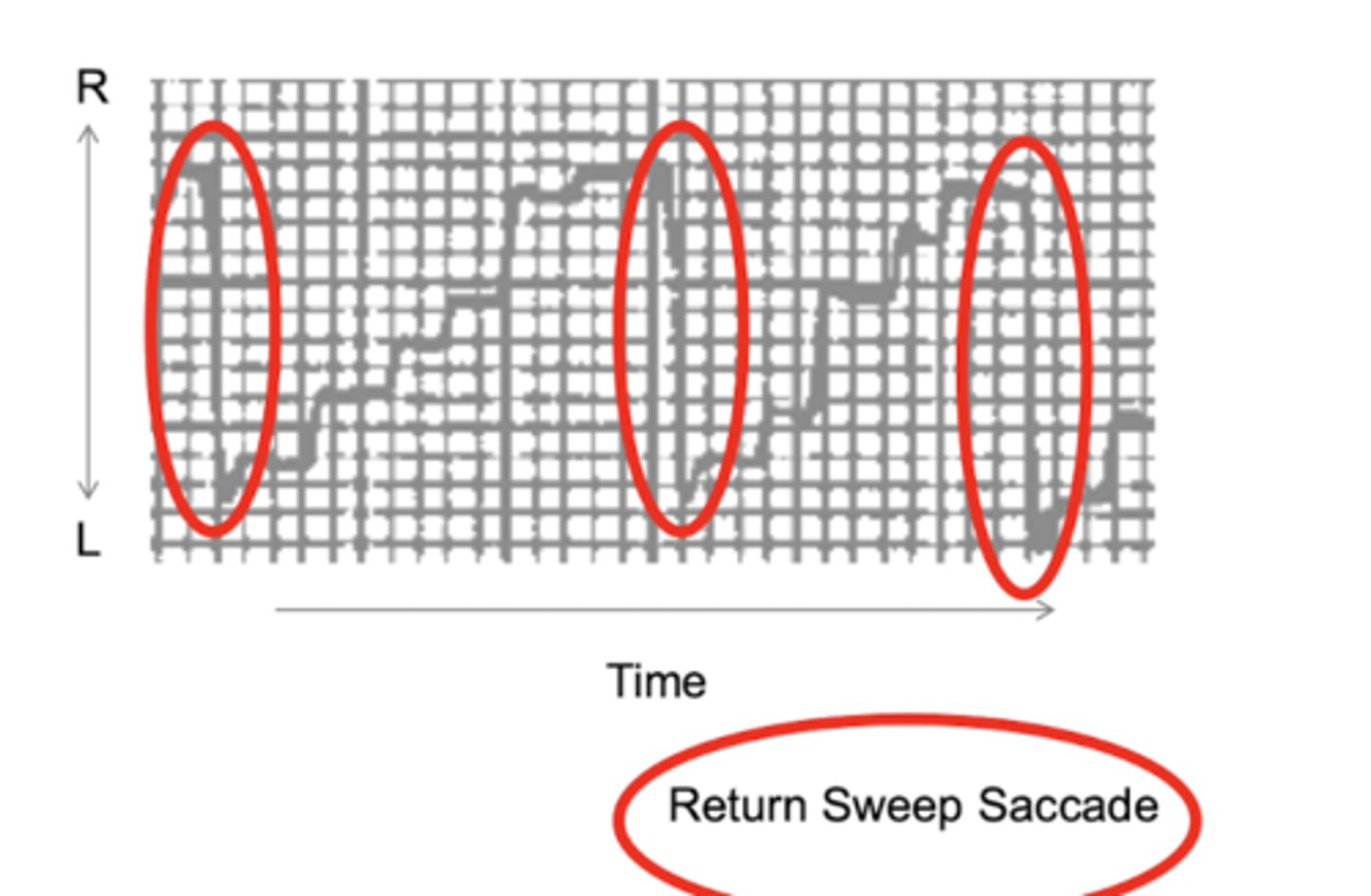
When does return sweep usually start and end?
starts at ~6 characters from end and goes to about 6th characters in of the next line
How much total reading time is taken up by eye movements?
no more than 10%
What does average span of recognition mean?
amount of words one can perceive and process with each fixation
What does fixation duration mean?
the length of time that the eye pauses or remains fixated on a word
What is the average fixation duration?
225 msec → text dependent (shorter for easy text and longer for difficult text)
What is reading rate?
number of words read per unit of time (usually words per minute)
What is the average reading rate of a college student?
200-350 words per min
when is the reading rate slower?
when reading harder material
is an extremely fast reading rate possible?
readers are just skimming words rapidly and comprehension is very low