Macroeconomics Final Exam
 Call Kai
 Learn
Learn Practice Test
 Spaced Repetition
 Match
Match Flashcards
 Knowt Play
1/67

Earn XP
Description and Tags
Name | Mastery | Learn | Test | Matching | Spaced | Call with Kai | Chat |
|---|
No analytics yet
Send a link to your students to track their progress
68 Terms
In its broadest sense, "economics" is best defined as the study of how:
limited resources are allocated to satisfy unlimited and competing wants.
The term "mixed economy" refers to an economy:
Having significant elements of both decentralized markets and centralized planning and control
From an economics perspective, human decision-making is based upon the concept of:
Rational self interest
The effects of the division of labour, in the general business of society, will be more easily understood, by considering in what manner it operates in some particular manufactures....
To take an example, therefore, from a very trifling manufacture; but one in which the division of labour has been very often taken notice of, the trade of the
-maker...
Pin
It is not from the benevolence of the butcher, the brewer, or the baker that we expect our dinner, but from their own interest... [No one] intends to promote the public interest, nor knows how much he is promoting it...He intends only his own gain, and he is in this, as in many other cases, led by_________to promote an end which was no part of his intention. ...By pursuing his own interest he frequently promotes that of the society more effectually than when he really intends to promote
an invisible hand
The author of The Road to Serfdom,_______believed that Too much government planning led to too much government power, which ultimately destroys freedom and makes men slaves.
Friedrich Hayek
"Quantitative Easing" is a term that was applied to efforts in the wake of the 2008 financial crisis by______ to stimulate the economy through expansionary_______policy.
The Federal Reserve, Monetary
Passed by Congress and signed into law by President Donald J. Trump in March 2020, the 2.2 Trillon Coronavirus Aid, Relief, and Economic Security(CARES) Act was an example of:
Fiscal Policy
In the first episode of "Free to Choose," Milton Friedman visited the University of Glasgow, where Adam Smith delivered the lectures that helped lay the basis for his influential book The Wealth of Nations (1776). There, Friedman told a story that he said illustrated the basic principles underlying the free market. "Look at this," Friedman said, holding up an item. "There is not a single person in the world who could make (it]...
" What brought people together to make this item?, Friedman asks.
"There was no Commissar sending out orders from some central office. It was the magic of the price system" —that is, voluntary cooperation through the impersonal operation of markets.
What was the item Friedman used as an illustration of how markets both use and encourage voluntary?
A pencil
Friedman also visited_______, which he praised as "a near-laboratory experiment" in free markets and limited government.
Hong Kong
"Free to Choose" is best characterized as an example of______ economics. The first episode "The Power of the Market"—emphasizes:
normative; the beneficial role played by markets in society, and how excessive government intervention in the economy reduces personal freedom.
Suppose that this hypothetical economy is initially producing a combination of fish and coconuts given by point B.
Everything else held constant, what is the opportunity cost that will be incurred if this economy attempts to produce/obtain one additional fish?
2 Coconuts
A combination of 3 fish and 8 coconuts:
is not currently attainable.
Any arrangement in which buyers and sellers voluntarily interact to exchange goods and services based on price is referred to as a(n):
Market
List the three principal goals of a sound macro economy.
Economic Growth
Health Labor Market
Price stability
The law of demand states that everything else held constant price and quantity demanded are:
inversely related.
The law of supply states that everything else held constant— an increase in the price of a good:
increases the quantity supplied of that good.
Suppose that, everything else held constant, an increase in the price of salsa results in a decrease in the demand for nacho chips. From this information, we may conclude that:
consumers regard chips and salsa as complementary goods.
Suppose a drop in the price of cotton reduces the overall cost of producing cotton T-shirts. Everything else held constant, we would predict that this would lead to a:
A rightward shift in the supply curve for T-shirts.
Assume that consumers regard pretzels and potato chips as substitute goods, Everything else held constant, we would predict that a decline in the price of pretzels would lead to:
a decrease in the demand for potato chips.
Which of the following would cause a leftward shift of the demand curve for good X?
an increase in consumer income (if good X is an inferior good).
Suppose there is an increase in consumers' taste for candy bars.
Everything else held constant:
the equilibrium price and quantity of candy bars will both increase.
Suppose there is "good weather" in cotton growing regions.
Everything else held constant, what would we predict would be the impact on the equilibrium price (P) and quantity (Q) of cotton?
P decreases and Q increases.
Suppose that consumers regard coffee and tea as substitute goods. Everything else held constant, what is the impact on the equilibrium price (P) and quantity (Q) of coffee if the price of tea increases?
P and Q both increase
Suppose there is a technological advance in coconut production.
Ceteris paribus, the supply-demand model predicts that this will cause.
the equilibrium price of coconuts to decrease, while the equilibrium quantity will increase.
Suppose the government institutes a minimum wage of $10.00 per hour for all labor. Ceteris paribus, a $10.00 minimum wage will:
result in a surplus of labor in the low-skill labor market, but will have no direct impact (be ineffective) in the high-skill labor market
Suppose the government institutes a minimum wage of $2.50 per hour for all labor. Ceteris paribus, a $2.50 minimum wage will:
have no impact (be ineffective) in both
It is often thought that the idea of socialism derives from the work of Karl Marx. However, Marx mainly critiqued capitalism and wrote relatively little about socialism. According to Heilbroner, the true architect of a socialist order—in the sense of being the first to actually organize an entire economy based on socialist principles-was:
Vladimir Ulyanov (a/k/a "Lenin").
One of the early "Utopian Socialists" was British industrialist Robert Owen, who in 1825 created a commune in Indiana to implement his socialist vision. The commune was called.
New Harmony
By 1900, Marx's predictions about the working class did not appear to be coming true-the working class was not becoming "revolutionary." One of Marx's disciples argued that, as a result, the movement needed to discover the "vanguard" of the workers i.e., leaders of the movement, professional revolutionaries who would force the revolution on behalf of the workers—rather than "revise" the core of Marxist doctrine.
Which of the following argued against "revisionism" and for "forcing" the revolution at that time?
Vladimir Ulyanov (a/k/a "Lenin")
The top Soviet planning agency under Stalin, which established general directives for the economy and its target rate of growth, was called:
Gosplan
Heilbroner cited an illustration drawn from a work by two Soviet economists called The Turning Point, which he called "a scathing attack on the realities of socialist planning."
In 1982, in order to stimulate the production of a particular product, the Soviet government raised the price it was willing to pay for an important input for that product.
The result was a massive surplus of the input—far too much was produced than was needed. Yet when the ministry in charge was asked to lower the price, it failed to act, and the surpluses persisted. "This is not surprising," wrote the authors-the ministry was too busy to decide.
"They have no time: Besides setting prices on [this input], they have to keep track of another 24 million prices. And how can they possibly know how much to lower the price today, so they won't have to raise it tomorrow?"
What was the input whose excessively high price led to massive surpluses?
moleskins
Understanding of the difficulties of central planning was slow to emerge. In the mid-1930s, while the Russian industrial drive was in full tilt, few voices were raised about its problems. Among those few were, an articulate and exceedingly argumentative free-market economist, and Friedrich
Hayek, of much more contemplative temperament. Together they launched an attack on the feasibility of socialism, [contending] that a socialist system was "impossible" because there was no way for the planners to acquire the information-"produce this, not that" —needed for a coherent economy....A planning system was bound to fail precisely because it lacked a [price signaling] mechanism.
-Robert Heilbroner, "Socialism"
This early critique of socialist planning was advanced by Friedrich Hayek and
Ludwig von Mises
Shortly after the defeat of Nazi Germany in 1945, Great Britain held a general election in which Prime Minister Winston Churchill's Conservative Party lost to the Labor Party. Once in office, the Labor embarked on a policy of nationalization of British industries and expansion of the "Welfare State." Five years later it was voted out of office and the Conservative Party regained control of parliament (under the leadership once again of Prime Minister Winston Churchill). Which of the following best describes Britain under the post-WWIl British Labor government?
Democratic Socialist
"Countless words will be dedicated in the following days to Mikhail Gorbachev, the Soviet leader who died Aug. 30 at the age of 91. But throughout his obituaries, two specific words will likely be repeated: glasnost and perestroika... But what do they actually mean?" -"Mikhail Gorbachev Championed 'Glasnost' and 'Perestroika.' Here's How They Changed the World." Time Magazine, August 30, 2022
The common English translations for "glasnost" and "perestroika" are
openness and restructuring
Which of the following would be included in (i.e., add to) U.S. GDP?
purchases by local governments on police cars built by Hyundai in its Montgomery, Alabama plant
Stage of Production
Lemon growers sell lemons to lemonade producers for $10,000
Lemonade producers sell lemonade to wholesalers for $ 15,000
Lemonade wholesalers sell to retailers (grocery stores) for $20,000
4. Lemonade retailers sell to consumers for $22,000
The value added by the retailers is
2,000
Assume that the lemons are all grown, processed into lemonade, and sold to domestic consumers during the same year. What is the impact on GDP for that year?
Adds $22,000 to GDP
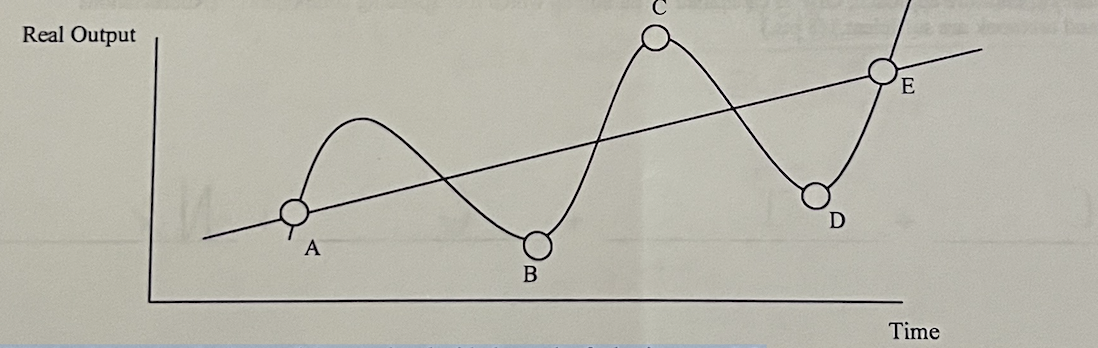
Which of the points in the graph is associated with the peak of a business cycle?
Point C
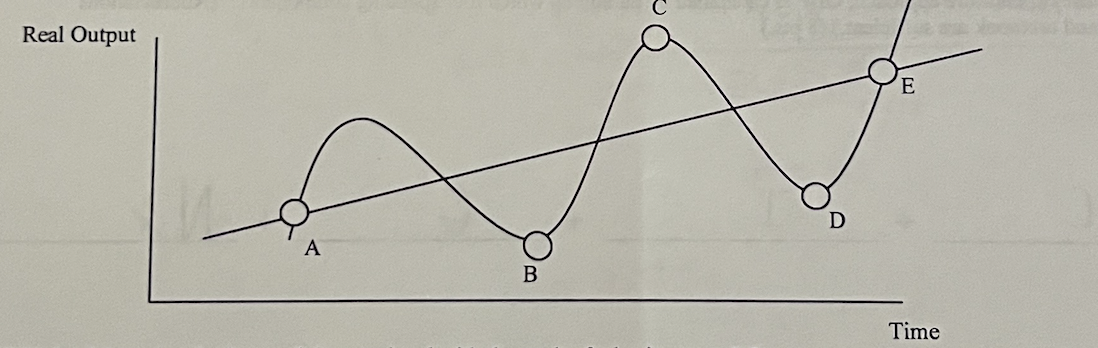
A period in which real output falls during a business cycle is referred to as a(n)________and would be represented in the graph above by a movement from______.
Recession, Point C to Point D
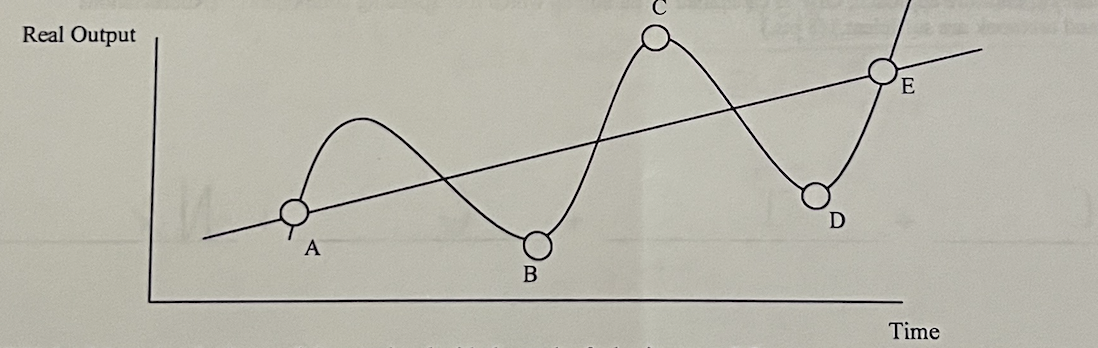
Which of the following bests represents trend growth?
Point A to Point E
Which of the following would be included in Gross Private Domestic Investment (GPDI)?
investments by firms on machinery, tools, and equipment
“Human Capital” refers to:
the knowledge, skills, and abilities workers acquire through education, training, and experience.
Long-term or "trend" growth in U.S. Real GDP is an annual rate of growth of approximately:
3%
This episode of "Commanding Heights" opened with a segment about the city of________, whose existence originated with:
Norilsk; is a prison camp in the Soviet Gulag system.
After a failed coup by hardliners in August 1991, the Soviet Union was dissolved in December 1991, ending its seven decade history. Who was the last leader of the now-defunct Soviet Union?
Mikhail Gorbachev
According to the expenditure approach, GDP is calculated by adding up which four spending components? (Abbreviations used in class and textbook are sufficient.) GDP= ______+________+______+_______
C,I,G,NX
Real GDP
Nominal GDP divided by the Deflator
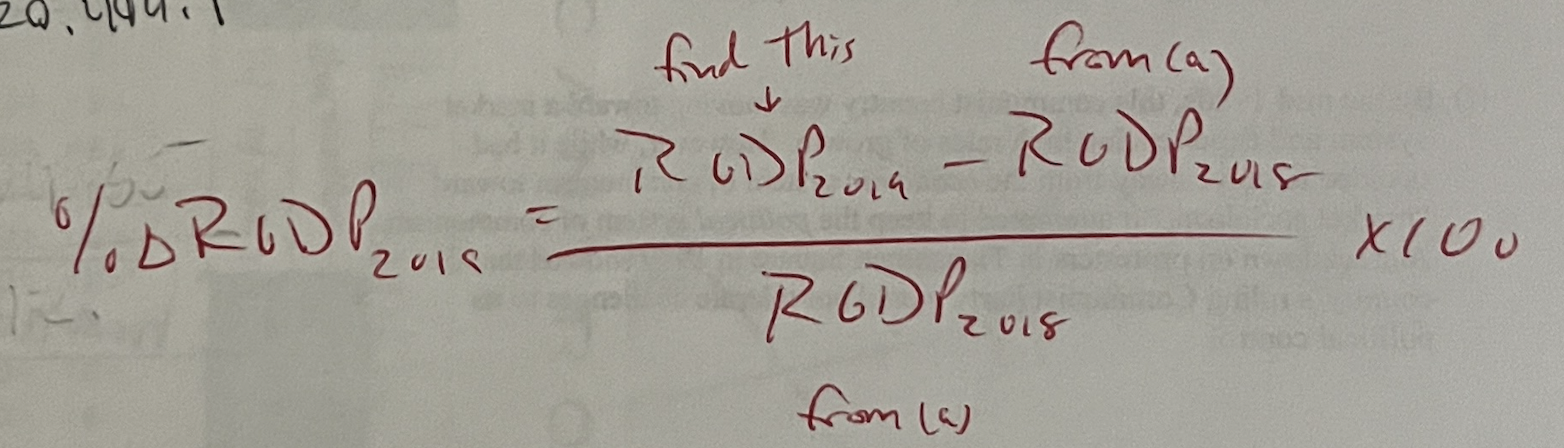
% Real GDP
RGDP of Year in question -RGDP of previous year/ RGDP from Previous year x 100
In 1973, a military coup toppled the Marxist president Salvador Allende.
Later the ruling military "junta," under the leadership of General Pinochet, called on Milton Friedman to advise them on how to reform their economy.
Chile
In the 1980s, Lech Walesa led the free trade union called Solidarity; later, he became the President of this country.
Poland
After a failed coup by Communist hardliners in August 1991, its leader formally dissolved this country in December 1991, ending its seven decade history.
Soviet Union
Unstable and plagued by hyperinflations, in 1985 this Latin American country called upon Harvard economist Jeffrey Sachs to develop a plan to reverse its problems. Sachs advocated "shock therapy," in which government spending was slashed, price controls were scrapped, and import tariffs (taxes) were cut.
Bolivia
A former British colony, this country obtained its independence in 1947.
It embarked upon a policy or central planning to industrialize its peasant economy and conquer poverty.
Moreover, self-sufficiency was ideal for protecting its manufacturing foreign industries, it sheltered is seen in more foreign industry competition. The result of these policies was to create an economy that was "over-protected, over-administered, over-planned."
India
By the mid-1980s, this communist country was moving toward a market system and experiencing high rates of growth.
However. while it nac decided to move away from the economic system of communism toward "market socialism," it attempted to keep the political system of communism.
A crackdown on protesters in Tiananmen Square in 1989 showed that the country's ruling Communist Party would not tolerate challenges to its political control.
China
Which U.S. president, in a famous speech at the Berlin Wall in 1987, said
"Mr. Gorbachev...tear down this wall!" (last name sufficient)
Reagan
Like many Latin American countries, Bolivia was plagued in the 1980s with bouts of extremely severe inflation; an extremely high rate of inflation is referred to as:
Hyper Inflation
Enlightenment, Reformation, Renaissance
Intellectual Change
Industrial Revolution
Technological Change
President________would seemingly have been more sympathetic to Chicago-style free market theories than to Harvard-style Keynesianism. But he was, in the words of Chicago professor Milton Friedman, "too willing to give up on principle for political reasons," for example by imposing wage and price controls to combat inflation in 1971.
Nixon
Shortly after the end of World War I, the Treaty of Versailles dictated that Germany and its allies would be required to "compensate" the victors for war costs by paying "reparations." Appalled by the amount of reparations that were being demanded, _________ quit the British delegation in protest, and wrote a critical book called The Economic Consequences of the Peace, which predicted that the Treaty would lead to an impoverished and hostile Germany.
Keynes
Shortly after the defeat of Nazi Germany in 1945, Great Britain held a general election in which Prime Minister Winston Churchill's Conservative Party lost to the Labor Party. The new Labor Prime Minister was:
Attlee
Upon Lenin's death, the Soviet Union was led by_______. Under his rule, every aspect of the economy was subject to central planning.
Stalin
His so-called "New Economic Policy" allowed farmers to sell their products and own their own land, and small businesses to operate. But the state would control heavy industries such as steel, coal, and railroads-—what he termed the "commanding heights" of the economy.
Lenin
During the administration of President________ federal government intervention in the economy expanded dramatically in an attempt to cope with the challenges presented by The Great Depression.
Roosevelt
Following WWII, the new Labor government began nationalizing major British industries. Three decades later, the Conservative government led by Prime Minister____________sought to undo this through "Privatization": Selling government-held shares of stock in industries such as electricity, coal, transportation, etc.
Thathcher
USA, 1979: "Things were at a low point in the United States" — President _______ was beset with multiple troubles, particularly the Iranian hostage situation abroad and spiraling inflation at home.
Carter
USA, 1979:_______was appointed chairman of the Federal Reserve system, the body that was responsible for U.S. monetary policy. The new chairman believed that inflation was one of the worst of all economic evils, and implemented a tough anti-inflation policy.
Volcker